09 10
Showing posts with label liberty. Show all posts

19 February 2018

Ezekiel 13: Peace-- But There is No Peace!


I have long loved Patrick Henry's address to the Virginia Convention: the "Give me liberty or give me death!" speech. Someday, I want to use Benjamin Franklin's method of studying, and this speech is the first thing that I want to dive into (probably followed by George Washington's Farewell Address). But tonight, in reading to Hero from the Bible, I discovered an allusion that Henry made that makes that final, powerful paragraph even more powerful.

Here's the end of the speech:


It is in vain, sir, to extenuate the matter. Gentlemen may cry, Peace, Peace-- but there is no peace. The war is actually begun! The next gale that sweeps from the north will bring to our ears the clash of resounding arms! Our brethren are already in the field! Why stand we here idle? What is it that gentlemen wish? What would they have? Is life so dear, or peace so sweet, as to be purchased at the price of chains and slavery? Forbid it, Almighty God! I know not what course others may take; but as for me, give me liberty or give me death!


Tonight, as we read in Ezekiel 13, I noticed this:


Because, even because they have seduced my people, saying, Peace; and there was no peace; and one built up a wall, and, lo, others daubed it with untempered mortar:
-Ezekiel 13:10  (emphasis added)


01 August 2017

In the Reign of Terror Audio Drama {Crew Review}

In the Reign of Terror


For this review, we were listened to In the Reign of Terror, and audio drama by Heirloom Audio Productions on CD, which is an adaptation of G.A. Henty's book In the Reign of Terrorm, and the downloadable study guide that goes with it.

The story is gripping. I didn't realize it at first, but this is not our first story from G.A. Henty. So far, I've really enjoyed all of his works -- and making it an audio drama, where they've gone a step further than just reading the story, and given it a sound track and audio effects, just really enhances the story. The characters, each portrayed by a different actor or actress, really come to life. The English sound English, and the French characters sound French. That actually made us work at understanding, particularly at first, because the French accent has always been one that's a little bit difficult for me to follow, and it's pretty thick at times. But our ears adapted, and we were able to follow without serious issues. The story is about 16 year old Harry Sandwith, who in the months just prior to the reign of terror, is engaged to be a companion to the five children of the Marquis de St Caux, and live with them in their country home some miles outside of Paris. Harry's family feels that, even if there is unrest due to the revolutionaries, it is unlikely to touch the home of the Marquis, but of course the revolution becomes both more widespread and more violent than anybody predicted, and Harry gets caught up in quite the adventure.


The recording is beautiful. The sound track is lovely -- both the music and also the various noises that they use to bring it to life. You can see the kind of attention to detail they put into sounds of all sorts in the clip they include on their "Who We Are" page, where they show how they collect the authentic sound of a door handle in a church for another title, In Freedom's Cause. In the Reign of Terror sounds like it's had that same attention to detail and high level of excellence as well.

I don't want to give away too much of the story, because I think you're going to love it, but of course things turn far more violent than the Marquis or anybody else anticipated at the outset. Harry has just enough time to learn some French and get comfortable with the family, and then things get crazy as the revolution picks up its pace. There are mobs, the Marquis rushes off to fight for the king. There is heroism in many places, betrayal, rescue -- at one point Harry even ends up briefly working as Robespierre's personal secretary!

Henty has included in his story a number of points of commentary that bring out the substantial differences between the French Revolution and the American Revolution, which I really appreciated because it made it really easy to have a series of conversations about the differences, and while, while the one was a noble thing that actually brought freedom to a nation, the other used noble verbage but descended into worse tyranny than what the existing rulers had exercised. As one character puts it, "It is not égalité, equality, the canaille -- that is, the common people, desire, but a reversal of roles." In the Reign of Terror starts with a bit of an introduction, where these ideas are given voice by Henty himself: "The difference was in their hearts. The difference was their attitude toward God."

In addition to the audio drama itself, we were also given a study guide, which is beautiful and extensive: 43 pages. The study guide is available through their Live The Adventure site. It starts out with some interesting background on G.A. Henty, and on a few of the key players in the French Revolution.


The study guide includes a lot of comprehension questions -- they have some for every chapter, if you are so inclined. We listened to this the way that we would a read aloud: no comprehension questions, and I didn't ask for narrations, but just let the discussion happen organically, which it did. If we had used it as a school book, I would have spread it out over a number of weeks, perhaps even a month or two, and we would have made greater use of the extension activities in the study guide. It's full of extra information: definitions of French words, and information boxes that help to paint a more complete picture of what it was like in France in that time, and the sharp contrast between the privilege and privation that existed.


There are two sets of questions for each chapter. The first are just basic comprehension questions, covering the sorts of things that we usually cover in narrations. But the second are really thought-provoking questions that could be discussion topics, or a jumping off point for writing papers for older students.


One thing that I particularly appreciate is that the questions both encourage the student to consider the story in relation to scripture and the gospel, but they are worded in a way nearly completely nondenominational, and while a one or two questions do suggest a total depravity/original sin perspective, it would be a very simple thing to adapt these questions to reflect the LDS understanding of the nature of man, which rejects original sin or holding children responsible for the crimes of parents, and embraces the inherent goodness that is implied by the Biblical assertion that we are the children of God. The study guide also encourages students to consider some of the great questions in government, relating to the purposes of government, what good governance looks like, and highlights the way that pretty rhetoric can disguise ugly intentions and deeds.


We had enough other stuff use of all the resources, but there is a lot of good stuff in the study guide, and you could use In the Reign of Terror and its study guide to do a really in-depth study of the differences between the American Revolution (which the introduction suggests shouldn't even really be called a revolution, but instead ought to be thought of as a "War for Independence") and the French Revolution, and a stepping stone to some great conversations about a host of important topics. And the study guide is written in a way that encourages you to consider things in light of what scripture teaches on the matter.

The story itself is great, and the study materials are outstanding. My first grader enjoyed the story, my fifth grader and I had some good conversations, and you could probably use this study guide with high schoolers for papers and discussions on a wide variety of important topics.


If you want to read more reviews of In the Reign of Terror click the banner below.

http://schoolhousereviewcrew.com/adventures-of-rush-revere-book-series-reviews/


Crew Disclaimer

01 February 2017

Commonplace Book: January


We have this desire to give our kids what we call an academically "rigorous" education. Andrew Kern and Christopher Perrin both taught me a bit about that. ... I asked them how we could pursue a rigorous education while retaining a sense of rest. What I didn't realize at the time was that the word "rigor" comes from the Latin rigor, rigoris, which means "numbness,stiffness, hardness, firmness, roughness, rudeness." Rigor mortis literally means "the stiffness of death," which I think we can all agree is not the goal of homeschooling our children!

Don't aim for rigorous education, Kern and Perrin both told me. If we are aiming to order our children's affections, learn to love what is lovely, join in the great conversation, and cultivate a soul so that the person is read in every sense of the word to take on the challenges around the corner and on the other side of the college entrance exams; work toward "diligence" instead.

"Diligence" come from the Latin diligere, which means to "single out, value highly, esteem, prize, love; aspire to, take delight in, appreciate." What we are really aiming for in giving our children a rigorous education is not just doing hard things, but cultivating a habit of focused attention. The word "student" comes from the Latin studium, meaning "Zeal, affection, eagerness." A diligent student, then, takes delight, eagerly and with great zeal, in what he loves.
-Sarah Mackenzie, Teaching From Rest, 4-5


Learn everything; later you will see that nothing is superfluous.
-Hugh of St.Victor, quoted in Paideia Notes


But the one achievement possible and necessary for every man is character; and character is as finely wrought metal beaten into shape and beauty by the repeated and accustomed action of will.
-Charlotte Mason 6:129


The will, too, is of slow growth, nourished upon the ideas proposed to it, and so all things work together for good to the child who is duly educated. It is well that children should know that while the turbulent person is not ruled by will at all but by impulse, the movement of his passions or desires, yet it is possible to have a constant will with unworthy or evil ends, or even to have a steady will towards a good end and to compass that end by unworthy means.
-Charlotte Mason 6:132-3


You will come to know that what appears today to be a sacrifice will prove instead to be the greatest investment that you will ever make.
-Elder Gordon B. Hinckley, April 1986, The Question of a Mission


There was this luxury of living.
-Pearl S. Buck, The Good Earth, 26


Wang Lung sat smoking, think of the silver as it had lain upon the table. It had come out of the earth, this silver, out of his earth that he ploughed and turned and spent himself upon. He took his life from this earth; drop by drop by his sweat he wrung food from it and from the food, silver. Each time before this that he had taken the silver out to give to anyone, it had been like taking a piece of his life and giving it to someone carelessly. But now for the first time such giving was not pain. He saw, not the silver in the alien hand of a merchant in the town; he saw the silver transmuted into something worth even more than itself -- clothes upon the body of his son. And this strange woman of his, who worked about, saying nothing, seeming to see nothing, she had first seen the child thus clothed.
-Pearl S. Buck, The Good Earth, 36


Is self-denial wise because there is something wrong with our passions, or because there is something right with our passions? Alma taught his son: “See that ye bridle all your passions, that ye may be filled with love.” (Alma 38:12; emphasis added.) He did not say we should suppress or eliminate our passions but rather bridle them—harness, channel, and focus them. Why? Because disciplining our passions makes possible a richer, deeper love.
-Bruce and Marie Hafen, Bridle All Your Passions


Education which leaves out God is destitute of all true value. Satan is aware of the great power which a true system of education gives to the people. He is, therefore, opposed to such a system. He knows full well that a generation trained in all  true knowledge cannot be lead by him, as they would if their education were neglected. He therefore stirs up all the agencies under his control to do everything in their power to defeat the purposes of God in regard to the education of our children.
-George Q. Cannon, Juvenile Instructor, 15 Apr 1890


It is easy to forget that teaching is holy work. The building up of the intellect - teaching children  to really thing - does not happen by the might of human reason, but rather by the grace of God. On an ordinary day, you and I likely have a set of tasks we've scheduled for our kids. But it's more than math. It's more than history. It is the building of our children's hearts and minds, and we can only do that if we realize that this is how we thank Him for the graces He so lavishly pours upon us.
-Sarah Mackenzie, Teaching From Rest, 11


 How can the Christian know divine rest and yet educate out of and to anxiety? How can a Christian “learn from Christ” who gives rest and then give no rest to their students? How can the Christian “pause” for refreshment every Sunday but offer no sabbath to students? Where is the sabbath pattern in our schools and studies?
-Christopher Perrin, Let's Pause a Moment


Now there is a pride a man has when he sees his eldest son reading aloud the letters upon a paper and putting the brush and ink to paper and writing that which may be ready by others, and this pride Wang Lung now had.
-Pearl S. Buck, The Good Earth, 231


It takes a certain fortitude, after all, to look at a pile of dishes and see in it the makings of a cathedral. The daily mundane is holy ground because the ordinary tasks of a monotonous Monday are where we meet our Maker.

The builders of medieval cathedrals knew what it meant to work their entire lives to please God without ever expecting to see their work completed. Many cathedrals would take more than a hundred years to build -- more than the span of a man's lifetime. I once heard a story of an artisan who worked tirelessly for many years to carve a beautiful bird into a portion of the cathedral that would be covered up. When someone asked why he was working so hard on something that no one would ever see, he replied, "Because God sees."

God sees your little wooden bird, too. Just as the artisans and carpenters of old built beautiful cathedrals for the glory of God, so do you. Yes, you - you who work tirelessly day after day over a geography lesson, a math test, a laundry pile, a kitchen sink. These are th moments wherein you build cathedrals for God.
-Sarah Mackenzie, Teaching From Rest, 11-12


And Wang Lung stood beside the two graves and watched and his grief was hard and dry, and he would not cry out loud as others did for there were no tears in his eyes, because it seemed to him that what had come about was come about, and there was nothing to be done more than he had done.

But when the earth was covered over and the graves smoothed, he turned away silently and he sent away the chair and he walked home alone with himself...

Thus thinking heavily, he went on alone and he said to himself,

"There in that land of mine is buried the first good half of my life and more. It is as though half of me were buried there, and now it is a different life in my house."

And suddenly he wept a little, and he dried his eyes with the back of his hand, as a child does.
-Pearl S. Buck, The Good Earth, 289-90


Now as the winter wore away and the waters began to recede so that Wang Lung could walk abroad over his land it happened one day that his eldest son followed him and said to him proudly,

"Well, and there will soon be another mouth in the house and it will be the mouth of your grandson."

Then Wang Lung, when he heard this, turned himself about and he laughed and he rubbed his hands together and said,

"Here is a good day, indeed!"
-Pearl S. Buck, The Good Earth, 303


Odin took the horn in both his hands and drank and drank. And as he drank all the future became clear to him. He saw all the sorrows and troubles that would fall upon Men and Gods. But he saw, too, why the sorrows and troubles had to fall, and he saw how they might be borne so that Gods and Men, by being noble in the days of sorrow and trouble, would leave in the world a force that one day, a day that was far off indeed, would destroy the evil that brought terror and sorrow and despair into the world.
-Padric Colum, Children of Odin


"Well, alright," he said. "If that's the way you want it, I'm for it even if it's only an agreement between you and your dogs. If a man's word isn't any good, he's no good himself."
-Wilson Rawls, Where the Red Fern Grows, 93


What is this earth and sea, of which I have seen so much? Whence is it produced? And what am I and all the other creatures, wild and tame, human and brutal, whence are we?

Sure we are all made by some secret Power who formed the earth adn sea, the air and sky; and who is that?

Then it followed most naturally; It is God that has made it all. Well, but then, it came on strangely, if God has made all these things, He guides and governs them all and all things that concern them; for the Power that could make all things must certainly have the power to guide and direct them.
-Daniel Defoe, Robinson Crusoe, 144


This term in its particular application means "that dominion which one man claims and exercises over the external things of the world, in exclusion of every other individual." In its larger and juster meaning, it embraces every thing to which a man may attach a value and have a right; and which leaves to every one else the like advantage. In the former sense, a man's land, or merchandize, or money is called his property. In the latter sense, a man has a property in his opinions and the free communication of them.

He has a property of peculiar value in his religious opinions, and in the profession and practice dictated by them. He has a property very dear to him in the safety and liberty of his person.
He has an equal property in the free use of his faculties and free choice of the objects on which to employ them. In a word, as a man is said to have a right to his property, he may be equally said to have a property in his rights.

Where an excess of power prevails, property of no sort is duly respected. No man is safe in his opinions, his person, his faculties, or his possessions. Where there is an excess of liberty, the effect is the same, tho' from an opposite cause.

Government is instituted to protect property of every sort; as well that which lies in the various rights of individuals, as that which the term particularly expresses. This being the end of government, that alone is a just government, which impartially secures to every man, whatever is his own.
-James Madison, On Property, emphasis original


But mere reading of wise books will not make you wise men: you must use for yourselves the tools with which books are made wise; and that is -- your eyes, and your ears, and common sense.
-Madam How and Lady Why, 4

21 July 2015

Loving Liberty is Tough

I love Liberty. I think it holds the key to curing so many of the world's ills: poverty, exploitation, church-state conflicts, discrimination, tons of things. Liberty lifts. Liberty strengthens. It ennobles.

Liberty is very, very unpopular.

Sure, people sometimes pay lip service to Liberty and the Constitution, but in general, people don't understand either, and they aren't that interested, and they don't like the sound of it.


We have learned by sad experience that it is the nature and disposition of almost all men, as soon as they get a little authority, as they suppose, they will immediately begin to exercise unrighteous dominion... (D&C 121:39)


"We need to use government to compel people to help, because otherwise people won't do..."

"We have to have compulsory education laws because otherwise people won't..."

I see it all the time. People don't want liberty because they want to force their neighbor to "be good." Which means some very different things to different people. Or, they'll come at it from the other side: it's been so common to use government as a limitless lever to shove people, that individuals can't imagine how anything could possibly get done without that shove. And, when you suggest that Liberty would not only work to improve society, but work better than compulsion, people often get pretty upset.

Add to that an awareness of just how much Liberty has been lost (the losses in the past 100 years are staggering), and it can sometimes get pretty disheartening.

Who am I kidding? It's completely discouraging, and if it wasn't that I am convinced that Liberty is an eternal principle, and an essential part of the Lord's plan, and also convinced that the Lord has things under control and the evil attacks on Liberty and all else that's good will be, in the end, utterly futile, I would give up. It's hard, constantly rocking the boat. It's exhausting, emotionally. It takes a toll on relationships I cherish, sometimes a heavy toll, and sometimes the cost is high, and I can't always see that my words have any impact, whatsoever.

I have long been fascinated by the story of Isaiah's call as a prophet.


Also, I heard the voice of the Lord, saying, Whom shall I send, and who will go for us? Then said I, Here am I; send me.

And he said, Go, and tell this people, Hear ye indeed, but understand not; and see ye indeed, but perceive not. Make the heart of this people fat, and make their ears heavy, and shut their eyes; lest they see with their eyes, and hear with their ears, and understand with their heart, and convert, and be healed.

Then said I, Lord, how long? And he answered, Until the cities be wasted without inhabitant, and the houses without man, and the land be utterly desolate, And the Lord have removed men far away, and there be a great forsaking int he midst of the land.

But yet in it shall be a tenth, and it shall return, and shall be eaten: as a teil tree, and as an oak, whose substance is in them, when they cast their leaves: so the holy seed shall be the substance thereof. (Isaiah 6:8-13)

I've been drawn to it since I was a teen, before I really understood any more than that Isaiah was being sent on a hard, hard mission. "Until the cities be wasted without inhabitant." That's a good long time to preach while nobody's listening. I admire a man who can take on an assignment, knowing it's going to be that. And I ached for the people who refused all the Lord's efforts to heal them. For a long time, that's all I saw from this passage. I didn't understand the last verse well enough to take anything from it. But my husband gave me Strong's Concordance for my birthday, and I've begun exploring the Hebrew and Greek meanings of some of the difficult words in the Bible, and it makes things so much clearer. The word that's rendered "substance" in this verse, is a "pillar" in Genesis 35:14&20. Well, the pillar of an oak tree is its trunk, which looses its leaves every fall, but then grows them back again. Isaiah's mission was to testify of Christ, and he taught the people that Christ would proclaim Liberty to the captives, and heal the brokenhearted. No, people then mostly didn't listen to Isaiah, but that didn't tell the whole story, any more than a oak's naked branches in early winter is all that's left of the tree.

More than once, I've stepped back, and tried to stop talking about Liberty. But the Gospel of Christ is all about Liberty, and if we are to exercise our hard-won agency we need to protect the Liberty that gives us the space in which to use it.  Every time, the Spirit gives me a breather, and then asks me to go back and do it some more. Talk some more. Try again to show people the gift that Liberty really is.

Still, watching the news, the outlook for Liberty right now is pretty bleak. However, I recently read an article that reminded me again, and in a new way, that the news isn't all that there is to the story.


It is crucial not only to think about the problem but also to see the solutions being lived out all around us. We need to learn to observe the marvelous businesses starting and succeeding every day, the beauty of spontaneous human interaction, the order and prosperity that emerge from the exercise of human choice. We should thrill in the many ways that people go about their lives in casual defiance of the central plan. We can glory in the creations all around us that were never mapped out or approved by politicians, or by the experts in their pay.

In other words, focusing on the solutions rather than solely on the problems can brighten your day and give rise to creativity in the service of the good. Liberty is not just the absence of oppression; it is the presence of well-lived lives and institutions that emerge despite every attempt to stop them. In this sense, freedom is blossoming all over the world. If we can focus on making that positive change, rather than dwelling on what’s wrong with the world, our task becomes more delightful and a dedication to liberty becomes more sustainable.


I love that. Look at the solutions being lived around us. Focus on the positive changes. Look for the wins. I need to get better at both seeing them, and at talking about them. After all: one good thing leads to another.

01 January 2014

Liberty and Salvation

It turns out that liberty and salvation are much more closely related than I'd realized.

First, a little background: In 1941, FDR's Department of the Treasury decided to sell bonds to fund US involvement in the war. As part of this effort they contacted a wide variety of private organizations, including unions, professional groups, service organizations, and churches, among them the Church of Jesus Christ of Latter-day Saints, hoping they would urge their members to participate in the "war effort" by buying bonds.

The First Presidency not only turned them down, they boldly condemned both the war and the Administration's New Deal policies, in the strongest of terms. You can read all 18 pages of their letter, plus some eye-opening historical context if you'd like. This bit jumps out:

Used by permission.


There are a couple things I've been mulling over about this in the couple days it's been since LDS Liberty posted it on their page shortly before Christmas. The first thing is the remarkable way the Brethren tied political and eternal salvation together, at least for Americans. This is an intriguing teaching, and as I've pondered it, it's started to come into focus and make a lot of sense to me. 

Agency is so central to the Father's Plan. I think of it as a "ruling principle" of the Heavens. The scriptures teach that separation from God is a death. Poor choice is the reason for the separation, and God has the power to prevent this tragedy. Yet He does not. 

Agency is that important. 

Agency means that when we come to earth, we risk permanent separation should we choose sin. Lucifer offered a risk-free plan, one that guaranteed that nobody would lose. When our Father chose Christ we shouted for joy, in spite of the risk.

Agency is that important.

The Lord, in the Doctrine and Covenants, tells us that He gave us the Constitution -in essence, He takes credit for Authorship - and then He explains why He did it:


That every man may act in doctrine and principle pertaining to futurity, according to the moral agency which I have given unto him, that every man may be accountable for his own sins in the day of judgment. (D&C 101:78


The way I see it, the Constitution is about preserving agency. That is the reason The Lord gives for giving us the Constitution: to preserve our freedom of choice. And He says further that the reason for that is so we'll all be responsible for our own actions (and no one else's) when it's all said and done. That cuts right to the heart of the purpose of life. 

The Constitution is that important. 

So when I think it through, it makes perfect sense for political and eternal salvation to be tied in the writings of the First Presidency, because they are, in fact, very closely related. 

That's cool, but so what? What should we do about it?

This quote is remarkable in that these brethren not only gave us an important gospel truth, but they also tell us about two distinct actions we ought to take:

1. "Return to the practice of the great fundamentals of Christianity."

The Savior summed his teachings up in a similarly succinct manner:


Jesus said unto him, Thou shalt love the Lord thy God with all thy heart, and with all thy soul, and with all thy mind. This is the first and great commandment. And the second is like unto it, Thou shalt love thy neighbour as thyself.  (Matthew 22:37-39)


 The Founders repeatedly talked about how key to the survival of the Union virtue is, both the Federalists and the Antifederalists. In fact, one of the Antifederalist objections was that the Constitutions renders too little homage to God; the Articles of Confederation had been more appropriately respectful, they said. While there was no nationally established religion, that is, no religion receiving tax support, nearly every single State had a religion or religions that did (and this continued into the 19th Century), and even the Federalists spoke of the importance of religious education and the necessity for virtue in order to maintain freedom. Virtue calls down the blessings of Heaven; both are necessary for establishing and maintaining freedom. The more broad the freedom, the larger the "space" in which to exercise our agency. Virtue, both public and private, is a critical element in maintaining our freedom, and there is nothing quite like the Gospel of Christ for persuading men that the effort of being virtuous is not only a good idea, but actually in their own best interest.

In our home, we use our homeschool education to support and enhance our teachings about the "fundamentals of Christianity." We often stop, when reading about history as well as fictional stories, and discuss who is the good guy, and who is the bad guy. Particularly interesting have been the times where it seems clear that there really wasn't any good guys in that historical episode. How "great" was Alexander the Great? (He more or less invaded the whole world...) We blend secular and spiritual instruction in every topic, even English grammar. We learn sacred and secular history they way they happened; all mixed together. And in doing so, there is some opportunity to point out some aspect of the Gospel in every day. It's what works for us.

2. "Return to the practice of the great fundamentals of ... Constitutional government."

You can't do this unless you know the fundamentals. Not just the fuzzy awareness that the Constitution has "checks and balances" that I left school with, not even just a general familiarity with the words of the document, though that is a good start. To know the fundamentals, you need to know the ideas that moved the inspired men we call the Founders. They set up our government based on a philosophy called Natural Law. Natural Law is not taught in our schools, yet it is the foundation our nation rests upon. The clearest explanation I've found for what it is is in the first chapter of The Thousand Year Leap by Cleon Skousen. (I highly recommend this book and Ezra Taft Benson's essay, The Proper Role of Government as a starting place for learning about good government.) Skousen quotes the Roman statesman Cicero to explain Natural Law:


"Therefore Law [of the Creator] is the distinction between things just and unjust, made in agreement with that primal and most ancient of all things, Nature, and in conformity to Nature's standard are framed with those human laws which inflict punishment upon the wicked and protect the good." (The Thousand Year Leap, p. 39)


Cicero believed that these laws of  Nature's God - Natural Law - could be discovered through the use of our Reason. He reasoned his way, using this philosophy, to the things that Christ summed up so beautifully as the greatest law and the second law: Love God, and love our neighbors. From this foundation our Founders worked to codify our government and protect the Natural Rights, or unalienable rights, that our Father in Heaven has given us.

Understanding this foundation makes the idea of limited government make perfect sense. The old ways conceived of the King as the fountain of rights. If the citizens had privileges, it was at the pleasure of the King, because He was sovereign, and typically ruled through some sort of Divine Right. But the Founders rejected monarchy and despotism, believing the People to be sovereign, and the People's Rights to be of Divine origin. The government is limited because government powers are not natural to them, but they are delegated to them by the People. This is a tremendously important idea! In this kind of government (and it has the specific, scriptural endorsement of the Lord), government can have no power that could not be exercised by an individual. It's an entirely different way of thinking about things. From The Proper Role of Government:


Leaving aside, for a moment, the question of the divine origin of rights, it is obvious that a government is nothing more or less than a relatively small group of citizens who have been hired, in a sense, by the rest of us to perform certain functions and discharge certain responsibilities which have been authorized. It stands to reason that the government itself has no innate power or privilege to do anything. Its only source of authority and power is from the people who have created it. This is made clear in the Preamble to the Constitution of the United States, which reads: "WE THE PEOPLE… do ordain and establish this Constitution for the United States of America."

The important thing to keep in mind is that the people who have created their government can give to that government only such powers as they, themselves, have in the first place. Obviously, they cannot give that which they do not possess. So, the question boils down to this. What powers properly belong to each and every person in the absence of and prior to the establishment of any organized governmental form? A hypothetical question? Yes, indeed! But, it is a question which is vital to an understanding of the principles which underlie the proper function of government.


Homeschool, again, plays a big part in our family's plan for what to do about it. We teach early and often about what our government is supposed to be, and what freedom should look like. We look at history and talk about what happens when people are not free. We relate things to the teachings of King Mosiah as he set up the Judges, and to other scripture stories. These are things that even a child can begin to understand, though it does take some effort to re-educate ourselves to see past the flimsy propagandized version of things that my husband and I were taught in the public schools. It is, however, well worth the effort.

It makes a great deal of sense that, at least in America, political and eternal salvation should be related to each other, because they are both so closely related to agency, and this land has been set up as a land of freedom, a beacon to all the world. The war over agency, far from being decided in the past, rages today, with government being a primary front in the battle. The price of failure, whether failure to maintain and restore the institutions that safeguard our political freedom or failure in relation to our eternal salvation, is terrible. It is no wonder that the First Presidency sounded such a clear warning about it.


P.S. I'm so glad you stopped by to read about the adventures at our house! If you want more, "Like" my blog on Facebook to get posts (and the articles n things I wish I had time to blog about) in your feed. Wanna see all the projects and ideas that I may or may not get around to? Follow me on Pinterest. Thanks for stopping by!

24 June 2013

On Nullification

I love Facebook. I keep in contact with my family better than I would without it. I have reconnected with people that I lost track of, and I love seeing how they are doing. And I do politics on Facebook. Conversations there have been key to my learning. Typically, conversations with people who think I'm completely, absolutely wrong are the ones that I find most profitable. I'm learning to write clearly, to distill my argument to its core, and communicate it as concisely as possible, and these things are tremendously valuable. I owe a debt of gratitude to those folks that keep coming back, in spite of our mutual frustration, to tell me how wrong I am.


Used by permission.
I've been at it again this weekend. The 10th Amendment Center posted about Alaska recently enacting a law nullifying all unconstitutional gun control laws. It's pretty awesome, actually. Wish my State was doing that, but it's not likely any time soon. I shared their graphic (left) and said, "I love it when people not only talk like we have a Constitutionally limited government, but act like it. Gives me hope."

Pretty predictably, I was challenged on it. Nullification makes several of my friends uncomfortable, and no wonder. It's completely outside of the usual "three branches of government with checks and balances" line that we're taught in school. In fact, to really understand it, you have to take the usual understanding of our government and toss it. This is an OK thing to do, because the usual story bears only a superficial resemblance to what things are supposed to be like under our Constitution. But it can be an uncomfortable thing to do. (It can also be exhilarating; there are reasons why America became known as "the land of opportunity.")

So my friend asks me:

I thought Fed trumped State.... thing is, what if you live in a state that hates you or your lifestyle? Move? What if a state seeks to infringe a right?


Good and legitimate questions. I did my best to answer them. I am still very much a student of the Constitution, but I've put some time in on this particular topic.

The federal does trump State. BUT. Only in the specific and limited areas where the Fed is authorized to act. Otherwise, not only is it the State all the way, but federal interference is actually a violation of our highest law. The Supremacy Clause is so misunderstood. Have a look:


This Constitution, and the laws of the United States which shall be made in pursuance thereof; and all treaties made, or which shall be made, under the authority of the United States, shall be the supreme law of the land; and the judges in every state shall be bound thereby, anything in the Constitution or laws of any State to the contrary notwithstanding.  
US Constitution, Article VII

It's the often over-looked phrase "laws of the United States which shall be made in pursuance thereof" that makes the limit, particularly in light of the 10th Amendment, which explicitly states that all powers not otherwise explained are reserved, placing them squarely outside federal jurisdiction.


The powers not delegated to the United States by the Constitution, nor prohibited by it to the States, are reserved to the States respectively, or to the people.

US Constitution, Tenth Amendment


Since Congress has a very short list of legitimate powers, there are many areas where States ought to be doing exactly what ALaska is doing here. And many areas of law that desperately need to be nullified. People like to paint nullification as a radical thing, but what do they expect? That the States should roll over and let the Feds walk all over them and usurp authority they were never intended to have? That's what usually happens. That's how the federal government got so overgrown. And it is likely that the process greatly accelerated with the passing of the 17th Amendment, when we switched to direct election of Senators.

In our nation's beginning, and to a certain extent still, there were two types of checks on the growth of the federal government: the horizontal checks, among the three branches that you hear so much about, but there are also vertical checks on its growth that arise through the State-federal interaction. It used to be that, because the States were responsible for the selection of Senators, they had a lot more pull; the Senator that allowed too much federal usurpation would find himself explaining to the very folks that felt the loss first: the State legislature that lost power in proportion to the federal gains. Behavior that tended to make the federal government grow more powerful would also tend to put the Senators that supported it out of a job, thus discouraging federal overreach. Whatever else it did, changing the way we select our Senators effectively booted the State governments, as entities, from the table, stripping them of voice or vote in the federal process. It dramatically shifted the balance of power away from local self-government and towards a powerful central government.

The federal government was never intended to be a powerful national government; if they had tried to sell that kind of agreement, ratification would never have happened. In fact, one of the Anti-Federalist talking points was that the Constitution created a national government, and thus should be quickly rejected. The Federalists were adamant that this is not the case, the Constitution creates a confederacy only, with the Federal government only functioning in a specific, narrow role. The States had recourse, through their election of Senators. Should the federal attempt to do what they ought not, the States could require the Senate to vote against it to check the action. When we switched to direct election of Senators, we crippled that vertical check, and Nullification took on an importance all out of proportion to what it would have originally had.

But even so, Nullification was a mainstream thing, early in our history. The Sedition Act, which was passed by Congress and signed by John Adams, established stiff fines and jail time for speaking and publishing things critical of the Federal government. Jefferson strongly opposed the law.


The judiciary was, for Jefferson, certainly not the answer to such problems. For one thing, the Supreme Court in his day was packed with Federalists who would surely have upheld the constitutionality of the Alien and Sedition Acts. For another, the Supreme Court was itself a branch of the federal government, and thus not an impartial arbiter. And finally, the judiciary was composed of human beings no different from the rest of mankind. "To consider the Judges of the Supreme Court as the ultimate Arbiters of Constitutional questions," he argued, "would be a dangerous doctrine which would place us under the despotism of an oligarchy. They have with others, the same passion for party, for power, and for privileges of their corps -- and their power is the more dangerous as they are in office for life, and not responsible, as other functions are, to the Elective control. The Constitution has elected no single Tribunal. I know no safe depository of the ultimate powers of society but the people themselves."

Nullification, by Thomas Wood, Page 45


The problem of federal overreach, in the case of the Alien and Sedition Acts in gross violation of the 1st Amendment, was one that caused considerable discussion. Jefferson and Madison had considerable correspondence, and Jefferson drafted some resolutions that got passed around quite a bit, eventually becoming the basis of the Kentucky Resolutions of 1798:
 

1. Resolved, That the several States composing the United States of America, are not united on the principle of unlimited sumission to their general [federal] government; but that, by a compact under the style and title of a Constitution for the United States, and of amendments thereto, they consituted a general government for special purposes -- delegated to that government certain definite powers, reserving each State to itself, the residuary mass of right to their own self-government; and that whensoever the general government assumes undelegated powers, its acts are unauthoritative, void, and of no force: that to this compact each State acceded as a State, and is an integral part, its co-States forming, as to itself, the other party: that the government created by this compact was not made the exclusive or final judge of the extent of the powers delegated to itself; since that would have made its discretion, and not the Constitution, the measure of its powers; but that, as in all other cases of compact among powers having no common judge, each party has an equal right to judge for itself, as well of infractions as of the mode and means of redress. [Emphasis added]  
(Nullification, Page 47; emphasis in the book.)


 For me, understanding Nullification required a whole new way of looking at the US. So many days we recited in school, "...One nation, under God, indivisible..." but that is not an accurate representation of what the Founders created or the People ratified when we adopted the Constitution. The old documents refer to "these united States" as often as they do "United States," and it's never the United States. They didn't solidify 13 colonies into a single nation, they created a permanent alliance - a confederacy - among 13 independent nations. They didn't do away with the State governments because the vast majority of governance took place at the State level, with primarily foreign interactions (both peaceful and hostile) in mind for the powers delegated to the federal government, though there are a few items intended to regulate - that is, make regular, in the usage of the time - the interactions between the member States. 

The federal government was never intended to be a giver of gifts or a righter of wrongs. Its legitimate scope is extremely limited, with the vast bulk of governance [supposed to be] left to the discretion of the individual State. So, what if your State doesn't like your lifestyle? You can see the answer to that question in slavery. Some places allowed it, some didn't. Certainly that was a way of life to those who practiced it, however distasteful it is to us now. If you don't like the laws in your State you can work to see them changed, or yes, you do have the option of leaving. My husband and I have discussed leaving our State for exactly that reason, more than once. The idea is all the more appealing since we have little hope of effecting the change we'd like to see. We look at things like homeschooling laws and gun laws when we are considering a place in order to get a feel for the laws in the place we're considering. It's certainly not the only thing we consider, but it is a factor. It would take an Act of God to make me move to California because their laws are so hostile to freedom. I want nothing to do with the place. But they have the right of self-governance, and can be like that if they want. 

Certainly some can be done with limiting the Feds by sending the right sort to represent us in DC. But it is also perfectly legitimate to expect that the State will require the federal government to stay within, or at this point it will more often be to return to the limits set forth for it. And those limits, until changed by an authentic act of the People through the amendment process, are the supreme law of the land.

10 June 2013

Economics 100

Learn Liberty has a pretty cool series of short videos dealing with economics, capitalism, and the relationship of these things to freedom. We're starting with Trade is Made of Win, and following their series. Hero is enthusiastic. We stop and talk them over pretty frequently, and I think he's catching a fair amount of it, which is pretty cool. And it's interesting to me as well; I never took an economics class of any sort, and I've recently been realizing that the relationship between economic liberty and civil liberty is such that they are inseparable.


We also labored through this one. It was harder: there are lots of words that Hero didn't know. But we took it little by little, and he was able to understand enough that he actually wanted to do more. Which I was a little worried about, since he saw the picture of the cool Junks and asked for it, so we did it first, rather than starting with the Trade is Made of Win, like I'd planned.


13 February 2013

The State of the Union(2013) and the Constitution

So, the other day I started to compare the State of the Union address (SOTU) to the Constitution. Only, I was a day early and ended up looking at last year's SOTU. This worked out ok; I got a little side-tracked and shared some fascinating things I've been learning about paper money and our Constitution. Today I'm going to try again, but with the actual 2013 address, again using a transcript from the Washington Post.

Once again, I'll admit my bias and my limitations up front: I don't like Mr. Obama. I think he is very bad for America. I am, however, doing my very best to be even-handed with this. If I find that he needs to be praised for something, I'll do it. If I find that he's doing it wrong, I'll say that too. I am neither Republican nor Democrat; I am a Constitutional Originalist. That is, I think that the Founders got it right, and we should, as a general rule, do it the way they outlined. If we want to make changes, they should be made properly, through the amendment process, and never through usurpation. Doing business by usurpation undermines all our various freedoms and the very concept of Rule of Law.


George Washington: If in the opinion of the People, the distribution or modification of the Constitutional powers be in any particular wrong, let it be corrected by an amendment in the way which the Constitution designates. But let there be no change by usurpation; for though this, in one instance, may be the instrument of good, it is the customary weapon by which free governments are destroyed.
Farewell Address, Sep. 19, 1796


I believe that our Founders were not only good and wise men, but that they were inspired of the Lord when they worked out our government. I am still a student of their writings, though I have been studying for a number of years now, and this comparison is, to the best of my ability and understanding, a comparison to the Founders' original intent.

So. What is the State of the Union. Mr. President?

One of the first things that jumps out at me, looking at this, is that Mr. Obama can scarcely complete a sentence without being interrupted for applause. This bothers me. It's actually one of the reasons why I prefer the transcript over the live speech. Although Mr. Washington gave his SOTUs as speeches, Thomas Jefferson felt that this was too much like the monarchal practice of giving the Speech From the Throne, and he sent a written report to Congress. This was the custom until Woodrow Wilson. Things began changing with the advent of mass media; the Constitutionally mandated information on the state of the union to be addressed to Congress became an address to the people, given in the presence of Congress. (See Wikipedia.) I think it would be advisable to return to a less ceremonial model for this address. It's a set-up nearly guaranteed to give the speaker a big head and exaggerated sense of their own importance. It's also an invitation to indulge in propaganda, rather than the informational, factual reporting that is supposed to be happening. I found this ThinkQuest list of  several specific propaganda techniques, and I will be keeping an eye out to see if Mr. Obama has used any of them in his speech. (To be fair, I would expect to see some or all of them used in most or all SOTU speeches going back at least as far as they've been carried to the People by mass media, and quite probably further back than that. It's not just Mr. Obama that uses propaganda.)


Mr. Obama: Mr. Speaker, Mr. Vice President, members of Congress, fellow Americans, 51 years ago, John F. Kennedy declared to this chamber that “the Constitution makes us not rivals for power, but partners for progress.”


Here in the first sentence is something that I would consider propaganda: "the Constitution makes us not rivals for power, but partners for progress." I'd call this a glittering generality. Here's how the ThinkQuest folks describe glittering generalities:


ThinkQuest: Glittering generalities are words that have different positive meaning for individual subjects, but are linked to highly valued concepts. When these words are used, they demand approval without thinking, simply because such an important concept is involved. For example, when a person is asked to do something in "defense of democracy" they are more likely to agree.

The avoidance of being power-hungry, or in Mr. Obama and Mr. Kennedy's words, "rivals for power" is a powerful cultural image, and I have yet to speak to anyone who wanted to impede progress, on any side of the debate. Progress seems to fit exactly the definition of a word that has "different positive meaning for individual subjects, but [is] linked to highly valued concepts." However, if we look at the Constitution itself, the Preamble will tell us what the purpose of the document is:


US Constitution: We the People of the United States, in order to form a more perfect union, establish justice, insure domestic tranquility, provide for the common defense, promote the general welfare, and secure the blessings of liberty to ourselves and our posterity, do ordain and establish this Constitution for the United States of America.


Nowhere in this list does the Constitution claim to be creating partners or promoting any concept as mushy and as poorly defined as "progress." What is "progress," anyway? I rather suspect that the progress I would most like to see -movement toward a small, even tiny, government using an original interpretation of the Constitution- would likely please our president very little, given his previous comments on how the Constitution is a charter of  "negative liberties."

Moving on. It appears that Mr. Obama is still quoting Mr. Kennedy, though the applause has broken the continuity of his thought.


Mr. Obama: “It is my task,” he said, “to report the state of the union.

This is a true statement. His duty to do so is outlined in Article 2 Section 3:


US Constitution: He shall from time to time give to the Congress information of the state of the Union, and recommend to their consideration such measure as he shall judge necessary and expedient; ...


He goes on:


Mr. Obama: “It is my task,” he said, “to report the state of the union. To improve it is the task of us all.”
Tonight, thanks to the grit and determination of the American people, there is much progress to report. After a decade of grinding war, our brave men and women in uniform are coming home.


To improve our union... I'm thinking this is more propaganda, another glittering generality. While Article I Section 8 does lay out a number of specific powers which are to be employed to "promote the general welfare," It is my opinion that promoting or encouraging the overall health or "general welfare" is considerably different from making actual improvements. It seems to me that improvements should be the exclusive territory of the private sector.

It is notable that Mr. Obama announced the "end" of the war last year in his SOTU address, and in very similar terms. It also seams like a stretch to me to call it a war at all, since Congress declined to declare war on anyone, and the declaration of war is their exclusive prerogative. (See Article I Section 8) Certainly the Commander-in-Chief can order troops around, even in the absence of a declaration, which has been done from time to time since the beginning of our nation. The first instance that I am aware of is the conflict with the Barbary Pirates at the beginning of Thomas Jefferson's presidency. According to Wikipedia's article on the conflict:


Wikipedia: In response, "Jefferson sent a small force to the area to protect American ships and citizens against potential aggression, but insisted that he was 'unauthorized by the Constitution, without the sanction of Congress, to go beyond the line of defense.'" He told Congress: "I communicate [to you] all material information on this subject, that in the exercise of this important function confided by the Constitution to the Legislature exclusively their judgment may form itself on a knowledge and consideration of every circumstance of weight." Although Congress never voted on a formal declaration of war, they did authorize the President to instruct the commanders of armed American vessels to seize all vessels and goods of the Pasha of Tripoli "and also to cause to be done all such other acts of precaution or hostility as the state of war will justify."


Maybe it's splitting hairs, but I think we should make a linguistic distinction between an actual, official, declared war, and a conflict we participate in without ever bothering to properly define. I think it is also worthy of note that Congress did act, and did authorize the actions Mr. Jefferson took. I don't know one way or the other if Mr. Bush either sought or received any similar authorization for the various conflicts which he started and Mr. Obama continued. I do know that Congress has enacted a couple laws which abdicate their responsibility for war to the president; it's just the sort of power-gathering that Washington warned against in his Farewell Address:


George Washington: It is important, likewise, that the habits of thinking in a free Country should inspire caution in those entrusted with its Administration, to confine themselves within their respective Constitutional Spheres; avoiding in the exercise of the Powers of one department to encroach upon another. The spirit of encroachment tends to consolidate the powers of all the departments in one, and thus to create whatever the form of government, a real despotism. A just estimate of that love of power, and proneness to abuse it, which predominates in the human heart, is sufficient to satisfy us of the truth of this position. The necessity of reciprocal checks in the exercise of political power; by dividing and distributing it into different depositories, & constituting each the Guardian of the Public Weal against invasions by the others, has been evinced by experiments ancient & modern; some of them in our country & under our own eyes. To preserve them must be as necessary as to institute them.


And, I think that will do for today. I didn't make it very far into the speech, but hopefully I can have a look again soon, and get a bit further then.

06 September 2012

The Proper Role of Government: Orgin of Wealth

It's been a while since I worked on President Benson's essay. I've actually come and looked at this section several times, and looked at some other things that go along with it, but I've not been able to bring it all into a post. However, I think this idea, along with the idea of Legalized Plunder, are some of the most important ideas that I've studied to date, because it explains the fundamental flaw in the thinking behind so many of the programs that we see coming out of government.

But first, the links to the previous installments in this series:

The Proper Role of Government, by Ezra Taft Benson
-- read the full text.
My commentary as I study his article:
Part I (Foundational Principles, Origin of Rights)
Part II (Separation of Church and State)
Part III (Source of Governmental Power)
Part IV (Powers of a Proper Government)
Part V (Government = Force)
Part VI (The US Constitution)
Part VII (Local Government)
Part VIII (Legalized Plunder)


Government Cannot Create Wealth
The assertion that he makes in this section is that government in unable to make wealth.


Students of history know that no government in the history of mankind has ever created any wealth. People who work create wealth.


Governments can tax and borrow money, if they are unscrupulous they can take it from their neighbors in conquest and imperialism, but they do not create wealth. Contrary to Mr. Obama's recent claims, the People really do build businesses, and through their work, they create the wealth of the nation. A very small percentage of that is legitimately used in taxes; the rest of it -the vast majority of money earned- rightly belongs to the person who did the work.

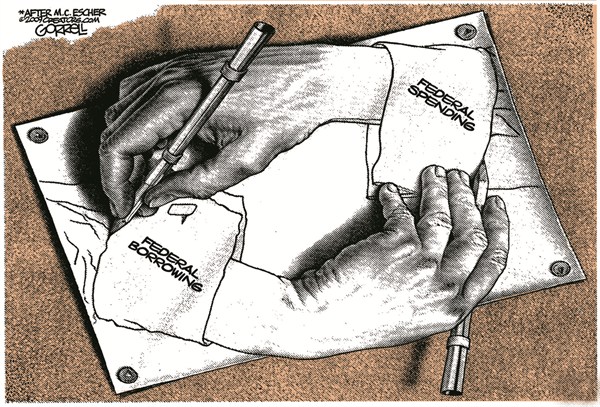
Cartoon Credit


 James R. Evans, in his inspiring book, "The Glorious Quest" gives this simple illustration of legalized plunder:
"Assume, for example, that we were farmers, and that we received a letter from the government telling us that we were going to get a thousand dollars this year for plowed up acreage. But rather than the normal method of collection, we were to take this letter and collect $69.71 from Bill Brown, at such and such an address, and $82.47 from Henry Jones, $59.80 from a Bill Smith, and so on down the line; that these men would make up our farm subsidy. "Neither you nor I, nor would 99 percent of the farmers, walk up and ring a man’s doorbell, hold out a hand and say, ‘Give me what you’ve earned even though I have not.’ We simply wouldn’t do it because we would be facing directly the violation of a moral law, ‘Thou shalt not steal.’ In short, we would be held accountable for our actions."


If I actually have the unbelievable gall to go around to my neighbors demanding money, most of them would not pay me. After all, they don't owe me anything. If I try to force them then it is a crime, and I should be punished. However, we have come to a point in our nation where many, perhaps even most, think nothing of taking government money for various entitlements, subsidies, and programs. But government produces nothing; that money comes from our neighbors. Which of your neighbors are you comfortable taking from? For myself, I think my neighbors should keep their money!


Cartoon credit


The free creative energy of this choice nation "created more than 50% of all the world’s products and possessions in the short span of 160 years. The only imperfection in the system is the imperfection in man himself." The last paragraph in this remarkable Evans book – which I commend to all – reads:
"No historian of the future will ever be able to prove that the ideas of individual liberty practiced in the United States of America were a failure. He may be able to prove that we were not yet worthy of them. The choice is ours." (Charles Hallberg and Co., 116 West Grand Avenue, Chicago, Illinois, 60610)


This system is the Free Market. And, contrary to what the labor unions and progressive politicians would like you to think, the Free Market is what is responsible for improving working conditions in America. It's not popular to say so, but the market, particularly when it really is free, and not the over-regulated sham of freedom we currently have, does a pretty good job of improving things. The best explanation of how this works that I have read comes from Thomas E. Woods Jr. According to Woods, we have "The Myth: The government and labor unions have protected American workers from greedy and exploitative businessmen." And we have "The Truth: Government intervention in the economy is counter-productive and ends up hurting the very workers it is supposed to help, as it hampers they very thing - capital investment - that raises our standard of living.  (33 Questions About American History You're Not Supposed to Ask, pg 172)" Since government does not and cannot create wealth, this makes a certain amount of sense, but Woods has a very clear explanation of exactly how it works.


Here's how Americans' real wages h ave been raised. ... In a free-market economy, businesses invest the vast bulk of their profits in capital goods that make labor more productive. Investing in a forklift, for example, makes it possible for a worker to move and stack far more pallets than before, and to reach heights that would have been impossible with his bare hands. Other kinds of machinery can multiply the efficiency of a single worker many times over, sometimes by orders of magnitude. The amount of goods the economy is capable of producing rises, at times even explodes. This is how wealth is created: we can produce more with the same (or a lesser) amount of labor. 

As a result of capital investment, firms can now produce many, many times more goods that before, and at considerably lower cost. Thanks to the pressures of market competition, firms pass on these cost cuts to consumers in the form of lower prices, better quality merchandise, or a combination of both. The ordinary person's standard of living increases, therefore, not because government takes from the rich to give to him or because labor unions "struggle" with employers to win him concessions. His standard of living increases because business firms can invest in machinery that makes it possible for more and more goods to be produced with fewer and fewer hands, thereby increasing the overall amount of material goods available and rendering them less and less expensive. (IBID 168)


Woods addresses working conditions of the past as well, another improvement that government and unions like to take credit for, but his explanation makes a whole lot more sense than the union story:


The objection is immediately raised: didn't workers in the past have to work very long hours? Without a doubt. By today's standards, people in the nineteenth century worked an exhausting schedule. But again, when output per worker is miserably low, then a supply of consumer goods that most people consider adequate requires people to work correspondingly long hours to produce them at all. That, and not the wickedness of big business, accounts for the low standard of living and long hours of work that existed in teh past. As the productivity of labor increases, and with it the level of real wages, people can begin to opt for additional leisure rather than continue to work the long hours of the past.

Without the need for any legislation or government coercion at all, a situation will eventually arise in which employers find it in their own economic interest to offer correspondingly fewer hours. ...

To the extent that maximum-hours legislation corresponded with people's desire to work fewer hours, it was superfluous, since such an outcome would have come about my means o the process just described. But tot he extent that such legislation was economically premature, forcing fewer hours on workers who needed the wages of their longer hours in order to maintain what they considered an adequate standard of living, it harmed the very people it was allegedly intended to help. (IBID172)


One other objection to the idea that unions are unnecessary and even counter-productive is that business sometimes take advantage of their workers. While that is true, and looking back into history from today's perspective, some of the conditions workers had to deal with were rotten. I'm a coal miner's granddaughter, and some of the stories of the things that happened to my Grandpa, it makes me wonder why he didn't prosecute! Which is my answer to what to do when a company does something criminal: don't pussy-foot around. Go down to the police station and prosecute! If it's a crime, it should be punished. If it's not, then the employee has a couple of options. They can get a different job (yes, I know this isn't always easy). They can put up with it. They can start their own business. The idea that folks are stuck, destined to work for a lousy company, unable to change their own fate is patiently false. It's often not easy to make the changes, but if things are bad enough, they'll do it. Especially if, working under a Free Market, they are assured that what successes they have, they can keep. America is supposed to be the land of opportunity. Certainly there is risk, but no reward worth having ever came without risk! And that includes building wealth.

29 March 2011

The Proper Role of Government: Legal Plunder

The Proper Role of Government, by Ezra Taft Benson
-- read the full text.
My commentary as I study his article:
Part I (Foundational Principles, Origin of Rights)
Part II (Separation of Church and State)
Part III (Source of Governmental Power)
Part IV (Powers of a Proper Government)
Part V (Government = Force)
Part VI (The US Constitution)
Part VII (Local Government)
Part VIII (Legalized Plunder)

Having looked at the things a government ought to do, Brother Benson turned his attention to the other side of the coin: things which it is right that a government should not do.


THINGS THE GOVERNMENT SHOULD NOT DO

A category of government activity which, today, not only requires the closest scrutiny, but which also poses a grave danger to our continued freedom, is the activity NOT within the proper sphere of government. No one has the authority to grant such powers, as welfare programs, schemes for re-distributing the wealth, and activities which coerce people into acting in accordance with a prescribed code of social planning. There is one simple test. Do I as an individual have a right to use force upon my neighbor to accomplish this goal? If I do have such a right, then I may delegate that power to my government to exercise on my behalf. If I do not have that right as an individual, then I cannot delegate it to government, and I cannot ask my government to perform the act for me.


I believe that last line bears repeating:


If I do not have that right as an individual, then I cannot delegate it to government, and I cannot ask my government to perform the act for me.


This becomes a very simple starting point a we consider the issues of our day. It becomes an easy way to measure proposed legislation against principle.

Can I force my neighbor to pay for radio broadcasting?

Can I make my neighbor help with another's mortgage?

Is it right to make my neighbor subsidize veterinary education?

Incidentally, I found these on a list of bills that Congress recently voted on. I selected bills that had had final votes, and tried to take the first ones there (that I could quickly follow the title's meaning- some seemed rather arcanely titled), rather than cherry-picking votes that would illustrate my point. As it happens, none of these bills aims to do things that I would be comfortable compelling the lady next door to do.

Because in our government sovereignty (the right to govern) rests in the people, rather than the ruler, and the government exists because the People will it so, it is a government of delegated powers, the authority for those powers being derived from the Natural Rights of the People. The People created their local and State governments, and the State governments, in turn, created the federal government, which was ratified by a vote of the People. Federal power flows from the People. That is, federal power consists solely of power delegated to it by the People.


If I do not have that right as an individual, then I cannot delegate it to government, and I cannot ask my government to perform the act for me.


Brother Benson goes on to talk about how this can be a difficult principle to live at times:


To be sure, there are times when this principle of the proper role of government is most annoying and inconvenient. If I could only FORCE the ignorant to provided for themselves, or the selfish to be generous with their wealth! But if we permit government to manufacture its own authority out of thin air, and to create self-proclaimed powers not delegated to it by the people, then the creature exceeds the creator and becomes master.


Any time you hear an argument that starts out, "But what if people don't..." You're probably viewing first-hand the difficulty of this principle.

"What if people don't educate their children properly?"
"What if property values drop?"
"What if people don't pay a living wage?"
"What if..."

The list is nearly endless. Violations of this live-and-let-live principle come in other forms too. Freedom absolutely requires both responsibility and consequences. It can be uncomfortable at times, if we do not anticipate those consequences. Another example I recently heard, incident to Wisconsin's union privileges debates, was this:


"Could the wealthy be asked to contribute even a very small portion of their money (come on, you are a millionaire surely you can afford the same amount of money the the public employees willingly said that they would give up out of their $40,000ish salary ) I have yet to meet any millionaire public employee."


First of all, if it's the tax man coming to your door asking for a "contribution," he's not going to be coming, hat in had, with a polite request. He'll bring the force of the IRS's private army, and the threat of jail time for tax evasion. Regardless of how you, the "donor," feel about this as a use of your personal earnings, regardless of your own needs, and regardless of your thoughts on the justice of the cause in question. That's not asking. And, when it's talking about someone else's money, that's not "taxing ourselves" as another friend asserted later in the conversation. It's force. And it's wrong.

The woman who made the suggestion is a friend, and a good woman. I believe that she, like so many, has simply never really thought through the thing she suggests. It's been generations since these principles were taught in government schools. I know that prior to reading Brother Benson's essay I certainly could not have told you what was wrong with suggestions like this, which are plentiful. I like to think I would have been vaguely uncomfortable with the idea, but the fact of the matter is, I was pretty clueless before I read the essay, and the Robinhood-like nature of this common suggestion may have appealed to me. After all, we're supposed to care for the poor, right? Reading this essay and the book "A Glorious Standard" made me realize how important these things are: what the government does is closely tied to the freedom we have to exercise our agency to the fullest.

Thing is, the way we care for the poor is important. The method is as important as the outcome, if we want to remain morally correct. Because government has funds only through taxation, I believe that charitable works can only justly be done through by private entities. I cannot take money from my neighbor lady to give to the poor, so I cannot authorize my government to take her money to give to the poor. I further believe that in our current situation, where the government has manufactured authority to do "charitable" work, it creates a complacency among those who would otherwise give more generously - after all, the government's got it handled. The heavy tax burden that results also reduces the individual's ability to give. Plus, when the government is deciding who gets the "charitable" contributions, we are often forced to give to those who do work we do not approve of. For me, groups receiving tax money I contributed to, but to whom I would never make a voluntary contribution includes organizations such as Planned Parenthood.


But if we permit government to manufacture its own authority out of thin air, and to create self-proclaimed powers not delegated to it by the people, then the creature exceeds the creator and becomes master. Beyond that point, where shall the line be drawn? Who is to say "this far, but no farther?" What clear PRINCIPLE will stay the hand of government from reaching farther and yet farther into our daily lives? We shouldn’t forget the wise words of President Grover Cleveland that "… though the people support the Government the Government should not support the people." (P.P.N.S., p.345) We should also remember, as Frederic Bastiat reminded us, that "Nothing can enter the public treasury for the benefit of one citizen or one class unless other citizens and other classes have been forced to send it in." (THE LAW, p. 30; P.P.N.S., p. 350)


In talking about government with my friends, I have found that a number of them reject the principles laid out in this essay by Brother Benson. When I have asked them to articulate what limits they see being on government, they haven't been able to do so, and at times have gotten quite upset with me over the question and my dissatisfaction with answers that boil down to "whatever the voter (or high court) wants." I cannot feel secure about any foundation for rights that leaves them vulnerable to the whims of the majority or our crooked politicians.


THE DIVIDING LINE BETWEEN PROPER AND IMPROPER GOVERNMENT

As Bastiat pointed out over a hundred years ago, once government steps over this clear line between the protective or negative role into the aggressive role of redistributing the wealth and providing so-called "benefits" for some of its citizens, it then becomes a means for what he accurately described as legalized plunder. It becomes a lever of unlimited power which is the sought-after prize of unscrupulous individuals and pressure groups, each seeking to control the machine to fatten his own pockets or to benefit its favorite charities – all with the other fellow’s money, of course. (THE LAW, 1850, reprinted by the Foundation for Economic Education, Irvington-On-Hudson, N.Y.)


My husband and I often comment on the most recent round of "Who Wants to be the Biggest Victim." You see this "game" all over in the race to collect or protect the latest cash prize. Raise the minimum wage, stop picking on unions, expand affirmative action... the list goes on and on.


THE NATURE OF LEGAL PLUNDER

Listen to Bastiat’s explanation of this "legal plunder."

"When a portion of wealth is transferred from the person who owns it – without his consent and without compensation, and whether by force or by fraud – to anyone who does not own it, then I say that property is violated; that an act of plunder is committed!

"How is the legal plunder to be identified? Quite simply. See if the law takes from some persons what belongs to them, and gives it to other persons to whom it does not belong. See if the law benefits one citizen at the expense of another by doing what the citizen himself cannot do without committing a crime…" (THE LAW, p. 21, 26; P.P.N.S., p. 377)


The Arizona Citizens Clean Elections Act that's being challenged in the courts rewards politicians that adhere to certain rules with tax money for their campaigns. That is, they take from the people and give to the politicians. Even worse, they have put a 10% surcharge on civil penalties and fines for this purpose: violate hunting or fishing ordinances and suddenly you're supporting a candidate of the government's choice. It's a clear case of the legalized plunder that Bastiat was talking about: those candidates couldn't take that money as individual citizens. It would be stealing. It's no different when the government does the dirty work for them. Arizona politicians who really want to be clean and principled will be opting out, in spite of the advantage to their opponent under this law (self-financed candidates trigger a donation to their opponent).

Our governments are rife with examples at both the state and the federal level. I'm confident it's at the local level too, I'm just not well enough informed to know of a specific case at this point.


As Bastiat observed, and as history has proven, each class or special interest group competes with the others to throw the lever of governmental power in their favor, or at least to immunize itself against the effects of a previous thrust. Labor gets a minimum wage, so agriculture seeks a price support. Consumers demand price controls, and industry gets protective tariffs. In the end, no one is much further ahead, and everyone sufferers the burdens of a gigantic bureaucracy and a loss of personal freedom. With each group out to get its share of the spoils, such governments historically have mushroomed into total welfare states. Once the process begins, once the principle of the protective function of government gives way to the aggressive or redistribute function, then forces are set in motion that drive the nation toward totalitarianism. "It is impossible," Bastiat correctly observed, "to introduce into society… a greater evil than this: the conversion of the law into an instrument of plunder." (THE LAW, p. 12)


The Constitution of our United States exists to secure the blessings of liberty for ourselves and our posterity. Legalized plunder leads to an ever diminishing level of freedom. We must speak up against it whenever and wherever we find it. We must elect leaders with the courage to say NO. We must find men of moral fiber, and that is a process that begins long before voting day. We may need to step outside our comfort zones and become those moral men serving the public ourselves, even as Washington was called from retirement several times to serve his country. We must wake up and defend our liberties from those who would plunder them from us, or we will wake up and find them gone.

LinkWithin

Blog Widget by LinkWithin