I've been taking a look at Teaching in the Branches again, where Miss Mason lays out a couple of foundational principles of education. It's obvious that she must have spent a great deal of time, not only teaching, but also thinking about teaching: these three principles really are foundational, but like all profound truths, it's pretty easy to go along for a long time without ever really being aware that they're there. The fact that she not only recognizes that education stands on these things, but can also put it into words so clearly, I suspect is the reflection of a great deal of work and thought and time on her part. Which fits with what we know of her, and is why there's a whole educational movement that takes its name from her. But as I'm thinking about it this morning, it makes me think what a truly remarkable teacher she was.
She talks about Authority, which I blogged about last time, and she threatens to talk about Habits, but doesn't actually get to it in the time allotted, and she also talks about Ideas.
In the matter of the Ideas that inspire the virtuous life, we miss much
by our laissez-aller way of taking things for granted. -Charlotte Mason, Teaching in the Branches
The leading brethren of the Church have, many times, spoken to this same goal of education as a means for leading the student to the virtuous life.
The Church stands for education. The very purpose of its organization is
to promulgate truth among men. Members of the Church are admonished to
acquire learning by study, and also by faith and prayer, to seek after everything that is virtuous, lovely, of good report, or praiseworthy. In this seeking after, they are not confined to narrow limits of dogma
or creed, but are free to launch into the realm of the infinite.
But gaining knowledge is one thing, and applying it, quite another.
Wisdom is the right application of knowledge, and true education—the
education for which the Church stands—is the application of knowledge to
the development of a noble and God-like character. -President David O. McKay, Moral and Spiritual Values in Education, April 1968
So again, as I outlined this section of the lecture, I found that Miss Mason had offered several specific techniques for coming at the principle that she's getting at:
When I was in high school, they let us choose a classic to read and write about. I thought that Gone with the Wind would be a fun book to read, and I wanted to write about... I think it was Civil War era fashions. I don't remember, exactly. Could have been something else.
So I started reading, thinking it would be like most of the books I'd read up to that point: the lead would be the hero, or in this case, the heroine.
By the end of the book, I just hated Scarlet, and I hated the book, and I just wanted to chuck it across the room. But it was for school, and I had to write that paper, so I did actually finish the thing. And put it down, and never looked at it again, just thankful to be done.
So, it came up in a book group I'm a member of, and people have been reading it, and it made me remember how much I'd wanted to just slap Scarlet silly last time around. But I also know that I am not who I was: I was right around 16 or 17 myself when I read it, and had never considered learning from books rather than just enjoying stories, no concept of how important supporting characters can be, or a host of other things I've learned about literature since I started homeschooling, and I was curious: would I still hate it as much I did previously? I don't know. I'm not the same person that I was back then; I've grown.
So I called up the used bookshop and they had it. For $3.50. So I grabbed it. And started it.
I looked at my copy of Pilgrim's Progress the other day... and realized it's a retelling and not the original. Drat. I suppose that I could buy a new one, but the book budget is currently used up, so I decided to make my own homemade copy. Since I'm doing one, I may as well do another, so I am also doing a copy of the poems my older son ought to be doing, but isn't because the whole etext thing isn't working for me right now. I greatly prefer a real book in my hand!
First, I went and grabbed the Project Guttenberg PlainText UTF-8 version of the text of Pilgrim's Progress that Ambleside Online links to, copied and pasted it into Open Office. I'm also making a copy of the recommended poems for Ambleside Online Year 5, which are not public domain, but are made available to the public free of charge because the women of AO are amazing and generous. Both of these texts copy and paste nicely to my word processor, so I don't have to go through and delete weird characters or anything like that. Next, I picked out a cool special character (Open Office has special characters on the Insert menu), bolded it, and used the word count tool to help me break it up The Pilgrim's Progress into readings, putting my special character about every 800 words, which is the length of reading the AO recommends for this book; the poems we'll just do one in a sitting so they don't need that kind of thing.
I also added a pretty title page with fancy font, and made sure that all my text was at least 12pt font: too much smaller and you'll have a small print edition of your text, as it's going to shrink when it's printed. If you like your text a little on the larger side, you might go 14. I typically print at about 10, so I'm happy with a smallish font. You can add in illustrations if you want, but I didn't; this version that I'm doing this time is a very functional book, but it's not really elegant. It is, however, cheap and tough: the ones that I did for Our Island Story and Secrets of the Woods have held up beautifully as I've read to my son over the past year and a bit.
I'm excited: Once upon a time, I used to participate in the Daring Bakers cooking challenges, but I struggled to keep up and dropped out after a while: it was too hard to be consistent. When I finally felt ready to try again, they had finished. And I haven't found a different baking challenge -- until now. King Arthur Flour is hosting one. And they're doing Gruyère-Stuffed Crusty Loaves. I'll need to find the fancy cheese, but otherwise, it's ingredients that I've got on hand. However, it's a method that I've never tried before, so that ought to be fun to do.
I have long loved Patrick Henry's address to the Virginia Convention: the "Give me liberty or give me death!" speech. Someday, I want to use Benjamin Franklin's method of studying, and this speech is the first thing that I want to dive into (probably followed by George Washington's Farewell Address). But tonight, in reading to Hero from the Bible, I discovered an allusion that Henry made that makes that final, powerful paragraph even more powerful.
Here's the end of the speech:
It is in vain, sir, to extenuate the matter. Gentlemen may cry, Peace,
Peace-- but there is no peace. The war is actually begun! The next gale
that sweeps from the north will bring to our ears the clash of
resounding arms! Our brethren are already in the field! Why stand we
here idle? What is it that gentlemen wish? What would they have? Is life
so dear, or peace so sweet, as to be purchased at the price of chains
and slavery? Forbid it, Almighty God! I know not what course others may
take; but as for me, give me liberty or give me death!
Tonight, as we read in Ezekiel 13, I noticed this:
Because, even because they have seduced my people, saying, Peace; and there was no peace; and one built up a wall, and, lo, others daubed it with untempered mortar: -Ezekiel 13:10 (emphasis added)
Last week's excitement about English history continues, and the kids dug up a game that we played the very first time they studied the Battle of Hastings, which was several years ago. They're also still listening to the stories of the Saxons nearly every day. Just as I was thinking that I would suggest a documentary, the kids found one on YouTube by themselves. All this interest in Hastings and King Harold has displaced a little bit of our regularly scheduled lessons, but I'm ok with that, as it's a great foray into genuine self-education, and I'm excited to see that. I can adjust my plans a little in order to encourage this kind of interest!
The biggest project this week has been making a collection of phenology wheels and recording some nature observations. The first day, building the wheels was our math for the day, working with compass and protractor. This was challenging for the younger kids, but we all got it done. It was fun to take a break from our regular math and have a special project; we haven't done that for a while.
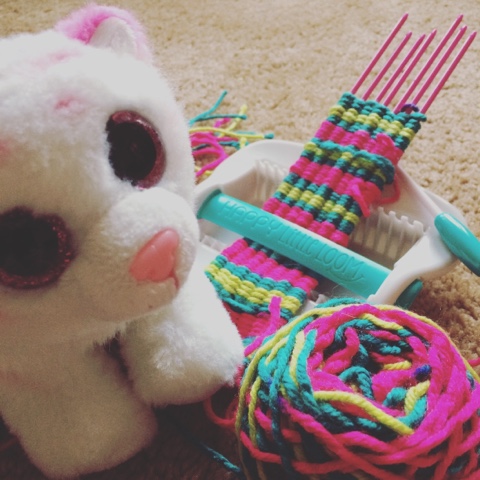
For her birthday, Miss Kitty received a visit from her grandparents, and they brought a cute little loom. Which she loves. She got her Grandpa to help set it up, and to teach her what to do. After that, when I presumed too much (didn't take much!) then she would remind me: "Grandpa already taught me this." She turned out her first woven item... and we promptly lost the tool that she's supposed to use to make the weaving happen. Bummer. But she has created her first object, a six-inch long "scarf" for Pinkus, which she is extremely proud of! And the tool did turn back up, and was promptly put into service working on a second project, which she also finished this week.
I finished reading The Gospel at 30,000 Feet, and I'm getting back into the swing of pre-reading. Which is good because I'm behind... again. Oops. I wish that I'd thought to start this last year. Pre-reading Hero's hardest books (and narrating them, because my brain needs training too, and that also gives me a record to jog my memory with Dragon comes through in a few years) has consistently been challenging. But I feel like even an imperfect attempt is helping me to grow, and making me a better teacher --even when I'm trailing behind him, rather than going before. We're playing leapfrog through this book. I think that I'm going to try to get all the way through one book at a time, rather than trying to keep up with all his books close to his schedule. I suspect that I will have more success this way, even though I will give up some of the benefits of slow reading. Doing a written narration on each chapter is challenging: the kids have grown into doing narrations of gradually longer passages with a single reading... but I have not. I'm getting better at it though!
Crazy weather! First, we got warm enough to actually play outside. Which two of the three could do: there's an ugly cold going through the household right now, and Hero's still in recovery, so the poor guy had to watch through the window while the first days of decent weather... went by without him peeping a nose out. Bummer. It's supposed to not only stay above 0F, it's supposed to peak out at 45F... followed by freezing rain and a plunge back to 11F. Oi. Crazy weather.
Inside, there's been lots of science this week. We got a microscope for Christmas from Nana and Grandpa, and the kids are all over looking at both the couple of slides that it came with, and also checking out different things around the house.
A commonplace is a traditional self-education tool: as you read, grab
a notebook. Write down things that embody Truth, Goodness, and Beauty.
Write down notable quotes, with or without your own thoughts about them.
Write down the questions you have as a result of the text you are
reading. You will find the book becomes a record of your own growth, and
it becomes a touchstone for memory of things you have studied in the
past. These are a selection of the passages that I've included in my
commonplace book this month:
The best dividends on labor invested have invariably come from seeking more knowledge rather than more power.
-Orville & Wilbur Wright, quoted in The Wright Brothers by McCullough, 125
Darkness cannot persist in the presence of light. I do not know, I do not know anybody who does know, how to put darkness into a room to make light vanish.
-Boyd K. Packer, quoted on Instagram
Madam How is never idle for an instant. Nothing is too great or too small for her; and she keeps her work before her eye in the same moment, and makes every separate bit of it help every other bit. She will keep the sun and the stars in order, while she looks after poor old Mrs. Daddy-long-legs there and her eggs. She will spend thousands of years in building up a mountain, and thousands of years grinding it down again; and then carefully polish every grain of sand which falls from that mountain, and put it in its right place, where it will be wanted thousands of years hence; and she will take just as much trouble about that one grain of sand as she did about the whole mountain... Most patient indeed is Madam How. She does not mind the least seeing her work destroyed; she knows that it must be destroyed. There is a spell upon her, and a fate, that everything she makes she must unmake again; and yet, good an wise woman as she is, she never frets, nor tires, nor fudges her work, as we say in school... Madam How is wiser than that. She knows that it will come to something.
-Madam How and Lady Why, 9-10
If no other knowledge deserves to be called useful but that which helps to enlarge our possessions or to raise our station in society, then mythology has no claim no the appellation. But if that which tends to make us happier and better can be called useful then we claim the epithet for our subject. For mythology is the handmaid of literature; and literature is one of the best allies of virtue and promoters of happiness.
-Bullfinch, Age of Fable, vii\
Perspective is to painting what the bridle is to the horse, the rudder to a ship... There are three aspects to perspective. The first has to do with how size of objects seems to diminish according to distance; the second, the manner in which colors change the further away they are from the eye; the third defines how objects ought to be finished less carefully the farther away they are.
-attributed to Leonardo DaVinci
... we must continue to understand and educate ourselves if we wish to have success in educating our children.
-Dean & Karen Andreola, Introduction to the Original Homeschooling Series, Charlotte Mason, 6:iv
We fail to recognize that as the body requires wholesome food and cannot nourish itself upon ANY substance so the mind too requires meat after its kind. If the war [WWI] taught nothing else it taught us that men are spirits, and that the spirit, mind, of a man is more than his flesh, that his spirit IS the man, that for the thoughts of his heart he gives the breath of his body. As a consequence of this recognition of our spiritual nature, the lesson for us at the moment is that great thoughts, great events, great considerations, which form the background of our national thought, shall be the content education we pass on.
-Charlotte Mason, 6:5
We started reading poetry a while ago. That sounds like so much more than it is: every day, I read 3 poems. One "belongs" to Hero, one to Dragon, and Peanut gets one too. And that's all we do: just read them. Honestly, I have wondered if there was any significant impact, because while the kids do like them enough to ask for them now, we seldom try to discuss them, or even narrate them. But I'm trying to help them to love what is lovely, and poems are, to my surprise (I was a reluctant skeptic at first), quite lovely.
Now, probably more than a year after we started reading poems, I finally saw concrete evidence that the poems are impacting my son: he grabbed the book after I was done reading them, and started reading it on his own.
I was probably not as wise as I should have been: my emerging reader was reading, and reading beautiful literature. But I wanted to get to our scripture boxes, and get some things marked off our list. I may have threatened to take away the book if he didn't pay at least a little bit of attention to the matter at hand. This was his reaction:
We came to an agreement where he got to continue to read the poems. And my eyes are a little more open to the value of our little poetry readings, and the richness that they offer, because of the thought-provoking nature of this incident. Hopefully, next time, I will be more wise in my efforts to find balance between lingering over the lovely things and getting through our list of tasks. It can be tough, some days!
They must grow up upon
the best. There must never be a period in their lives when they are
allowed to read or listen to twaddle or reading-made-easy. There is
never a time when they are unequal to worthy thoughts, well put;
inspiring tales, well told. ... we shall train a race of readers who
will demand literature - that is, the fit and beautiful expression of inspiring ideas and pictures of life. -Charlotte Mason 2:263, emphasis original
I'm so glad that we have found Classical Education and Miss Mason's gentle wisdom to help us all grow to be more fully human, more fully reach our potential as God's children. It makes the whole of our lives more beautiful to be making the attempt, however unsteady it sometimes is. Good poetry, despite my initial skepticism, really does deserve a place among the "best books" that we ought to be using to educate ourselves and our children.
... seek ye diligently and teach one another words of wisdom; yea, seek ye out of the best books words of wisdom, seek learning even by study and also by faith... -Doctrine and Covenants 109:7
I've always had a hard time knowing what to do outside, but counting birds for the eBird project has become a favorite. So far this year I've seen ten species (and I didn't hardly peep a foot outside in January, because it was so miserable), and but surprise was that there are already American White Pelicans in the area this year. I looked them up, and they're not common in our area until closer to April, though it's not unheard of to see them around the area now, either. Pelicans are cool. They have a really distinct way of circling around overhead, always near our river. I like watching them; this year we'll have to see if we can't get down to the waterfront while they're there so we can watch some of the other things they do. Pelicans are fun to watch.
::2::
There's some cool free audiobooks out there. LibriVox has several of our favorites, such as Children of Odin, and The Golden Fleece and the Heroes Before Achilles. Those are some that the kids go back to over and over. This week, I found another free one that I want to have a listen to: Lafayette and the Revolution, about how a French Marquis came to be fighting in the American Revolution.
::3::
So, NASA's been finding planets around other stars for a while. I even had an app on my phone for a while that would show me things about them, before I deleted it in favor of language learning stuff. Now, they've found some cool ones: planets that might have water. And they're not even that far away. I need to figure out where Aquarius is, because that's where NASA says this Trappist system is located, and it'd be cool to know how to stare in their general vicinity.
::4::
The kids invaded and nabbed my electrical tape to enhance their sticks. The big guy has created a pilum; the small two immediately copied him, but theirs are swords, they tell me. It's really quite remarkable what a little electrical tape can do to a stick. And the things they come up with in "play"; I certainly didn't tell them to recreate ancient weapons. I just said to go outside to play! I'll be interested in seeing how long these stick around: they are carefully stacked outside the door, after I told the kids that their "weapons" were not allowed in the house.
::5::
I'm a Constitutionalist, and I learn foreign languages for fun: I believe that words matter. They have meaning and how you put them together is important. But it still sometimes catches me by surprise to see how big a difference it makes to change the structure of a sentence, even just a little bit. With a little bit of mindfulness, we can avoid teaching (or at least avoid reinforcing) ugly stereotypes by tweaking the way that we speak about groups of people: The "zarpies" example in this article is particularly interesting. Reading that article made me think of the research on teaching colors that I read a while back - the one that explained why color is so difficult to teach, and why kids often will take a lot longer than you'd expect to really get the hang of it. Turns out that some linguistic mindfulness will go a long way here, too.
A pretty typical day in our life. The kids are 5th grade, 1st grade, and preschool.
4:00am - Wake up (I heard the Daddy's alarm) and send him off to work. It's really early.
4:20 - back to bed.
8:00am - Wake up again, still tired. I think that I'm anemic, so I'm thinking about what I can have for breakfast that will help with that. Look at my phone -- text helps my brain to focus.
8:10 - The kids attack me for snuggles. Hero asks if he can make mac n cheese for breakfast. Gross. I say yes, but there's no way I'm eating that. They laugh; they're used to me hating it. We snuggle a few minutes, then I get up and try to think. I hate being anemic; makes morning time really rough, no matter how much sleep I get. Hero shows me the dragon he drew this morning.
8:40 - Hero's got the mac n cheese almost done. I'm putting up today's list of things that need to happen. There's cool art on my markerboard again; I try to make the list around it, so that it doesn't get erased too soon. I also move last week's Brahms piece to the bottom of our playlist so that we can listen to a new one first this week. Dragon asks for his Legos down.
9:00 - I'm done messing with the computer, and inspect a transformer Dragon made on my way to turn on Brahms.
9:15 - I have the Duplos off the floor, and I'm enjoying the Brahms, about to do some yoga. Hero turns up with his violin, and I ask him to do that after we've had a few more minutes with Brahms. He decides he'd like to vacuum for his chore today instead, so I put off my yoga and ask him to do the computer room as well as the living room. And I remember that one of Dragon's books grew legs yesterday and walked away. Gotta find that book, soon, or something else that will work in its place.
9:30 - Hero's done with the vacuuming and moves on to reading; Dragon is working on some 100s chart games on the computer. I give him a couple patterns to color on his chart, he makes up a couple patterns, and then chooses some other educational games. I text the Daddy a couple times -it's his break time- and then go try again with the yoga.
10:05 - Yoga's done, and it went well. I started working on Crow Pose about a year ago because I read that it was a good beginner arm balance. I have no idea how long it usually takes people to learn to balance (though I've read the scoliosis makes it harder to do - and mine was bad, before I started yoga), but I'm super happy to finally hold it for a second or two today. This is the first time that I'd say that I was actually able to balance in the pose for a second or two; that feels good.
When I'm done with yoga I look at Dragon's game he wants to show me, then remind him that (although Christmas lights games are cool) he's supposed to be playing math games. He heads back to do some dot-to-dots when I tell him his math time is almost up. Peanut is sitting next to him, watching what he's up to, and commenting on the pictures he makes. "That's a purple dinosaur!"
I pick up a towel left on the floor last night, and straighten out the bookshelves, hoping that I'll find the missing book -- which I do. Hero starts practicing his violin. School ran late yesterday, almost till bedtime, and he is not looking for a repeat. We try to finish everything early, but it seems like every now and then the kids need a reminder of why that's a good idea.
I put my clothes in the bathroom, planning for a shower, then tell Dragon his math games are done, and help get Peanut some day clothes.
10:30 - Dragon and I finish reading about ancient Egyptian gods and mummies. He narrates beautifully. Hero is setting up our calendar and wants to do Morning Basket next. Works for me.
We start with our calendar, which we do in Japanese. Mostly. Except for the part where I tell Dragon to stop acting crazy. That's English.
The Wise Man and the Foolish Man, in Japanese, with actions. We skip the new one, Popcorn Popping on the Apricot Tree. Up next: poems. Those are a fan favorite. All of the kids have their own set: Peanut gets Nursery Rhymes, and then as usual, insists on looking at the pictures in her book; Dragon is in A Child's Book of Poems; and Hero's meeting Emily Dickinson. They each get one:
I Saw Three Ships
I saw three ships come sailing by,
Come sailing by, come sailing by,
I saw three ships come sailing by,
On New Year's Day in the morning.
And what do you think was in them then,
Was in them then, was in them then,
And what do you think was in them then,
On New Year's Day in the morning?
Three pretty girls were in them then,
Where in them then, were in them then,
Three pretty girls were in them then,
On New Year's Day in the morning.
One could whistle, and one could sing,
And one could play the violin;
Such joy there was at my wedding,
On New Year's Day in the morning.
The Friendly Cow
The friendly cow, all red and white,
I love with all my heart;
She gives me cream with all her might,
To eat with apple tart.
She wanders lowing here and there,
And yet she cannot stray,
All in the pleasant open air,
The pleasant light of day,
And blown by all the winds that pass
And wet with all the showers,
She walks among the meadow grass
And eats the meadow flowers.
The Bee is Not Afraid of Me The bee is not afraid of me, I know the butterfly; The pretty people in the woods Receive me cordially. The brooks laugh louder when I come, The breezes madder play. Wherefore, mine eyes, thy silver mists? Wherefore, O summer's day?
We also do our memory work - most of it fast and yelling, and do the scripture boxes. Dragon's attention is going fast today, and he ends up in a timeout near the end, but recovers quickly. We've had three days or so of rain, and he needs to be outside; it shows.
11:00 - I eat some peaches and to leftover deviled eggs, set Hero up with reading Age of Fable, then take his narration. And finally get my shower. There's voluntary reading going on; I like that, and don't interrupt it.
11:30 - When I get out, I announce that everybody needs to get shoes on and go outside for 20 minutes. In the middle of the happy scramble, there's a squirrel out front that needs to be watched, so they pause and do that. Hero goes out the door with a book in his hand; that must be my kid.
While they are outside, I work on this blog post, and start gathering up some easy crockpot recipes I promised a friend of mine. I've got a timer set so that I don't get too involved and sabotage the kids' efforts at doing school efficiently today.
11:55 -- There's tears outside; Peanut got too close to an active swing. Everybody comes back inside and has a cheese stick. I need to do some lunch. Probably with black beans, since they have iron. Hero grabs our Japanese text and we finish off the first unit; next time we'll be in chapter 2! We're moving slowly, but I think it's working pretty well. After that, he reads some stories to Peanut. Dragon is playing with his Legos again.
12:30 - Hero wants math. I'm trying to get lunch, but stop and get him started. I persuade Dragon to get out his violin. He does a nice job once he settles into it.
Peanut builds a cool circle track for the "train-train" -- all by herself!
Next I have Dragon work on his hiragana (Japanese alphabet) using flashcards today. He's doing a really nice job, and getting better at recognizing the exotic letters -- and reading them. I am pleased.
1:15 - Lunch is getting close. I have got to get better at doing it earlier. Our new schedule is still foreign-feeling, and hoping that the Daddy finds something better, soon, isn't helping me adjust. I put some biscuits in the oven to go with the chili, and check Hero's math. He needs more practice on multiplying; I send him back to correct his work. He's really ready to do something else. I tell him to finish. And warn Dragon and Peanut that fighting over trains will lose them the trains. Peanut gets sent to her room to finish whining.
1:30 - Lunch is on. It's tasty. Soup - the first soup of the fall - and biscuits. After the prayer, I read Lamb's Shakespeare to the kids; we're working on Comedy of Errors, and everyone is doing really well with it. I am surprised at how much I'm enjoying it; Shakespeare is a new experience for me, too. This is our second play, and I'm pleasantly surprised at how funny it is. The boys do a sort of tandem narration, with both of them contributing bits, and they're following it quite well.
1:45 - My best friend calls, and I invite her over to join us for lunch. She says she'll be here in 20 minutes, so we quit Shakespeare and I grab Secrets of the Woods. Officially, this is Dragon's book, so he's the only one that narrates, but we don't get far because I realize that he doesn't know what it means to "tap a tree", so we're off to YouTube to learn about that.
2:00 - I get Dragon to take out the recycles for his family work - he's delighted with the job and does it in the noisiest way possible. It is very loud. My friend arrives, and I banish the kids to the yard. Dragon is still experimenting with how loud he can possibly be. Peanut joins him. I tell them no water; it's not warm enough. Go. Out. Side. My friend and I exchange stories of our days - mine with the kids, hers driving school bus. We laugh and shake our heads at Dragon's antics.
2:30 - The Daddy calls; he's done with work, and do I want anything from Walmart? I do - Hero wants an Optimus Prime cake for his birthday campfire party tomorrow, so I need sugar to make frosting. My friend and I continue chatting.
3:00 - Daddy's home! He joins the conversation, which is delightful. Tells about today's antics from the powers that be at work. It's amazing they stay in business. Dragon asks for some computer time; Hero is reading. Peanut finds her purple boa and is prancing around with it.
3:45 - My friend has to leave, and the Daddy heads out again to do some home teaching.
4:10 - Dragon and Peanut request play-doh. And all the play-doh tools. Hero is playing a video game; he asks me to set the time for 30 minutes, which is about half his screen time. I set up the play-doh, then go look for the cake pan Hero requested.
4:20 - More dishes. Only, I need to do some laundry. So I get that started first. {Can I just say how much I love me a labor-saving device!}Back to the dishes While I work, I set up some Japanese YouTube videos for passive listening; passive exposure makes a huge difference in our language study.
4:25 - My sister called. Yay!! We chat for a while, she wants to know about how the new job is going; I ask about her kids. And tell Dragon, "Go find a thing to do," about 4 times in the half-hour conversation. When it's done, I turn the Japanese back on. And try to get a few dishes done. And do a thing for a kid. And wash a dish.
Dishes are the job I used to throw tantrums over when I was a kid. They're still not my favorite. But that's not why they're not getting done very efficiently today. I have actually learned to enjoy a clean kitchen -- enough to put forth the effort necessary to get it there. But I have a hard time staying on task. {sigh} One of these years, I'll have a clean house.
5:10 - The Daddy calls. His home teaching people asked for a little help, so he's slower than he anticipated. I love when he calls; I know very well that he doesn't have to do it, but it's so nice. I work very hard at not dropping the phone into the water -- I'm holding it with my head while I attempt to get a few dishes clean.
5:20 - The Japanese is back on, now that I'm not on the phone. (Nobody's paying attention, including me, but it's amazing what the brain does in the background, as far as sorting patterns, when you're not really paying attention.) I just want a nap. Which reminds me: I still haven't looked to see if I've still got iron supplements, or if they're still good. I need to do that. And it's about time to move the laundry. And I've got to make that cake. Which means butter needs to be out warming up... I feel like I'm not getting any closer to the bottom of my to-do list... which just might be getting longer. All I want is a nap.
Hero is building Poke-balls from cardboard to play with his friends tomorrow.
6:00 - I found the iron. It, along with a good collection of other expired stuff is now in the trash. I flipped the laundry. And finally made some progress on the dishes. {When we finally fix or replace the dishwasher, it will be nice.} But the kitchen is looking almost reasonable, and it shouldn't be too bad to keep it that way while I make dinner. I hope.
After a while the Daddy came home again. Dragon enlisted his help cutting out a Poke-ball of his own.
I remembered that Peanut hadn't practiced her violin yet. She was delighted to do it, and she's making really good progress at fingering. After that she gets a shower.
7:30 - One pizza made; two warmed up, and a birthday cake in the oven. We settle in for some Avitar: Last Airbender.
8:30 - Show's over; ice cream is eaten. The cake is out and looks good. Hero is super excited about; totally worth the effort.
8:40 - Family scriptures and prayers.
8:55 - Kids head upstairs to brush teeth and stuff. Everybody is tired. There's tons of things still on my to-do list, but I feel pretty good about most of the day anyway. Somehow, there's always more tasks than time, but the important stuff gets done most of the time.
9:00 - Personal scriptures and prayers with the boys; Peanut barely made it. Since she's not wearing diapers to sleep anymore, I send her potty one last time. She looks asleep by the time it's her turn for scriptures, but when I go to leave, she manages to mumble, "I not asleep..." So I kiss her and read her two verses.
9:25 - All the kids and the Daddy are asleep. I sit in the dark and do some Japanese flashcards and make a move in my chess.com games.
9:40 - Downstairs again. The house is delightfully quiet. I check on the baked goods, but some of them aren't cool yet, so I play Minecraft for a little bit, have a drink of water, and listen to some clawhammer banjo.
10:15 - I'm itching to play my own banjo, so I turn off the tunes, and get mine out, just for a couple minutes. Can't do long; it's getting late.
I've noticed that, among the many amazing Mother-Educators in the Charlotte Mason tradition, there are a ton of very smart women who hold Shakespeare in very high regard, but I've never cared enough about Shakespeare enough even to dislike him. None of his works I've been exposed to was at all interesting; they have been uniformly dull.
Part of this comes from appallingly bad teaching. In eighth grade, when we "did" Shakespeare, the teacher had been a remedial teacher, but, he regretfully informed us, they had gradually taken his remedial classes away from him, and so he was teaching us. (I always felt so sorry for the struggling learners with no escape, and no inspiration to love learning from a man like that.) He waxed poetic about the value of watching the play, then showed us the same 5 minutes 5 days running, and no more. I think we might have read a few lines, too, but can't remember for sure. I was so painfully bored in that class that I often would watch the second hand go around the clock, noting the time each time it passed 12. For the whole hour. Because watching the second hand was more interesting than the class. So that's how we did Act I. Then he told us that nothing of importance happened in the middle, and we skipped to the end, which he butchered in precisely the same fashion he had used on Act I.
This did nothing to endear the Bard to me, and if we did any other plays in school, I don't remember it.
But the Ambleside ladies insist that he's worth reading, repeatedly, and they are, particularly collectively, very, very smart, so we're giving him a shot. The Ambleside Online schedule has Taming of the Shrew on their list for this year, so that's what we started with.
Then, the consensus being that Shakespeare is meant to be watched, not read, we watched the movie. The boys loved it. I was not so sure, and went back to the Ambleside ladies and grumbled a bit, and asked for more encouragement, which they very kindly gave.
So we printed out a copy of the frame story's script, and we looked up some of the hard words, and read through it, using stuffed animals on a blanket "stage" to help us follow the action. That was kind of fun. Hero and I did all the reading, but Dragon and Peanut both participated too - I helped them to say a few lines each. (Don't you love the Jedi suit? It was his Halloween costume, but he wears it all the time.)
Then, we watched the play again. This time, I liked it lots more than the time before. I'd understood the words the first time -- but not the puns and plays on words. And, with the additional context from the frame story (which the movie version skipped), the whole thing was just funny. Hero's favorite part is the part where Patrucio kisses away Katherine's refusal to marry, and my favorite is where Luccencio's dad shows up, and he's almost the only person not pretending to be someone else, but nobody believes him!
The ladies on Ambleside say that Much Ado About nothing is a good play for beginners, so I think that's going to be the next one that we do. Because maybe Shakespeare is worth a little effort!
What is man, that thou art mindful of him? (Psalm 8:4)
What is man, that thou shouldst magnify him? (Job 7:17)
One need not grope for answers to these penetrating questions ... “Ye are a chosen generation, a royal priesthood, an holy nation” (1 Pet. 2:9). “Ye … are … a spiritual house, an holy priesthood” (1 Pet. 2:5).
-Thomas S. Monson, April 1988
Our little ones are no less than the Children of God. What education is suitable for God's children? What kind of education awakens and nurtures their divine spark, enabling them to obey the Savior's injunction to be perfect, and grow toward their potential as joint-heirs with Christ?
Given this view of the students, it makes perfect sense that the development of godly character should be the true aim of education. Knowing why provides the motivation, but there still remains the question of how best to go about offering this sort of education to my children. It will not, I think, be merely adding "character" classes to the lineup, alongside the math, history, science, and so on that we are already studying.
So, I began to ask myself, "How does one develop good character, and how can education be a tool in this process?" The first step is to reintroduce God to education.
“[T]he knowledge of God is the principal knowledge, and the chief end of education.
-Charlotte Mason, A Philosophy of Education
"Our children should be indoctrinated in the principles of the
Gospel from their earliest childhood. They should be made familiar with
the contents of the Bible, the Book of Mormon and the Book of Doctrine
and Covenants. These should be their chief text books, and everything
should be done to establish and promote in their hearts genuine faith in
God, in His Gospel and its ordinances, and in His works."
-Wilford Woodruff (source)
Wherever possible, scripture should be introduced into education. Handwriting practice can include verses from the Standard Works. Memorization of scripture, poetry, and other uplifting materials is appropriate for students of all ages. (The Scripture Memory System has been invaluable in our home for this.) Sacred history can and should be reintegrated into the study of history, and the hand of Providence, so often evident in the history of the world, should be discussed whenever it is noted. Current government school practice has made it the norm to divorce education from faith in any and every way, and to belittle, demean, or simply to ignore (as if He was of no consequence) the role of God in history, science, and all other areas of study. This tendency must be resisted. Doing as Wilford Woodruff suggested, and making scripture the first, chief, and most lasting textbook will go far in moulding our own character as well as that of our children, because it will impress upon us and them who they are, what their potential actually is, as well as cultivating the ability to perceive the active hand of our Father in shaping the fate of men and nations.
[T]he development of character comes only as we focus on who we really are. -Russell M. Nelson, Living by Scriptural Guidance
From a foundation of scripture, we then must seek for other ways to help our children grow into men and women of good character - and to help them understand why we are guiding them on this path, so that, when they are grown, they will continue along the same lines. Classical Education has a long history and well-worn paths, proven as effective methods of accomplishing these goals. Andrew Kern, quoted in "Classical Paradigm" said this:
"Classical Education is the cultivation of wisdom and virtue through meditating on the good, the true, and the beautiful."
So we put the good, the true and the beautiful in front of our children at every opportunity. One way we can do this is through the use of high quality literature. Indeed, in times past, one of the principle reasons for learning Latin and Greek was to be able to meet the great literature of these cultures in its own language. But even without such accomplishment in foreign languages, there is a wealth of high quality literature available. And when we spend time reading it, all kinds of wonderful things happen. We are exposed to ideas that might otherwise be absent from our circle. And we meet personality types we might not otherwise meet as well. This can be a significant assist as we teach and prepare our children for the wider world, beyond the shelter of our home.
I think, with books, I can warn my children against certain character types long before we actually meet any of them without encouraging a judgmental and critical spirit, and without exposing them to personal unhappiness in the process.
Charlotte Mason, in common with many classical educators, suggests reading good books for their moral lessons as well as for their literary value. The better the literary quality, the more likely it is that the reader will gain something of moral value from his reading. Miss Mason thought that children should be put in touch with the great ideas, with information clothed in literary language provided by great minds. Good books - meaning well-written books - contribute good material for moral growth. -Wendi Capehart, Books Build Character
I am delighted by this idea that we can use these fictional characters to discuss persons and personalities - all without using specific real world examples, so as to avoid pointing out others' flaws (always a hazardous and questionable occupation) or potentially hurting somebody's feelings. How useful! I think we've already done this, to a certain extent, but now I want to watch our stories not only for the good behavior they may inspire, but also for the less desirable behavior to discuss and ponder. It is a whole class of teaching moments that I hadn't fully recognized in both literature and scripture.
"We know that the pillar of Classical Education is classics. ... A
classic is a book, or a work of art or music or anything, which you can
read or appreciate again and again and again, and get more out of it
each time. ... It's particularly apropos for Christian educators,
because implies what is the great classic? The Bible. Which you could read an infinite number of times, and get more out of it each time." -Andrew Pudewa, "What Are We Really Doing Here?"
There are, of course, many other areas of character development. Family work - the process of teaching kids to participate in and value work - is also hugely important.
Work builds and refines character, creates beauty, and is the instrument of our service to one another and to God. I don't know that, classically, educators would have had to explicitly include learning to do physical work in the curriculum, but in our day, with so many labor-saving devices, and the overly indulgent attitude towards childrearing that has become prevalent, I find that it is helpful to specifically include work in our educational routine. And this also serves the ends of a Classical Education:
Work builds and refines character, creates beauty, and is the instrument of our service to one another and to God. -D. Todd Chirstopherson, Reflections on a Consecrated Life
Including household chores in our routine serves to break up the day, keeping everyone from getting stale from sitting around doing the same thing all the time, it teaches necessary life skills, and is one aspect of how we can teach our children to work hard.
“All true Work is sacred; in all true Work, were it but true
hand-labour, there is something of divineness. Labour, wide as the
Earth, has its summit in Heaven.” -Thomas Carlyle, quoted in Reflections on a Consecrated Life
This idea of climbing toward a heavenly summit is really the basis of what happens in a Classical Education. In that process of climbing toward the divine, we are likely to see such fruits as jobs and citizenship, but those things, worthy as they are, are not the end of education in themselves. The education of God's children is much, much more than mere training for a transitory mortal job. It is setting their feet firmly on the path toward their Eternal Home.
Dragon's current poems come from Robert Louis Stevenson's book, A Child's Garden of Verses. We don't do anything fancy; we just read them most of the time. This was today's poem:
SINGING
Of speckled eggs the birdie sings
And nests among the trees;
The sailor sings of ropes and things
In ships upon the seas.
The children sing in far Japan,
The children sing in Spain;
The organ with the organ man
Is singing in the rain.
This, of course, requires some explanation; Dragon wants to know: "What's an organ man?" So we turn to YouTube, because some things just need to be heard to be understood, and music is one of those things. This, which isn't a proper song, just clips of hand organs strung together, is what we found, and they listened to it and gave it mixed reviews. Dragon liked it and listened to it more than once. Hero, on the other hand, was underwhelmed, but curious about how they work.
One of the things I really like about the things we've been using from the Ambleside Online curriculum is the way that it leads so naturally into enriching experiences, like this one. I doubt that I would have thought to introduce the kids to hand organs, but because we do the suggested poems, here we are.