09 10
Showing posts with label math. Show all posts

10 October 2019

Mobeus Math

The other day, this video came through my Facebook feed:


It was really interesting, but it was late, and I wanted to do it with the kids. So I waited until they were awake. And we got out the tape and scissors and colored scrapbook papers (which helped with seeing the different things that happened as we were cutting, and made it easier to understand than it is with his that are all one color. And we made all his shapes --plus, Dragon found one more, where it makes 4 tiny curved almost-squares. They are also a pretty interesting shape.

We got all these shapes from flat papers taped, and then cut apart. (Except the double mobeus at the top: that's one of the ones we've been cutting.)


Building it all with 3 kids plus me took a few minutes. But I think that it was well worth the time, for the work on patterns and predictions and everything else. Some very good mathematical thinking going on!

Then, we watched the explanation, to make sure that we'd understood all the different things, and the reasons WHY the paper did what it did. Math took well over an hour today, but it was lots of fun. Well worth it.


17 June 2019

#GraphTheWeather

Early this month, I saw a post on Facebook from a lady that was doing something to track wildfires in her nature journal; I wasn't real clear on what it is that she was doing: wildfires are not a thing in our neck of the woods. But she had it in a circle, and it was colored different shades of red, and it was really quite striking.

I thought, what if I did that with the daily temperatures?

So I built a chart.
In a circle, because I loved how that looked.


And, because it was already the fourth, and because I don't actually have an outdoor thermometer to look at, I grabbed some data from the Weather Underground. Which is pretty cool, actually, because that means that I've got the actual high and low for the day, rather than just whatever it is whenever I remember to look at the thermometer. This also meant that I have a range of colors to represent each day, which turns out to be quite striking, even after only a couple of days of data. I got the kids into the project; it totally counts as math!

31 May 2019

Math as a Window to God's Character


I got asked today about how it is that I came to see math as a window into the character of God. I'm not sure how to show what I've learned, other than to tell how I came to know it.

* * *


I did not enjoy math in school.

The way I was taught, math was arbitrary: a never ending pile of largely unrelated formulas that must be memorized perfectly and then worked flawlessly. Close doesn't count; it's right --or it's wrong. Teachers seldom had an answer for "When are we going to use this?" They assured us that the upper math has value, but never seemed able to articulate what that value was.

I graduated from high school with a huge sigh of relief: the pre-calculus course I'd taken that year had not gone well, and the hit to my grades carried a heavy cost at scholarship time, and I figured that I'd reached the ceiling of what I was capable of in math. Though I briefly flirted with studying astrophysics, in the end the math intimidated me out of the dream, so I went with Japanese, which required no further math at all.

Then we decided to homeschool.

This meant starting over in math, from the beginning. I was intimidated, not considering myself to be very good at the stuff, but I figured that if I had a particularly "mathy" child, we could outsource math classes when I started feeling like I was in over my head.

But elementary math shouldn't be so hard. I headed to the forums to read about various math curricula. In the process, I ended up discovering how it is that people come to love math: math is patterns. And patterns are both beautiful and fascinating. Math is patterns that can be approached in many different ways, taken apart, and played with, and put back together. On occasion, I got so into a problem -a pattern- that I continued to work it even after my son's interest was spent. (This emphasis on patterns is also the core of the "new math" that everybody hates: my experience was far from unique, unfortunately, and the new "constructivist" approach to teaching math is difficult for parents who were taught with the algorithms only method, like I was.)  We started with Miquon math, which in spite of some weaknesses, taught me as much as it did my children, and then when my oldest outgrew it we continued with MEP, first because it's free, but then afterward we stayed with it because it's just excellent at teaching the kids to find the patterns. And we've all learned a lot about how to see the patterns. I find that I'm actually excited to find out what happens as my oldest gets into the "higher" maths: I am looking forward to the chance to try my hand at it again, this time realizing that there is an underlying pattern, a Real Idea, some bit of reality, that is being described by each type of problem.

I should not have been so surprised by the beauty; math is full of Truth about the world around us, and Truth, Beauty, and Goodness fit together, so where you find one, you'll usually find all three. But the idea that math could be beautiful was so different from the grind of algorithms that I'd always experienced. The reality is, algorithms are only a relatively small part of the story, and if you can work the formula, but you can't see the pattern that makes it function, then you don't really get it, and you haven't learned what it has to teach.

06 December 2018

A Math Narration

Everybody's a little bit under the weather, especially me, and I wanted to do math, but not worksheets today. Happily, I follow the Let's Play Math page on Facebook, which is always posting something that's both fun and mathy, and they popped up in my feed, so first, I set up my oldest practicing a couple of his troublesome math facts with the cool math-art thing they had. He and I both did some, and I hung them up on our art door.


Well, Dragon didn't want to be left out of the fun math, so I found one for him, too: a thing where you figure out the differences, and I hoped that he'd learn a cool strategy for figuring out differences, which he did. But it ended up being much cooler than that: we ended up looking at even/odd patterns in the difference problems. It started because I wanted to give a problem: "There are 18 candies, Jon has 5 more than Carl. How many does each boy have?" And you end up with Jon having 11.5 and Carl having 6.5. And I wondered which times you'd have to split a candy. So we made a big thing to show it.


It took us a little while to get it right: we skipped a couple of numbers, and we had all of them with the pattern sides up at first, but that was kind of hard to tell one set from the next, so we fiddled with the boxes for a while to get them to go right. But we got there. At the end, I asked Dragon to tell me what he'd learned. So he did.


30 October 2018

Number Play


One of the most unexpected things that has happened with homeschooling is the way that this second chance at learning math has really revolutionized the way that I understand and approach math: I always wondered why it is that kindergarten books start out with patterns, thinking that those had very little to do with math. Boy did I miss the boat:

Patterns are the heart and soul of math.
And they're fascinating.

So today, I'm helping Dragon with his math, and it's patterns, and they're driving him crazy.


I had a look at that third one, and saw that it's increaing by odd numbers:

1+3=4
4+5=9
9+7=16

So it's a pattern of "interval", I told him. And he was confused. So I asked him, "What's an interval?" And he said it's the space between. Yep. I also reminded him to get out his notebook so he's got some scratch paper to play around with, which he did.

And he noticed a different pattern, as he was looking over his multiplication chart:

2x2=4
3x3=9
4x4=16

So it's a multiplication pattern, squaring, and traveling diagonally down the center of the multiplication table. Which is cool. Both patterns fit.

5x5=25
6x6=36

He starts figuring out the next numbers in the sequence; it's pretty obvious, really, looking at the multiplication table. So I wondered what comes next when you do it my way. Maybe I should have predicted what happened, but I didn't:

16+9=25
25+11=36

It's pretty cool. I would never have predicted a relationship between this adding of odd numbers thing to square numbers. Makes me want to explore these numbers more, though I wouldn't know how to go about doing it. I love that our math program (we use MEP) sometimes causes these spontaneous discoveries that we can play with.

Numbers are so much cooler and more interesting than I ever suspected in school.

08 February 2018

This Week: Phenology Wheels


Last week's excitement about English history continues, and the kids dug up a game that we played the very first time they studied the Battle of Hastings, which was several years ago. They're also still listening to the stories of the Saxons nearly every day. Just as I was thinking that I would suggest a documentary, the kids found one on YouTube by themselves. All this interest in Hastings and King Harold has displaced a little bit of our regularly scheduled lessons, but I'm ok with that, as it's a great foray into genuine self-education, and I'm excited to see that. I can adjust my plans a little in order to encourage this kind of interest!

The biggest project this week has been making a collection of phenology wheels and recording some nature observations. The first day, building the wheels was our math for the day, working with compass and protractor. This was challenging for the younger kids, but we all got it done. It was fun to take a break from our regular math and have a special project; we haven't done that for a while.


30 October 2017

One Possible Answer

Today, Dragon(7) realized that, when adding -- or finding the missing number in an addition problem -- there is "only one possible answer".

Yay!


Here's to hoping that getting the math done won't be such a battle. I'm hoping this is a turning point. At the very least, it was a turning point for today's work: he's working well and quickly, getting the set of problems I gave him for today done. I have yet to figure out why it is that legos are his best manipulative. But they are. I grabbed them one day when I was too lazy to get the "real" math manipulatives out. Not at all sorry; they're the one I reach for first now, because they just work better for whatever reason.

I didn't think math was that hard for him! He just needed to get past the mental barrier and Do The Work.

They're all pretty good at math, really. 


And, they all happened to do math at the same time this time, and it was fun to see all that productivity going on all at once.


11 August 2017

Bilingual Calendering Update

I realized tonight that it's been almost exactly three years since we started to do a calendar "circle time" in Japanese. I was pretty frightened to even try, but my friend Mrs. C. was right: it's been much more do-able than I thought, back then. And all of us have grown as a result. We started pretty straight forward: just a calendar for "Today is the 11th of July." Actually, we often just count our way through the calendar, since there is some specific jargon for counting days of the month in Japanese. I need to work on helping the kids learn to say, "Yesterday was the 10th. Today is the 11th. Tomorrow is the 12th."


We've learned several songs in the process of doing this calendar stuff. Our toothbrushing song is in Japanese, and the kids know the Wise Man and the Foolish Man, among a few others. We're reinforcing place value -- and Japanese doesn't have the irregular and confusing "teen" numbers: numbers to 100 are completely regular in every way and make place value simple, which is nice. We can count to 1000, and sort of tell time. It's tough teaching and learning time on an analog clock in a new language, but they're getting there!


After starting to work with Latin Christiana, I decided to adopt some of their methods in our Japanese -- specifically, we're practicing some of our verb conjugations by chanting them. It's working so well for the Latin, that I thought I'd try it here, and it seems to be working here as well. It's a nice easy introduction to grammar, which I've been feeling the need to do. I plan to continue to introduce new grammar and vocabulary in this way, starting with the most common and most regular verbs.


For three years of work, it doesn't sound like much. But then I realize that we've done that much in spite of the fact that calendar time is one of the things that we miss as much as we hit. And my own ability to deal with these parts of the language has been greatly enhanced by working on them these past three years. And that's all to the good, because where I improve, I can help my kids more effectively.

We still don't have anybody but each other to speak to, and I'm still not fluent. But I do see marked improvement in all of our skills. Showing the kids what I have learned, in spite of not being fluent, doesn't freak me out anymore. We know more words, we use them more frequently in our daily lives. We just started watching the Netflix cartoon "Troll Hunters" -- in Japanese. And we have several regular channels for watching Minecraft videos in Japanese. It's amazing how much my kids have learned -- and use naturally and fluently -- from watching Minecraft videos on YouTube. I wish that I was able to sit down and watch it with them more often; we all learn more when I can come and do some dictionary work to help expand our vocabulary.


I really can't say enough good about the HiNative app. It lets me ask natives how to say the various things we want to say, so that we're learning real Japanese, checked over by real native speakers, and not a pseudo-Japanese imposter that we make up thinking that we're speaking Japanese. That's a real lifesaver, because I have yet to locate a book that will teach us household Japanese. But we keep asking for the sentences that we want to learn, and it's slowly adding up.

Progress, including slow progress, is success.

I'm glad that I didn't let not knowing scare me off. This is fun.

06 June 2017

K5 Learning {Crew Review}

K5 Learning


K5 Learning is a supplementary program, intended to help kids build their reading, math, and spelling skills, whether they are homeschooled or attending a public school. We don't do a lot of computer-based instruction like this, but tried it out when we were given a six month subscription to the K5 online program for this review. You can have up to 4 kids on a single account; enrolling in the program and setting things up was easy. Not only do they have a log-in for me, but once I enroll them, each of the kids has their own log-in (and I can make the password easy) which was great. The dashboard is easy to use and very clear; everything I wanted to find, I was able to find quickly.

The program started with a pretest. They'd broken things up with cute little games after each set of questions, but the test is multiple guess and about thirty minutes long. That is a long time to sit at a computer and answer questions, many of which are deliberately too hard. I understand why they would need to include questions that are harder than the child is expected to know: some kids will need that material in order to be placed correctly. They need the incorrect answers to be certain of the child's placement. However. Peanut(4) is on the very youngest end of the intended age range, and she's not reading yet - but the reading test never seemed to realize that she got everything wrong except letter sounds. It just kept asking her questions that she had no idea about, and often no way of knowing, since she'd have to read to get the answer correct. It did not feel very responsive at all, which was frustrating, and made it hard not to skew the results by coaching and helping. Dragon(6)'s test was easier: he was aware that he was getting lots of questions wrong which was hard on him, but got through it with a lot of reassurance that it's ok not to know everything - the test is made that way on purpose, and it helps the test to know what kind of questions to give him in the lessons, which was an ok explanation. 

However. The test did not accurately assess where Dragon is at, at all. The program we use isn't strong on geometry at his age, and it uses only basic terms for the geometry he has had, so he didn't know the word "congruent". As a result he missed a number of questions on the test - the test looked at a very narrow selection of skills dealing with geometry, and often used advanced vocabulary with no explanations, which seems odd for a program that intends to supplement a wide variety of math curricula: there should be room for the different ways that different curricula teach. It placed my boy that's just finishing up 1st grade math into an early Kindergarten level: a full two years behind his actual level. He ended up with a lot of color and shape matching, and questions like this:


His reaction: "This math is pathetically easy."

He flew through four lessons the first day, with perfect or near-perfect scores, and after a single sitting his enthusiasm for the course was greatly diminished. Getting the level of the work adjusted is possible, but you can't just take care if it yourself: you have to send a message to K5, and they adjust it for you. Without being able to look at the material that you're moving your child into. They do have a one-page document that briefly summarizes what the various grades cover, which I used that to guess where he ought to be. Unfortunately, when I emailed support, they were also frustrating to deal with: it was not as simple as a quick email to say, "Would you please adjust the level." Although I had given them the user name for the student that needed to have their math level adjusted, they started out  looking at Peanut's account, rather than Dragon's, and the process of getting that figured out and then fixing things was a pain. However, we did get it adjusted, and once it was taken care of, Dragon's math activities went much more smoothly.

After that, one of the things that they had him doing was working on some addition using this cute 100s chart. Afterwards, I asked him how it was going, and he told me about it, including telling me about patterns that he'd been noticing in the work. Noticing patterns is what real mathematics is all about, and we spend a lot of time talking about patterns in our numbers, so I like that this is supporting that kind of thinking. For whatever reason, place value has been tough for him to wrap his head around completely. We haven't used a 100s chart in a while, and in addition to the work in the lesson, it also sparked some conversations about how the problems move around on the chart, and he was able to verbalize how it works, which I liked, and would probably not have thought to teach in this way without K5.
 

Peanut's reading test put her much closer to where she really belongs, but the questions were not structured very well for someone who is still learning letter sounds and first blends: rather than giving her simple words (I would have preferred individual CVC words to start) they gave her whole sentences, and asked her to find the I-sound, which appeared sometimes at the beginning and sometimes in the middle, with no cues as to which she should expect. They only introduced a lowercase i, but sometimes she needed to pick out a word that started with a capital I. And there was no hint function at all, which she would have really benefited from, which all means that she can't do these lessons at all independently, and that defeats the purpose of having her do practice on the computer: I like to use computer games primarily for practice and review, so that she can use it relatively independently.


There was a sight words section, which could have been pretty valuable, but I didn't end up being very excited about it. The concept is nice, and the dinosaur delighted my kids -she's even purple, which is Peanut's favorite- but in the end, I felt the learning wasn't really happening. They'd introduce the sight word, and then there would be a sentence down there in the grass at the bottom of the screen, and the idea is for the child to pick the sight word out of the three or four words in the sentence. But they don't vary the sentences enough, and the sight words often ended up being in the same position in the sentence every time in a set of exercises. I thought she was doing great at first, until we had a set where the sentences did vary the position of the target word in the sentence. She got every one of them wrong: she'd been just clicking the same position, not really looking at the words. Given the age of the kids, it's a pretty predictable problem, and it's disappointing that the programmers and content designers didn't foresee it, or notice it in beta testing. Again, there was no hint function, and no help if she seems to be taking a long time: it just repeats the question a couple of times (and the repeat locks her out from giving a response, which caused some frustration), and then eventually it just tells her the answer.

Additionally, not all of the words are actually sight words -- words such as "am" and "at" are not only highly phonetic, but also great candidates for teaching as first blended words, since there's only two letters to manage, but they were both in the first set of five "sight" words that Peanut was given. With so many real sight words that do need to be memorized, I cannot understand why they are including basic phonetic words in the sight words section.


The kids loved this cool little dinosaur that would bounce onto the screen every so often and hatch. Lots of giggles when he was around. They only got to see him if the question was answered correctly, otherwise the dinosaur sings a little ditty. Which was another thing: I felt like the feedback was  unclear: there was nearly as much song and dance for the wrong answers as there was for the right ones. How is my child supposed to know that she got it wrong if there is as big a prize for wrong answers as there is if she's correct? One of the strengths of the video game format is the ability to give clear feedback that unambiguously differentiates between correct and incorrect answers, with bells and whistles for only correct answers, which ends up resulting in kids being highly motivated to figure it out -- but this program seems to be afraid to mark a wrong answer wrong, and that doesn't do anybody any favors, least of all the child who is trying to learn to read. These games might work better for an older child that is already more skilled at reading, but they were not a good fit for Peanut.


K5 Learning also has a spelling section. Neither of my kids have started spelling, so they didn't use it, but I had a look using my 1st grader's account. You can add custom words, but I just took a look at the ones they generate automatically. There is a spelling word section, and a vocabulary builder. In the spelling section the words are spoken, sometimes by a male voice, sometimes a female; the student then types the word. Most of the audio was clear, but some were very hard to understand, particularly the male voice. One of the words (be) I could not understand, even after the program showed me how to spell it -- it just didn't sound like anything, and was so quick that it was impossible to make out. This would have been very frustrating for my children. The vocabulary tutor gives the definition, and asks the student to type the word. Unfortunately, the definitions are not always distinct enough to know the exact word they want: the correct answer for "pronoun. - Belonging to a female" is "her" -- "hers" is marked incorrect, even though it also answers that definition. Dragon was given this clue, which I have copied and pasted just as they wrote it for the 6-year-olds; there was no visual cue:


Airtight sealed metal container for food or drink or paint etc..  Also:  To know how to; To have the ability to.


The word was "can". I posed this question to him verbally, as a "what's my secret word" question (he loves that kind of game), and he had no idea. Expecting that 6-year-olds will be able to divine what word they're looking for here doesn't seem very age-appropriate to me, particularly considering that at this age many kids are still emerging readers, and will struggle to even decipher this clue, which includes an abbreviation and several items of advanced punctuation.


K5 offers several reports to summarize how your child is doing. They are nice, as far as they go, but the math reports do not show you the types of problems that your child is missing: to know that he missed a couple of questions in "algebra" is less than useful, when, as I looked at the work he was doing, I would have said that he was learning place value and two-digit addition. Headings that relate to 1st grade work and samples of problems missed would have been more useful.


If you click "View Math Progress Report" there is a little more information, but the headings do not match up between the two sections of reports. There is no indication of how they deal with work that is not mastered: I don't know if it's brought back for him to work on in a different session. And there is no way to manually assign him a certain type of problem that I'd like to see him practice. Looking at the lessons completed/lessons mastered, I'm not sure how they come up with 6 of 7 lessons mastered: when we do our math at the kitchen table, all but one of the lessons under numbers and operations I would consider not mastered, and ask him to do some more of that type of question, but they have marked him as having mastered all but one of these sections. This appears to mean that one of the sections that he scored 30% on has been counted as "mastered"?? That seems... odd. And why did they move him from Addition Level 1 Volume 1 into Volume 2, when he was only scoring 73% in Volume 1? That low of a score indicates a need for more practice, not harder work, and the scores on Volume 2 are predictably low, reflecting the lack of mastery of the previous level.


The spelling reports are better. They give a pretty detailed break down of what the student has been working, how often, and how well they've been doing. The headings on the bottom section are all clickable, which allows you to organize the data from a number of different learning sessions in a variety of different ways, and if you click "details" on the lower right of the screen,  you can see the word list used in that set, which words they spelled correctly, and which ones they got wrong. The spelling section has nice reports.


I feel like this program has a lot of potential to be a fun way to practice and review important skills, but as it is now it misses the mark in some important ways.


To read about how other families used K-5 Learning in their homes, and see how it worked for them, please click on the banner below:


Click to read Crew Reviews


Crew Disclaimer

07 February 2017

Times Alive {Crew Review}

The timing was perfect when we were asked to review Times Tables the Fun Way. I was excited to have a tool to help my son learn his multiplication facts, and Hero(10) was interested, too, though he doesn't usually get excited about learning math facts. Times Alive is online lessons with animated songs and stories to learn times tables the fun way; it's  mnemonics for multiplication facts. Hero had the concept of multiplication down, and was ready to work on memorization of all his facts before we do our speed drills and move into multiple digit work: perfect. 


A review of the Times Alive online lessons for learning multiplication facts in a fun way.


What it is: mnemonics to help remember the multiplication tables through the nines.
What it is not: lessons in multiplication. 

This is an OK supplement. It's been a nice way for Hero to remember things, now that he's built an understanding of multiplication concepts in our regular math lessons, and he likes it, which is important. Learning the multiplication facts is an important hurdle to get over, and this program has done a nice job of making that work much more pleasant for him to get through.

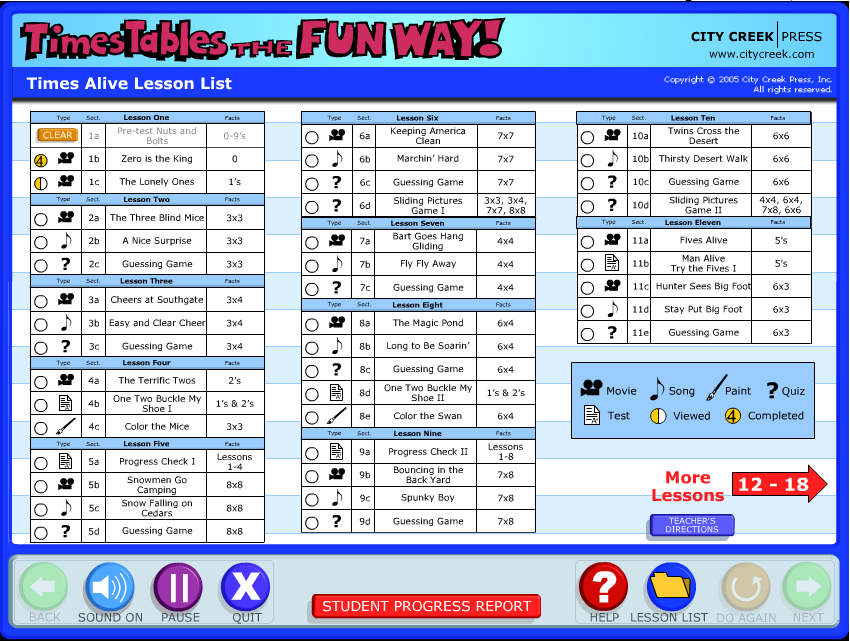
Here's a screenshot of the dashboard. The program marks when you've completed a lesson; you can see here that he'd done the first one and part of a second - those are the yellow circles on the top left - when I took this screenshot. It's really easy to glance at the screen while Hero is working and see how far he has gotten as he progresses through the lessons.


A review of the Times Alive online lessons for learning multiplication facts in a fun way.


There are eighteen lessons, and while some cover a single fact, others cover a group of math facts: the zeros, ones, the twos, the fives, and the nines are all taught as a group. This works well for the zeros and ones, but I feel like it's increasingly problematic for the larger numbers: it's just not that effective. The twos "mnemonic" is just skip counting. For the 5s they offer skip counting and a correlation to the clock. And with the nines it's the trick where the digits add up to 9. Each remaining problem has a little mnemonic and a song to help remember it. You can see a sample from their promotional materials:


Hero started out by taking the pretest. He'd been introduced to multiplication and understood how it works, but we haven't done any serious work on multiplication facts prior to using Times Alive, and that was apparent from the pretest; I told him that I didn't expect him to know it all or to be at all fast, because we haven't worked on this yet. But it was still stressful. Then he started just going through and listening to all of the movies and songs. This took a couple sittings; I let him work through it at his own pace. I felt like the speed of the presentations was overly slow, but he never complained about it, so it must not have bothered him. I can, however, see how the slower pacing would be really advantageous if you had a student that needed that. And customizing the number of repetitions of the various songs and clips is as simple as just clicking on the lesson again.


A review of the Times Alive online lessons for learning multiplication facts in a fun way.


A few of the songs are catchy enough that, after working on his multiplication, my son continues singing, "six times four is twenty-four..." for quite a while. And it's appealing enough that my six year old wants in too, though I didn't let him, since he hasn't got the conceptual framework for multiplication, yet, and this program will not give him one.


A review of the Times Alive online lessons for learning multiplication facts in a fun way.


There's a Student Report for parents and teacher to look at, to see how their student is progressing, which is find and easy to read. It shows the pretest results, and then the results of each little quizzes they have at intervals through the program. After doing the videos he shows marked improvement in both speed and accuracy.

Unfortunately, there are some serious drawbacks to the program. On the Student Report, I don't seem to be able to see what problems he missed on any of the quizzes, which means that I can't ask him to review the specific trouble problems without giving him an additional test outside of the program. I feel like being able to identify and target facts that are giving him trouble is an important function for this type of program, and it's frustrating that it's not there. Also, when it's time to do the practice problems, it's sometimes possible to just hit enter and skip through the problems without doing them, and that could cause problems if your student is inclined to do that sort of thing. I am also disappointed that several of the problems rely on skip counting, rather than having a real mnemonic: I don't want him to continue to have to rely on skip counting; I want him to actually remember the individual problems. He could already skip count prior to starting the program, so there's basically no boost for those sets of facts.

Still, even with these drawbacks, and having been under the weather for much of the month-long review period, Hero enjoyed working on this program (even when he didn't feel good), and his multiplication facts improved dramatically in spite of having several days off school. Using it has been both enjoyable and good for him.

To see what other Homeschool Review Crew families thought of Times Alive, click the banner below:


Click to read Crew Reviews


Crew Disclaimer

02 February 2017

Snapshots From Our Day

Just an ordinary day, doing ordinary things.

Both boys practiced math facts. We're working toward mastery, which includes speed drills for Hero, though Dragon's not ready for those. Listening to Andrew Pudewa's talk, Mastery Learning and Ability Development, has reenforced my decision to require the kids to do timed tests. There's a lot of value in knowing the facts cold -- and he shares a cautionary tale from his own family about what happens when kids don't know their facts, but move into harder math anyway, including how it affects his daughter's perception of herself and her abilities. Math facts and speed drills are a good thing.

A candid peek into a day in our Christian Classical homeschool education.


We're having a watercolors phase, and they've been out on the table nearly constantly for several days now, except when I insist on clearing things off for meals. This is Hero's current project, the goddess Artemis. It's a coloring sheet we printed, and he's having a great time painting it. Lots of Greek stuff going on -- looking forward to writing more about it when I share the review that I'm working on, near the end of the month.

A candid peek into a day in our Christian Classical homeschool education.


So much reading going on lately; it's just lovely. Hero's been re-reading a number of the sci-fi series he has recently, plus devouring classic fiction that I assign. Here he's working on Gone Away Lake, from the Ambleside Online free-reads list. So many good books on their curriculum! So glad I finally figured out how to use it.

A candid peek into a day in our Christian Classical homeschool education.


A while back I started asking Dragon to read to Peanut. Turns out they both love it (even if she was distracted when I caught them doing it), and it's been huge: he doesn't really want to read to me, much, but he will cheerfully read to her. So I ask him to. And his reading is really taking off. I love this part, where they discover that they love reading.

A candid peek into a day in our Christian Classical homeschool education.


This has got to be the cutest "gate" ever invented. It's actually open in the picture. When they wanted to close it, they'd spread out their feet as far as they would go, and the two of them can cover a lot of ground! Surprisingly effective... but I have long legs.

A candid peek into a day in our Christian Classical homeschool education.


Lunch. Baked potatoes. Yum.

A candid peek into a day in our Christian Classical homeschool education.

And the "meat" of the day. Good stuff.


Hope you liked your peek into our day of school today! How's your day been?

23 September 2016

A Day in the Life

A pretty typical day in our life. The kids are 5th grade, 1st grade, and preschool.

4:00am - Wake up (I heard the Daddy's alarm) and send him off to work. It's really early.

4:20 - back to bed.

8:00am - Wake up again, still tired. I think that I'm anemic, so I'm thinking about what I can have for breakfast that will help with that. Look at my phone -- text helps my brain to focus.

8:10 - The kids attack me for snuggles. Hero asks if he can make mac n cheese for breakfast. Gross. I say yes, but there's no way I'm eating that. They laugh; they're used to me hating it. We snuggle a few minutes, then I get up and try to think. I hate being anemic; makes morning time really rough, no matter how much sleep I get. Hero shows me the dragon he drew this morning.


8:40 - Hero's got the mac n cheese almost done. I'm putting up today's list of things that need to happen. There's cool art on my markerboard again; I try to make the list around it, so that it doesn't get erased too soon. I also move last week's Brahms piece to the bottom of our playlist so that we can listen to a new one first this week. Dragon asks for his Legos down.


9:00 - I'm done messing with the computer, and inspect a transformer Dragon made on my way to turn on Brahms.


9:15 - I have the Duplos off the floor, and I'm enjoying the Brahms, about to do some yoga. Hero turns up with his violin, and I ask him to do that after we've had a few more minutes with Brahms. He decides he'd like to vacuum for his chore today instead, so I put off my yoga and ask him to do the computer room as well as the living room. And I remember that one of Dragon's books grew legs yesterday and walked away. Gotta find that book, soon, or something else that will work in its place.

9:30 - Hero's done with the vacuuming and moves on to reading; Dragon is working on some 100s chart games on the computer. I give him a couple patterns to color on his chart, he makes up a couple patterns, and then chooses some other educational games. I text the Daddy a couple times -it's his break time- and then go try again with the yoga.


10:05 - Yoga's done, and it went well. I started working on Crow Pose about a year ago because I read that it was a good beginner arm balance. I have no idea how long it usually takes people to learn to balance (though I've read the scoliosis makes it harder to do - and mine was bad, before I started yoga), but I'm super happy to finally hold it for a second or two today. This is the first time that I'd say that I was actually able to balance in the pose for a second or two; that feels good.


When I'm done with yoga I look at Dragon's game he wants to show me, then remind him that (although Christmas lights games are cool) he's supposed to be playing math games. He heads back to do some dot-to-dots when I tell him his math time is almost up. Peanut is sitting next to him, watching what he's up to, and commenting on the pictures he makes. "That's a purple dinosaur!" 


I pick up a towel left on the floor last night, and straighten out the bookshelves, hoping that I'll find the missing book -- which I do. Hero starts practicing his violin. School ran late yesterday, almost till bedtime, and he is not looking for a repeat. We try to finish everything early, but it seems like every now and then the kids need a reminder of why that's a good idea.


I put my clothes in the bathroom, planning for a shower, then tell Dragon his math games are done, and help get Peanut some day clothes. 


10:30 - Dragon and I finish reading about ancient Egyptian gods and mummies. He narrates beautifully. Hero is setting up our calendar and wants to do Morning Basket next. Works for me. 

We start with our calendar, which we do in Japanese. Mostly. Except for the part where I tell Dragon to stop acting crazy. That's English. 


The Wise Man and the Foolish Man, in Japanese, with actions. We skip the new one, Popcorn Popping on the Apricot Tree. Up next: poems. Those are a fan favorite. All of the kids have their own set: Peanut gets Nursery Rhymes, and then as usual, insists on looking at the pictures in her book; Dragon is in A Child's Book of Poems; and Hero's meeting Emily Dickinson. They each get one:

I Saw Three Ships
I saw three ships come sailing by,
Come sailing by, come sailing by,
I saw three ships come sailing by,
On New Year's Day in the morning.

And what do you think was in them then,
Was in them then, was in them then,
And what do you think was in them then,
On New Year's Day in the morning?

Three pretty girls were in them then,
Where in them then, were in them then,
Three pretty girls were in them then,
On New Year's Day in the morning.

One could whistle, and one could sing,
And one could play the violin;
Such joy there was at my wedding,
On New Year's Day in the morning.


The Friendly Cow
The friendly cow, all red and white,
 I love with all my heart;
She gives me cream with all her might,
 To eat with apple tart.

She wanders lowing here and there,
 And yet she cannot stray,
All in the pleasant open air,
 The pleasant light of day,

And blown by all the winds that pass
 And wet with all the showers,
She walks among the meadow grass
 And eats the meadow flowers.


The Bee is Not Afraid of Me
The bee is not afraid of me,
I know the butterfly;
The pretty people in the woods
Receive me cordially.

The brooks laugh louder when I come,
The breezes madder play.
Wherefore, mine eyes, thy silver mists?
Wherefore, O summer's day?


We also do our memory work - most of it fast and yelling, and do the scripture boxes. Dragon's attention is going fast today, and he ends up in a timeout near the end, but recovers quickly. We've had three days or so of rain, and he needs to be outside; it shows.

11:00 - I eat some peaches and to leftover deviled eggs, set Hero up with reading Age of Fable, then take his narration. And finally get my shower. There's voluntary reading going on; I like that, and don't interrupt it.


11:30 - When I get out, I announce that everybody needs to get shoes on and go outside for 20 minutes. In the middle of the happy scramble, there's a squirrel out front that needs to be watched, so they pause and do that. Hero goes out the door with a book in his hand; that must be my kid.


While they are outside, I work on this blog post, and start gathering up some easy crockpot recipes I promised a friend of mine. I've got a timer set so that I don't get too involved and sabotage the kids' efforts at doing school efficiently today.

11:55 -- There's tears outside; Peanut got too close to an active swing. Everybody comes back inside and has a cheese stick. I need to do some lunch. Probably with black beans, since they have iron. Hero grabs our Japanese text and we finish off the first unit; next time we'll be in chapter 2! We're moving slowly, but I think it's working pretty well. After that, he reads some stories to Peanut. Dragon is playing with his Legos again. 


12:30 - Hero wants math. I'm trying to get lunch, but stop and get him started. I persuade Dragon to get out his violin. He does a nice job once he settles into it. 


Peanut builds a cool circle track for the "train-train" -- all by herself!


Next I have Dragon work on his hiragana (Japanese alphabet) using flashcards today. He's doing a really nice job, and getting better at recognizing the exotic letters -- and reading them. I am pleased. 


1:15 - Lunch is getting close. I have got to get better at doing it earlier. Our new schedule is still foreign-feeling, and hoping that the Daddy finds something better, soon, isn't helping me adjust. I put some biscuits in the oven to go with the chili, and check Hero's math. He needs more practice on multiplying; I send him back to correct his work. He's really ready to do something else. I tell him to finish. And warn Dragon and Peanut that fighting over trains will lose them the trains. Peanut gets sent to her room to finish whining.


1:30 - Lunch is on. It's tasty. Soup - the first soup of the fall - and biscuits. After the prayer, I read Lamb's Shakespeare to the kids; we're working on Comedy of Errors, and everyone is doing really well with it. I am surprised at how much I'm enjoying it; Shakespeare is a new experience for me, too.  This is our second play, and I'm pleasantly surprised at how funny it is. The boys do a sort of tandem narration, with both of them contributing bits, and they're following it quite well.


1:45 - My best friend calls, and I invite her over to join us for lunch. She says she'll be here in 20 minutes, so we quit Shakespeare and I grab Secrets of the Woods. Officially, this is Dragon's book, so he's the only one that narrates, but we don't get far because I realize that he doesn't know what it means to "tap a tree", so we're off to YouTube to learn about that.


2:00 - I get Dragon to take out the recycles for his family work - he's delighted with the job and does it in the noisiest way possible. It is very loud. My friend arrives, and I banish the kids to the yard. Dragon is still experimenting with how loud he can possibly be. Peanut joins him. I tell them no water; it's not warm enough. Go. Out. Side. My friend and I exchange stories of our days - mine with the kids, hers driving school bus. We laugh and shake our heads at Dragon's antics.

2:30 - The Daddy calls; he's done with work, and do I want anything from Walmart? I do - Hero wants an Optimus Prime cake for his birthday campfire party tomorrow, so I need sugar to make frosting. My friend and I continue chatting.

3:00 - Daddy's home! He joins the conversation, which is delightful. Tells about today's antics from the powers that be at work. It's amazing they stay in business. Dragon asks for some computer time; Hero is reading. Peanut finds her purple boa and is prancing around with it.

3:45 - My friend has to leave, and the Daddy heads out again to do some home teaching.

4:10 - Dragon and Peanut request play-doh. And all the play-doh tools. Hero is playing a video game; he asks me to set the time for 30 minutes, which is about half his screen time. I set up the play-doh, then go look for the cake pan Hero requested. 


4:20 - More dishes. Only, I need to do some laundry. So I get that started first. {Can I just say how much I love me a labor-saving device!}Back to the dishes While I work, I set up some Japanese YouTube videos for passive listening; passive exposure makes a huge difference in our language study.

4:25 - My sister called. Yay!! We chat for a while, she wants to know about how the new job is going; I ask about her kids. And tell Dragon, "Go find a thing to do," about 4 times in the half-hour conversation. When it's done, I turn the Japanese back on. And try to get a few dishes done. And do a thing for a kid. And wash a dish.

Dishes are the job I used to throw tantrums over when I was a kid. They're still not my favorite. But that's not why they're not getting done very efficiently today. I have actually learned to enjoy a clean kitchen -- enough to put forth the effort necessary to get it there. But I have a hard time staying on task. {sigh} One of these years, I'll have a clean house.

5:10 - The Daddy calls. His home teaching people asked for a little help, so he's slower than he anticipated. I love when he calls; I know very well that he doesn't have to do it, but it's so nice. I work very hard at not dropping the phone into the water -- I'm holding it with my head while I attempt to get a few dishes clean.

5:20 - The Japanese is back on, now that I'm not on the phone. (Nobody's paying attention, including me, but it's amazing what the brain does in the background, as far as sorting patterns, when you're not really paying attention.) I just want a nap. Which reminds me: I still haven't looked to see if I've still got iron supplements, or if they're still good. I need to do that. And it's about time to move the laundry. And I've got to make that cake. Which means butter needs to be out warming up...  I feel like I'm not getting any closer to the bottom of my to-do list... which just might be getting longer. All I want is a nap.

Hero is building Poke-balls from cardboard to play with his friends tomorrow. 


6:00 - I found the iron. It, along with a good collection of other expired stuff is now in the trash. I flipped the laundry. And finally made some progress on the dishes. {When we finally fix or replace the dishwasher, it will be nice.} But the kitchen is looking almost reasonable, and it shouldn't be too bad to keep it that way while I make dinner. I hope. 


After a while the Daddy came home again. Dragon enlisted his help cutting out a Poke-ball of his own. 


I remembered that Peanut hadn't practiced her violin yet. She was delighted to do it, and she's making really good progress at fingering. After that she gets a shower.


7:30 - One pizza made; two warmed up, and a birthday cake in the oven. We settle in for some Avitar: Last Airbender. 


8:30 - Show's over; ice cream is eaten. The cake is out and looks good. Hero is super excited about; totally worth the effort. 


8:40 - Family scriptures and prayers.

8:55 - Kids head upstairs to brush teeth and stuff. Everybody is tired. There's tons of things still on my to-do list, but I feel pretty good about most of the day anyway. Somehow, there's always more tasks than time, but the important stuff gets done most of the time.

9:00 - Personal scriptures and prayers with the boys; Peanut barely made it. Since she's not wearing diapers to sleep anymore, I send her potty one last time. She looks asleep by the time it's her turn for scriptures, but when I go to leave, she manages to mumble, "I not asleep..." So I kiss her and read her two verses. 

9:25 - All the kids and the Daddy are asleep. I sit in the dark and do some Japanese flashcards and make a move in my chess.com games.

9:40 - Downstairs again. The house is delightfully quiet. I check on the baked goods, but some of them aren't cool yet, so I play Minecraft for a little bit, have a drink of water, and listen to some clawhammer banjo.


10:15 - I'm itching to play my own banjo, so I turn off the tunes, and get mine out, just for a couple minutes. Can't do long; it's getting late.


Day In the Life Aug 2015
Day In the Life Nov 2011


LinkWithin

Blog Widget by LinkWithin