09 10
Showing posts with label Family History. Show all posts

12 June 2019

Claim Their Anointing


Scripture study is a funny thing. In the middle of following this question, I'll realize that it's related to that thing over there, and next thing you know I'm lost in the "rabbit hole" --but typically happy as a clam about it.

That's kind of how it went this time. I got to the adult session of Stake Conference early, and was thumbing through my Scripture Journal, and decided to fill in some of the things that I've found about lineage in the last little while as I waited for the meeting to start. There's this unexpected connection between lineage and priesthood that I've been noticing, though I haven't really explored it all very well. But I searched "lineage" in the scriptures, and one of the verses that came up was this one:


...by virtue of the decree concerning their right of the priesthood descending from father to son, they may claim their anointing if at any time they can prove their lineage, or do ascertain it by revelation from the Lord...
-Doctrine and Covenants 68:21


And I though, hold on here, bishops are anointed? It's not just a regular ordination?

So when the meeting was done, I went up front to see if I could ask the Stake President real quick (he's a friend of mine, and I couldn't see any of the bishops), and I ended up getting the attention of the visiting Seventy instead. Since I thought he might know, I went ahead and asked, not about regular Bishops, since I was 95% certain they just get regular ordinations, but about the Presiding Bishops. He said no. So I asked if he knew what the verse was talking about, and he didn't. Which was neither surprising nor distressing; it's not one that gets a lot of attention, and I was as much making sure that I hadn't missed something obvious as anything: I didn't really expect that either he or our good Stake President would know much about it; it just doesn't get discussed. But you don't know, really, until you ask.

So here I am, trying to learn more about anointings. Way back when, Elder Bednar shared a technique for scripture study that I think of as "Brother Bednar's Cut and Sort" technique: he looked up all the forms of his word, and then put them in a document, then cut them up, and sorted them into piles. I tried this with the word humility once. It completely transformed my understanding of the topic, and I never even really finished. It seems like a likely technique for learning more about this.

There's only 367 instances. ...  How hard can it be? ... right?

24 September 2018

Find Names for the Temple: A Step-by-Step Method for Success {Book Review}

In June, I was called to be the new Lead Family History Consultant, which I was excited about, but also more than a little intimidated: my family has been members of the Church of Jesus Christ for a very long time; I count both early leaders and a number of faithful genealogists among my ancestors, and the easy research is long since done and gone. I've been poking my family tree for the past twenty years or so, trying to persuade it to produce temple names, but only once in all that time did I find a few names for a handful of sealings for one family. It was, as people say, a very special experience to take my own family names to the temple, but mostly, when people would talk about needing to go and do work for family members at the temple, I just felt left out: I knew there was people there to find, but I didn't know how to find them.

Between reading Find Names for the Temple: A Step-by-Step Method for Success by Nicole Dyer and Diana Elder, and some training from the Stake, things have changed: I have what I am confident will be the first of many temple cards printed out and ready to go, and I'll be making the trip to the temple (it's 3 hours from here) sometime in the next month or so. I can't even say how excited I am to finally have the skills to be able to find these people that have been hiding in my tree!

24 April 2017

Dala Horses

So we did this art project from ArtAchieve (there's a review coming at the first of May), and it went really well, particularly considering that they were a little reluctant to do it at first! The kids, particularly Dragon, are learning a whole bunch of things with this style of art, and they're making some really nice art. The project has you do a line drawing first:

Top: Dragon, Hero. Bottom: Peanut, Mom


Then you paint it. They give several examples, and tell what's traditional, mention that you don't have to do that if you don't want to, then turn the kids loose to make their own designs.

Top: Dragon, Mom. Bottom: Peanut, Hero.

And they did.


In fact, the next day, they wanted to do more. It was pretty cool. I made them do their regular school work; told them that this time the horses were an "after school activity". Which was fine with them.  They set and did them after their regular work was done.


Peanut did one, then the boys came and joined her and they all started the lesson over, but their impromptu art class got interrupted: Daddy got home and horses weren't very important any more. Right then, at least. So Peanut was the only one with a completed work from that batch.


I was pretty impressed with her. These lessons are intended for kids who are much older than she is, and she had very little help with this one, since I was trying to get some dinner made before we all went to Scouts for the evening. I tried to persuade her to do watercolor, but since we'd used acrylics the first time, she wanted those same paints the second time. A lot of her cute details got obscured when she painted, as a result.

The art lesson has a lot of extras, so we checked some of them out. There's a flyover of Sweden, Norway, and Finland. That was fun; we have ancestors that lived in those places, but especially in Sweden and Norway.


They've got some information about a Smörgåsbord - I had no idea those were Swedish - and while I think that I'm not going to be making anything nearly as fancy as what their article describes, when I searched for Smörgåsbord on Pinterest, I did find this recipe for these cookies. I have no idea how authentic they are, but they were yummy! 


We also looked at a factory, where they make Dala Horses. That was pretty interesting. Hero likes whittling. So far, he's only used his pocket knife on sticks from the yard, and a few bars of soap, but we're in the market for better projects for him, and he was all over the little tips they mentioned, like to pay attention to the grain of the wood. I think it would be pretty awesome if we could arrange for him to make a real wooden one, rather than just a painting, but we haven't made that happen. Yet. It's remarkable to me how much they're doing with such a basic knife. I thought carving required much more specialized tools.


Because we have some Swedish ancestry, I also looked up where our people were, and compared it to where these horses were made, but it looks like it's far enough away that these were probably not a thing that our ancestors were involved in: the 3 hour drive is not a big deal today, but in those days, that was a long distance. Still, it was fun to look it up, and to look at some of the designs. Even if the horses weren't a thing in Uppsala, where our people were, it's probable that they had very similar traditional designs. It's always fun to look up that kind of thing and make even a tenuous personal connection.

15 March 2017

Odd Bits: Folk music, Archaeology, and More...


::1::

One of the things that homeschooling has done for me is to introduce me to some lovely folk music. I'd like to learn to play it on the Banjo, a lot of it, but so far, that's an item on my to-do list that isn't so easy to get crossed off. In the mean time, I'm absolutely loving listening to Jesse Ferguson, who sings Scottish folk songs. Have a listen; he's lovely. I always wonder if my Scottish ancestors knew or loved any of these songs.


::2::

On the first of every month, I post a collection of thoughts from my commonplace book, which is one of my favorite self-education tools. I love that using it is participating in the great English and American tradition of self-education, and continuing personal development. Occasionally, I'm asked what it is. The article I've taken this quote from has a pretty good explanation, some pictures, and instructions for how to start one.


A commonplace book is essentially a scrapbook / compilation of information that the creator deems relevant. Commonplace books became popular with thinkers in 15th century England and were eventually promoted as a scholarly tool by major universities such as Yale and Harvard.
-Jamie, Project: Start a Commonplace Book


::3::

I stopped buying cereal a couple years ago, and breakfast, which the kids mostly take care of on their own, continues to be a little hap-hazard. Lots of times, the kids will eat leftovers, or open a can of fruit. But if we're low on those things, it can get interesting. I think I might try this idea out: homemade instant oatmeal. Looks like a piece of cake to make, which is perfect: I love that the kids are gaining independence and confidence in the kitchen by making their own breakfasts. She's got instructions on masking tape on her jars, which is brilliant. And it looks like it'd be easy to switch up the flavors, too.


::4::

Archeology is cool. Archeology that shows up just in time to dovetail with our work on Greece and Greek civilization is even better. And that's what this article about a warrior's grave they found in Greece is. And there's a Roman makeup case, with fingerprints visible in the cream that's still in it. Gotta love the never-ending search for the perfect beauty product! And there's the whole kingdom from Arthurian legend that they found. That's pretty awesome, too. Makes me want to go read something about King Arthur: it's been a while. Archeology is good stuff.


::5::

Marginalia. I only recently learned that there's a word for all the stuff that you write in the margins. They told us not to write in our books in school, cautioned that there would be Serious Consequences if we did, because Those Books Are Very Expensive. The caution stuck: I have never really been one to write or highlight in my books, and when I shop, I generally want a clean book, even used. The only book that I've seriously annotated is my scriptures, which I love "making tracks" through, because it helps me to remember what I've learned, find it later, and retain it longer. And it's a visual reference for which sections I've given serious attention to, and which ones still need that kind of treatment. But I think I'm going to start making more notes in other books, too:

I like to think of these little jottings as being little messages to Jemimah from those same ancestral tombs, that through them she will get to know these people from her history a little better.  She will know how they thought about things, and how they interpreted knowledge, and she will get their input into the very same words that she is reading.  When she reads How They Brought the Good News from Ghent to Aix, she will know to listen for how "the light, rollicking metre almost produces the effect of the hoof beats of the galloping horse" because her Great Grandmother will have told her to listen.
-Jeanne, A Peaceful Day: Marginalia

I love the idea that the notes that their family made in their books has become a connection between the generations, a way for departed loved ones to continue to teach long after they've left us. That's a beautiful, all by itself. It makes me wonder (again) whatever happened to my Grandmother's library, and if she made notes in any of her books. What would they tell me about her? Those little notes can have impact, especially if the reader is receptive, or has a connection to the note-taker:


As I read Rebecca’s copy of the book, I started to notice how her notes changed the way I was reading. The passages she chose to mark, and the notes she wrote at the end of chapters, framed the way I was reading the novel. ... I’ve read books in the past with marginalia – usually used books that had previous owners unknown to me – and while those notes also pointed out passages to me that I otherwise may have skimmed over or which may not have been necessarily significant to me upon first glance, I never really paid attention to it beyond those pauses. ... This experience – of reading Rebecca’s copy of The Engagements – was markedly different, though. Because we’re not just Book Riot colleagues, but also good friends, not only was my perception of the novel changed, my perception of Rebecca – as a friend, as a woman, as a reader – was also changed.
-Rachel Manwil, To Note or Not to Note: How Marginalia Changed the Way I Read


::6::

I ran across this interesting post about the difference between an educational system and an educational method. She's talking about how the Charlotte Mason philosophy is a method, not a system, and there are a lot of good insights about the reason the distinction is important, but the thing that struck me was the way that this applies to language learning. Around 2 or 3 years ago, I changed, dramatically, the way that I learn languages, and started studying sentences, harvested from either my dictionary's sample sentences, or from real native Japanese text and native speakers. I make flashcards from whole sentences, and study vocabulary, syntax, usage, and all that all in a single go. If that's all I did, it would still just be a system, but the other half of the idea was to create an immersive environment - a Japanese bubble - so that we also are hearing correct pronunciation, more correct grammar and syntax, and interacting with the languages in ways that are natural, organic, and fun. Fun, guilty pleasure (example: Minecraft videos) is actually desirable in this case. The combination is amazing. Families who successfully pass a heritage language generally do a couple of things, but one of the big ones is to arrange for roughly a third of the day to happen in the minority language: and that is surprisingly doable in a situation like ours where we are all learning together. Obviously, it would be faster and better if we had more live feedback, regular access to someone who knows more than me, but we are making good progress even with minimal contact with people who are fluent, which is pretty amazing.


Getting good is good. Those things are all good. It’s nice to be full and it’s nice to have a big vocabulary. It’s just that you’re more likely to eat more if you focus more or less totally on making and procuring tasty food than “efficient”, “filling” food. Similarly, if you focus just about exclusively on having fun through the language, while you still suck, while you’re not full yet, you’ll naturally “eat” more of it, and eat more often, and naturally get “fuller” faster.
-Khatzmuto, Why Don't You Learn Like You Eat?, emphasis original (content warning: this article is clean, but if you browse his site, be aware he's sometimes rude, and occasionally pretty crude)


02 March 2017

Watercolors and "Learning Projects"

Learning about watercolors and giving ourselves grace when we do "learning projects" -- and mixing in a little family history for fun.


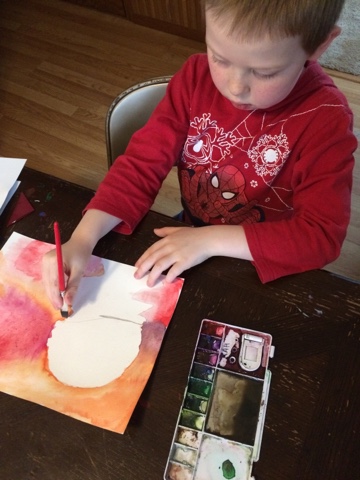
We are enjoying a series of art lessons from Creating a Masterpiece right now (watch for a review in a couple weeks). I love watercolors, and so that's the part I was most excited about -- and so it's the type of project that we did first. The basic project was something that we haven't done any of before: wet on wet technique. It was fun to play around with it -- and it actually worked! I haven't been very happy with my past efforts, so I haven't done much at all with it. But this time, it worked, which was exciting. It's always lovely when art works.


Learning about watercolors and giving ourselves grace when we do "learning projects" -- and mixing in a little family history for fun.
My first African Sunset.


Learning about watercolors and giving ourselves grace when we do "learning projects" -- and mixing in a little family history for fun. We were sick for a while in February, so Hero and I did this one day, and then Dragon did it later, which was an interesting dynamic. I hadn't realized how much support there is in doing it in a group, but it became really apparent: Dragon struggled, even though he'd watched the same instructions as Hero and I. The struggle isn't bad, though: it gave us an opportunity to talk about how sometimes, and especially when we're trying something new, it's ok if the project turns out not like we'd wanted, or even "ugly". We call those "learning projects" and we talked about how, even if the picture doesn't turn out, giving ourselves permission to try anyway helps us to be able to learn from the experience and the next one is better. It's an important conversation to have: perfectionism, and an unwillingness to take the risk of trying can really ruin your ability to enjoy doing art, and hamstring the enjoyment of playing around with it. I'm hoping to be able to encourage the kids to give themselves a little grace, especially when they're trying something new.

To that end, I told them about my first crochet project: I asked my Grandma to teach me when I was still pretty young, probably around 10 or 12, and she did. She was a great teacher, and got me started on a project, then sent me home with plenty of yarn and a hook. I don't remember how it happened, but that first project was a rug, and it was hideous. It was made of a bunch of odd colors of rug yarn that she had laying around, and I just used them up, one after another. And it didn't lay flat at all: it took me a while to get the hang of keeping the tension consistent. I was supposed to be making a circle, but it ended up a lumpy, misshapen oval-ish thing. It absolutely could not lay flat. And I knew it was hideous, but I'd put so much effort into it, that I loved it anyway, and kept it on my floor for a long time. I don't think it exists anymore.

Probably the most important thing that I learned from that project was not to expect much from a "first project". The second thing that I crocheted was much better, and in the 30ish years since that first project I've made a number of things that I'm really happy with, including a few that I'd be willing to say are really beautiful: my favorite was a long runner that I made in white crochet thread and gave my Grandma as a Christmas present when I was living with her one year. She kept it on the upright piano that Grandpa got her. After she passed, my mother adopted it, and keeps it on the table that my great-grandfather made. If I had given up when that first rug turned out so badly, none of that could have happened. I think a lot of the credit for my willingness to continue goes to Grandma's patient teaching and sincere encouragement.

Learning about watercolors and giving ourselves grace when we do "learning projects" -- and mixing in a little family history for fun. Learning about watercolors and giving ourselves grace when we do "learning projects" -- and mixing in a little family history for fun. Once I'd told my story to Dragon, he was much more willing to try again. We did a couple of things differently: first, I waited until I was sure that he was completely well. The first effort had been on a day where he looked well at first... but later wilted, and was sick again for another day or two. I didn't bring things out again until I was sure he was good. And then, I got out my own paints and did a second picture alongside him, so he could see what I was doing. I didn't love the trees from the project, so I tried something different, but by the point of adding those final details, he was humming right along, so it didn't matter that we weren't quite right together anymore. Early on, we also flipped his first picture over and used the back to practice some of the new techniques and strokes that the project required. Normally, he doesn't have a lot of problems with fine motor, but this project was challenging: it had a specific outcome he was looking for, rather than the free-form work he usually does with watercolors, and that makes a difference.

Learning about watercolors and giving ourselves grace when we do "learning projects" -- and mixing in a little family history for fun.
My second painting.
 Another thing that we did that's different from usual is that I actually touched his brush and paper a few times. He was getting so frustrated, and verbal explanations weren't cutting it. Typically, he doesn't want my interference, but this time he welcomed it. And the project worked. He was excited to show it to his dad at the end of the day. I was so glad that he'd been willing to try again. Good things, all over the place there. Lots of learning -- and some of it was even with the watercolors!

Learning about watercolors and giving ourselves grace when we do "learning projects" -- and mixing in a little family history for fun.
Dragon's second painting.

I was interested to see what Peanut did: officially, she wasn't participating. She hadn't shown any interest in doing the same thing as us. However, when Hero and I did it, she's wanted her paints, and I'd handed her a page for a Chinese New Year (year of the chicken!) that I'd printed, but we had never gotten around to doing, and she happily painted it. She must have been paying more attention than I gave her credit for, because the body ended up looking an awful lot like the skies that we were doing that day. She's a pretty observant little thing!

Learning about watercolors and giving ourselves grace when we do "learning projects" -- and mixing in a little family history for fun.

It was such a fun project. The kids want to try some of the other mediums that we've never done before: I picked up some soft pastels and some charcoal for them, and they're looking forward to trying those out. But if I'm pleasing myself, there's going to be more watercolors in store, at the least, for me. I love watercolors, partly for their own sake, but partly because I feel like learning to do them gives me a greater connection with my Great-grandma, who also loved them, and left enough paintings that all the family members that wanted one, were able to have one. My Dad's got two. That's a pretty awesome legacy, and it's not even the only medium where she left a wealth of art for her family to cherish. She's a pretty remarkable woman. 


Learning about watercolors and giving ourselves grace when we do "learning projects" -- and mixing in a little family history for fun.
Hero's final African Sunset.


21 November 2015

FAN Club - In search of Gardners

We have a persistent brick wall on my family's Gardner line, back in Scotland. It's bugged me for years and years. I'm attempting to learn more about the area and the people around my ancestors, in an effort to find where they disappeared to in the preceding generations.  So. I'm told this is called FAN club research. Here's an introduction.


I also located some Family Search pages about the areas these people are from. I know of records that were made in Falkirk, Stirlingshire, Scotland, as well as several parishes in Renfrewshire, Scotland. I've started making a list of all the locations they were in, and after watching the FAN Club video, I will probably move this to a spreadsheet, the more easily to organize and search as I widen my net.

Gonna be an adventure!

01 August 2012

Alex the Geat and Fractions

We've been focusing on history a lot this summer, trying to finish up the Ancients before fall. Not that you'd know it to read my blog! But we have. We've made it through Alexander the Great, who, it turns out, is really very interesting. So, we're reading along and learning about all the areas that he conquered (all of the known world, basically), and what he did in the areas that he conquered, and we learned that he had them pay tribute. The book estimated that it was about 10% of their production that the conquered areas had to pay. Now, we've talked some about fractions, but they're pretty tricky, so we stopped and talked about that. It went like this:

"The conquered areas had to pay one tenth of their production. Do you understand how much is one tenth?"

"No."

"Ok. So, if they have 10 cows [I draw 10 really ugly cow-like-objects on the markerboard], then one of them gets sent to Alexander. [I color one of the "cows" purple.] How would you write one tenth?"

We figure that out.

"If Alexander was really nice to the people, then they might only pay one ninth for tribute."

I think this sounds like a good time to talk a little more about fractions, so I go grab several pages of paper, which we pretend into chocolate bars, and some scissors for dividing them.

"OK. Which do you think is more, 1/2 or 1/3?"

"1/3."

"OK. Let's see if you're right."

I cut the first "chocolate bar" into 1/2s, and the second one into 1/3.

"Which one is bigger?"

He points to the 1/3; I set it on top of the 1/2.

"You'd rather have 1/3 of a bar, instead of a 1/2 of a chocolate bar?"

"NO!!" [giggle]

"OK. I'm going to divide the next one into quarters. Are they going to be bigger or smaller than the 1/3s?"

"Bigger."

"OK." [cut cut cut] "Here it is. What do you think? Is it bigger?"

"No."

"What if we make fifths? Will those be bigger?"

"No."

"OK." [cut cut cut] "Fifths are tricky to cut. These aren't perfect. But they're pretty close. What do you think, are they bigger or smaller than the fourths?"

"Smaller."

"Why?"

He had to think about that one for a while. If the numbers we were writing on the bottom were getting bigger, why weren't the pieces bigger and bigger? That was a tricky question. We talked about how that bottom number was talking about how many pieces we are making, and so what if we had 1/100? That's dividing our chocolate with 100 people! My goodness, that piece is going to be the size of an M&M! He thought that was pretty funny, and was now quite confident that he'd rather have 1/2, versus 1/100 of our "chocolate bar." So we went back to the original question: Would it really be nicer if Alexander was to ask the people for 1/9, rather than 1/10? Now, he was able to say he'd rather pay 1/10, and understand why that's actually a smaller number. I was pleased. And we continued to read about this interesting guy that took over the world 300 years before Christ.


02 October 2011

A Safeguard and Protection

After listening to Brother Bednar's talk in Conference I wanted to find a way to help Monkey begin to learn to love family history work. Although the talk was primarily addressed to youth, Brother Bednar also specifically included children in his remarks. Then, after I found another clip (below) on lds.org, my husband and I became even more determined to find a way to make this happen.


I will hardly ever ask the question, "Are you preparing to go on a mission?" I will ask the question, "Are you worthy to be in the temple? And will you be next year? And will you be the year after that? Are you doing the research in your own family, and helping other people with their research?" 

That, for a young person, in the wickedness of the world in which we live today, is one of the greatest safeguards against the temptations of the adversary.

-David A.Bednar

A safeguard against the temptations of the adversary; protection from the wickedness of our world.

We need that.

We need to protect our children so they can grow up to the Lord! Now that he says it, it makes perfect sense that the temple would offer that protection to our children and youth. Of course the temple will draw my children closer to the Lord! Funny, President Hunter invited us to make the temple the great symbol of our membership, but in teaching my son I never thought to invite him to do the same.

OK. Now what. My big boy doesn't read yet. Not enough, anyway. And the little one not at all. (Though he does point at my alphabet strips and say, "That-- me!") How can I involve such little ones in family history and temple work? Obviously neither one can do real research just yet.

Things we can do

  • Tell ancestor stories.
  • Make an "Ancestor Book" - this would be good for long, "boring" Sundays, or for Family Home Evenings.
  • If I get names ready maybe they can help print and organize the temple cards
  • With (a lot of) help, Monkey could put dates into PAF after a temple trip
  • We could find space for an "Ancestor Map" and mark where they lived
  • We can take our digital recorder to Nana & Grandpa's house & ask them for stories

What else? How can we help our children do this?


16 August 2009

Sunday Scripture


Behold, I will send you Elijah the prophet before the coming of the great and dreadful day of the Lord:

And he shall turn the heart of the fathers to the children, and the heart of the children to their fathers, lest I come and smite the earth with a curse.

-Malachi 4:5-6


After this vision had closed, another great and glorious vision burst upon us; for Elijah the prophet, who was taken to heaven without tasting death, stood before us, and said:

Behold, the time has fully come, which was spoken of by the mouth of Malachi—testifying that he [Elijah] should be sent, before the great and dreadful day of the Lord come—

To turn the hearts of the fathers to the children, and the children to the fathers, lest the whole earth be smitten with a curse—

Therefore, the keys of this dispensation are committed into your hands; and by this ye may know that the great and dreadful day of the Lord is near, even at the doors.

-Doctrine and Covenants 110:13-16


LinkWithin

Blog Widget by LinkWithin