09 10
Showing posts with label Logic Stage. Show all posts

21 March 2017

Bessie's Pillow {Crew Review}


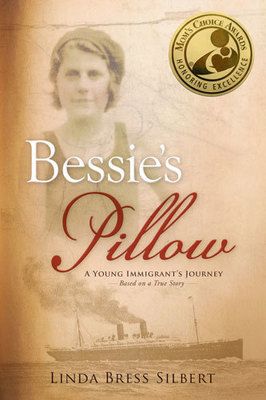
Bessie's PillowBessie's Pillow, written by Linda Bress Silbert, is a historical novel, based on the true story of the author's grandmother and her immigration from Lithuania's Jewish ghetto to escape persecution, which we were given to reveiw. After reading the excerpt on the publisher, Strong Learning, Inc., website, I was hooked, and when it arrived (finally!) I sat down and started it.

By the end of the day, I'd read half the book.

If I hadn't been trying to get over the flu, I would have been seriously tempted to stay up late and finish it. Instead, I finished the story before noon the next day. It was a beautiful story and a page-turner. I added this excerpt to my commonplace book, from an exchange Bessie has with her father early in the book:


"No, Tateh, I am afraid," I say, and begin to cry.
"Boshka," he replies, "There will come many times in your life when you are afraid. In these moments, you must surrender your fear and go wherever [the moment] takes you, and trust that you have the strength to do what you must to survive." 
-Bessie's Pillow, p36


I think this piece of timeless wisdom, all the more poignant for having come from a rabbi in a ghetto who, knowing he will never see her again, sends his daughter away to safety, encapsulates the message of the book. The story is the story of how she lives this counsel, over and over and over again throughout her life.

Once I had read the book myself, I knew that it wasn't suitable for a family read-aloud, which is what I had first planned for it: my younger two are not ready for all of the challenges Bessie faces. Bessie is fortunate to be able to travel first class, and to have well-off friends and family to assist her when she arrives in America as a refugee. But she comes from the Jewish ghetto, where the pogroms -mobs that attacked the Jews- go on violent rampages with torches and weapons, where parents try to protect their daughters from rape at the hands of the pogroms, and  and where the Russians conscript Jews and send them, poorly clothed and often unarmed, to the front lines of the war. Most of the Jewish conscripts do not come home. It's a harsh life, and the author does her readers the favor of showing the reality of it. At one point after coming to America Bessie takes a job for a few days in a sweatshop sewing factory, where she is locked in with all the rest of the women who are sewing, and treated very poorly, before she is unjustly fired. Bessie also sees the harsh realities of tenement living. And the author remains faithful to her family history when scarlet fever takes the two of Bessie's children, only a day apart. All this is done tastefully, and it's particularly good and timely to have this kind of story when there are so many refugees in the world right now, and immigration is such a hot topic. It's good to have stories of why people become refugees and immigrants, even if it's only part of the book. But I think it's a little much for Dragon(6) and Peanut(4). However, Hero(10) is old enough and mature enough to begin to see the hard realities of the world, and this book did nicely as his next lesson on that point, both in the lessons of seeing the things that Bessie saw, and also in terms of Bessie's own reaction to these things, which was uniformly compassionate and caring. She really was a remarkable woman.

At that point, having read it myself, it was time to give it to my son. I talked to him after he'd started it, to make sure that he understood why it was worth it to Bessie's family to send her away like they did: he hadn't. Although he knows something about our Church's history, and the mobs that our people faced even here in America, I don't think that it's terribly real to him yet, and he didn't understand this either. So we had a conversation about that. And he kept going back to the story. I'd asked him to read the first three chapters (they're short; that was about 15 pages), and he just kept going: he was hooked. It didn't take him a lot longer to read it than what it took me. I know that he kept thinking about it, though, because a week or two after he'd finished the book, he was sweeping the kitchen and commented on a part of the story where Bessie chases someone with a broom. I like a book that keeps us thinking, even after it's done. That's one of the marks of good literature.

Because we got sick (and that was so fun we did it again), we didn't really dig into the extras that the author has collected on her site, as we've spent a lot of this winter just trying to keep our heads above water on the basics while we caught Every Cold Invented. But there are some really fun-looking resources on there: radio shows, dance steps, recipes, all kinds of things to help you place Bessie in her historical context in a more visceral way. There are also other resources for looking through Ellis Island immigration records, and information about the ships that Bessie and her brothers traveled on, the Hamburg-American line, including fun things like diagrams of the ships and menus for what they ate on board. I think that, if you get a chance to read other reviews (click the banner below for a list of all the Review Crew members who are reviewing this book), that some members of the Review Crew even found that they had ancestors who came through Ellis Island!

Click to read Crew Reviews


Crew Disclaimer

28 November 2016

Frog Study: Blanchard's Cricket Frog

We're learning about local frogs this year, in the hope of possibly recognizing them better when we're out and about. Our State has only about 12 of them, so I've slipped them in here and there on our schedule. Today's frog is a cutie: Blanchard's Cricket Frog.


This is the first time I've done a study like this, and I'm not quite sure how to take it from our kitchen table to being able to actually being able to identify frogs when we find them next summer, but I figure the chances are better with a inexpert effort than they are if we don't try at all! So right now, we're drawing them. And listening to some YouTube recordings of their song. And that's pretty much it. Today we did Blanchard's Cricket Frog, which is a cute little thing: fits on a fingertip with plenty of room to spare.

This is the drawing from Dragon(6). In addition to learning about these cute little guys, he's also learning to see well enough to draw. I have him sit on my lap (ufta! he's not little anymore!) and help him know what to look at, and how to really see it in a way that works for drawing:

He draws a circle for the eye, which is the most prominent feature.
"Look, the eye is cool, but it's easiest to start with the outline of the whole frog, and worry about the inside details later; let's save the eyeball for last, so you can tell more easily where it belongs. Look at the frog's nose, instead. See how this part is part of a circle?" -I run a pencil along the curve of the frog's mouth, showing him the circle-
"Next to that big circle part, there's this small curve, where the other eye is hiding. See how those connect?"
"Yes."
"Do you think you can draw the big circle part and the little one? Can you see how they go?"
"Yes." And he did it pretty credibly.
"Good. Now, look, first. Put your eyes up here on the picture. See how his back goes along like this, not super round, but not quite curvy, either?"

We went along like that, trying to help him to see what he needs, and reminding him to look at the picture before he draws, and at the end, his frog is pretty credible, particularly the front half, and the front leg, which he did entirely by himself. He's making good progress with his drawings, though judging from his comments after it was done, I don't think he can see his progress, yet. Unfortunately, his nature book is lost right now, so we didn't put this in there, just on regular paper, which makes it hard to look back and see how progress really has been happening. Hopefully, we'll find it soon and tape in this drawing.


Hero(10) is well past the point where he needs me to sit and hold his hand. He's been turning out stacks of ever-improving drawings for quite a while, now, and I didn't have to do any more than just show him the frog I wanted him to observe, and let him choose which picture he was going to do; he takes care of the rest.


It's been too busy a day for me to get this drawing into my own nature book, but I'm hoping that, here in the next little bit, I can put a cute little frog in my notebook, and possibly even paint him a little to show his lovely colors. I've got a cottonwood leaf pressed in my book that I'm finishing up this evening.


18 August 2016

Novice Bakers

Tis the season: we've been given a bunch of zucchini. Which means zucchini bread - the kids want more. So, this time, Hero wanted to do the baking, and he's been doing really well with that. We're at the stage where I need to be available, but I'm not to hover; it's his project. So I set him up with the recipe, and I went and checked on some things, and when I came back things were ... interesting.

There was about an inch of oil in the bowl, along with the eggs and sourdough. When we measured, the eggs and oil combined came to just over 3 cups. I couldn't bring myself to just throw it out and start over -- and it would take several hours to get the sourdough ready. So we quadrupled the recipe. Mostly. I didn't have enough sourdough to actually do it, and the measurements were just a little bit, ah, fuzzy. We put it in the stock pot, because that was the only thing big enough to hold it all.


When all the mixing and measuring was done, we had enough batter to make 8 loaves. But we don't have 8 loaf pans; we have 2. So I started digging around. 

Two loaf pans. Check.

Two mini loaf thingys that I always burn. Check.

This time, they didn't burn. Yay! but the dough is so soft - I think we should have had a little more flour - that when I tried to get it out, the tops came off. Very messy. We ended up eating them with spoons out of the dishes. But we ate them, and they were tasty. Win.


Casserole dish. Check. This is a lot of zucchini bread.


Still going. Let's try the square pan. Check.

Finally. We used up all the batter!


So. Maybe it was because his sister was "helping" which could have been a lot for a new baker to deal with, in addition to managing the recipe on his own. Or maybe it was just one of those things that happens; we think he added the 2/3c oil, then looked at the sugar measurement and added that, in oil, as well. Whatever happened, we now have a ton of bread. And he has experience which he just couldn't have had from things going the way they ought to go.

He shared some with his cub scout den and with our violin teacher, who just had a baby. And we froze some. And we ate a bunch.

And it's all very yummy.

19 March 2015

Fallacy Study

One of the problems with our public discourse is that a huge portion of it is completely illogical. Logic is as basic to good, rational thinking as addition facts are to math. But nearly nobody learns logic in school anymore. This week, I actually had someone tell me that logical fallacies are "subjective." She didn't like what I was saying, so she tried to make it untrue. However, that thinking is as wishful as the child who tries to deny that 1+1=2. 

We were discussing this article. Whatever your opinions about vaccinations, this article is fantastic for the study of logical fallacies. So much so that I plan to print it out and save it for when we do the study of logic in a few years. Honestly, I don't blame this mom for being irrational. She is clearly grieving the loss of her oldest, worries for her second child's health, and is terrified about what's going to happen to her newborn, following a possible measles exposure. And all this is going on while her brain is steeping in the postpartum hormone stew. Nope, I don't blame her one bit for being irrational. It is highly unlikely that I would do any better at all, in her place. That's a tough spot, and I have a lot of sympathy for her. 

But she's still irrational.

Her words on Facebook have gone somewhat viral, and there's a whole lot of people looking at them and nodding their heads. It is indicative of the serious failings of public schools that so few seem able to see the many deep flaws in the thinking. But they don't; if they did the post wouldn't be viral. Even some very smart people who are supposed to be very well educated are falling prey to it. This showed up in my feed, posted by a woman who was valedictorian of my sister's class. Her comment? "Well said." Though I like the girl that posted it, I have to disagree with her assessment. This piece is irrational. And if we are to keep our freedoms, we absolutely must do better than the emotional gibberish that this article typifies. 

In a couple years, I will ask my kids to look at this and other news items, and identify the logic faults. Name the fallacies, and explain how the piece they are looking at exemplifies that flaw. I am doing the same exercise here. If you haven't already, it may be useful to read the complete original. Most of my fallacies have been taken from this Intellectual Self Defense list, though a few do come from other places. I've tried to link those to an explanation.


Logical fallacy #1: False Cause
She blames *all* non-vaccinators for the (possible) exposure of her child, even though she knows nothing about the sick child.

Logical Fallacy #2: Begging the Question
She takes as a premise the safety and reliability of vaccines, and then tries to use that to prove... the safety and reliability of vaccines. It doesn't work. You can't prove a thing simply by repeating it in slightly different words.

Logical Fallacy #3: Ad Hominem. 
This one is to attack the person, rather than the argument. "...then I am happy to call you an imbecile as well as misinformed." Classic. She's not even *trying* to address the actual concerns of non-vaxxers. She's just calling names. In addition to being a bad, non-persuasive argument, it's just plain old bad manners.

Logical Fallacy#4: Ad Misericordiam. 
This fallacy is an irrelevant or exaggerated appeal to our sympathy. She herself said that her daughter's death is unrelated to the vaccine question. "The fact is, there was no vaccine for her. Not for her illness." But we're not supposed to notice that, because "she died. She died and now she is gone." She's invoking a strong societal norm (it's rude to argue with a grieving mother) to quash any dissent. It's not an argument; it's manipulating the situation to discredit any dissenters by making them appear heartless. It's common enough in our public discourse, but it only works because the vast majority don't reason well.

Logical Fallacy #5: Confirmation Bias. 
This is only accepting evidence that confirms what you already believe, and she's not shy about it. "There is no, none, nada, nothing in science that proves this. If you want to use google instead of science to 'prove me wrong' then I am happy to call you an imbecile as well as misinformed." She's come right out and said, in the most insulting way she can, that there is no evidence that will persuade her to reconsider. She announces her bias, loud and clear.

There are others. Straw Man. Red Herring. Appeal to Authority. Misleading Vividness. And so on. We've all but banished logic from our schools. Rather than examining fallacies and propaganda, in order to avoid them, our schools are teaching them, explicitly, as "persuasion" techniques. Really, it's no wonder that our public discourse consists of so much of bullying the opposition into silence. 

I sympathize with this mom's anger and pain. What she is going through is enough to make almost anyone a little crazy. She wrote this in a moment of intense stress. But it doesn't make her premise or her arguments logically sound. Nor does it bring any justice to her blame. A sizable percent (I believe it's around 1/3) of measles cases are in the vaccinated population, and it's not unheard of for the recently vaccinated to "shed" the germs. There is no way to know which way those odd ran. I don't blame her for her poor logic, or even making for her rant public; she is grieving, terrified, and in the throes of the dramatic postpartum hormone shifts. It's a perfect storm, and she can easily be excused for her irrationality. I certainly can't guarantee that I'd do any better in the same place; I, too, know a thing or two about grief, and know from experience that it does not lend to clear thinking. But our public discourse must be better than irrational, emotional tirades. Alexander Hamilton had the right of it:


"For in politics, as in religion, it is equally absurd to aim at making proselytes by fire and sword. Heresies in either can rarely be cured by persecution." (Federalist #1)


What this mom has really discovered is that life is risky business. No matter what you do and how careful you are, you cannot eliminate risk or pain from life. Wesley was right: "Life is pain, Highness. Anyone who tries to tell you otherwise is selling something." Vaccinated or not, kids get sick sometimes. And it sucks. People get sick. Sometimes they die; the survivors mourn. The pain is real and legitimate. But we can't let that pain be a reason to let our public discourse be rants and bullying, not if we want freedom. America must do better than this.

18 October 2011

Beautiful Math

You can play with math. This has been a huge revelation to me. And it makes math interesting in a way that it hasn't ever been before.

I've been realizing that things like the Commutative Law in addition (it doesn't matter what order you add the numbers) are more than just strange words you occasionally bump into in the text; they're signals that something cool is going on, and there's probably an opportunity for play if I can just find it!

Turns out, once you realize they're there, opportunities for play in math aren't that hard to find. For instance, snowflakes. I love to photograph snowflakes, and I think cutting them out it tons of fun too. And it's almost time to build some to decorate the house. Turns out they can be more than fun decorations: they have math in them. And stories. Check out this symmetry lesson at Moebius Noodles. And, if your kid is up to such a thing, it bumps into multiplication too. And powers. How cool is that? (Don't skip the comments - there's a whole 'nuther fun activity, with story telling, in there. Plus, they have hints that there might be math in origami, so I googled that.

Oh yeah. There's math in origami. We'll have to come back to origami, because Monkey's still got pudgy munchkin fingers. But what fun!! Check this guys "bucky balls" out. Wouldn't that be a fun Christmas decoration! Little fishing wire... hang it from the ceiling. Yeah. I could be a geek. But it's art-math!


Part 2 has some interesting points about the properties of the bucky ball... and its relationship to a 20 sided die.


Anyway, here's a link for fractions with origami. Looks like fun. I actually printed that one out. (I think I might need a math games reference book if this keeps up...) Oh, cool, there's a whole site on origami in the elementary education classroom! OK, so it looks like they want you to buy their book to get the really good stuff (though they do offer a whale lesson, and if you email them they'll send a 101 Ways to Use Origami in the Classroom) and it looks good enough that I put it on my wish list at Amazon. Though why anybody thinks I'd pay $999 for a used origami book is beyond me!! That's not the only option Amazon has, happily. Plus, the suggested books people buy with it also look like a lot of fun. (If you decide to peek, I'd love it if you'd use my affiliate link.)

Here's another upper-grade origami/math book, from the same folks as the Miquon books that are working so nicely for us. Grade 7-11... we're not there yet, but it looks like such fun! Slip the activities in there between other math for a break? I hope my kids think it's as interesting as I do.

14 October 2011

Teaching the Reformation

We're doing the Ancients this year in history, so we're not to the Reformation - yet. But reading Fire in the Bones: William Tyndale, Martyr has made me aware of the sacrifices that the reformers made so that we could read the scriptures in comfort and safety. Although I'd heard of the Inquisition, I'd somehow entirely missed what it was about. I had no idea that people were burned at the stake for possessing and reading the Bible! I don't know a lot about it yet, but I'm learning. And next year, Monkey will too.

Cocoa, at Chocolate on my Cranium, is doing the Reformation with her kids right now. And hers a little older than mine, but she's gathered together a wonderful list of resources on the Reformation, mainly from the manuals and magazines put out by the Church, that she's sharing. I can't wait to dig into some of them myself!

18 August 2011

Classical Homeschooling Carnival #18

Here it is again - another Classical HS Carnival! We've got quite a few entries this time, so settle in and enjoy!

A lot of families mark the start of their school calendar at this time of year. Cellista, of La Scuola d'Argento shares an intimate glimpse of a day in the life with her post, The First Day of School.

Paula ran unto a new idea late in her planning, and is reworking her schedule in Planning 201: Retreat and Regroup at Wakefield Academy.

Other folks are steaming along, full speed ahead. Nadene, of Practical Pages, shares how read-alouds have become the glue that holds their homeschool together through good days, bad days, and everything between, in Read-Alouds: the Homeschooling Glue.

Paige shares her new writing program with A Week with Classical Writing Aesop: Day 1. It's the first of a 5 part series on Elemental Blogging.

At Delightful Children's Books, Amy has made a great list of 11 Children's Books About Stars and Space.

If your student is a further along in their educational journey, try Regina's Ninth Grade Biology Notes at Green Apple's Blush.

Here on Baby Steps we have finally begun our study of Ancient History, and we kicked it off by building a Shaduf.

Last, but certainly not least, MissMOE has a lovely review, History Portfolio Review, posted at Homeschooling While Living the Life of Easier. She has many pictures, both before and after the pages were used, giving a nice feel for the portfolios.


That concludes this edition; I hope you enjoyed it! Submit your blog article to the next edition of Classical Homeschooling Carnival using our carnival submission form. Past posts and future hosts can be found on our blog carnival index page.

05 November 2010

On Classical Education

We've been playing at school for quite some time, but shortly The Real Thing begins. I've been studying up so that I know what I'm doing. It's time to put into words what exactly is a Classical Education. What does that mean at our house, for our boys? Although I've been studying classical homeschooling for 3 years now, planning to use it when Monkey got big enough, putting the answer to the question, "What is Classical Homeschooling?" into words is no easy feat. I'm giving it a go anyway.


"We believe in education, and we spend a substantial part of our budget on the education of our young people. We expect them to think. We expect them to investigate. We expect them to use their minds and dig deeply for knowledge in all fields. If we have a motto, it is this: ‘The glory of God is intelligence.’ "
-Gordon B. Hinckley
(Teachings of Gordon B. Hinckley [1997], 127)


The Basics

The Classical education is a framework, a philosophical structure with which to organize and give form to the everyday effort of education. Within this framework there is a great deal of freedom to follow the student's interest; to spark his delight. Broadly speaking, the education of a child is broken into three general stages: the Grammar Stage, the Logic Stage, and the Rhetoric Stage. These three together are known as the Trivium.


Classical education depends on a three-part process of training the mind. The early years of school are spent in absorbing facts, systematically laying the foundations for advanced study. In the middle grades, students learn to think through arguments. In the high school years, they learn to express themselves. This classical pattern is called the trivium.
-Susan Wise Bauer


In the Grammar Stage, we'll learn the basics - the foundation or "grammar" of the various topics we study. The use and structure of language, arithmetic, elementary science, and history. While this will include memorizing lists, math facts and so forth, it will also include reading the story that is history, as well as plenty of classic literature and hands-on projects. The student may also begin Latin in the Grammar Stage.


So far (except, of course, for the Latin), our curriculum contains nothing that departs very far from common practice. The difference will be felt rather in the attitude of the teachers, who must look upon all these activities less as "subjects" in themselves than as a gathering-together of material for use in the next part of the Trivium.
-Dorthy Sayers
The Lost Tools of Learning


The Logic Stage - middle school, more or less - revisits each area of study, and find connections. Connections in events; relationships in all sorts of knowledge. In addition, the student in the Logic Stage studies logic itself, in order to better understand the relationships between the various pieces of information that he revisits or encounters. Learning logic formally also allows the student to identify faulty arguments and propaganda in advertising, politics, and so on. Logic Stage students should also be ready to begin working with some original sources. As they continue reading they will see a number of unabridged classic books and poems. The student also begins to study Latin if they haven't already.


A classical education isn't a matter of tacking logic and Latin onto a standard fifth-grade curriculum. Rather, logic trains the mind to approach every subject in a particular way -- to look for patterns and sets of relationships in each subject area.
-Susan Wise Bauer
The Well-Trained Mind, 234


In the Rhetoric Stage the student takes the knowledge and skills already gained and uses it to consider ideas and then express his thoughts about those ideas clearly, elegantly, and forcefully, whatever the "subject" under discussion.


Rhetoric is dependent upon the first two stages of the trivium. The grammar stage laid a foundation of knowledge; without knowledge, the rhetorician has nothing of substance to say. The logic stage taught the student to think through the validity of arguments, to weigh the value of evidence. In the rhetoric stage, the student uses knowledge and the skill of logical argument to write and speak about all the subjects in the curriculum.
-Susan Wise Bauer
The Well-Trained Mind, 462


The Purpose

For members of my faith, learning is a religious mandate from which we are not released upon graduation. Education is, and must be, a life-long pursuit. The purpose of a child's education is less to fill his mind with everything he'll need to know throughout his whole life - an impossible task for a mere 12 years - and more to give him the tools with which to learn all he will need moving forward from graduation.


For the sole true end of education is simply this; to teach men how to learn for themselves; and whatever instruction fails to do this is effort spent in vain.
-Dorthy Sayers
The Lost Tools of Learning

LinkWithin

Blog Widget by LinkWithin