09 10
Showing posts with label scripture. Show all posts

15 November 2018

It's the Same (but different) in Japanese

President Nelson asked us to read the Book of Mormon by the end of the year, and I was a touch sad, thinking, "There is no way that I'm going to be able to do that in Japanese. Not that fast."

I've been studying Japanese for years, and 2 or 3 years ago, I started reading the Book of Mormon in Japanese. It was hard, much harder than reading the Spanish I did ages ago: there are no cognates. And while everyday Japanese is full of English loan words, the Book of Mormon just is not. So progress was slow: in the beginning I often read less than a single verse in a sitting. I'd worked up to where, on a good day, I could read around 10 verses. I think that my personal best, prior to Conference, was somewhere around 12 verses in a day.


English: 
...but they regard not the work of the Lord, neither consider the operation of His hands...

Japanese:
They do not stop their eyes on the works of the Lord's hand.
-2 Nephi 15:12 (Compare Isaiah 5:12)


So President Nelson asks us to read, and I figure I'm going to have to take a break and go back to English for a while. This is disappointing: I've worked so hard, and I'm afraid that if I break my streak I'll lose ground.

"There is no way that I'm going to be able to do that in Japanese. Not that fast."
Then, the Little Voice:

"Well, actually...."

That's all he said.
I took the plunge.
That day, I read 1 Nephi 1, the whole chapter.
I was so happy with myself. Personal best!


English:
[Him] who should come to redeem His people from their sins.

Japanese:
that Honorable One who will certainly come to redeem His own people from
(away from) their sins.

-Alma 5:21


The next day I looked at a schedule and realized how inadequate a pace 1 chapter a day is. Most days, my list calls for about three chapters. Some days I did it, but I started to fall behind. That's a lot of reading, and the fact is, I'm not that good at Japanese. So many words! A new language just has an unbelievable number of words and phrases that you need to recognize in order to be able to read. I know more than I used to, but...

I kept trying. Slogging along. Losing a little bit of ground every day.
I figured I could catch up with whatever I miss in English in the last week or two of the year.


English:
For the kingdom of the devil must shake, and they which belong to it must needs be stirred up unto repentance...

Japanese: 
The devil's kingdom will certainly shake. To certainly repent, they must be pressed/urged.
-2 Nephi 28:19


Eventually, I was about 15 days behind, which means somewhere in the neighborhood of 35-45 chapters behind. Last week, I decided to take a day off of school, to try to catch up. I asked the kids for help, and they were amazing. They did all kinds of things independently and for each other, so that I could read. It was so hard. I was tired. My brain was full. And I would take a break, and then come back to it. I read 5 days' worth. It was amazing! I'd never read so much Japanese in a month, prior to the challenge, as what I read that day! And I was also a little bit disappointed: 5 days wasn't enough to really catch up. The date moved too, so I only gained 4 of those 5 days.

The next morning, I woke up with a sore throat and no voice.


English: 
Thou shalt go before this people, and I will go with thee and deliver this people out of bondage.

Japanese: 
You shall stand at the front/vanguard of this people. I will be with you [this word is often  how they describe friends being with each other] when you go, and rescue out this people from slavery.
-Mosiah 24:17


No voice meant no school. This was frustrating, because it's so important to keep school going, but there it was: I can't do much with no voice and no energy. Turns out, it was a blessing.

So I sat on the couch and read. We didn't even pretend to do school that day: the kids had a free day, and I read on the couch. I fell asleep, and they did quiet things so I could rest. I made up another 2 days: I was now less than 10 days behind. It was invigorating!


English:
...and having peace of conscience...

Japanese:
"conscience" is a compound of "good" and "heart":
...having gained tranquility in their good heart...
-Mosiah 4:3


The next several days, I made up more.
Not much, just one or two extras each day. But it added up.
I began to hope I would make it all the way, in Japanese.

It's a miracle; there's no way that I could do it on my own.
It's too big. Too hard. Too much.

But I really can do all things, even crazy things like read the whole Book of Mormon in another language, in three months, through Christ: the strength to do it is His.

Every day I find little gems. As many times as I have read the Book of Mormon, this is almost like having a whole new book of scripture. (What a blessing that would be, if He gave us more of His words again!) I'm building up quite a collection of things to put in my scripture journal when the reading is done; I'm not even trying to do that right now, just putting in a little tag, since I'm reading on my phone: this lets me listen and read at the same time, and it turns out that I know some words by sight, and others by sound, but when I follow along as the phone reads, then the Holy Ghost helps me remember things, and I am spending less and less time in the dictionary.

It was crazy to try.
I think it's going to actually happen.

I'm so glad I took the leap.
What a blessing this has turned out to be.

And it's not even done, yet.


21 November 2017

My Bibles


One of the questions that I frequently get asked is what edition(s) of the Bible am I using. Three times in the past two days people wanted to know what I'm using, so here you go.

My most basic resource is my LDS edition of the King James Version of the Bible: all of the traditional text you'd find in any KJV, but with footnotes that include all the rest of the volumes of scripture in the Church's cannon.


LDS Bible Study Guide


Although the "quad" version -- with the Bible bound into the same volume as the Book of Mormon -- is not as tough as getting a separate Bible and "triple", I always buy the quad because it pleases me to have a very literal fulfillment of prophecy in my hands:


The word of the Lord came again unto me, saying, Moreover, thou son of man, take thee one stick, and write upon it, For Judah, and for the children of Israel his companions: then take another stick, and write upon it, For Joseph, the stick of Ephraim, and for all the house of Israel his companions: and join them one to another into one stick; and they shall become on in thine hand.
-Ezekiel 37:15-17 (emphasis added)


My quad is what I reach for when I want my scriptures. It would be remarkable how books written in such dramatically different times and places: ancient Israel, ancient America, and modern America, can be so completely unified in message and doctrine, if they were all from different minds. However. They all point to Christ. He is the Lawgiver; the prophets in the various times and places are scribes, not authors: Christ is the Author. So it makes perfect sense that they are in perfect harmony.

I've also got a chronological Bible; it's KJV as well.

LDS Bible Study Guide

I must admit... not a lot of thought went into choosing this: I walked into Barnes and Noble and grabbed one off the shelf. I was in a hurry. I think I had little kids with me... that didn't want to be at the store. The entire process of selection was probably less than five minutes from the time I arrived at the Bible section to when I headed to the checkout. It's pretty basic: just a paperback. Very few study tools; no footnotes at all. Not at all an expensive one; I just wanted something plain that would set it all on a timeline that I could put a bookmark in.

See, the cool thing about studying the Bible is that because there's this huge community of believers with whom we share the Bible, there are a ton of resources for studying it. Lots of different styles of reading plans: 90 days, or a year, or two years. The traditional order or chronological reading plans or plans that sample from all over. Tons of resources out there. My son had asked me to read it to him in story order, and looking at the chronological schedules, I knew that I needed to have a book to move through, rather than attempt to keep track of a piece of paper to tell me where to read from. I know from experience that I'll make a brave start, get distracted, lose my paper... and be defeated by the project. That's not how I wanted to do things with my son, so I bought a book. Now my younger son is also reading through the Bible with me, and so the book as two bookmarks in it.

Apparently, there are multiple ways of organizing things chronologically: there's some disagreement on the details. I don't really care. The one that I grabbed off the shelf that day has been fantastic for me, but I suspect another would have served just as well. Having it in story order means that there's a strong narrative to attach the doctrines to -- and that means that I remember them better. That I'm not bogged down in unending genealogies or other repetitive passages. We get through them, and then the narrative picks back up where it left off. Knowing where Isaiah and Jeremiah and especially the "small prophets at the back of the book" fit into the story... it makes a huge difference in knowing where they fit in the story; starting to see how they interact with each other is pretty amazing.

Those are the only two print Bibles I have right now. I also use the Church's Gospel Library app and the online scriptures edition quite a bit. I love the search feature that lets you search for any word anywhere it appears. I love that I can limit the search on the website to scriptures only -- or have a look at the larger library. And I've got a big fat Strong's Concordance that makes me a very happy girl. My husband got it for my birthday a few years back; I love it. That's not a Bible edition, exactly, but it's worth mentioning: it's a bit like the Bible Dictionary. It explains the Hebrew and Greek words that the Bible was translated from. Every word in the whole thing: Old Testament and New Testament. My dictionary-loving language-geeky heart is in love with this study tool.


LDS Bible Study Guide

Going forward, I've got my eye on a couple more Bibles. If I was going to get a second English translation, I'd probably pick up a nice copy of the NIV. Most likely the selection process will be at B&N again... and I'll just grab a simple one, like I did with the chronological version. I do also have a Japanese edition, but I haven't dug into it much yet, just some memory work with the kids, and a word study on "intent" so far. However, I know from reading the Book of Mormon that using a second language (even if you're still a beginner at the language) is a key to new insights into familiar passages. It's a slow process, but it's totally worth it. I sometimes use the Bible Gateway to look at a collection of Bible translations together, and see how a number of different teams translated the passage I'm interested in. That can be very interesting. And I've got "Nothing New Under the Sun: A Blunt Paraphrase of Ecclesiastes" and "Grace is Not God's Backup Plan: An Urgent Paraphrase of Paul's Letter to the Romans" both by Adam S. Miller on my wishlist. Those two come highly recommended by my brother-in-law. And the more that I wrap my head around Bible geography, the more helpful and illuminating that is. I've actually started drawing and painting maps of various journeys for my scripture journal. The process of building a map is really instructive, and I highly recommend it.

And that's what I use.

18 July 2017

Mapelle Films: Trust Fund {Crew Review}


Trust Fund Movie

It's a bit of a change of pace to review a movie, rather than books or curricula! But Trust Fund has a fun homeschool connection: the cinematographer and producer, Isaac Alongi, was one of the early homeschoolers: he and his parents started homeschooling in 1982. He's now the talent behind Mapelle Films. So we watched Trust Fund.

It's a prodigal son - or in this case, prodigal daughter - story, and the framework of this beautiful parable (see Luke 15) is the anchor for the whole story. Reese, the younger, free spirited daughter of a successful publisher is feeling confined by her life, and the need to pay attention to basic mundane things... like having money in her account to pay her bills. Like paying her own rent or working. She's writing a book, and that should be enough "adulting" to cover everything. She doesn't get along very well with Audrey, the older sister, the perfect one who does everything "right".

Like so many girls from good families, Reese has "bad boy syndrome": the man she falls for is bad news: he's a member of an Italian crime family. Reese steals from the trust her late mother had set up for the girls and runs away to Italy, little realizing just how much trouble she's getting herself into. She comes within a hair's breath of ruining her life, but, fortunately for her, she's the heroine in a movie, and the parable has a happy ending! It's a fun chick flick: my husband was completely uninterested, and my oldest son was pretty ho-hum about it. I should have planned things better and had a girlfriend over to watch with me, but I didn't think of it in time. Even if my guys were unimpressed, I thought it was fun!


There's some cool things about this movie. The story, even though you know the basic outline because it's based on the parable, still keeps you guessing, and there's a couple of twists that I didn't see coming. And the pacing was different in a fun way: When, as an adult, I got my own copy of Disney's Cinderella, I was really surprised at how the style of the older movie is different from more recent ones: there's lots less changing of the camera angle, and there's more space in the movie to just enjoy, or to reflect. Trust Fund reminded me of that, just a little bit: the pace isn't as frantic as some of the newer movies. Maybe it's because we watch so much of action shows (the comic movies are big winners at our house), but this was a really nice change of pace. As far as the content, although she's run away with a boyfriend, and when she comes home there's another love interest, the movie is refreshingly free of bedroom scenes or anything of the sort. The only possible complaint as far as "too much skin" is that all the young women in the movie wear these (really cute) very short skirts... and that's it. That's the only content "advisory" that a parent might need to be aware of... and it's nothing! (I probably wouldn't even have noticed, if it wasn't for the fact that I strongly dislike wearing short skirts myself, so I kept thinking, "cute, but probably uncomfortable".) A movie with no content advisories whatsoever is a lovely change of pace! I also like the way that they follow the parable in that, when Reese comes home, the movie is only half done. The second half of the movie follows Audrey much more closely, and looks at her struggles to cope with Reese's decisions and her dad's responses... and the love interest that threatens to "replace" their mother in his heart. The father really is an amazing person. I had never before realized how super-human a parent would need to be, in order to respond the way that parable outlines. It's an interesting thing to ponder, as a parent. I'd never thought about the Prodigal Son as a lesson book on parenting... I see that passage a little differently now.

Mapelle Films also has an interesting study guide to go with the movie. Honestly, I was more than a little skeptical about it: it's a movie... what're you supposed to "study"? But the study guide was thought-provoking. It's written from a Protestant point of view, and the study guide to me suggests it's been written from a "total depravity" understanding of human nature. Total depravity, which goes hand in hand with the idea of original sin, is a Protestant doctrine which holds that we are, fundamentally, wholly corrupt, unable to even attempt to follow Christ because of what they refer to as our "sin nature". LDS theology holds that we are responsible for only our own sins and not for Adam's transgression, and that while we exist in a fallen world, we are, fundamentally, the children of God (Romans 8:16), and made in His image (Genesis 1:26-27), and being made in His image means that we are, at the core and in spite of the fall, fundamentally good and able to attempt to keep the commandments of our own will, though our imperfections in doing so mean that we must unavoidably rely upon the Savior's Grace. Still, even with these significant differences in theology, there was a lot in the study guide that was really thought provoking and beneficial to ponder. The makers of this movie have given long and careful thought to the parable that it's built upon, and they have a lot of insight to offer. These theological differences between Christian denominations in no way affect the movie; they only become apparent in reading the study guide.

There's also a companion volume -- you actually see it in the movie, which is kind of fun -- Love Was Near. It's recommended for girls age 12 and over, and since Peanut isn't even close, we didn't ask for that, but a number of the other reviews did, so if you're interested in the book or seeing other reviews, click the banner below:

http://schoolhousereviewcrew.com/adventures-of-rush-revere-book-series-reviews/


Crew Disclaimer

12 May 2017

Quench Not the Spirit


In his first letter to the Thessalonian saints, Paul gives them instructions, including these verses:


Rejoice evermore.
Pray without ceasing.
In every thing give thanks: for this is the will of God in Christ Jesus concerning you.
Quench not the Spirit
Despise not prophesyings. 
Prove all things; hold fast that which is good.
-1 Thessalonians 5:16-21


I don't think that I've noticed anyone talking about not "quenching" the Spirit, but it makes sense: we compare the Spirit to a flame. In the ancient temple, the smoke from alter represented the Holy Spirit, burning away the sins of the people, represented by the sacrifices they brought. The candlestick that burned constantly in the Holy Place also represented the Holy Ghost -- to quench the candle put out the light that allowed them to see while they were in the Tabernacle. To quench the fire of the alter meant that the sacrifice was not burned away. Quenching the Spirit in our lives has serious consequences.

The interesting thing about this analogy of the Spirit to a fire is that the only thing we need to do for a fire to go out is... nothing. If you don't feed a fire, it slowly dies. To keep the Spirit's influence bright in our life, we need to be constantly doing the things that invite it, or it will dwindle and fade away. One of the best ways to invite the Spirit is to study the scriptures then act on their teachings. 


When our study efforts expand, so will the influence of the Holy Ghost in our lives increase. Let us search the scriptures with pen in hand, making note of new insights and recording spiritual promptings. Thereafter, let us strive to apply what has been learned to our personal lives. The Spirit will quicken our inner selves; new understanding will come precept upon precept.
-Keith K. Hilbig, Quench Not the Spirit Which Quickens the Inner Man 


There is always a huge emphasis on scripture study in the counsel we receive, and April Conference was no exception; I felt like my notes were "read your scriptures, read your scriptures, be nice, read your scriptures..." and I think it can be easy to think of that as an end unto itself, when perhaps it's more like a gateway to additional blessings, including having our nagging concerns eventually resolve, and having greater access to the Holy Ghost in our lives --and with it, greater certainty in our lives.

“The Spirit of God speaking to the spirit of man has power to impart truth. … Through the Holy Ghost the truth is woven into the very fibre and sinews of the body so that it cannot be forgotten.”
-Elder Joseph Fielding Smith, quoted by Douglas L. Callister, Seeking the Spirit of God


20 April 2017

5 Days of Books: A Feast of Ideas


The written word is really pretty miraculous. It allow us to communicate over not only vast distances in space, but also through time: Hero(10) and I are reading Robinson Crusoe as part of his school work right now, and in a very real way we are having a conversation, albeit a bit one-sided, with Daniel Defoe. This is really quite remarkable, since Mr. Defoe died in 1731, just shy of 300 years ago. But, through the miracle of books, we can consider the ideas that he thought were important enough to write down. One of the major themes we've encountered is that of God's love, and we get to see how Crusoe finally turns to the Bible in order to turn to God. It's a beautiful thing.

Mormon theology holds that writing, rather than being an invention of man, is actually a gift from God, originally given by inspiration, and that Adam and his children kept records, including records of God's dealings with and commandments to man. The Biblical account in Genesis gives us the highlights, preserved in those early records and recorded and passed to us by the prophet Moses, of some of the most important events and ideas of human history.

It is this ability to transmit the ideas and events of the past to future generations that makes the written word such an amazing thing: we don't have to start fresh every generation, ignorant of the things that have been learned by those who have gone before us. Books give us access to the "Great Conversation" that has been going on through the ages. And they give us the opportunity to bring that heritage, and its character-shaping power, to our children.


Some ideas can be found by the senses, but many ideas, especially those influencing character and behavior, travel from one mind to another. Of these, some are certainly passed by word of mouth or family traditions. But just as providing three proper meals a day requires planning, Charlotte [Mason] urges us to focus on quality and intentionally put our children in touch with ideas the best minds, which can be found in living books.
-Amy Hines, A Rich Feast of Ideas


Today over lunch, I read aloud from Pinocchio, who learned the folly of being a picky eater. The book has really captivated the kids' attention, and after reading about his antics they're not sure if they like Pinocchio or not. He, through his own bad behavior, goes without supper, and when Geppetto sacrifices his own breakfast for him my kids were appalled that Pinocchio would refuse to eat a part of it, then complain that he was still hungry. It was particularly timely, as my own picky eater left a small pile of green peppers on his plate. He prefers them raw, not cooked, but I could see the wheels turning. After that we got out our poetry for the day. I've been mulling over Hero's first poem from Wordsworth off and on all afternoon; there's a lot in there. Reading over lunch and throughout our day allows us to feed our minds as well as our bodies.


The life of the mind is sustained upon ideas... the best thought in the world is stored in books; we must open books to children, the best books; our own concern is abundant provision and orderly serving. 
-Charlotte Mason 6:25-26

We want the best books because we want the best, most ennobling ideas for our children -- and for ourselves, too. When we plan our education, we need to spread a generous feast.


All this week, I'm posting about books. Stop by again to read about:

The 5 Days of Books series is part of the Homeschool Review Crew Annual Blog Hop: 5 Days of Homeschooling. Click this graphic or browse the linky below to see what other Crew members are writing about.

5 Days of Homeschool Annual Blog Hop - 2017


29 March 2017

#PrinceOfPeace: Scripture

Finding peace and joy through the words of the #PrinceofPeace in the scriptures. #PrinciplesofPeace


I don't remember the question anymore, but I remember what my Dad told me: the answers to the important questions are in the scriptures. Go to the scriptures. It may take time to find them, but I don't have wait for someone else to answers and show them to me: I can go to them myself, and I can search out the answers to the questions that are important to me.

This changed my life.

Up to that point, I'd been rather passive, waiting for someone to tell me what is in the scriptures. Partly, this was because I was young: it's not unexpected for a child to rely on her trusted adults to teach her. But my dad taught me to act, rather than waiting for someone else to do it for me. He taught me that my questions are important enough for the Lord to answer them. That conversation taught me that I am strong enough to seek my own answers, capable enough (even though I was young at the time) to understand what the scriptures say and what the Holy Ghost teaches.

He was also teaching me the value of scripture itself; I don't think that you can overstate the value of scripture.

Studying history with my kids, one of the things I've learned more about is the heroes and martyrs of the Reformation. Some of them are names known to many - William Tyndale, for instance, who did the first translation of the Bible into English, and was martyred for his work. Other names are not so famous: many common people sacrificed to possess even a few pages of Tyndale's translation -- and some of them died for their sacrifice. I found myself wondering: would I have been willing to take their risks, to make their sacrifices, to pay their cost, in order to have the scriptures? We live in a time and place where scripture is inexpensive or free, and plentiful. We have copies in our home for all of the members of the family, in as many languages as we care to have, both print copies, searchable electronic copies, and audio copies. We mark and use up our books, and then we replace them. And we do it all without fear.

It is a luxury that our forefathers could not have imagined.


Since that conversation with my Dad I've grown up, moved out, and I've got a family of my own. I've turned to the scriptures to try to find comfort in grief, strength to get through challenges, and wisdom to know how to try to help others. In the pages of my scriptures I've learned to find the Lord's love for me.

Verily I say unto you my friends, fear not, let your hearts be comforted; yea, rejoice evermore, and in everything give thanks...
-Doctrine and Covenants 98:1


In the scriptures, I've learned that the joy promised to the Lord's people is not some dim, distant future thing, but can be joy in the present tense, joy in the mist of trial, joy that comes from knowing God's love, and feeling the reality of the Lord's tender mercies.


But let all those that put their trust in thee rejoice: let them ever shout for joy, because thou defendest them: let them also that love thy name be joyful in thee. For thou, Lord, will bless the righteous; with favor wilt thou compass him as with a shield.
-Psalm 5:11-12

Now it's my turn to teach my own children to love the scriptures, to turn to the Lord, and to search His words for the answers to the difficult questions they do and will face. It's my job to let them see me search the scriptures, and working to conform my life to the things they teach: regardless of the cost.

It is written, Man shall not live by bread alone, but by every word which proceedeth out of the mouth of God.
-Matthew 4:3


Learn the #PrinciplesofPeace from the #PrinceofPeace mormon.org


28 February 2017

Ohio! Here We Come {Crew Review}

Nature Books With A Biblical Worldview {By the Way Book Series Reviews}

We were asked to review Ohio ~ Here We Come!, which is one of titles in the By The Way Book Series. It's a hardcover picture book about the State of Ohio, and especially nature in Ohio, that aims to help parents to start conversations about their Christian faith with their children. There are also nature posters that you can purchase if you'd like. When I pre-read the book, I didn't see any theological conflicts: the story is a story about a family, and in the course of going about their day, they periodically talk about God and the Bible. It's lovely.


Nature Books With A Biblical Worldview {By the Way Book Series Reviews}

Inside the front cover of the book is a reference to the Bible verse that inspired their company name, and it's one that I love:


And thou shalt teach [God's words] diligently unto thy children, and shalt talk of them when thou sittest in thine house, and then thou walkest by the way, and when thou liest down,and when thou risest up. 
-Deuteronomy 6:7


A book review for "Ohio! Here We Come!", published by By The Way Books.

They don't have our home State yet, so I picked Ohio because the Mormon church has a fair amount of history in that State, and I thought it would be nice to have a better sense of the context for that history as it comes up. It's extra nice that that goal works so well with the goals of the book's author. I shared it with Dragon(6) first, and he was pretty excited: he was jumping up and down so much that it was hard to get a decent picture of him and the book. 

A book review for "Ohio! Here We Come!", published by By The Way Books.


The book itself is beautiful. The pictures that illustrate Ohio are photographs, and there is a ton of them. Bright, beautiful colors, a mix of city and country scenes: there's lots to look at in this book. But it's not just a list of facts; all the interesting things about the State of Ohio you could ask for have been woven into a family vacation story about two kids, Alex and Lexi, who are cartoon kids, so there's a clear distinction between real facts about Ohio and the fictional storyline. I was impressed at how uncontrived it felt as I read it. There are a few places where it's a little forced, but by and large, the story flows well and you just learn along with the kids. I invited Dragon to come and hear the story, but pretty soon Peanut(4) showed up, and I noticed that Hero(10) was hanging around looking interested, too.

One thing that had everyone intrigued the first day we read was this cool treasure hunt. Dragon was poring over these pictures, trying to memorize them, and he was so excited to look for them as we started into the first few pages of the book.  

A book review for "Ohio! Here We Come!", published by By The Way Books.

We started reading, but we didn't get very far before we were talking about all the cool bits of information in the book. We learned about rainbow trout spawning, and about the number of teeth a coyote has - which lead Dragon to wonder how many he has, and the next thing I knew Dragon looked like this, trying to count his own pearly whites.

A book review for "Ohio! Here We Come!", published by By The Way Books.


We hadn't gone very far, when we came to a section about how God, for over 6000 years, has been "turning down the lights of daytime getting ready for the darkness of the night". The verse referenced, Amos 5:8, is one that I had not previously noticed (though it's not far from one of my favorites, Amos 3:7). We looked it up, and it's such a poetic, beautiful verse.

Seek him that maketh the seven stars and Orion, and turneth the shadow of death into the morning, and maketh the day dark with night, that calleth for the waters of the sea, and poureth them out upon the face of the earth: the Lord is his name.
-Amos 5:8

We talked about the verse a little bit, and about how God is so dependable (which the story points out seamlessly), and then about how when Dragon does what he says he will do, he is learning to be dependable, like our Heavenly Father. It was a great teaching moment.

And then, he wanted to know what came next. Which was piglets on the farm in the story; twelve of them. Peanut did not approve, though I never did get a decent explanation from her about why she never wants to have a pig. Apparently, they are not pets. Four-year-olds know these things, I guess. Dragon thought it was pretty amazing that pigs have so many babies all at once, and gave Peanut The Look when she was so adamant that she didn't like them. Kids are so funny!


A book review for "Ohio! Here We Come!", published by By The Way Books.

It was especially fun to find this verse, from Psalm 118, because it's one that Peanut has been working on memorizing in Japanese. It was an unexpected opportunity to reinforce both the verse, and the meaning of it. And it's just such a lovely verse and a great reminder anyway.

A book review for "Ohio! Here We Come!", published by By The Way Books.

 Reading this with my kids was very pleasant. It looks like a short little thing; I didn't expect it to take long to read at all, but we would get busy chatting about the pictures and the places, and everything, and it took us several sittings to make it all the way through the first time. I think that it's going to have quite a few trips through it before it stops being "new" because it's just so packed full of interesting information, the scavenger hunt, and so many beautiful pictures. It took us several sittings to mosey our way through the whole thing the first time, because there's just so much to see. This book is a welcome addition to our home's library.

To see what other Homeschool Review Crew families thought of their books - and to have a sneak peek at all 6 titles that we're reviewing for By The Way Books - click the banner below:

Click to read Crew Reviews


Crew Disclaimer

09 February 2017

Psalm 14: Peace in Trial

A study of Psalm 14, and its message of peace and hope, with supporting examples from the Book of Mormon.


My husband and I have observed that, the past while, maybe a year, maybe two, it seems like everybody is having a really hard time, all at once. Normally, when I look around at my friends, at any given time there a several going through something that is really hard. But lately, I feel like there is more hurt. More people crying out in pain, more people suffering stoically, more people limping along under great burdens, doing the best they can. I don't know why it is that suddenly everyone is hurting all at the same time. Maybe we just finally started seeing properly, though our friends we have discussed this with have noticed the same trend. I've seen some really beautiful examples as people try to lift each other, even when they are, themselves, hurting badly.

Some pain is simply a part of life: illness, injury, disability, death. Many times these things are just part of the mortal condition that is meant to test and try us. But sometimes, the pain comes from the actions of others' poor choices. Sometimes it's the result of ignorance or accident; sometimes it's callousness or cruelty.

This Psalm speaks that kind of pain.


Do all these evildoers know nothing? 
They devour my people as though eating bread;
they never call on the Lord.
But there they are, overwhelmed with dread,
for God is present in the company of the righteous.
You evildoers frustrated the plans of the poor;
but the Lord is their refuge.
O, that salvation would come out of Zion!
When the Lord restores his people,
Let Jacob rejoice and Israel be glad! 
-Psalm 14:4-7, NIV (see also KJV)


Pain, poverty, trial, loss, heartache... these things are part of the human condition. It was meant to be so. Experiencing these things builds in us the capacity to appreciate, to experience fully, their opposites: health, comfort, peace, togetherness, and joy. Taken in isolation, things look grim, but, as Lehi tells us, "all things have been done in the wisdom of him who knoweth all things" -- including permitting the more unpleasant experiences that life offers. The Lord intends us to be happy, in spite of the trials.


For I know the thoughts that I think toward you, saith the Lord, 
thoughts of peace, and not of evil, to give you an expected end. 
Then shall you call upon me, and ye shall go and pray unto me, 
and I will hearken unto you. 
And ye shall seek me, and find me,
when ye shall search for me with all your heart.
And I will be found of you, saith the Lord: 
and I will turn away your captivity,
and I will gather you from all the nations,
and from all the places whither I have driven you, saith the Lord;
and I will bring you again into the place
whence I caused you to be carried away captive.

-Jeremiah 29:11-14


It's not the experiences that make a believer or an unbeliever; trials are common to us all: it is our choices, especially if we choose to learn to know our Savior that determines the outcome of our trials. Nephi left the same comforts of home that Laman and Lemuel did, and they all traveled through the same wilderness.The big difference between them was that Nephi knew the Lord, he took his questions to God, and as a result, he understood at least some of the reasons for the hardships. In short, he knew and trusted Christ.  He knew what the Psalmist knew, what the scriptures teach us to know: the Lord was his refuge, and He wants to be ours, too.

Christ bore the burden of our infirmities so that he would know how to succor us; He gives us the opportunity to develop the same compassion through the experience of our own pain, so that we can follow His example and learn to go about doing good.


Thanks to Him, wounded souls may be healed and broken hearts may be mended. There is no burden that He cannot ease or remove. He knows about our infirmities and sicknesses. I promise and testify to you that when all doors seem to be closed, when everything else seems to fail, He will not fail you. Christ will help and is the way out, whether the struggle is with an addiction, depression, or something else. He knows how to succor his people.
Marriages and families that are struggling for whatever reason—economic challenges, bad media influences, or family dynamics—will feel a calming influence from heaven. It is comforting to “feel and see” that He rose from the dead “with healing in his wings”...
-Walter F. Gonzales, Learning With Our Hearts


Psalm 14 gives us the recipe: we call upon the Lord, we make Him our refuge, and then He is present for us. Then He provides for us, strengthens us, and our afflictions are swallowed up in the joy of Christ.


Click the button to see the index for my Bible Study posts, or come join the conversation over on Facebook; we'd love to have you.


We're studying the Bible; We'd love you to come join us.


29 January 2017

Odd Bits: Classical Homeschool, Abuse Awareness, the Bible, and so on

Odd bits from my home and around the web: Classical Christian Education, Abraham's wanderings, abuse prevention, self-education, and violin lessons. Good times!


::1::

I ran across this, Charlotte Mason and Classical: A Delicious Mix of Philosophies, the other day, that's also looking at the 8 principles of Classical Education that Dr. Perrin lays out that I've been blogging about in my Classical Education series. Looks like it's a couple months old, so they'll have had some time to put up some posts, and I'm looking forward to reading them.


::2::

I finished my second map for the Bible Geography course that I'm taking. I now know where Ur was, and Haran, where Abraham went when he left town, and Hebron, which is the location of the Tomb of the Patriarchs, where Abraham, Isaac, and Jacob are traditionally thought to be buried. I'm still working on putting a listing of the verses that relate on the page just behind the map for reference. Need to do that for the Exodus map I made, too. Abraham was a loooong time ago. That's one thing that really struck me from this study: with Moses, you're able to narrow it down to just a few times and places where he would have been, but there's just a lot more uncertainty about Abraham's locations. In any case, knowing where some of the key points happened, and putting them on the map myself, and the map in my scripture journal, helps me to cement them more firmly into my brain. And to follow the story a little better. Also: Abraham started all this wandering when he was just a young'in: only 75 years old. That's one tough dude.

Odd bits from my home and around the web: Classical Christian Education, Abraham's wanderings, abuse prevention, self-education, and violin lessons. Good times!


::3::

I was browsing around the Read Aloud Revival's webpage, and I found this awesome listing of podcasts and other lectures. Some of my favorite speakers are there - in fact I've already listened to several of the lectures. But there are also some new speakers for me to discover while I make dinners and fold laundry. I'm looking forward to digging in.


::4::

I'm adding a new blog to my blogroll: about domestic abuse, but not the beat up your family kind, the manipulate and control kind. It's called Songs from the Cage, and it's written by a woman who left a narcissistic abuser, and her journey. It also touches on the ways in which her community failed her by playing into her husband's hands, not in a "they're awful; hate them" kind of way, but in a "this is what abusive people do; be aware" kind of way. It's so important. I suspect that this type of abuse is very common -- and that lots of well-intentioned, kind people, people who are trying to help, have played into the hands of abusers. I have seen it happen in my circle from time to time, and it's just heart breaking. Please, have a look.


::5::

My favorite self-education group is doing calligraphy this year, among other things. I've played around with hand-lettering some, but not extensively. However, it's something that's so fun to do in my scripture journal that I have been wanting to do more. This beginners' guide suggests starting with "faux calligraphy" -- look-alikes done with a regular pen. Which is perfect because I not only don't have a pen, but I'm not sure yet what pen I want. And this tutorial has a really cool look, with all the connectors dipping below the line, and a cool suggestion for how to practice: write the alphabet. And, of course, practice pages. Gonna need some of those.


::6::

I am so excited! Hero is learning his first Irish jig -the Swallowtail Jig- and his teacher thinks he'll be ready in time to play it around St. Patrick's Day. She's amazing at the Irish music, and I'm so excited that one of the kids is ready to play some! And, although I didn't sneak a picture of all the cuteness, I just love watching her teach my little ones - she's amazing with kids who are "too little" for instruments. Soooo patient with Peanut's crazy that peeks out from time to time. It's true, what they say about older kids learning music so much faster. But it's also true that my little ones adore lessons, and while they are slow with the music, they are also learning other things that I value tremendously. And they do learn the music, too.


Odd bits from my home and around the web: Classical Christian Education, Abraham's wanderings, abuse prevention, self-education, and violin lessons. Good times!


10 January 2017

SchoolhouseTeachers.com Yearly Membership {Crew Review}

High-quality, Self-paced, Online Homeschool Resources {SchoolhouseTeachers.com}


The first thing I learned when I clicked over to SchoolhouseTeachers.com is that they're a division of The Old Schoolhouse Magazine. And what a great resource!  They have so many interesting online courses as well as resources for homeschool parent support, including homeschool planners. Many of their resources that could supplement our Classical style of homeschooling. They have online courses designed for all ages, from preschool to parent; a number of the varied options they offer for high school looked interesting enough for me to want to do them, and they also have several offerings specifically for adults. This review is for their Yearly Membership, so there's enough time to do several of their offerings during one membership. Here are a few of the options that I thought sounded interesting on my first glance through their extensive list:

For the kids:
All About the Alphabet (Preschool)
Creation, Nature, and You (Elementary)
Keyboarding (Elem.-High School)
Beginning Latin (Elem. - High School)
Web Game Design (Middle - High School)
Checks and Balances (Elem. - Middle School)
Free Market Economics (Middle - High School)
Creative Storytelling (Elem. - Middle School)
Scientific Method (Elem. - Middle School)


For me:
Geography of the Bible (High School)
History of Christianity (High School)
How to Teach Elementary Math (Family)
Going Deeper: The Books of the Bible (High School)
Learning to Write the Charlotte Mason Method (Family)

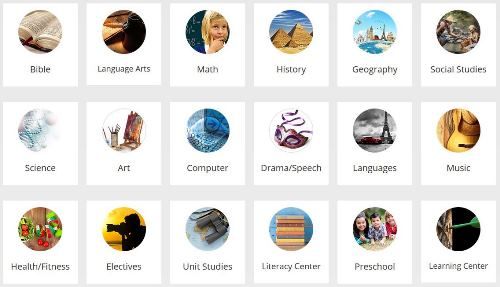
All of the courses that I looked at were either web-based, downloadable, or a combination of the two: watch a film, then download some additional work to do at home. The amount of prep work for the teacher varied considerably between the courses that I worked with, and there are so many more available than the ones that I looked at, so make sure you click through to check out courses that other Crew members used in their homes. Here's the categories that SchoolhouseTeachers offer:


High-quality, Self-paced, Online Homeschool Resources {SchoolhouseTeachers.com}


And here are the three courses that I selected for our family to actually use:

Beginning Latin

Hero(10) had outgrown our old Latin introductory course, so I was pleased to discover that SchoolhouseTeachers offers Beginning Latin, and when we tried it, we both like the simple no-frills style. It's an online course: we watch movies, then he has some worksheets to fill out.


A review of the SchoolhouseTeachers.com online courses: Yearly Membership with the Homeschool Review Crew.

He says he likes "the way they bring in the words, with nothing else to pay attention to, so you can focus on just that." I like that he likes it, and that it's moving further into Latin, introducing conjugations and declensions, which he hasn't seen before; he's ready for it. The pace seems to be good for him, as well: not too fast, not too slow.

All About the Alphabet

I decided to try out All About the Alphabet with Peanut(4), to finish off learning her letters and sounds. This is a fun add-on course, a nice bonus in addition to the other courses that fit our family, but it's not enough to be worth the subscription if it's the only one you want. It's simple and straightforward: you get a PDF with activities to do for each letter, and ideas for making books for the letters. We jumped in at A.

A review of the SchoolhouseTeachers.com online courses: Yearly Membership with the Homeschool Review Crew.

A review of the SchoolhouseTeachers.com online courses: Yearly Membership with the Homeschool Review Crew.

There are several things that I really like about doing this course. One is that I don't have to think up all the things that begin with each letter; they have a nice list. And the activities they suggest are varied and interesting. However, the course didn't come with any printables, so I had to make up my own. It wouldn't have been very difficult to include those, and is disappointing that they chose not to. Printables would have made this course completely open-and-go, which would have been better. That being said, we're having a blast at it - Dragon(6) is even kind of jealous that he isn't in preschool anymore - and Peanut is learning both the names and the sounds, which is exactly what is supposed to be happening.


Geography of the Bible

The last course that I chose is the high school course Geography of the Bible for myself. The course is set up as a series of videos, each with a list of Biblical passages used.  The first concern I always have with Bible material produced outside of The Church of Jesus Christ of Latter-day Saints and its membership is denominational differences: will it stick to just the simple text of scripture, or will it be overtly Protestant? I watched Moses: Exploring the Exodus, a 45 minute tour of the lands of the Israelite captivity and Exodus, and the movie was excellent. The script often quoted the exact words of the Bible's text. The scenery was beautiful. Similarly, Hebron: City of Promise was excellent. They told the story faithfully, but were also frank about the uncertainty in the archeological record. I didn't notice any interdenominational theology conflict problems at all, and found the video material to be quite interesting.

The main thing I found odd for a geography course was that there are very few maps in the videos, and none in the additional materials, and that was disappointing. When I checked with customer support, they told me that, no, I hadn't missed anything, and that it's more of a "lands, culture, and people from the particular area of study," and not so much of map work. But the main reason I picked this course is that the geography -meaning the location of events and people- is all a mushy mess in my head, and I can't wrap my head around the nuances of what's happening with "lands, culture, and people from the particular area of study," -- until I put them on a map. I need to trace the course of events, myself, preferably on a blackline map, (and not a ready-made one, with everything all marked up) to really get what is happening. For me, this is a major omission; I had to find outside maps.

However.

I love this course. It is easily the best of the ones we've tried.

I actually drew and painted my own Exodus map (and there's nothing like drawing a thing to make you really see it), then went back and re-watched the video, pausing in places to write stuff down and look places and people up, I looked up some verses, and looked at some of the recommended archeology resources and research assignments, and the whole process was delightful and incredibly informative, and I absolutely would not have done my own map, nor thought nearly so hard about where things ought to be placed, and the relationships of places, and the impact that had on how the story went, had there been maps included. It makes a beautiful addition to my scripture journal, and I plan to put in some information about the various Pharaohs and other historical notes behind it. I'm pretty excited about the prospect of having a little collection of these in my notebook, as I look at various Bible stories; they have units covering all the major Bible stories, both Old Testament and New Testament.

A review of the SchoolhouseTeachers.com online courses: Yearly Membership with the Homeschool Review Crew.

Looking at their research assignments for the the two units that I've worked on in the time that I've had the materials to review, I feel like this is a course that a high school student is going to need some assistance with, unless all you want for them to do is just watch the movies, and they'd really be missing out if that's all they do. Both units come with a great variety of research topics - enough that you could almost turn either one of the units into a complete semester; it's not intended that the student will answer every question. In the Moses unit they're good about referring the student to research materials and I was readily able to find research materials for the topics they propose, but in the Hebron unit it's just... questions. And when I started trying to search for the answers, I found it tough going even as an adult: there are a lot of opinions out there on Bible archaeology, and if you don't have a guide, then it's hard to know how to judge between them. So that was a little bit frustrating. On the flip side, though, it did lead me to dig in deeper and think harder, trying to figure things out. But I do think that a high school student would benefit from having an adult mentor do the course with them. And that's not a bad thing: it creates tons of opportunities for discussing both geography and doctrine.

This course is something I am enjoying tremendously, and I would absolutely recommend it to my friends, and I really look forward to when I can work on it after the kids go to sleep. It can be tough to squeeze out time to work on this sort of thing when you're the Mom, but I'm going to keep chipping away at it, because it's just so interesting. I am learning so much and it is really enhancing my understanding of the stories covered in both these units. I'm excited to complete this course, and really glad that I'll have a whole year to do it.


In the course of working with these courses, I ended up talking to customer support twice (once to ask about the maps for the geography course, and once to ask about finding the worksheets for Latin when they were migrating to the lovely new-and-improved version of their site), and they make it so easy: there's a little chat box at the bottom of their pages anytime you're signed in, and so talking to a real person is quick and painless, which is a huge bonus. Customer service, and what happens when things aren't going perfectly, can be a really telling experience when working with a company, and in this case, I couldn't have asked for better. Schoolhouse Teachers is welcome addition to our homeschool day.

You can connect with Schoolhouse Teachers in their Facebook Group. To read what other Crew families have to say about the SchoolhouseTeachers Yearly Subscription, please click the box below.

Click to read Crew Reviews


Crew Disclaimer

03 January 2017

Foreign Language Comparison

How to use your second language in your scripture study, even if you're not good at the language yet.


One of the things that I love to do is to do some of my scripture reading in a foreign language. Years ago, I read the whole Book of Mormon in Spanish. I didn't do anything special (and I never got very good at the language -- you don't need to be terribly fluent, just stubborn and willing to go slow); I just read stuff. Usually with my Spanish book and my English book side-by-side. One of my favorite passages comes from that effort. I was cruising along, starting to pick up just a little bit of speed, getting into 2 Nephi, where I read this.


Adán cayó para que los hombres existiesen; y existen los hombres para que tengan gozo.
-2 Nefi 2:25 


It's a pretty well known verse, but I was working hard, and didn't recognize it when I read it, which turned out to be a good thing: it's easy to let your brain turn off when reading things that are extremely familiar, but that didn't happen this time. I still remember how the next verse slammed into me:


Y el Mesías vendrá en la plenitud de los tiempos, a fin de redimir a los hijos de los hombres...
-2 Nefi 2:26


I stopped what I was doing, grabbed the English book, and read the passage again:


Adam fell that men might be; and men are, that they might have joy.  And the Messiah cometh in the fulness of time, that he may redeem the children of men from the fall...
-2 Nephi 2:25-26


I've never looked at that passage the same since then, and I've never been able to think of the Fall of Adam without feeling the connection to the mission of the Messiah. Before that day, I'd never really noticed the connection, even though it should have been obvious. I'd seen the bit about joy, but never really understood the connection of joy to either Adam or the Redemption. The experience gave me a taste for doing some of my scripture study in another language that I've never lost. (As an added bonus, it's really good for your language study, even if you only read in very small bursts).

Japanese is my language that I'm messing around with now, and I'm very, very slow at it. But, because of the cool electronic tools they've come up with, it's way easier this time to not only read, but to start to integrate it into topical study. Right now, I'm looking at the concept of "intent". Which isn't a word we use a lot in English, outside of the phrase "real intent". It was kind of mushy in my head. But Japanese, it turns out, has a number of really descriptive ways of saying it.

Japanese is cool. It gets a bad rap as being hard to learn because the writing system is pretty exotic, but really, learning to write is the secret to success with the language: a huge percent of the language is compound words, so once you learn the basic meanings of about 2000 words, you can tell a lot about the meaning of thousands more. Our word intent has been translated in a whole bunch of ways when they put it in Japanese. The first one I noticed was mokuteki.

Looks like this:

How to use your second language in your scripture study, even if you're not good at the language yet.


There's two characters in this compound, the first one means eye -- it even almost looks like an eye -- and the second one means target. Intent: the eye's target. I was talking to a friend of mine about this, and she told me that when her mom was teaching her to bowl, she told her to keep her eye on the front pin, or the space between the pins, because where here eye was -her intent- that's where her ball was going to go. We do something similar in the marital arts, with the toes, knees, punch, and also the eyes and will, all pointing to the same thing. If one of them points elsewhere, beside where your opponent is, then your punch looses power. It's interesting to think of how that can be described as  "confused intent", if all the various components of our actions are not aligned properly into "real intent".

It's a whole line of thought, as well as a whole conversation about the scriptures with my friend, that never would have happened without my efforts at reading the scriptures in a second language. And this isn't the only word that's used in the Japanese where it just says "intent" in English; I've found seven variants so far, and each one of them sheds a little more light on the concept. What I think would be really interesting would be to then search those words and phrases, and see what they become when they come back into English: is it only "intent" or do they translate into other words and phrases as well?

Changing languages is really easy on the website: in the top right corner is a little world. Click it, then pick your language. For this project, I've had the English search on my computer screen, and the Japanese on my phone. Switching the iPhone app to a new language is a little more involved, but once you do it once, you can set up a bookmark, which makes switching back and forth really easy. And there are side-by-side versions for the iPhone, too, in a bunch of languages. (I wrote a tutorial for how to do set up your bookmarks so they do the work for you, if you'd like step-by-step instructions.)

So try it out. Dust off your high school language, or your mission language, or take the plunge into the language you've been wanting to learn. It's ok if you only do a verse, or even part of a verse, when you're starting. It's OK to be a beginner; it's OK to not understand everything at first; it takes time to get quick at it. It's OK to go slow; there's no right speed for scripture, and sometimes it's remarkable what slowing waaaaay down does for making me ponder verses that I've overlooked. It's a fun kind of work. And it pays rich dividends in terms of insights that just aren't available in your native tongue.


We're studying the Bible; We'd love you to come join us.


LinkWithin

Blog Widget by LinkWithin