09 10
Showing posts with label family. Show all posts

12 June 2019

Claim Their Anointing


Scripture study is a funny thing. In the middle of following this question, I'll realize that it's related to that thing over there, and next thing you know I'm lost in the "rabbit hole" --but typically happy as a clam about it.

That's kind of how it went this time. I got to the adult session of Stake Conference early, and was thumbing through my Scripture Journal, and decided to fill in some of the things that I've found about lineage in the last little while as I waited for the meeting to start. There's this unexpected connection between lineage and priesthood that I've been noticing, though I haven't really explored it all very well. But I searched "lineage" in the scriptures, and one of the verses that came up was this one:


...by virtue of the decree concerning their right of the priesthood descending from father to son, they may claim their anointing if at any time they can prove their lineage, or do ascertain it by revelation from the Lord...
-Doctrine and Covenants 68:21


And I though, hold on here, bishops are anointed? It's not just a regular ordination?

So when the meeting was done, I went up front to see if I could ask the Stake President real quick (he's a friend of mine, and I couldn't see any of the bishops), and I ended up getting the attention of the visiting Seventy instead. Since I thought he might know, I went ahead and asked, not about regular Bishops, since I was 95% certain they just get regular ordinations, but about the Presiding Bishops. He said no. So I asked if he knew what the verse was talking about, and he didn't. Which was neither surprising nor distressing; it's not one that gets a lot of attention, and I was as much making sure that I hadn't missed something obvious as anything: I didn't really expect that either he or our good Stake President would know much about it; it just doesn't get discussed. But you don't know, really, until you ask.

So here I am, trying to learn more about anointings. Way back when, Elder Bednar shared a technique for scripture study that I think of as "Brother Bednar's Cut and Sort" technique: he looked up all the forms of his word, and then put them in a document, then cut them up, and sorted them into piles. I tried this with the word humility once. It completely transformed my understanding of the topic, and I never even really finished. It seems like a likely technique for learning more about this.

There's only 367 instances. ...  How hard can it be? ... right?

07 June 2019

Making it Safe to Not Know


I no longer remember precisely what it was that got me thinking about it, but:

It's really important that we create an environment where it is safe to not know something.

Not in a neglectful kind of way, where we're complacently not trying, but in a the sort of way where it's ok not to know yet, and it's so ok to ask questions, to try out incomplete ideas, to say the sentence half in your native language, half in the one you're studying, to take a stab at it, and try -even knowing that your effort is going to be half-baked and incomplete.

Because there is so much learning in the trying.


28 October 2017

The Family is Central: The Center of Safety {Guest Post}


THIS POST IS THE FINAL POST IN THIS SERIES. TOMAS CLIFFORD LAST OF MY GUEST BLOGGERS, ALL OF THEM COMMENTING ON THE FAMILY PROCLAMATION, AROUND THE THEME: FAMILY IS CENTRAL. OTHER TITLES IN THIS SERIES INCLUDE: 

~THE FAMILY IS CENTRAL: CENTRAL TO HAPPINESS 
~THE FAMILY IS CENTRAL: A SACRED INSTITUTION
~FAMILY IS CENTRAL: A CENTER OF FULFILLMENT


My name is Thomas Clifford and I am a member of the Church of Jesus Christ of latter-day saints. My family is the most important thing to me in the entire world. Today I want to talk about The Family A Proclamation to the World and how important it’s message is and the fact that family is the center of my world. Today want to talk about the safety of the family. As parents, it is our job to make sure that our children are safe. We need teach them to leave situations better than it was when they got there. 

"HUSBAND AND WIFE have a solemn responsibility to love and care for each other and for their children. “Children are an heritage of the Lord” (Psalm 127:3). Parents have a sacred duty to rear their children in love and righteousness, to provide for their physical and spiritual needs, and to teach them to love and serve one another, observe the commandments of God, and be law-abiding citizens wherever they live." - The Family - A Proclamation to the World

We need to teach them to love each other and the people they interact with. They need to know that we each make mistakes and its okay to make mistakes. We need to learn from these mistakes. Family means being surrounded by people who love them and will help them be better. The family is their protector and safety net in life. Friends come and friends go but family is forever.


Tom Clifford is a father of 5 and lives with his sweetheart in Appleton, Wisconsin. He does freelance work in branding and social media marketing. He enjoys all things technology and has been a social media influencer since 2007.


18 October 2017

The Family is Central: A Sacred Institution {Guest Post}


THIS POST IS THE SECOND IN A SERIES. SAMUEL HILL IS THE FIRST OF A COUPLE OF GUEST BLOGGERS, ALL OF THEM COMMENTING ON THE FAMILY PROCLAMATION, AROUND THE THEME: FAMILY IS CENTRAL. OTHER TITLES IN THIS SERIES INCLUDE: 

~THE FAMILY IS CENTRAL: CENTRAL TO HAPPINESS 

~THE FAMILY IS CENTRAL: CENTRAL TO FULFILLMENT


Many today wonder why people of faith hold the family in such high regard despite all the imperfections that seem to infect the institution. When we defend the sanctity of the family in the many debates over gay marriage, religious rights, etc., we are frequently criticized for the high rates of abuse, infidelity, and divorce even in marriages of faith.

One answer that we do not often hear from the defenders of the traditional family is this, which I consider to be the most important: the family is a sacred institution to God. Of all the answers that people of faith can offer, this ought to be the most prominent. In the plan of God, the “family is central.” and cannot be done without.

Why this emphasis, not just from people of the Abrahamic faiths, but also from God himself? The simple reality is that the family is THE bedrock of every good teaching, both in a religious sense, and in a worldly sense.

One of the finest accounts of this quality of the family comes from the Book of Mormon tale of the Army of Helaman. Having converted to the faith of Christ from an idolatrous and murderous life, the people of Ammon were threatened with extinction by their former brethren, the Lamanites, because of their faith. “Now there was not one soul among all the people who had been converted unto the Lord that would take up arms against their brethren; nay, they would not even make any preparations for war...” When these people came to “believe and to know the truth, they were firm, and would suffer even unto death rather than commit sin...” And indeed, when their former brethren came to battle against them, the people of Ammon “went out to meet them, and prostrated themselves before them to the earth, and began to call on the name of the Lord...” Although 1005 of them were slain that day, their example swayed an even greater number of Lamanites to repent and follow their example. (Alma 24, approx. 77 B.C.)

Although they found brief periods of peace in the decade that followed, within 15 years they were at war with the Lamanites again. No longer a small skirmish aimed at only a single small population, the full massed army of the Lamanite nation had gathered to conquer or destroy the people of Ammon and their protectors, the Nephites. Seeing the destruction and suffering, the people of Ammon thought to break their word to God, and take up arms against the Lamanites in defense of their freedoms. Instead, 2000 their sons who were too young to join their parents’ covenant forswearing violence, volunteered to go to war in their stead. These “very young” boys are referred to repeatedly as “stripling,” an archaic word that means in essence, a young adolescent. In my mind I liken them to myself as a scrawny 14 year old whose chest was about as well defined as a piece of plywood (apologies to Mr. Friberg).

Despite their youth, and their inexperience in war, these striplings were described as “exceedingly valiant for courage,” and “true at all times in whatsoever thing they were entrusted” (53:20). Their response, when asked by their commander whether they ought to join in a terrible battle against a mighty army, a battle that had already taken the lives of thousands of seasoned soldiers, was thus:


46 For as I had ever called them my sons (for they were all of them very young) even so they said unto me: Father, behold our God is with us, and he will not suffer that we should fall; then let us go forth; we would not slay our brethren if they would let us alone; therefore let us go, lest they should overpower the army of Antipus.
47 Now they never had fought, yet they did not fear death; and they did think more upon the liberty of their fathers than they did upon their lives; yea, they had been taught by their mothers, that if they did not doubt, God would deliver them.
48 And they rehearsed unto me the words of their mothers, saying: We do not doubt our mothers knew it. (emphasis added)(Alma 53, approx. 64 B.C.)


Imagine the example these young men were raised with: Their parents had the conviction to surrender their own lives without a fight out of devotion to their faith; mothers and fathers willing to make the ultimate sacrifice to keep their word to God. I do not wonder that they became paragons of faith, integrity, and courage. Luckily for us, our parents don’t have to be willing to die to show us a good example. Any parent that tries to be a good parent, will learn “to love and serve one another, observe the commandments of God, and be law-abiding citizens wherever they live.”


These are just a few ways that the family teaches us:
  • Pacing the hallway and singing to a child with stomach flue all night while they scream and cry? They learn to understand unconditional love.
  • Admitting to your kid that something you did was wrong and apologizing to them? You’ve just taught them to be honest and humble.
  • Getting up at an absurd hour because someone in your neighborhood needs help? You’ve just taught your kid to sacrifice for others.
  • Explaining to you kid who just dropped an air conditioner out the window that even though you’re upset, you still love them no matter what? You’ve just given them a glimpse of how God loves them.
  • Lovingly working alongside your child to clean the crayon marks off the walls? You’ve taught them both patience and responsibility.
  • Making your kid do chores for money to replace the neighbors window that just met the business end of a baseball? That’s a lesson in accountability.
  • The alcoholic father dragging himself to an AA meeting week after week despite frequent relapses? That’s teaching his kids about repentance.
  • Praying together when you’ve lost your job and you don’t know how to eat next week? You’re teaching the kids to rely on God.
  • Showing up at their baseball game even when you are dog-tired and the weather sucks? You’ve taught them that they matter to you.


This list could go on forever, and I’ve no doubt that most of you are thinking back to things your parents did that left an impression. I think you get the point: There is no other organization or structure on the face of the earth that can impart the many lessons needed to build strong societies, good governments, and a wholesome human race.


Samuel Hill is a husband, father, historian, gardener, disciple, gamer, teacher, political scientist and swordsmen without enough time to do them all. When he's not playing with his kids, he is often found neck deep in some old book that causes his wife to weep with boredom. Thereafter he is frequently found baking something to pay her back.

08 October 2017

The Family is Central: Central to Happiness


THIS POST IS THE FIRST IN A SERIES. I'M LOOKING FORWARD TO INTRODUCING YOU TO A COUPLE OF GUEST BLOGGERS, ALL OF THEM COMMENTING ON THE FAMILY PROCLAMATION, AROUND THE THEME: FAMILY IS CENTRAL.

~THE FAMILY IS CENTRAL: CENTRAL TO HAPPINESS 
~THE FAMILY IS CENTRAL: A SACRED INSTITUTION
~THE FAMILY IS CENTRAL: CENTRAL TO FULFILLMENT


The family is central to the Creator's plan for the eternal destiny of His children -- central to the Plan of Happiness. Families are a gift from God, designed to nurture and protect us here and now, and to fit us for life in His kingdom in the hereafter.


Individual progression is fostered in the family, which is “central to the Creator’s plan for the eternal destiny of His children.” The home is to be God’s laboratory of love and service. There a husband is to love his wife, a wife is to love her husband, and parents and children are to love one another. Throughout the world, the family is increasingly under attack. If families fail, many of our political, economic, and social systems will also fail. And if families fail, their glorious eternal potential cannot be realized. 

Our Heavenly Father wants husbands and wives to be faithful to each other and to esteem and treat their children as an heritage from the Lord. In such a family we study the scriptures and pray together. And we fix our focus on the temple. There we receive the highest blessings that God has in store for His faithful children.
-Russell M. Nelson, April 2008


When I think about our Father's plan, how we lived with Him, and then came to earth to receive a body, to be tested and to be challenged, and all the growth opportunities, the way that we are to live together in love, and when life ends, we are to have loved much and to weep for the loss of those who leave us, and return to Him again. When I think of all that, family is there in every aspect, every step of the way. Family reaches to the very heart of the Plan, so much so that if families fail the earth is cursed, and wasted at His coming.

One of my sisters has sheet music for a song, Keeping Sheep, that compares parenting to shepherding, and talks about all the voices that say that it's not important, it's expendable, it's beneath us. It's a beautiful song, and now that we've got kids, we can't sing that thing without bawling our eyes out. This is my favorite part:


So many voices say to me,
“A sheep-fold is no place to be.
Your time in there is dull and slow,
And lambs leave very little room for you to grow.”

Oh, If I ever start to stray,
Deceived by thoughts of greener pastures,
Remind me Lord, that keeping sheep
Will lead to happier ever-afters.


God works in plain and simple things. The small, the weak, the over-looked. These are His stock in trade. Like ordinary homes, and ordinary, tired parents. He speaks in a still, small voice, one that you have to actively pay attention to in order to hear. And the value of things that He asks us to do is often like that little voice: easy to overlook.

Children need their families. Not preschools, not fancy clothes, not Stuff in all its assorted forms. They need their parents, their time, their attention. Mine need me, and yours need you. Parenting is intense, and it can be really, really hard, and there's soooo many people who want to tell us that it's not really worthwhile. But when we find the heat of opposition is the hottest, that's where the best work for the Kingdom is done. Satan doesn't oppose the stuff that doesn't matter.

Families matter. The traditional family is key to our Father's plan for our happiness. 


29 March 2017

#PrinceOfPeace: Scripture

Finding peace and joy through the words of the #PrinceofPeace in the scriptures. #PrinciplesofPeace


I don't remember the question anymore, but I remember what my Dad told me: the answers to the important questions are in the scriptures. Go to the scriptures. It may take time to find them, but I don't have wait for someone else to answers and show them to me: I can go to them myself, and I can search out the answers to the questions that are important to me.

This changed my life.

Up to that point, I'd been rather passive, waiting for someone to tell me what is in the scriptures. Partly, this was because I was young: it's not unexpected for a child to rely on her trusted adults to teach her. But my dad taught me to act, rather than waiting for someone else to do it for me. He taught me that my questions are important enough for the Lord to answer them. That conversation taught me that I am strong enough to seek my own answers, capable enough (even though I was young at the time) to understand what the scriptures say and what the Holy Ghost teaches.

He was also teaching me the value of scripture itself; I don't think that you can overstate the value of scripture.

Studying history with my kids, one of the things I've learned more about is the heroes and martyrs of the Reformation. Some of them are names known to many - William Tyndale, for instance, who did the first translation of the Bible into English, and was martyred for his work. Other names are not so famous: many common people sacrificed to possess even a few pages of Tyndale's translation -- and some of them died for their sacrifice. I found myself wondering: would I have been willing to take their risks, to make their sacrifices, to pay their cost, in order to have the scriptures? We live in a time and place where scripture is inexpensive or free, and plentiful. We have copies in our home for all of the members of the family, in as many languages as we care to have, both print copies, searchable electronic copies, and audio copies. We mark and use up our books, and then we replace them. And we do it all without fear.

It is a luxury that our forefathers could not have imagined.


Since that conversation with my Dad I've grown up, moved out, and I've got a family of my own. I've turned to the scriptures to try to find comfort in grief, strength to get through challenges, and wisdom to know how to try to help others. In the pages of my scriptures I've learned to find the Lord's love for me.

Verily I say unto you my friends, fear not, let your hearts be comforted; yea, rejoice evermore, and in everything give thanks...
-Doctrine and Covenants 98:1


In the scriptures, I've learned that the joy promised to the Lord's people is not some dim, distant future thing, but can be joy in the present tense, joy in the mist of trial, joy that comes from knowing God's love, and feeling the reality of the Lord's tender mercies.


But let all those that put their trust in thee rejoice: let them ever shout for joy, because thou defendest them: let them also that love thy name be joyful in thee. For thou, Lord, will bless the righteous; with favor wilt thou compass him as with a shield.
-Psalm 5:11-12

Now it's my turn to teach my own children to love the scriptures, to turn to the Lord, and to search His words for the answers to the difficult questions they do and will face. It's my job to let them see me search the scriptures, and working to conform my life to the things they teach: regardless of the cost.

It is written, Man shall not live by bread alone, but by every word which proceedeth out of the mouth of God.
-Matthew 4:3


Learn the #PrinciplesofPeace from the #PrinceofPeace mormon.org


15 March 2017

Odd Bits: Folk music, Archaeology, and More...


::1::

One of the things that homeschooling has done for me is to introduce me to some lovely folk music. I'd like to learn to play it on the Banjo, a lot of it, but so far, that's an item on my to-do list that isn't so easy to get crossed off. In the mean time, I'm absolutely loving listening to Jesse Ferguson, who sings Scottish folk songs. Have a listen; he's lovely. I always wonder if my Scottish ancestors knew or loved any of these songs.


::2::

On the first of every month, I post a collection of thoughts from my commonplace book, which is one of my favorite self-education tools. I love that using it is participating in the great English and American tradition of self-education, and continuing personal development. Occasionally, I'm asked what it is. The article I've taken this quote from has a pretty good explanation, some pictures, and instructions for how to start one.


A commonplace book is essentially a scrapbook / compilation of information that the creator deems relevant. Commonplace books became popular with thinkers in 15th century England and were eventually promoted as a scholarly tool by major universities such as Yale and Harvard.
-Jamie, Project: Start a Commonplace Book


::3::

I stopped buying cereal a couple years ago, and breakfast, which the kids mostly take care of on their own, continues to be a little hap-hazard. Lots of times, the kids will eat leftovers, or open a can of fruit. But if we're low on those things, it can get interesting. I think I might try this idea out: homemade instant oatmeal. Looks like a piece of cake to make, which is perfect: I love that the kids are gaining independence and confidence in the kitchen by making their own breakfasts. She's got instructions on masking tape on her jars, which is brilliant. And it looks like it'd be easy to switch up the flavors, too.


::4::

Archeology is cool. Archeology that shows up just in time to dovetail with our work on Greece and Greek civilization is even better. And that's what this article about a warrior's grave they found in Greece is. And there's a Roman makeup case, with fingerprints visible in the cream that's still in it. Gotta love the never-ending search for the perfect beauty product! And there's the whole kingdom from Arthurian legend that they found. That's pretty awesome, too. Makes me want to go read something about King Arthur: it's been a while. Archeology is good stuff.


::5::

Marginalia. I only recently learned that there's a word for all the stuff that you write in the margins. They told us not to write in our books in school, cautioned that there would be Serious Consequences if we did, because Those Books Are Very Expensive. The caution stuck: I have never really been one to write or highlight in my books, and when I shop, I generally want a clean book, even used. The only book that I've seriously annotated is my scriptures, which I love "making tracks" through, because it helps me to remember what I've learned, find it later, and retain it longer. And it's a visual reference for which sections I've given serious attention to, and which ones still need that kind of treatment. But I think I'm going to start making more notes in other books, too:

I like to think of these little jottings as being little messages to Jemimah from those same ancestral tombs, that through them she will get to know these people from her history a little better.  She will know how they thought about things, and how they interpreted knowledge, and she will get their input into the very same words that she is reading.  When she reads How They Brought the Good News from Ghent to Aix, she will know to listen for how "the light, rollicking metre almost produces the effect of the hoof beats of the galloping horse" because her Great Grandmother will have told her to listen.
-Jeanne, A Peaceful Day: Marginalia

I love the idea that the notes that their family made in their books has become a connection between the generations, a way for departed loved ones to continue to teach long after they've left us. That's a beautiful, all by itself. It makes me wonder (again) whatever happened to my Grandmother's library, and if she made notes in any of her books. What would they tell me about her? Those little notes can have impact, especially if the reader is receptive, or has a connection to the note-taker:


As I read Rebecca’s copy of the book, I started to notice how her notes changed the way I was reading. The passages she chose to mark, and the notes she wrote at the end of chapters, framed the way I was reading the novel. ... I’ve read books in the past with marginalia – usually used books that had previous owners unknown to me – and while those notes also pointed out passages to me that I otherwise may have skimmed over or which may not have been necessarily significant to me upon first glance, I never really paid attention to it beyond those pauses. ... This experience – of reading Rebecca’s copy of The Engagements – was markedly different, though. Because we’re not just Book Riot colleagues, but also good friends, not only was my perception of the novel changed, my perception of Rebecca – as a friend, as a woman, as a reader – was also changed.
-Rachel Manwil, To Note or Not to Note: How Marginalia Changed the Way I Read


::6::

I ran across this interesting post about the difference between an educational system and an educational method. She's talking about how the Charlotte Mason philosophy is a method, not a system, and there are a lot of good insights about the reason the distinction is important, but the thing that struck me was the way that this applies to language learning. Around 2 or 3 years ago, I changed, dramatically, the way that I learn languages, and started studying sentences, harvested from either my dictionary's sample sentences, or from real native Japanese text and native speakers. I make flashcards from whole sentences, and study vocabulary, syntax, usage, and all that all in a single go. If that's all I did, it would still just be a system, but the other half of the idea was to create an immersive environment - a Japanese bubble - so that we also are hearing correct pronunciation, more correct grammar and syntax, and interacting with the languages in ways that are natural, organic, and fun. Fun, guilty pleasure (example: Minecraft videos) is actually desirable in this case. The combination is amazing. Families who successfully pass a heritage language generally do a couple of things, but one of the big ones is to arrange for roughly a third of the day to happen in the minority language: and that is surprisingly doable in a situation like ours where we are all learning together. Obviously, it would be faster and better if we had more live feedback, regular access to someone who knows more than me, but we are making good progress even with minimal contact with people who are fluent, which is pretty amazing.


Getting good is good. Those things are all good. It’s nice to be full and it’s nice to have a big vocabulary. It’s just that you’re more likely to eat more if you focus more or less totally on making and procuring tasty food than “efficient”, “filling” food. Similarly, if you focus just about exclusively on having fun through the language, while you still suck, while you’re not full yet, you’ll naturally “eat” more of it, and eat more often, and naturally get “fuller” faster.
-Khatzmuto, Why Don't You Learn Like You Eat?, emphasis original (content warning: this article is clean, but if you browse his site, be aware he's sometimes rude, and occasionally pretty crude)


02 March 2017

Watercolors and "Learning Projects"

Learning about watercolors and giving ourselves grace when we do "learning projects" -- and mixing in a little family history for fun.


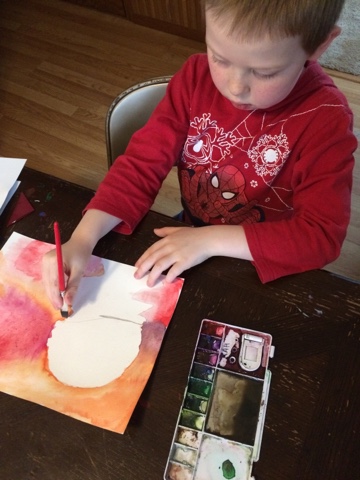
We are enjoying a series of art lessons from Creating a Masterpiece right now (watch for a review in a couple weeks). I love watercolors, and so that's the part I was most excited about -- and so it's the type of project that we did first. The basic project was something that we haven't done any of before: wet on wet technique. It was fun to play around with it -- and it actually worked! I haven't been very happy with my past efforts, so I haven't done much at all with it. But this time, it worked, which was exciting. It's always lovely when art works.


Learning about watercolors and giving ourselves grace when we do "learning projects" -- and mixing in a little family history for fun.
My first African Sunset.


Learning about watercolors and giving ourselves grace when we do "learning projects" -- and mixing in a little family history for fun. We were sick for a while in February, so Hero and I did this one day, and then Dragon did it later, which was an interesting dynamic. I hadn't realized how much support there is in doing it in a group, but it became really apparent: Dragon struggled, even though he'd watched the same instructions as Hero and I. The struggle isn't bad, though: it gave us an opportunity to talk about how sometimes, and especially when we're trying something new, it's ok if the project turns out not like we'd wanted, or even "ugly". We call those "learning projects" and we talked about how, even if the picture doesn't turn out, giving ourselves permission to try anyway helps us to be able to learn from the experience and the next one is better. It's an important conversation to have: perfectionism, and an unwillingness to take the risk of trying can really ruin your ability to enjoy doing art, and hamstring the enjoyment of playing around with it. I'm hoping to be able to encourage the kids to give themselves a little grace, especially when they're trying something new.

To that end, I told them about my first crochet project: I asked my Grandma to teach me when I was still pretty young, probably around 10 or 12, and she did. She was a great teacher, and got me started on a project, then sent me home with plenty of yarn and a hook. I don't remember how it happened, but that first project was a rug, and it was hideous. It was made of a bunch of odd colors of rug yarn that she had laying around, and I just used them up, one after another. And it didn't lay flat at all: it took me a while to get the hang of keeping the tension consistent. I was supposed to be making a circle, but it ended up a lumpy, misshapen oval-ish thing. It absolutely could not lay flat. And I knew it was hideous, but I'd put so much effort into it, that I loved it anyway, and kept it on my floor for a long time. I don't think it exists anymore.

Probably the most important thing that I learned from that project was not to expect much from a "first project". The second thing that I crocheted was much better, and in the 30ish years since that first project I've made a number of things that I'm really happy with, including a few that I'd be willing to say are really beautiful: my favorite was a long runner that I made in white crochet thread and gave my Grandma as a Christmas present when I was living with her one year. She kept it on the upright piano that Grandpa got her. After she passed, my mother adopted it, and keeps it on the table that my great-grandfather made. If I had given up when that first rug turned out so badly, none of that could have happened. I think a lot of the credit for my willingness to continue goes to Grandma's patient teaching and sincere encouragement.

Learning about watercolors and giving ourselves grace when we do "learning projects" -- and mixing in a little family history for fun. Learning about watercolors and giving ourselves grace when we do "learning projects" -- and mixing in a little family history for fun. Once I'd told my story to Dragon, he was much more willing to try again. We did a couple of things differently: first, I waited until I was sure that he was completely well. The first effort had been on a day where he looked well at first... but later wilted, and was sick again for another day or two. I didn't bring things out again until I was sure he was good. And then, I got out my own paints and did a second picture alongside him, so he could see what I was doing. I didn't love the trees from the project, so I tried something different, but by the point of adding those final details, he was humming right along, so it didn't matter that we weren't quite right together anymore. Early on, we also flipped his first picture over and used the back to practice some of the new techniques and strokes that the project required. Normally, he doesn't have a lot of problems with fine motor, but this project was challenging: it had a specific outcome he was looking for, rather than the free-form work he usually does with watercolors, and that makes a difference.

Learning about watercolors and giving ourselves grace when we do "learning projects" -- and mixing in a little family history for fun.
My second painting.
 Another thing that we did that's different from usual is that I actually touched his brush and paper a few times. He was getting so frustrated, and verbal explanations weren't cutting it. Typically, he doesn't want my interference, but this time he welcomed it. And the project worked. He was excited to show it to his dad at the end of the day. I was so glad that he'd been willing to try again. Good things, all over the place there. Lots of learning -- and some of it was even with the watercolors!

Learning about watercolors and giving ourselves grace when we do "learning projects" -- and mixing in a little family history for fun.
Dragon's second painting.

I was interested to see what Peanut did: officially, she wasn't participating. She hadn't shown any interest in doing the same thing as us. However, when Hero and I did it, she's wanted her paints, and I'd handed her a page for a Chinese New Year (year of the chicken!) that I'd printed, but we had never gotten around to doing, and she happily painted it. She must have been paying more attention than I gave her credit for, because the body ended up looking an awful lot like the skies that we were doing that day. She's a pretty observant little thing!

Learning about watercolors and giving ourselves grace when we do "learning projects" -- and mixing in a little family history for fun.

It was such a fun project. The kids want to try some of the other mediums that we've never done before: I picked up some soft pastels and some charcoal for them, and they're looking forward to trying those out. But if I'm pleasing myself, there's going to be more watercolors in store, at the least, for me. I love watercolors, partly for their own sake, but partly because I feel like learning to do them gives me a greater connection with my Great-grandma, who also loved them, and left enough paintings that all the family members that wanted one, were able to have one. My Dad's got two. That's a pretty awesome legacy, and it's not even the only medium where she left a wealth of art for her family to cherish. She's a pretty remarkable woman. 


Learning about watercolors and giving ourselves grace when we do "learning projects" -- and mixing in a little family history for fun.
Hero's final African Sunset.


12 February 2017

Tasty Snack?

Dragon: I need something for my stomach.

Mom: Shall we give it a boot?

D: {giggles} No!

M: A worm? A tasty fish head?

D: No! We don't even have one of those! And if we did, it would taste nasty!!

M: Well, you don't like any of my suggestions, but you're not making any of your own...

D: How about some peaches?

M: Sure. Go get 'em.


I do enjoy giving that boy a bit of a hard time.


01 February 2017

Commonplace Book: January


We have this desire to give our kids what we call an academically "rigorous" education. Andrew Kern and Christopher Perrin both taught me a bit about that. ... I asked them how we could pursue a rigorous education while retaining a sense of rest. What I didn't realize at the time was that the word "rigor" comes from the Latin rigor, rigoris, which means "numbness,stiffness, hardness, firmness, roughness, rudeness." Rigor mortis literally means "the stiffness of death," which I think we can all agree is not the goal of homeschooling our children!

Don't aim for rigorous education, Kern and Perrin both told me. If we are aiming to order our children's affections, learn to love what is lovely, join in the great conversation, and cultivate a soul so that the person is read in every sense of the word to take on the challenges around the corner and on the other side of the college entrance exams; work toward "diligence" instead.

"Diligence" come from the Latin diligere, which means to "single out, value highly, esteem, prize, love; aspire to, take delight in, appreciate." What we are really aiming for in giving our children a rigorous education is not just doing hard things, but cultivating a habit of focused attention. The word "student" comes from the Latin studium, meaning "Zeal, affection, eagerness." A diligent student, then, takes delight, eagerly and with great zeal, in what he loves.
-Sarah Mackenzie, Teaching From Rest, 4-5


Learn everything; later you will see that nothing is superfluous.
-Hugh of St.Victor, quoted in Paideia Notes


But the one achievement possible and necessary for every man is character; and character is as finely wrought metal beaten into shape and beauty by the repeated and accustomed action of will.
-Charlotte Mason 6:129


The will, too, is of slow growth, nourished upon the ideas proposed to it, and so all things work together for good to the child who is duly educated. It is well that children should know that while the turbulent person is not ruled by will at all but by impulse, the movement of his passions or desires, yet it is possible to have a constant will with unworthy or evil ends, or even to have a steady will towards a good end and to compass that end by unworthy means.
-Charlotte Mason 6:132-3


You will come to know that what appears today to be a sacrifice will prove instead to be the greatest investment that you will ever make.
-Elder Gordon B. Hinckley, April 1986, The Question of a Mission


There was this luxury of living.
-Pearl S. Buck, The Good Earth, 26


Wang Lung sat smoking, think of the silver as it had lain upon the table. It had come out of the earth, this silver, out of his earth that he ploughed and turned and spent himself upon. He took his life from this earth; drop by drop by his sweat he wrung food from it and from the food, silver. Each time before this that he had taken the silver out to give to anyone, it had been like taking a piece of his life and giving it to someone carelessly. But now for the first time such giving was not pain. He saw, not the silver in the alien hand of a merchant in the town; he saw the silver transmuted into something worth even more than itself -- clothes upon the body of his son. And this strange woman of his, who worked about, saying nothing, seeming to see nothing, she had first seen the child thus clothed.
-Pearl S. Buck, The Good Earth, 36


Is self-denial wise because there is something wrong with our passions, or because there is something right with our passions? Alma taught his son: “See that ye bridle all your passions, that ye may be filled with love.” (Alma 38:12; emphasis added.) He did not say we should suppress or eliminate our passions but rather bridle them—harness, channel, and focus them. Why? Because disciplining our passions makes possible a richer, deeper love.
-Bruce and Marie Hafen, Bridle All Your Passions


Education which leaves out God is destitute of all true value. Satan is aware of the great power which a true system of education gives to the people. He is, therefore, opposed to such a system. He knows full well that a generation trained in all  true knowledge cannot be lead by him, as they would if their education were neglected. He therefore stirs up all the agencies under his control to do everything in their power to defeat the purposes of God in regard to the education of our children.
-George Q. Cannon, Juvenile Instructor, 15 Apr 1890


It is easy to forget that teaching is holy work. The building up of the intellect - teaching children  to really thing - does not happen by the might of human reason, but rather by the grace of God. On an ordinary day, you and I likely have a set of tasks we've scheduled for our kids. But it's more than math. It's more than history. It is the building of our children's hearts and minds, and we can only do that if we realize that this is how we thank Him for the graces He so lavishly pours upon us.
-Sarah Mackenzie, Teaching From Rest, 11


 How can the Christian know divine rest and yet educate out of and to anxiety? How can a Christian “learn from Christ” who gives rest and then give no rest to their students? How can the Christian “pause” for refreshment every Sunday but offer no sabbath to students? Where is the sabbath pattern in our schools and studies?
-Christopher Perrin, Let's Pause a Moment


Now there is a pride a man has when he sees his eldest son reading aloud the letters upon a paper and putting the brush and ink to paper and writing that which may be ready by others, and this pride Wang Lung now had.
-Pearl S. Buck, The Good Earth, 231


It takes a certain fortitude, after all, to look at a pile of dishes and see in it the makings of a cathedral. The daily mundane is holy ground because the ordinary tasks of a monotonous Monday are where we meet our Maker.

The builders of medieval cathedrals knew what it meant to work their entire lives to please God without ever expecting to see their work completed. Many cathedrals would take more than a hundred years to build -- more than the span of a man's lifetime. I once heard a story of an artisan who worked tirelessly for many years to carve a beautiful bird into a portion of the cathedral that would be covered up. When someone asked why he was working so hard on something that no one would ever see, he replied, "Because God sees."

God sees your little wooden bird, too. Just as the artisans and carpenters of old built beautiful cathedrals for the glory of God, so do you. Yes, you - you who work tirelessly day after day over a geography lesson, a math test, a laundry pile, a kitchen sink. These are th moments wherein you build cathedrals for God.
-Sarah Mackenzie, Teaching From Rest, 11-12


And Wang Lung stood beside the two graves and watched and his grief was hard and dry, and he would not cry out loud as others did for there were no tears in his eyes, because it seemed to him that what had come about was come about, and there was nothing to be done more than he had done.

But when the earth was covered over and the graves smoothed, he turned away silently and he sent away the chair and he walked home alone with himself...

Thus thinking heavily, he went on alone and he said to himself,

"There in that land of mine is buried the first good half of my life and more. It is as though half of me were buried there, and now it is a different life in my house."

And suddenly he wept a little, and he dried his eyes with the back of his hand, as a child does.
-Pearl S. Buck, The Good Earth, 289-90


Now as the winter wore away and the waters began to recede so that Wang Lung could walk abroad over his land it happened one day that his eldest son followed him and said to him proudly,

"Well, and there will soon be another mouth in the house and it will be the mouth of your grandson."

Then Wang Lung, when he heard this, turned himself about and he laughed and he rubbed his hands together and said,

"Here is a good day, indeed!"
-Pearl S. Buck, The Good Earth, 303


Odin took the horn in both his hands and drank and drank. And as he drank all the future became clear to him. He saw all the sorrows and troubles that would fall upon Men and Gods. But he saw, too, why the sorrows and troubles had to fall, and he saw how they might be borne so that Gods and Men, by being noble in the days of sorrow and trouble, would leave in the world a force that one day, a day that was far off indeed, would destroy the evil that brought terror and sorrow and despair into the world.
-Padric Colum, Children of Odin


"Well, alright," he said. "If that's the way you want it, I'm for it even if it's only an agreement between you and your dogs. If a man's word isn't any good, he's no good himself."
-Wilson Rawls, Where the Red Fern Grows, 93


What is this earth and sea, of which I have seen so much? Whence is it produced? And what am I and all the other creatures, wild and tame, human and brutal, whence are we?

Sure we are all made by some secret Power who formed the earth adn sea, the air and sky; and who is that?

Then it followed most naturally; It is God that has made it all. Well, but then, it came on strangely, if God has made all these things, He guides and governs them all and all things that concern them; for the Power that could make all things must certainly have the power to guide and direct them.
-Daniel Defoe, Robinson Crusoe, 144


This term in its particular application means "that dominion which one man claims and exercises over the external things of the world, in exclusion of every other individual." In its larger and juster meaning, it embraces every thing to which a man may attach a value and have a right; and which leaves to every one else the like advantage. In the former sense, a man's land, or merchandize, or money is called his property. In the latter sense, a man has a property in his opinions and the free communication of them.

He has a property of peculiar value in his religious opinions, and in the profession and practice dictated by them. He has a property very dear to him in the safety and liberty of his person.
He has an equal property in the free use of his faculties and free choice of the objects on which to employ them. In a word, as a man is said to have a right to his property, he may be equally said to have a property in his rights.

Where an excess of power prevails, property of no sort is duly respected. No man is safe in his opinions, his person, his faculties, or his possessions. Where there is an excess of liberty, the effect is the same, tho' from an opposite cause.

Government is instituted to protect property of every sort; as well that which lies in the various rights of individuals, as that which the term particularly expresses. This being the end of government, that alone is a just government, which impartially secures to every man, whatever is his own.
-James Madison, On Property, emphasis original


But mere reading of wise books will not make you wise men: you must use for yourselves the tools with which books are made wise; and that is -- your eyes, and your ears, and common sense.
-Madam How and Lady Why, 4

27 January 2017

Five Things I Love About Homeschooling


There are so many good things that come to our family through homeschooling. The reality is that you could make a really long list of reasons why homeschooling is wonderful. I've written before about reasons why homeschool is great for me. Today, I want to write about why it's great for my kids.


::Number One::

The purpose of education is more than just filling the brain with facts and useful knowledge; it's the cultivation of an upright character: education should improve the whole person, not just the intellect. Certainly, the intellect is an important part of education, but it's not the only thing. Homeschooling allows us to address the intellectual, the moral, the religious, the emotional, the social, and all other aspects of development, and to do so in a way that fits our family's worldview.

A man may possess a profound knowledge of history and mathematics; he may be an authority in psychology, biology, or astronomy; he may know all the discovered truths pertaining to geology and natural science; but if he has not with this knowledge that nobility of soul which prompts him to deal justly with his fellow men, to practice virtue and holiness in personal life, he is not a truly educated man. Character is the aim of true education; and science, history, and literature are but means used to accomplish the desired end. Character is not the result of chance work but of continuous right thinking and right acting. True education seeks, then, to make men and women not only good mathematicians, proficient linguists, profound scientists, or brilliant literary lights, but also honest men, combined with virtue, temperance, and brotherly love-men and women who prize truth, justice, wisdom, benevolence, and self-control as the choicest acquisitions of a successful life."
-David O. McKay, Gospel Ideals, pp. 440-441, emphasis added


::Number Two::

Homeschooling allows us to put education back into its proper place as the handmaid of religion.  This wasn't at all important to me when we started - it would not even have made the list, as it really hadn't occurred to me. We were initially concerned about bullying and about strong academics. But faith in education has come to be one of the top reasons that I love homeschooling: it gives us the fullest freedom in the expression of our faith in our educational efforts as is possible. At home, we are free to seek learning by study and also by faith. I grew up with the idea that life was segmented: public/school life was one thing, and private/religious life was another, but I don't think that's at all desirable, and I don't want that for my kids. Classically, theology was considered the queen of the sciences; we can put it back into its proper place in our education.

And then we want to study also the principles, and to get the very best teachers we can to teach our children; see that they are men and women who fear God and keep his commandments. We do not want men or women to teach the children of Latter-day Saints who are not Latter-day Saints themselves. ...it is for us to train our children up in the fear of God. God will hold us responsible for this trust.
-John Taylor, Journal of Discourses 20:179


::Number Three::


My kids aren't spending energy on worrying about their safety. We don't have systemic bullying problems: if someone starts being mean to someone else, we deal with it. Quickly, and in the context of our family values. We don't practice what to do if our school suddenly has an active shooter or a bomb threat. We do practice the martial arts, and spend time empowering our kids to be able to (eventually) handle themselves in a dangerous situation. But they're not losing sleep over something terrible happening because they had a lockdown or a shooter drill.

In many places it is literally not safe physically for youngsters to go to school. And in many schools - and it's becoming almost generally true - it is spiritually unsafe to attend public schools. Look back over the history of education to the turn of the century and the beginning of the educational philosophies, pragmatism and humanism were the early ones, and they branched out into a number of other philosophies which have led us now into a circumstance where our schools are producing the problems that we face. 
-Boyd K Packer  (Charge to the David O. McKay School of Education, Oct. 9, 1996) 


::Number Four::

Homeschool means that there is tons of one on one instruction: there will never be more than three students in the vast majority of our classes. It means that we can meet the kids where they are, rather than teaching to the middle, or the bottom of the class, and avoid all the problems that causes. It minimizes the amount of boredom the kids have to endure while they wait for the class to work through material they've already completed; my husband  and I both wasted a lot of time waiting for the class to catch up when we were in school. And nobody is trying to slap a label on my noisy, active boy when he can't sit still and quiet for 8 hours running; he can have strong academics and room to move the way he needs to.

"We believe in education, and we spend a substantial part of our [church's] budget on the education of our young people. We expect them to think. We expect them to investigate. We expect them to use their minds and dig deeply for knowledge in all fields. If we have a motto, it is this: ‘The glory of God is intelligence.’ "
-Gordon B. Hinckley, (Teachings of Gordon B. Hinckley [1997], 127)


::Number Five::

Homeschooling strengthens family relationships, particularly sibling relationships. Part of this is simply the quantity of time that they spend together. Part of it is the quality of time: they see each other when they are at their best, rather than always only when they are tired from a long day of hard work. They help each other, teach each other, play together, and grow together.

"Home should be the center of one's earthly experience, where love and mutual respect are appropriately blended."
-L. Tom Perry, Ensign Nov 2002, page 9


These are some of my top reasons why I think that homeschooling is best for our kids. It's work, and there is some sacrifice, but I think that it is worth every bit of sweat and effort. The benefits we see from living this lifestyle are so far beyond anything that I ever imagined with we began down this road. If you want to read more about why homeschooling families love it, click through and have a look at the other bloggers participating in the Homeschool Review Crew's roundup this time.


The things we  LOVE about  Home  Schooling


21 October 2016

Almost Pets


Hero, for one of his Webelos projects, needs to have a plant. And he needs to learn about reasons why plants are good. NASA did a study on what plants filter the air most effectively, and I had him read an article on the study. Then we went to the store to see what they had.

I wanted to check out the Mother-in-law's Tongue, but it's much larger than I realized, and they wanted $80 for the one they had in stock. Wow. Probably going to be a while before I have one of those. But they had other things. Ferns and Pothos and succulents and ivys and all kinds of fun plants. I love looking through the plant section.

We set out to get Hero a plant, but it quickly became apparent that Dragon was going to be crushed if he didn't get one, too, and what the boys do, the girl must do, so Peanut wanted one, too. I wondered what this little excusrion was going to cost, but we were in luck: they had some tiny plants in pots maybe 2 inches across for $2, and I let Dragon and Peanut choose one of those. Hero, needing it for a project, got to choose one that was in a 4 inch pot for $4. Not too bad. But all those plants needed to be repotted. Happily, we found some pots that were on clearance, so each kid got to choose a colored pot. And we found trays to put under; those were more than I'd hoped for, and kind of oversided for the pots, but with kids watering, I don't think we'd be ok to do without. All total, it was just under $15, which I feel pretty good about!


So. Now we have plants. Two of the three got names. Hero has a Silver-Veined Fittonia that he's dubbed "Silvy." Dragon's is a Hypoestes. The tag didn't say, but the store people told us when he asked. Anyway, it's got green and pink leaves, so he's calling it "Grink." And Peanut chose a mini spider plant, but didn't name hers, at least not yet. Last night a friend stopped by, and he very kindly consented to introductions to all three plants; the kids were so excited about it, and he was a great sport. Upstairs to the boys' room to inspect two plant-pets there, and then down to the kitchen: I persuaded Peanut that her plant needed more light than is available on her dresser. Which means that I can also see it, and that will help me remember to help her water her plant-pet. I think the kids are almost as excited about these plants as they would have been if I'd got them a puppy or a fish!

This morning, I reminded Dragon that after he got dressed the window needed to be opened so the plants could have some light. No problem. The window was opened before he woke up, and he'd just get dressed in the bathroom so that his plant would be happy in the light.

These kids are so sweet; they crack me up.

14 September 2015

Send Me


Doing surgery on a zebra that has sprung a leak was not on the list of things I anticipated that I'd do when I became a mother, but my two year old daughter is so delighted when her zebra is "all better". I'm delighted too; her delight makes me grateful to be at home to do these "inconsequential" things. Because I don't believe that they're inconsequential at all; I am building a relationship with my daughter. The zebra is just one of many moments where she learns that her mom is there for her.

"Happiness in family life is most likely to be achieved when founded upon the teachings of the Lord Jesus Christ. ... Mothers are primarily responsible for the nurture of their children."
-The Family: A Proclamation


It's a big job, Mothering, and there are a whole lot of things that look inconsequential, when viewed individually. But, for my daughter, the two minutes I spent fixing her toy (rather than throwing it away because it's broken) are a BIG DEAL. Nurturing, Mothering, in many ways they are more than the sum of their parts. It's one of those places where the Lord takes the small and the simple, and magnifies it for His great works. Doing His work means that I spend my days doing small, simple things. Things that, taken individually, don't look like much. Any single moment, any single day, probably isn't going to look very significant. But looks can be deceiving.


Read the rest at We Talk of Christ, We Rejoice in Christ.


13 July 2015

Vacation Time!


So, my sister had a baby. An adorable one, to boot. The kids and I got to run away for a few days to smother her in kisses. It was quite the adventure. 


Dragon and Cousin C played at getting married. Or, they tried to. "I tried to get married, but my wedding was crashed FIVE TIMES!" Her little brother clearly thought they were playing Chase, rather than House, with hilarious results. 


We took all the cousins to the zoo. They were pretty sure that a picture of the whole bunch of them was torture. Buncha cuties. The part where they're lined up in age order is a happy accident. 


The statues were clearly the best part of the zoo. So much so that Uncle D and I discussed how a date to the zoo - no kids allowed - would be nice. Then, we could read plaques and look at animals (rather than statues: we checked out ALL the statues we found) and linger a bit if we wanted to. Silly grown-ups. That's not how you do zoos! 


Cute baby! Cute sister! 


We messed with this big watery globe thingy they had just inside the front gate for a while at the end, putting off the end of the event: Nana and Grandpa were leaving to visit Uncle J and aunt N: they're moving at the end of the month, and could use a hand getting ready. 

The next morning I got together with a blogging buddy. We'd planned to do some geocaching, but it was a canyon, and there wasn't enough signal to play. We had a great time anyway. 


It was lovely. Nobody wanted to leave. At some point, I'd love to do something like this again. 


On the way back, we drove past the temple where my Grandma used to be an organist. 


More excitement the next day: we took the kids for a picnic on Temple Square. Dragon was particularly impressed with the Conference Center. 


The last day, I slipped in a quick get-together with a college friend. It was such a lovely trip. 

LinkWithin

Blog Widget by LinkWithin