09 10
Showing posts with label homeschool. Show all posts

02 September 2019

Charlotte Mason: A Thoroughly Christian Education


It is of utmost importance that our children should in the first place, be taught faith in God. This cannot be left out of our system of education. Every child in our midst should be taught how to obtain a knowledge of God, this should be the cornerstone and foundation of ALL education. 
-George Q Cannon, quoted in A Meeting With the Principle, p5 (emphasis added)


By the time that I was in middle school, I knew that there were parts of my life that were not supposed to touch: school was one world, and church was another world. They each had their own cultures, their own rules, their own groups of friends and acquaintances. I learned very early that the results of trying to blend the two worlds were at best, awkward. In high school when I was attending early morning Seminary, I used my scriptures before school at church, and then carried them to school with me so that I could take them home and have them in the evenings. It felt like carrying contraband, bringing my scriptures to school and putting them in my locker. It felt like cheating the few times I read them during lunch: I knew very well that the scriptures didn't belong in public, but especially not in school: the banishing of prayer from schools, practically, was the banishing of God. If I wanted to pray, it was going to have to be silent. (Later, I learned that it's technically more nuanced than that; but that's what I understood at the time.) He, and thus His word, was not welcome. Knowing that the scriptures were not welcome, it felt like I was risking Big Trouble to have them out or even have them at school at all.


We allow no separation to grow up between the intellectual and 'spiritual' life of children, but teach them that the Divine Spirit has constant access to their spirits, and is their Continual Helper in all the interests, duties and joys of life.
-Charlotte Mason, 6:xxxi


As we considered if we wanted to homeschool, religious instruction was never something that came up: it never even occurred to me at that point. I knew that some people educated at home for religious reasons, but I did not understand it. Our first reasons had to do with academics and social concerns revolving around bullying and the like. At that time, I still largely thought of education and religion as belonging to completely separate spheres of my life, existing in completely different "buckets", the one mostly irrelevant to the other.


Danger lurks when we try to divide ourselves with expressions such as “my private life” or even “my best behavior.” If one tries to segment his or her life into such separate compartments, one will never rise to the full stature of one’s personal integrity—never to become all that his or her true self could be.
-Russell M Nelson, Let Your Faith Show, April 2014


Learning to allow my faith to intersect with education was disorienting. It should have been obvious, but it was years before I thought to include a prayer at the start of our day: I effectively brought the ban on prayer home with me, because it was so deeply ingrained in how I thought about how to learn. Early on we started to include memorizing scripture in our memory work. But even still, when we started using the Rod and Staff grammar series, published by a Mennonite press, which typically uses examples drawn from the Bible, it felt good --but also illicit: teaching "academic" subjects with "religious" examples and exercises was odd, and sometimes disorienting. I could see that the Spirit approved of, and was directing the integration of faith and education. But it was interacting with the taboos that I absorbed early and well, and it was sometimes uncomfortable. Still, we kept going and I kept trying new things and learning how to do it better. But there was so much more that I still had -have, no doubt- to learn. One of the kind women of Ambleside Online, knowing that I was participating in the 20 Principles study group, suggested that I skip to Charlotte Mason's 20th Principle: that education should be thoroughly Christian, and said that she thought it would help. She was right.


You ought not to teach even the alphabet or the multiplication tables without the Spirit of God.
-Brigham Young, quoted in Karl G. Maiser: A Biography


Miss Mason talked about education as "the handmaid of religion." A handmaid is a servant: she's saying that, when it's in its proper role, education serves religion. It's meant to broaden our sight, and point it toward Him. Education is not primarily an academic or economic activity; it's role is to assist us in developing a godly character.


A man may possess a profound knowledge of history and mathematics; he may be an authority in psychology, biology, or astronomy; he may know all the discovered truths pertaining to geology and natural science; but if he has not with this knowledge that nobility of soul which prompts him to deal justly with his fellow men, to practice virtue and holiness in personal life, he is not a truly educated man. Character is the aim of true education; and science, history, and literature are but means used to accomplish the desired end. Character is not the result of chance work but of continuous right thinking and right acting. True education seeks, then, to make men and women not only good mathematicians, proficient linguists, profound scientists, or brilliant literary lights, but also honest men, combined with virtue, temperance, and brotherly love-men and women who prize truth, justice, wisdom, benevolence, and self-control as the choicest acquisitions of a successful life."
-David O. McKay, Gospel Ideals, pp. 440-441, emphasis added


Miss Mason referred to the "Great Recognition" that parents must come to: that all knowledge comes from God, and is part of one great whole of Truth. Any divisions within Truth are artificial constructs. Miss Mason uses a fresco depicting how it all comes from our Father. Brandy Vencel explained it this way:


It was as our own day, in which a big black marker has drawn a thick dividing line between the level which holds Thomas Aquinas enthroned with the Law, Gospels, and Prophets on either side, and the level which holds the areas of study. These areas of study are all well and good, we say, but what have they to do with God, and what has God to do with them?

This is nothing less than a failure to understand who God is, and what He is like.

Do we really think we would find ourselves studying grammar and arithmetic if such things did not originate in the mind of God Himself? And do we really think we can know anything without His grace giving us the insights we so desperately desire?
-Thoroughly Christian: CM's 20th Principle (emphasis original)


My first efforts at integrating faith and education were like most starting places: neither large nor impressive: we'd been working on memorizing scriptures even before my oldest was school age. When we "started school" this was recategorized to become part of "memory work" -and that was pretty much it. I had no idea what rich blessings it would bring us all to simply recite a handful of verses (nearly) every day. We also started reading the narrative passages of the Bible pretty early on.

This was a start, and gradually, as we got further into this homeschool journey, the original reasons started to diminish in importance, as I started to dimly grasp what a blessing it is to be able to pause and talk about the Gospel, about Christ, about Creation, as it comes up.


Education which leaves out God is destitute of all true value. Satan is aware of the great power which a true system of education gives to the people. He is, therefore, opposed to such a system. He knows full well that a generation trained in all true knowledge cannot be lead by him, as they would if their education were neglected. He therefore stirs up all the agencies under his control to do everything in their power to defeat the purposes of God in regard to the education of our children.
-George Q. Cannon, Juvenile Instructor, 15 Apr 1890


But even when we were including scripture and speaking freely of our Father in Heaven, even then that is not as big, not a thorough as Miss Mason thought was needed for an education to thoroughly Christian. She talks about how "God ...is Himself, personally, the Imparter of knowledge, the Instructor of youth, the Inspirier of genius": it all comes from Him in the first place. To attempt to teach anything without acknowledging that it comes from Him is much like the rod that shakes itself: completely out of order.  Education is the doorway through which we have the opportunity to become acquainted with His works, His thoughts, His ways: it's the passage that leads us to become like He is.



This post is part of a series. Feel free to visit the series index for more thoughts on the Charlotte Mason's 20 Principles of Education.

30 July 2019

Principled Education: Authority


It's interesting: this is the third time that I've read Miss Mason's Teaching in the Branches, which is an essay Charlotte Mason read at one of their meetings about the principles that their schools run on. The second time through, I felt like I'd entirely missed the point the first time. And this time, while I do think it would be going a bit far to say I'd missed the point the second time, I do think that I was still unclear on it --in spite of having pulled out 14 points in an "outline" of sorts of the essay. But she says right out, near the beginning, what the three main principles she thinks they ought to be attending to are:


(1) The recognition of authority as a fundamental principle, as universal and as inevitable in the moral world as is that of gravitation in the physical; 
(2) The recognition of the physical basis of habits and of the important part which the formation of habits plays in education; 
(3) The recognition of the vital character and inspiring power of ideas. 
-Charlotte Mason, Teaching in the Branches


The idea, at the time, was that the local groups running the schools affiliated with Miss Mason would get together and have lectures or other presentations on various aspects of these ideas. Now, for me, the idea is to consider the principles that our homeschool runs upon, and to put some thought into working out how that looks in practice in my home. Turns out, it's a topic well worth revisiting, repeatedly.

07 June 2019

Making it Safe to Not Know


I no longer remember precisely what it was that got me thinking about it, but:

It's really important that we create an environment where it is safe to not know something.

Not in a neglectful kind of way, where we're complacently not trying, but in a the sort of way where it's ok not to know yet, and it's so ok to ask questions, to try out incomplete ideas, to say the sentence half in your native language, half in the one you're studying, to take a stab at it, and try -even knowing that your effort is going to be half-baked and incomplete.

Because there is so much learning in the trying.


24 February 2019

A Day in the Life


7:30: I hear the kids moving around, pulling out their sketch books and digging for something to eat, and I wake up too. The Daddy has long since gone to work. The littlest comes and climbs in bed with me, and brings a story: Three Samauri Cats. The other two jump (literally) onto my bed, and I read the story from the bottom of a pile of people.

8:00: I remind the kids that they've got about an hour to get ready for school, and go get my yoga mat. There are two Librivox stories going in two different rooms. I can hear them both, but I try to tune them out, and check in on a friend that just had a baby. I sit on my yoga mat and organize a couple of things the new mom needs. And answer some questions. And peek at social media.

8:40: I'm still sitting on my mat, but I haven't actually done any yoga, yet. I glance at the clock, realize how close we are to school time, and get to work on the yoga.

8:50: I mention to the child sitting next to me, chatting and drawing, that school starts in 10 minutes, and they decide to get a shower. "Hurry please." I send another one to get dressed. And attempt chaturanga, but and up doing it with floor support. Next time, maybe.

06 January 2019

Scheduling our Charlotte Mason Homeschool Day

I think that one of the things that's hardest for me to work out as we homeschool is: how much work will fit in a day? I spent a fair amount of time trying to figure this out over Christmas break as I worked up our new schedules. It's an important question: Hero is getting to the point where I need to start helping him to develop the skills to organize himself; he needs to start being a touch more independent about his school work.

But before I can hand him a schedule, I have to make one.

18 October 2018

A Little Outside Time

We headed to our current favorite park yesterday. I misjudged how chilly it was, so we grabbed the leaves for our nature books and jumped back into the car to do the actual drawing. And then we took a walk. It was a breezy day, and there were all these fluffy white seeds flying everywhere. The kids assumed they were cottonwood seeds, and while I had my doubts (aren't those earlier in the year than this?) I couldn't say for sure that they weren't, so I didn't say anything. But I'm really glad we went on the walk, rather than just wimping out and going home. Turns out, it wasn't cottonwood fluff, it was from milkweed.


 And not only is it really soft, but we found one on the ground that had fallen out in a clump.


04 April 2018

Learning Languages: Moving Beyond the Textbook {part 1}


Education is the Science of Relations’; that is, a child has natural relations with a vast number of things and thoughts: so we train him upon physical exercises, nature lore, handicrafts, science and art, and upon many living books, for we know that our business is not to teach him all about anything, but to help him to make valid as many as may be of those first-born affinities that fit our new existence to existing things.”
-Charlotte Mason, 12th Principle


When we begin to study a foreign language, we are beginning a whole new set of relationships. The serious student of an additional language will eventually open the door to relationships with a whole new culture and the people who inhabit that culture both in the local community and also, through technology, gain the ability to communicate with people in the areas where the “foreign” language is the local community language, even if they cannot travel there in person. The student learns new ways of describing all sorts of things, and (perhaps more importantly) new ways of thinking about the things they describe. No wonder learning a language is a daunting task! Sadly, too often, students of languages learn little, and retain less: even reasonable fluency is a distant goal that few seem to achieve outside of those favored few able to spend several years living in an area where the new language is spoken.

29 July 2017

Odd Bits: Planning, Latin, and Burdens


::1::

We started doing Latin a while back, and I started wondering: once we've learned some stuff, what is there that we can read? I'm sure that I'll find some other, more traditional things, but there's this fun list of classic children's books that have been translated into Latin. Some of them are even picture books, which should make a good starting place for building a collection of Latin works. I think that, when you are serious about learning a language, collecting materials in that language should be a priority: literacy follows books, not the other way around, so I don't like to wait until we are already good at it before we start finding materials that are enjoyable to look at.


::2::

I love this story about the guy that got the Constitution amended -- who pushed and pushed until one of the Amendments that James Madison authored, one considered for inclusion in the Bill of Rights, but never actually ratified, was passed in 1992. Just as good is the way that the process affected the teacher that gave the poor grade that started it all.


::3::

It's time to make some lesson plans, if I can ever get my life to settle down and figure out how to get some uninterrupted time at my desk! This season isn't very good for that kind of thing. So here's a couple of homeschool links:

::4::


18 July 2017

Doctor Aviation {Crew Review}

Doctor Aviation


My kids, particularly Hero(10), who loves all things airplanes, were really excited when I told them we would have the opportunity to learn about aviation history while we review Doctor Aviation. It's a six-month aviation course that consists of 15 video lessons, each with an accompanying PDF with all kinds of extras: readings from a variety of books and magazines, YouTube videos, links to virtual tours, and suggestions for relevant places to visit if you happen to be local, as well as activities to do. We are doing it as an enrichment course, but there's enough here that you could easily do it for a high school full credit course, or as a continuing education project for adults. It's really flexible, though, and I've been able adapt and springboard off of the suggested activities for my younger kids as well, even though they are not at all the intended audience. I find the videos to be informative, with plenty for me to learn -- and they hold the attention of both Hero(10) and Dragon(7).

When you log in there's a nice dashboard that shows your current lesson and your progress through the course. It's easy to navigate; the video is at the top, with a list of right under it, and the PDF resources below that.


The lessons are all structured so that, first you learn about "Technical Trivia", where he explains the parts and pieces of aircraft, and how they work, then he covers "Notable Innovators" where he talks about major contributors to the field of aviation, and finally "Legendary Aircraft" where he covers particular airplanes. The videos are each about an hour long, and Dr. Aviation himself is easy to listen to and informative. He alternates between lecturing next to a small aircraft, and showing pictures of the planes and people that he's teaching about.

As soon as we started doing the course, a couple of things started happening in our family. One is that a large percent of the many Lego creations that my boys turned out since we started the review are airplanes. As they'd learn about things, this would be incorporated into increasingly realistic replicas, limited more by the pieces available than anything else: the kids clearly understand what they're doing well enough that it could have been better if they'd had the parts. The other lovely result is the boys, in addition to devouring the materials from the course, would look at all kinds of additional aviation documentaries on YouTube in their free time. I love it when learning inspires enough enthusiasm that the kids seek out more on their own! There has definitely been a lot of self-directed learning that has expanded and explored on these topics.


In addition to the videos, the PDFs for each lesson also always includes recommended books for further reading. This was one area where the course really shines. While my boys love airplanes, and want to know all about how they work, I've always been content that they do work. But the books recommended include several biographies, of notable aviators, and I love those. So this course has a fair amount to offer, even if you're not really into airplanes, because the people around airplanes are really interesting people, and the books I've read have been very interesting. Hero is a strong reader, so in addition to watching the videos, I've had him choose several books from the suggestions to read. Hero and I didn't always read the same ones, but he's also been very happy with the titles he chose. Keeping the videos at the pace of his reading has slowed things to somewhat less than the intended schedule, so we will probably not do the readings for all the units in order to see all the videos before our subscription runs out, but it's been very beneficial to him to do the readings that he has done. Although our library has occasionally not had the exact titles recommended, we've been able to find ones by the same author, or on topics that we would not have explored if we hadn't had the book list to help me know what to look for. Finding Dragon a few age appropriate titles on the same topics has also been easy, even though these are not included in the materials.

In addition to additional reading material, the PDFs also include activities that you can do. One of the ones that I would like to do with the kids, but haven't yet, is to chalk out the outline of the Wright Flyer on the ground in order to get an appreciation of the scale the Flyer was built on. It's too large to draw on our driveway, and I haven't made it up to the church to borrow the parking lot, but I think that's a really cool way to bring home the scale of the thing. There are also additional resources for finding videos, websites, and virtual tours related to the lesson topics. For the high school or adult learner, you could really go quite in-depth with the materials provided.

Feeling, as I do, that education ought to be thoroughly Christian, there are a number of things I appreciate about this course. Dr. Aviation does not shy away from mentioning God and His involvement in history. Perhaps it is because I grew up with education and faith so strictly compartmentalized by the strong anti-religion taboos in public schools, but I always appreciate it when He is acknowledged as naturally as occasionally is the case in these videos. After reading the recommended McCullough biography on the Wright Brothers, I was as much or more impressed by their character as I was by their genius, and have added that one to my wish list as one I would like to add to our home library. The videos have also emphasized the positive character of other aviators. It's nice that my kids can learn about aviation, but I love that the course is holding up such great role models for my kids; character is the true aim of education.

This course has been great for us. It's extremely adaptable to meet the needs of a wide range of ages, and my kids hang on every word.


If you want to read more reviews of the Doctor Aviation program -some Crew members used as a high school credit- click the banner below.

http://schoolhousereviewcrew.com/adventures-of-rush-revere-book-series-reviews/


Crew Disclaimer

10 July 2017

Make-a-State {Crew Review}


Home School in the Woods has several Activity Packs, as well as the Project Passport that we reviewed previously, and many other offerings, but this time we've been given the Make-a-State Activity to review which was perfect timing for us: I had planned to do some work with Hero this year for Wisconsin state history. In addition to having Hero(10) do this lapbook, I also am doing it with Dragon(6), and even Peanut(4) is enjoying the coloring, cutting, and gluing -- because she is Big, like her brothers; ask her and see. Happily, while they are learning about our State, she is getting some nice practice in on her fine motor skills. It's a win all around. 

One cool thing about this packet is that it's very simple. Once we set it up, we just added a little bit to it a couple of times a week. There are 20 projects in all, plus instructions for assembling them into a very nice lapbook, but while that sounds huge, it doesn't feel huge, working on it. The kit that you receive from Homeschool in the Woods had materials for doing all 50 States, which is nice. When I was a kid, our family moved around, but I considered Utah to be our home. We had just moved to Wisconsin, and so when my 4th grade teacher announced that we were going to be learning about our "home state" I raised my hand and asked, "So, will I be learning about Utah? Because Wisconsin is not my home state." That was one of several times when that teacher did NOT smile at me; I had a difficult year that year. But if your family has similarly strong ties to several States, it would be a simple thing to use this Activity-Pak to learn about whichever States your interest draws you to, and at no extra cost for the additional States. In fact, because we do have a lot of family and church history that takes place in Utah, I'm considering asking the kids if they are interested in doing a second lapbook for Utah, when we have finished Wisconsin. There are several other States that our family has ties to that would be candidates for that kind of activity at some point, either in doing the whole project again, or in doing selected booklets.

 It's really easy to adapt to the various levels the kids are ready for: Peanut is primarily cutting and coloring, which is great for her fine motor skills and her need to be included when we do school. Dragon is getting his first exposure to some of the State trivia (our bird is a Robin, and our flower is a Wood Violet), and Hero is getting all that, plus he's getting practice at searching for information that he needs for this kind project: I'm having him do his own googling for most of the things, and helping him to figure out how to extract information from his search results: What are the biggest cities in the State? What was the population at the last census? Part of what I intend for him to gain from the activity is an increased ability to find this kind of information. Make-a-State's adaptivity is one of my favorite features about it.

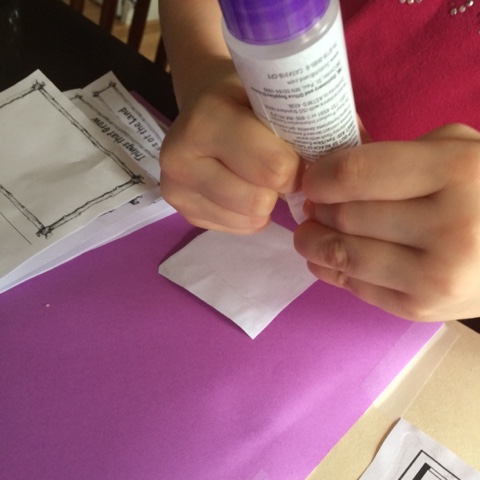
Activity 7, the wildlife and plants of Wisconsin booklet (pictured left), is supposed to be printed front to back. My printer doesn't do that very well, and the instructions for how to do it are somewhat lacking on how the alignment ought to be, so putting that particular book together was something of a headache. We ended up printing two pages and gluing them back to front, and then assembling the booklet from there, rather than printing it doublesided. That being said, that booklet ended up being one of my favorites as the kids filled it out. I had the boys select and draw plants and animals from Wisconsin, and it was fun to see them draw on the things they have learned from our time doing nature study to fill this out. So far, this has been the only booklet that gave us trouble in assembly, and I've worked on 13 of the 20 included projects. All the rest of the instructions have been clear and easy to follow, and even the four year old can do a large amount of the cutting and assembly successfully.

Putting our own rivers on the State is challenging; I'm glad we don't have very many major rivers, and no mountains to try to depict! We ended up with some geographically suspect city placement, even with coaching on how to go about locating cities relative to several points on the border, but I feel like it was a good exercise anyway, and that even with some inaccuracy there's been good learning that went on here. It's also showed me that in our art instruction we need to talk about how to measure and look at some tricks to help my oldest be more aware of proportion. This is good information, and I really handn't suspected it before, so I'm glad that this project is set up the way that it is.


Lapbooks are, by nature, fiddly fussy projects. We don't do a lot of them for exactly that reason. I found that this worked better when we did a section once or twice a week, rather than when I tried to do several in a day. There's a lot of time spent in cutting and gluing. We used some of that time listening to an audio drama, and some of it listening to native drums, but by the middle of the lapbook, it still was feeling like a whole lot of cutting and pasting. However. I think that we did a better job of learning about our State than we would otherwise have done without this project. It really gave a lot of form and structure to "learn about Wisconsin", and they made it easy to know what things to look up. I've lived here most of my life, but in the process of filling out the little books with the kids I learned new things, too. I don't do a lot of lapbooks because they're a lot of fuss and a certain amount of busywork, but it really is a nice format for this kind of study. We need to learn about Wisconsin, and there's a lot of little disconnected bits of trivia that it's nice to know -- which seems less trivial when they're all connected in the lapbook. And the books are really cute as well as they come together. Homeschool in the Woods has even recently started offering À La Cart Projects, so that you can include just what interests you.

If you want to read more reviews of this and other Home School in the Woods' hands-on history products, click the banner below. There's other State lapbooks that are being shown, as well as a variety of American History packages, Old and New Testament materials, helps for composer and artist studies, and some really beautiful timelines that Crew members have been looking at so they can share their thoughts with you.

Click to read Crew Reviews


Crew Disclaimer

24 June 2017

Aviation Learning and Play


Hero(10) loves airplanes. He has for a while now. So he's really enjoying the assignments that I'm giving him from the Doctor Aviation program that we're working on for one of next month's reviews. I love that he's extending the learning into his free time, and so are the younger kids. The boys are having such a good time that they're going beyond what I've asked for, and they're building stuff in their freetime that's based on what they're learning. I love it when that happens. Hero's was very specifically modeled on one of the real airplanes that he's been learning about; Dragon(6) modeled his on Hero's. Gotta love the intersection of learning and play.


27 January 2017

Five Things I Love About Homeschooling


There are so many good things that come to our family through homeschooling. The reality is that you could make a really long list of reasons why homeschooling is wonderful. I've written before about reasons why homeschool is great for me. Today, I want to write about why it's great for my kids.


::Number One::

The purpose of education is more than just filling the brain with facts and useful knowledge; it's the cultivation of an upright character: education should improve the whole person, not just the intellect. Certainly, the intellect is an important part of education, but it's not the only thing. Homeschooling allows us to address the intellectual, the moral, the religious, the emotional, the social, and all other aspects of development, and to do so in a way that fits our family's worldview.

A man may possess a profound knowledge of history and mathematics; he may be an authority in psychology, biology, or astronomy; he may know all the discovered truths pertaining to geology and natural science; but if he has not with this knowledge that nobility of soul which prompts him to deal justly with his fellow men, to practice virtue and holiness in personal life, he is not a truly educated man. Character is the aim of true education; and science, history, and literature are but means used to accomplish the desired end. Character is not the result of chance work but of continuous right thinking and right acting. True education seeks, then, to make men and women not only good mathematicians, proficient linguists, profound scientists, or brilliant literary lights, but also honest men, combined with virtue, temperance, and brotherly love-men and women who prize truth, justice, wisdom, benevolence, and self-control as the choicest acquisitions of a successful life."
-David O. McKay, Gospel Ideals, pp. 440-441, emphasis added


::Number Two::

Homeschooling allows us to put education back into its proper place as the handmaid of religion.  This wasn't at all important to me when we started - it would not even have made the list, as it really hadn't occurred to me. We were initially concerned about bullying and about strong academics. But faith in education has come to be one of the top reasons that I love homeschooling: it gives us the fullest freedom in the expression of our faith in our educational efforts as is possible. At home, we are free to seek learning by study and also by faith. I grew up with the idea that life was segmented: public/school life was one thing, and private/religious life was another, but I don't think that's at all desirable, and I don't want that for my kids. Classically, theology was considered the queen of the sciences; we can put it back into its proper place in our education.

And then we want to study also the principles, and to get the very best teachers we can to teach our children; see that they are men and women who fear God and keep his commandments. We do not want men or women to teach the children of Latter-day Saints who are not Latter-day Saints themselves. ...it is for us to train our children up in the fear of God. God will hold us responsible for this trust.
-John Taylor, Journal of Discourses 20:179


::Number Three::


My kids aren't spending energy on worrying about their safety. We don't have systemic bullying problems: if someone starts being mean to someone else, we deal with it. Quickly, and in the context of our family values. We don't practice what to do if our school suddenly has an active shooter or a bomb threat. We do practice the martial arts, and spend time empowering our kids to be able to (eventually) handle themselves in a dangerous situation. But they're not losing sleep over something terrible happening because they had a lockdown or a shooter drill.

In many places it is literally not safe physically for youngsters to go to school. And in many schools - and it's becoming almost generally true - it is spiritually unsafe to attend public schools. Look back over the history of education to the turn of the century and the beginning of the educational philosophies, pragmatism and humanism were the early ones, and they branched out into a number of other philosophies which have led us now into a circumstance where our schools are producing the problems that we face. 
-Boyd K Packer  (Charge to the David O. McKay School of Education, Oct. 9, 1996) 


::Number Four::

Homeschool means that there is tons of one on one instruction: there will never be more than three students in the vast majority of our classes. It means that we can meet the kids where they are, rather than teaching to the middle, or the bottom of the class, and avoid all the problems that causes. It minimizes the amount of boredom the kids have to endure while they wait for the class to work through material they've already completed; my husband  and I both wasted a lot of time waiting for the class to catch up when we were in school. And nobody is trying to slap a label on my noisy, active boy when he can't sit still and quiet for 8 hours running; he can have strong academics and room to move the way he needs to.

"We believe in education, and we spend a substantial part of our [church's] budget on the education of our young people. We expect them to think. We expect them to investigate. We expect them to use their minds and dig deeply for knowledge in all fields. If we have a motto, it is this: ‘The glory of God is intelligence.’ "
-Gordon B. Hinckley, (Teachings of Gordon B. Hinckley [1997], 127)


::Number Five::

Homeschooling strengthens family relationships, particularly sibling relationships. Part of this is simply the quantity of time that they spend together. Part of it is the quality of time: they see each other when they are at their best, rather than always only when they are tired from a long day of hard work. They help each other, teach each other, play together, and grow together.

"Home should be the center of one's earthly experience, where love and mutual respect are appropriately blended."
-L. Tom Perry, Ensign Nov 2002, page 9


These are some of my top reasons why I think that homeschooling is best for our kids. It's work, and there is some sacrifice, but I think that it is worth every bit of sweat and effort. The benefits we see from living this lifestyle are so far beyond anything that I ever imagined with we began down this road. If you want to read more about why homeschooling families love it, click through and have a look at the other bloggers participating in the Homeschool Review Crew's roundup this time.


The things we  LOVE about  Home  Schooling


07 November 2016

Out in Autumn


We are enjoying an uncommonly mild Autumn. Everybody is kind of waiting for the other shoe to drop, but we're enjoying it until then! When we were out the other day, the first thing we noticed that, although it was mid-morning, there was a lot of water (dew?) on the plants. 


Each little hair on the Mullein was decorated with its own tiny drop. 


The pictures don't really do it justice. And that was just one of the lovely things we saw. 


The kids were all about the quarry area of the park this time. We stacked rocks with the Littles for quite a while while the Bigs played in the bushes.


While we sat and played with the rocks, we found these cool leaves with deep groves in the veins. I don't know what kind of tree they came from, but the looked really cool. 


The goldenrod seeds were beautiful, though my phone struggles to do them justice. 


There were a lot of beautiful little things that it would be so easy to walk by. I love that our Nature Study days help me slow down an see some of this stuff. 


Hero had a chat with a naturalist the other day for a Webelo project, and one of the things the naturalist told us is that nests of sticks tend to be birds' nests; squirrels build with leaves, and they most prefer oak leaves because they break down much more slowly than other types. So I was excited to find a squirrel nest while we were out. 


I was amazed to find these still blooming; I guess the mild weather hasn't been cold enough to put them to sleep, even though we've had several good frosts now. 


When I was a kid, I used to think Autumn was ugly. Dull brown and nothing at all to see. Looking around now, I'm amazed at all the things I was blind to. I'm glad I've learned better; Autumn is lovely.

LinkWithin

Blog Widget by LinkWithin