09 10
Showing posts with label happiness. Show all posts

19 November 2017

The Sabbath and Idolatry

Sabbath Day LDS


There's lots of different things that get focused on when we start talking about the Sabbath day. There's obedience, and holiness, and things we should (or should not) be doing. Sometimes, we talk about certain verses. The Doctrine and Covenants tells us to bring our oblations -our offerings- that we may be unspotted from the world. But there are other, less familiar, passages as well:


Verily my sabbaths ye shall keep: for it is a sign between me and you throughout your generations; that ye may know that I am the Lord that doth sanctify you.
-Exodus 31:13, emphasis added


I feel like, with the Sabbath so often being disregarded, it's easy to think of it as a relatively minor part of the covenant. To be obeyed when there's nothing pressing going on, when it works for you. But if the boss schedules, you... what're you going to do? Ya gotta eat, right?

The Lord is pretty serious about the Sabbath, though.
Sabbath breaking was a capital offense under the Law of Moses.

Stop. Look at that again.

The Lord  is very serious about the Sabbath.
He ordered death by stoning for Sabbath breaking.

The Sabbath is important. All the time-
-not just when there's no game on.

Ye shall keep the sabbath therefore; for it is holy unto you: every one that defileth it shall surely be put to death: for whosoever doeth any work therein, that sould shall be cut off from among his people. Six days may work be done; but in the seventh is the sabbath of rest, holy to the Lord. 
-Exodus 31:14-15


So, why the emphasis? What's so important about a day of rest?

A few years back, I discovered that they publish chronological versions of the Bible, and when my kids asked me to read them the Bible, we decided that's how we're going to do it: we're going to get the story, in order. It's amazing. I can't recommend it enough: putting the story in order makes things make so much more sense. Hero and I have been reading it for a couple of years now; he was pretty small when he made the request. We sometimes read just a few verses, occasionally it's been multiple chapters. And as we go along, passages that I have read in the traditional order, but had not context for, they are starting to come into focus. And sections that always bogged me down and defeated my efforts to read the whole thing cover to cover have been split up and become much more manageable, when read chronologically.

We're about halfway through the book; it's exciting: I now think of it as being halfway through the story. Having a strong narrative to attach the sermons and prophecies to makes a huge difference in how I'm understanding and retain things, and in the connections that I'm able to make as I read it. So. The Northern and Southern Kingdoms have long since split, and the North has fallen into serious apostasy.

It started with Jeroboam. He's always, "Jeroboam, son of Nebat, who made Israel to sin". What a way to be remembered! He introduced idolatry in the Northern Kingdom; taught them to chase after false gods - wood and stone, made by their own hands, gods that don't think or breathe. Gods with no power.  And they refused to return to the Lord, on the whole, until they were destroyed. We read about the brief reprieve, under Hezekiah, who was contemporary with Isaiah (and just a little bit prior to Lehi -- about the same distance in time as we are from Joseph Smith right now). But if you look in the Chronology, in the Bible Dictionary, right under Hezekiah it says, "End of the Northern kingdom".

So, right before Isaiah there was a much less well-known prophet, Hosea. He, like Isaiah, was sent to a people who would not listen. Like Isaiah, Hosea's marriage was made at the instruction of the Lord, and his family was a sign to the people.


And the Lord said to Hosea, Go, take unto thee a wife of whoredoms and children of whoredoms: for the land had committed great whoredom, departing from the Lord. 
-Hosea 1:2


So Hosea does it; he marries a woman named Diblaim, and she bears him three children: Jezreel, Lo-ruhamah, and Lo-ammi.


When the Law of Moses was given, the Lord told them that if they would keep the commandments, they would be the beneficiaries of a host of blessings. Rain in "due season", plenty to eat, protection from enemies -even when the other nations are vastly stronger.


Ye shall keep my sabbaths, and reverence my sanctuary: I am the Lord. 
If ye walk in my statutes, and keep my commandments, and do them; ... I will have respect unto you, and make you fruitful, and multiply you, and establish my covenant with you. ... And I will set my tabernacle among you: and my soul shall not abhor you. 
And I will walk among you, and will be your God, and ye shall be my people.
-Leveticus 26:2-13


So there's this inverse connection between idolatry and sabbath worship: they don't seem to ever coexist. To the degree that you do the one, you don't do the other. If you obey the first of the Ten Commandments, if you have no other gods, then you will keep the Sabbath. They are linked. But Israel in the Northern kingdom turned to idolatry under Jeroboam, son of Nebat, who made Israel to sin. And now as Hosea is sent to them, their day of grace is nearly done, and destruction awaits them, foreshadowed in his children's prophetic names:


Jezreel: once the capital, after the fall of the kingdom it was never important again.
Lo-ruhamah: the name means "not having obtained mercy".
Lo-ammi: the name means "not my people". 

And then there's this amazing imagery, thoughout the book of Hosea, of Christ as the bridegroom -- and His church, the daughter of Israel, as an unfaithful whore of a wife, gone chasing after every sin imaginable, consorting with every other fake and useless god, turning away from the husband who sacrificed His very body for her.

But He loves her anyway.
He wants her back.


And I will visit upon her the days of Baalim, wherein she burned incense to them, and she decked herself with her earrings and her jewels, and she went after her lovers, and forgat me, saith the Lord. 
Therefore, behold, I will allure her, and bring her into the wilderness, and speak comfortably unto her... For I will take away the names of Baalim out of her mouth, and they shall no more be remembered by their name... And I will betroth thee unto me for ever; yea I will betroth thee unto me in righteousness, and in judgment, and in loving kindness, and in mercies. I will even betroth thee unto me in faithfulness: and thou shalt know the Lord. 
-Hosea 2: 13-20


There's this contrast between the richly deserved destruction, brought on by idolatry: betrayal so profound that it is compared, not just to adultery, but to whoredom. To deliberate, repeated, gross unfaithfulness in the holiest of relationships. And in contrast to the abominations of the people, there's this amazing steadiness, this depth of love, of mercy. The Lord knows exactly what his bride has done... and He wants her anyway.

That's Hosea. Hosea taught me what a terrible betrayal it is to put something -anything- before the Lord. And he taught me how, however often, the Lord is not just willing but anxious to have us back. Hosea's whole book is about how much the Lord loves His people. And Hosea's themes come back in later writers. You see it in the book of Isaiah, and tonight we found it reading in Jeremiah.

Jeremiah follows Isaiah, this time among Judah, in the Southern Kingdom. His prophecies cover a good chunk of time, including the reign of Zedekiah, the same king we're familiar with from Lehi's exodus from Jerusalem. Jeremiah picks up Hosea's theme:


Israel was holiness unto the Lord, and the firstfruits of his increase... The priests said not, Where is the Lord? and they that handle the law knew me not: the pastors also transgressed against me, and the prophets prophesied by Baal, and walked after things that do not profit. ... Hath a nation changed their gods, which are yet no gods? but my people have changed their glory for that which doth not profit. 
Be astonished, O ye heavens, at this, and be horribly afraid, be ye very desolate, saith the Lord. For my people have committed two evils; they have forsaken me the fountain of living waters, and hewed them out cisterns, broken cisterns, that can hold no water.
-Jeremiah 2:3-12


In chapter 3, Jeremiah talks about how Judah had her sister's example as a cautionary tale: Israel turned to idolatry and was destroyed, but Judah has only given lipservice to the lesson; she plays at observing the forms, but the Lord is not at the center of her affections. And it's bringing disaster upon her.

And then Jeremiah offers the people the cure:


And it shall come to pass, if ye diligently hearken unto me, saith the Lord, to bring in no burden through the gates of this city on the sabbath day, but hallow the sabbath day, to do no work therein...
-Jeremiah 17:24


The cure for the ills brought on by idolatry, the suffering that comes from allowing anything to come before the Lord in our lives and our hearts, is to shore up our Sabbaths. It is both a barometer, offering us a clue to how we are doing, and also an immunization, offering protection against the evils of the day.

Is your faith wavering? Keep the Sabbath.
Do you need blessings? Keep the Sabbath.
Have you strayed from what you know? Keep the Sabbath.

Keep the Sabbath. It's a starting place. A place to catch your balance and draw strength to face the rest of the week. Keep the Sabbath; attend your meetings and learn how to try a little harder to stand a little taller. It's firm ground from which to begin the long climb to the heights that He, in His mercy and love, invites us: to approach Him, to be joint-heirs with Him.

Keep the Sabbath; He is Lord of the Sabbath, and His plan is a plan of happiness, but unfaithfulness leads to misery every. single. time.

No wonder the Sabbath is a delight! 


18 October 2017

The Family is Central: A Sacred Institution {Guest Post}


THIS POST IS THE SECOND IN A SERIES. SAMUEL HILL IS THE FIRST OF A COUPLE OF GUEST BLOGGERS, ALL OF THEM COMMENTING ON THE FAMILY PROCLAMATION, AROUND THE THEME: FAMILY IS CENTRAL. OTHER TITLES IN THIS SERIES INCLUDE: 

~THE FAMILY IS CENTRAL: CENTRAL TO HAPPINESS 

~THE FAMILY IS CENTRAL: CENTRAL TO FULFILLMENT


Many today wonder why people of faith hold the family in such high regard despite all the imperfections that seem to infect the institution. When we defend the sanctity of the family in the many debates over gay marriage, religious rights, etc., we are frequently criticized for the high rates of abuse, infidelity, and divorce even in marriages of faith.

One answer that we do not often hear from the defenders of the traditional family is this, which I consider to be the most important: the family is a sacred institution to God. Of all the answers that people of faith can offer, this ought to be the most prominent. In the plan of God, the “family is central.” and cannot be done without.

Why this emphasis, not just from people of the Abrahamic faiths, but also from God himself? The simple reality is that the family is THE bedrock of every good teaching, both in a religious sense, and in a worldly sense.

One of the finest accounts of this quality of the family comes from the Book of Mormon tale of the Army of Helaman. Having converted to the faith of Christ from an idolatrous and murderous life, the people of Ammon were threatened with extinction by their former brethren, the Lamanites, because of their faith. “Now there was not one soul among all the people who had been converted unto the Lord that would take up arms against their brethren; nay, they would not even make any preparations for war...” When these people came to “believe and to know the truth, they were firm, and would suffer even unto death rather than commit sin...” And indeed, when their former brethren came to battle against them, the people of Ammon “went out to meet them, and prostrated themselves before them to the earth, and began to call on the name of the Lord...” Although 1005 of them were slain that day, their example swayed an even greater number of Lamanites to repent and follow their example. (Alma 24, approx. 77 B.C.)

Although they found brief periods of peace in the decade that followed, within 15 years they were at war with the Lamanites again. No longer a small skirmish aimed at only a single small population, the full massed army of the Lamanite nation had gathered to conquer or destroy the people of Ammon and their protectors, the Nephites. Seeing the destruction and suffering, the people of Ammon thought to break their word to God, and take up arms against the Lamanites in defense of their freedoms. Instead, 2000 their sons who were too young to join their parents’ covenant forswearing violence, volunteered to go to war in their stead. These “very young” boys are referred to repeatedly as “stripling,” an archaic word that means in essence, a young adolescent. In my mind I liken them to myself as a scrawny 14 year old whose chest was about as well defined as a piece of plywood (apologies to Mr. Friberg).

Despite their youth, and their inexperience in war, these striplings were described as “exceedingly valiant for courage,” and “true at all times in whatsoever thing they were entrusted” (53:20). Their response, when asked by their commander whether they ought to join in a terrible battle against a mighty army, a battle that had already taken the lives of thousands of seasoned soldiers, was thus:


46 For as I had ever called them my sons (for they were all of them very young) even so they said unto me: Father, behold our God is with us, and he will not suffer that we should fall; then let us go forth; we would not slay our brethren if they would let us alone; therefore let us go, lest they should overpower the army of Antipus.
47 Now they never had fought, yet they did not fear death; and they did think more upon the liberty of their fathers than they did upon their lives; yea, they had been taught by their mothers, that if they did not doubt, God would deliver them.
48 And they rehearsed unto me the words of their mothers, saying: We do not doubt our mothers knew it. (emphasis added)(Alma 53, approx. 64 B.C.)


Imagine the example these young men were raised with: Their parents had the conviction to surrender their own lives without a fight out of devotion to their faith; mothers and fathers willing to make the ultimate sacrifice to keep their word to God. I do not wonder that they became paragons of faith, integrity, and courage. Luckily for us, our parents don’t have to be willing to die to show us a good example. Any parent that tries to be a good parent, will learn “to love and serve one another, observe the commandments of God, and be law-abiding citizens wherever they live.”


These are just a few ways that the family teaches us:
  • Pacing the hallway and singing to a child with stomach flue all night while they scream and cry? They learn to understand unconditional love.
  • Admitting to your kid that something you did was wrong and apologizing to them? You’ve just taught them to be honest and humble.
  • Getting up at an absurd hour because someone in your neighborhood needs help? You’ve just taught your kid to sacrifice for others.
  • Explaining to you kid who just dropped an air conditioner out the window that even though you’re upset, you still love them no matter what? You’ve just given them a glimpse of how God loves them.
  • Lovingly working alongside your child to clean the crayon marks off the walls? You’ve taught them both patience and responsibility.
  • Making your kid do chores for money to replace the neighbors window that just met the business end of a baseball? That’s a lesson in accountability.
  • The alcoholic father dragging himself to an AA meeting week after week despite frequent relapses? That’s teaching his kids about repentance.
  • Praying together when you’ve lost your job and you don’t know how to eat next week? You’re teaching the kids to rely on God.
  • Showing up at their baseball game even when you are dog-tired and the weather sucks? You’ve taught them that they matter to you.


This list could go on forever, and I’ve no doubt that most of you are thinking back to things your parents did that left an impression. I think you get the point: There is no other organization or structure on the face of the earth that can impart the many lessons needed to build strong societies, good governments, and a wholesome human race.


Samuel Hill is a husband, father, historian, gardener, disciple, gamer, teacher, political scientist and swordsmen without enough time to do them all. When he's not playing with his kids, he is often found neck deep in some old book that causes his wife to weep with boredom. Thereafter he is frequently found baking something to pay her back.

08 October 2017

The Family is Central: Central to Happiness


THIS POST IS THE FIRST IN A SERIES. I'M LOOKING FORWARD TO INTRODUCING YOU TO A COUPLE OF GUEST BLOGGERS, ALL OF THEM COMMENTING ON THE FAMILY PROCLAMATION, AROUND THE THEME: FAMILY IS CENTRAL.

~THE FAMILY IS CENTRAL: CENTRAL TO HAPPINESS 
~THE FAMILY IS CENTRAL: A SACRED INSTITUTION
~THE FAMILY IS CENTRAL: CENTRAL TO FULFILLMENT


The family is central to the Creator's plan for the eternal destiny of His children -- central to the Plan of Happiness. Families are a gift from God, designed to nurture and protect us here and now, and to fit us for life in His kingdom in the hereafter.


Individual progression is fostered in the family, which is “central to the Creator’s plan for the eternal destiny of His children.” The home is to be God’s laboratory of love and service. There a husband is to love his wife, a wife is to love her husband, and parents and children are to love one another. Throughout the world, the family is increasingly under attack. If families fail, many of our political, economic, and social systems will also fail. And if families fail, their glorious eternal potential cannot be realized. 

Our Heavenly Father wants husbands and wives to be faithful to each other and to esteem and treat their children as an heritage from the Lord. In such a family we study the scriptures and pray together. And we fix our focus on the temple. There we receive the highest blessings that God has in store for His faithful children.
-Russell M. Nelson, April 2008


When I think about our Father's plan, how we lived with Him, and then came to earth to receive a body, to be tested and to be challenged, and all the growth opportunities, the way that we are to live together in love, and when life ends, we are to have loved much and to weep for the loss of those who leave us, and return to Him again. When I think of all that, family is there in every aspect, every step of the way. Family reaches to the very heart of the Plan, so much so that if families fail the earth is cursed, and wasted at His coming.

One of my sisters has sheet music for a song, Keeping Sheep, that compares parenting to shepherding, and talks about all the voices that say that it's not important, it's expendable, it's beneath us. It's a beautiful song, and now that we've got kids, we can't sing that thing without bawling our eyes out. This is my favorite part:


So many voices say to me,
“A sheep-fold is no place to be.
Your time in there is dull and slow,
And lambs leave very little room for you to grow.”

Oh, If I ever start to stray,
Deceived by thoughts of greener pastures,
Remind me Lord, that keeping sheep
Will lead to happier ever-afters.


God works in plain and simple things. The small, the weak, the over-looked. These are His stock in trade. Like ordinary homes, and ordinary, tired parents. He speaks in a still, small voice, one that you have to actively pay attention to in order to hear. And the value of things that He asks us to do is often like that little voice: easy to overlook.

Children need their families. Not preschools, not fancy clothes, not Stuff in all its assorted forms. They need their parents, their time, their attention. Mine need me, and yours need you. Parenting is intense, and it can be really, really hard, and there's soooo many people who want to tell us that it's not really worthwhile. But when we find the heat of opposition is the hottest, that's where the best work for the Kingdom is done. Satan doesn't oppose the stuff that doesn't matter.

Families matter. The traditional family is key to our Father's plan for our happiness. 


29 March 2017

#PrinceOfPeace: Scripture

Finding peace and joy through the words of the #PrinceofPeace in the scriptures. #PrinciplesofPeace


I don't remember the question anymore, but I remember what my Dad told me: the answers to the important questions are in the scriptures. Go to the scriptures. It may take time to find them, but I don't have wait for someone else to answers and show them to me: I can go to them myself, and I can search out the answers to the questions that are important to me.

This changed my life.

Up to that point, I'd been rather passive, waiting for someone to tell me what is in the scriptures. Partly, this was because I was young: it's not unexpected for a child to rely on her trusted adults to teach her. But my dad taught me to act, rather than waiting for someone else to do it for me. He taught me that my questions are important enough for the Lord to answer them. That conversation taught me that I am strong enough to seek my own answers, capable enough (even though I was young at the time) to understand what the scriptures say and what the Holy Ghost teaches.

He was also teaching me the value of scripture itself; I don't think that you can overstate the value of scripture.

Studying history with my kids, one of the things I've learned more about is the heroes and martyrs of the Reformation. Some of them are names known to many - William Tyndale, for instance, who did the first translation of the Bible into English, and was martyred for his work. Other names are not so famous: many common people sacrificed to possess even a few pages of Tyndale's translation -- and some of them died for their sacrifice. I found myself wondering: would I have been willing to take their risks, to make their sacrifices, to pay their cost, in order to have the scriptures? We live in a time and place where scripture is inexpensive or free, and plentiful. We have copies in our home for all of the members of the family, in as many languages as we care to have, both print copies, searchable electronic copies, and audio copies. We mark and use up our books, and then we replace them. And we do it all without fear.

It is a luxury that our forefathers could not have imagined.


Since that conversation with my Dad I've grown up, moved out, and I've got a family of my own. I've turned to the scriptures to try to find comfort in grief, strength to get through challenges, and wisdom to know how to try to help others. In the pages of my scriptures I've learned to find the Lord's love for me.

Verily I say unto you my friends, fear not, let your hearts be comforted; yea, rejoice evermore, and in everything give thanks...
-Doctrine and Covenants 98:1


In the scriptures, I've learned that the joy promised to the Lord's people is not some dim, distant future thing, but can be joy in the present tense, joy in the mist of trial, joy that comes from knowing God's love, and feeling the reality of the Lord's tender mercies.


But let all those that put their trust in thee rejoice: let them ever shout for joy, because thou defendest them: let them also that love thy name be joyful in thee. For thou, Lord, will bless the righteous; with favor wilt thou compass him as with a shield.
-Psalm 5:11-12

Now it's my turn to teach my own children to love the scriptures, to turn to the Lord, and to search His words for the answers to the difficult questions they do and will face. It's my job to let them see me search the scriptures, and working to conform my life to the things they teach: regardless of the cost.

It is written, Man shall not live by bread alone, but by every word which proceedeth out of the mouth of God.
-Matthew 4:3


Learn the #PrinciplesofPeace from the #PrinceofPeace mormon.org


12 October 2016

Counting Blessings

I feel cranky this evening. A little bit whiney. (I hate whining.) So I'm making myself count blessings. But they're not in any particular order.

*I am married to a fantastic man. He works super hard to protect and provide for our family. And he's my best friend. So glad I married my best friend. 

*I get to stay home with my kids. 

*it rained today. I love water from the sky. Bonus points for the way it makes the trees' colors extra vivid. More bonus points for not needing to go anywhere in it. 

*Food is yummy; cooking delicious food for people I love is fun. 

*I have mismatched socks that make me smile. 

*The kids wanted to do watercolors this morning. We abandoned most of the schedule for an art day. It's been a while, and it felt good to put paint on paper, even if I didn't finish yet. 

*My banjo is so pleasant to play. And the 5 minutes here and there are starting to add up a little: I sound halfway credible on a couple of songs, not just Twinkle Twinkle Little Star! 

*I've got a whole bunch of copies of scripture. There's my basic English paper set that's the entire standard works. And the Church's app that's got the whole kit in my pocket to peek at whenever. That's also got the Tripple in Japanese (plus a bunch of other languages, but I don't use those). I've got a paper Japanese Bible, though it's still pretty hard for me. And the Welsh Book of Mormon. That one's cool because Welsh was the first language it was translated into, and it kind of looks like they've never updated it: it doesn't even have verses. I'm not so hot at Welsh, but once I get started, I'll do part of my reading there. 

*My house is heated. I have running water. Which means I get hot showers, more or less daily. This is a luxury that I appreciate. 

*I have children. There was a time when I wondered if that would happen for us. Now we have three

*I have a yard for them to play in - and for me to dig in. Dirt is good for us all. 

*Yoga is fixing my scoliosis. Pretty amazing, given that I was told its incurable. 

*Learning about herbs has dramatically decreased the trips we take to the doctor. We used to get every cold, all the flus. They'd turn into sinus infections, bronchitis, and pneumonia pretty routinely. And sooooo many ear infections. Now we hardly ever get sick enough to be miserable, and it's been ages - probably over a year - since we took any of that stuff to the doctor or had antibiotics. Herbs are a pretty remarkable blessing for us. 

Ok. That's hardly a comprehensive list, but I feel better, and there's some other things I want to do before bed. 

12 August 2016

What Did You Give Up?


I recently read the conversion story of a woman, a liberal university professor living in a lesbian relationship, and a little bit of her journey as she made the dramatic changes to align her life with the Truth she discovered in the Bible. It's a remarkable story, and I find myself wondering if I exemplify Christian love as well as the church she found does. There's a lot of food for thought in the story.


 I had some really burning questions for people. I would go up to my homeschool mom friends, and say “Look, I have to give up the girlfriend: What did you have to give up to be here?” I heard amazing things that made me realize I did not have any more to give up than anyone else. I learned there were other people in my church who struggled with sexual sin, with lust, with faithlessness … and they told me that! They took the risk of no longer looking all cleaned up to me.

What an amazing question. What did you give up? 

My initial reaction was that I haven't given up much. I was born into a family that's been strong in the church for generations. Nobody disowned me when I got baptized; Mom made me a beautiful pink dress (probably the last pink dress I ever owned), floor length, with a sweetheart neckline and this amazing satiny fabric. I was in Little Girl Heaven, and not thinking of sacrifice at all. There were cookies and out of town relatives all smiling proudly.

But later, when the dress and the cookies were done, the work began.

 There was mockery and ostracism at school. 

There was that young man I chose not to date because he did not share my beliefs. 

There was that time when, after I passed the audition, I found that rehearsal was on Sundays and Wednesdays, and conflicted with every church meeting. I can still sing several of the songs, even though I only went twice. 

There was prioritizing marriage over study abroad in Japan in college, and trips to Japan that I skip now because I put my children's needs -my role as a mother- before my martial arts practice and dreams of travel. 

There are homeschool groups I cannot join, opportunities my children are barred from, because we are the "wrong" sort of Christians. 

Job opportunities and other activities our family has walked away from because they demanded Sabbath work. 

There are days and weeks and months and years spent at home, rather than on career, travel, adventure vacations, and so on. 

Once I start thinking about it, there's a fair amount of sacrifice. But it doesn't usually feel that way. Once it did. In junior high school, when I was a pariah, and nobody would talk to me except to mock me, and I wasn't certain of my conversion, when all I saw was stacks and stacks of rules, Thou Shalt Not, but I had not yet discovered why God's plan is called the Plan of Happiness... I'm not so different from the rich young ruler; I was being good, but I couldn't see where it was all headed, either. And we don't know how his story ends; there's no knowing if he came around again later.


Eventually I realized that there are 1001 reasons why we call it the Plan of Happiness; gradually the glimpses of what He is trying to do with my life started to feel real. Things are still hard. They're hard right now, and adherence to the faith is a major factor in what's going on. But there is immense joy in the journey, and satisfaction in the service, too. There is deep satisfaction in knowing that you have done your level best to do God's will - and that He knows it, too. My efforts to give up all I have and come follow Him are still imperfect - but He knows that I am giving it my very best. Effort counts. Intent matters.

When I stack things up and count the blessings and the cost, I find that I have been richly rewarded for the sacrifice. This was the phrase that came to mind:

...it shall be given unto you; good measure, pressed down, and shaken together, and running over...

There's another important thing she says in that paragraph:


I learned there were other people in my church who struggled with sexual sin, with lust, with faithlessness … and they told me that! They took the risk of no longer looking all cleaned up to me.
-Journey of Grace, emphasis added


I think this is important, but it's so, so hard. It's hard to be vulnerable to judgement, to risk revisiting painful episodes, to know how to deal with talking about problems that involve other people without being gossipy, to risk exposing the messy, broken parts of ourselves. We have to be kind and gentle when those around us are not looking "all cleaned up". There's a lot of sensitivity to the Spirit that needs to be had in having this kind of conversation. But look at the fruits that it bore for this church and their new friends, when they had the courage to allow a peek past the cleaned up parts: look at the understanding they were all able to develop, the bridges they became -I love the quote, “You are a bridge, and bridges get walked on.” There's so much truth in that. It's not easy. She talks about how the conversion process creates "comprehensive chaos", and I think she's right. And not just at the outset; conversion is an ongoing thing; we can never stop trying to become better, more Christlike, and the process continues, upending things we thought were solid. Sacrifice is a process of sanctification at any point on the path, not just at the beginning of our journey with Christ.


Let us here observe, that a religion that does not require the sacrifice of all things, never has power sufficient to produce the faith necessary unto life and salvation; for from the first existence of man, the faith necessary unto the enjoyment of life and salvation never could be obtained without the sacrifice of all earthly things: it was through this sacrifice, and this only, that God has ordained that men should enjoy eternal life; and it is through the medium of the sacrifice of all earthly things, that men do actually know that they are doing the things that are well pleasing in the sight of God. When a man has offered in sacrifice all that he has, for the truth's sake, not even withholding his life, and believing before God that he has been called to make this sacrifice, because he seeks to do his will, he does know most assuredly, that God does and will accept his sacrifice and offering, and that he has not nor will not seek his face in vain. Under these circumstances, then, he can obtain the faith necessary for him to lay hold on eternal life.
-Joseph Smith, Lectures on Faith 6:7


So, what did you give up?


And he said to them all, If any man will come after me, let him deny himself, and take up his cross daily, and follow me. For whosoever will save his life shall lose it: but whosoever will lose his life for my sake, the same shall save it.

31 July 2016

Took a Walk

The kids got invited to a birthday party, and I got to take a nature walk all by myself.  That hasn't happened in a loooong old time.


It's really different, doing nature all by myself. I liked it. And I missed the kids.  Before I had kids, I never used to have that problem. I went places and did things by myself, and it was fine. Now, even when I'm enjoying it, I'm thinking, "Oh, Hero would like that. It would be fun to show this to Peanut. That's where Dragon would be jumping." Funny how things change.


I never used to even see the little wildflowers. 


They're all over the place. Little gifts from Heaven.


The trail I was on is a little bit different habitat from where I'm usually birding. 


It's only a little different, but it sure made a difference in the birds I was hearing. 


But quite a few of the ones I know were there. I like that. It's a good feeling, knowing the critters that are around. My bird-friends were singing all over the place. And there was a bunch of little bitty frogs that I kept startling. They were too quick to hop into the underbrush, though, for me to get a picture of them. I ought to learn more about the frogs. They're cool.


Chickadees have been kind of scarce in my yard lately, but there were tons of them in the woods. I enjoyed watching them. They were behaving differently than they do in my yard, too. That's always interesting, watching old friends do new things in new places. Nature always has plenty to teach.


I heard some of the Clay-colored Sparrows that I recently figured out. They're cool; they sound a bit like bugs. Now that I know them, I smile whenever I hear them. They're shy, though; I've only seen them a handful of the times that I've heard them.


The flowers are still blooming, but this one shrub was already yellow, and the cicada song has switched from their early song to the late song. I'm seeing signs of Fall all over, and I'm having a hard time deciding how I feel about that. I feel much the same kind of ambivalence about my kids growing up. They're getting big enough to leave places, without a parent. Even Peanut. I'm slowly getting more "me time". Peanut has a long way to go, still; she's only 3. But Dragon is starting to prepare for his baptism in another 2 years. It'll be done and over so fast, he'll be baptized and preparing for the priesthood, like Hero is now, and I won't hardly know what hit me. Hero is already more than halfway to adulthood - he'll be 10 in September, and when he's doubled his age, he'll probably be nearly finished with his mission. Maybe have a sweet young thing on his mind.

It's a long way off, yet, but I'm realizing that this season of my life, like summer, isn't going to last forever. I suppose that's a good thing. To everything there is a season.

But I'm glad that it's summer now.

14 September 2015

Send Me


Doing surgery on a zebra that has sprung a leak was not on the list of things I anticipated that I'd do when I became a mother, but my two year old daughter is so delighted when her zebra is "all better". I'm delighted too; her delight makes me grateful to be at home to do these "inconsequential" things. Because I don't believe that they're inconsequential at all; I am building a relationship with my daughter. The zebra is just one of many moments where she learns that her mom is there for her.

"Happiness in family life is most likely to be achieved when founded upon the teachings of the Lord Jesus Christ. ... Mothers are primarily responsible for the nurture of their children."
-The Family: A Proclamation


It's a big job, Mothering, and there are a whole lot of things that look inconsequential, when viewed individually. But, for my daughter, the two minutes I spent fixing her toy (rather than throwing it away because it's broken) are a BIG DEAL. Nurturing, Mothering, in many ways they are more than the sum of their parts. It's one of those places where the Lord takes the small and the simple, and magnifies it for His great works. Doing His work means that I spend my days doing small, simple things. Things that, taken individually, don't look like much. Any single moment, any single day, probably isn't going to look very significant. But looks can be deceiving.


Read the rest at We Talk of Christ, We Rejoice in Christ.


31 July 2015

Psalm 5: Prayer and Joy


I've been excited to get to Psalm 5, because it's the first one that's referenced in the Hymnal. So, the first thing I did was to go look up which hymn uses it: Did You Think To Pray. And I found this beautiful acapella version,  which even comes with a bonus verse that I wasn't familiar with: 

When you met with great temptation, did you think to pray?
By His dying love and merit, did you claim the Holy Spirit
As your guide and stay? 
Oh, how praying rests the weary! 
Prayer will change the night to day.
So, when life gets dark and dreary, 
Don't forget to pray.


In our hymnal, the hymn is referenced to  my favorite verse in the chapter:


It's good to be reminded that "prayer is the source of comfort, relief, and protection, willingly granted by our loving, compassionate Heavenly Father. (Richard G. Scott, Apr 2007)" The Psalmist lays out two contrasting paths: the path of wickedness, which leads to destruction, and the path of humility and righteousness, which leads to the temple and to joy. Prayer seems to be the key that turns us from the one path to the other. 


I submit that a return to the old pattern of prayer, family prayer in the homes of the people, is one of the basic medications that would check the dread disease that is eroding the character of our society. We could not expect a miracle in a day, but in a generation we would have a miracle.

A generation or two ago, family prayer in the homes of Christian people throughout the world was as much a part of the day’s activity as was eating. As that practice has diminished, the moral decay discussed by the Apostle Paul has ensued.
-Gordon B. Hinckley, Feb 1991


Although it would take a great deal of time to see the effect upon the whole society, I do not believe that it would take that long for families and individuals to see the impact on a small scale. I know that, when I am doing well with my prayers, my inner peace becomes far more stable, in spite of what may be happening in the world around me.

One thing that stands out to me, looking at all this, is the way that we are able to choose either of the two paths. I intend to choose joy. Joy is the result of choosing God's way -- the way of prayer. The world can be a very dark place, but we are able to choose joy, even in the dark times.

"But let all that put their trust in thee rejoice: let them ever shout for joy, because thou defendest them: let them also that love thy name be joyful. (vs. 11)"


This idea of joy, joy strong enough to penetrate to our core, even in dark, hard times really grabbed my attention, and I spent quite a while studying it. One of the first things I did was browse through the Topical Guide's entry on Joy. There's a lot in there; this list doesn't even begin to scratch the surface, particularly not if you start branching out into related topics, such as Gladness or Peace. Truly our Father's plan is a Plan of Happiness! Here are a few of the passages that stood out to me:

Psalm 5:11
Ezra 3:12-13
Psalm 16:11
Psalm 30:5 (especially the JST footnote)
Isaiah 12:2-3
Matthew 5:11-12
Luke 2:10
John 15:10-12
Galatians 5:22
3 John 1:4
1 Nephi 11:21-23
Alma 27:17-18

Along with all the passages of scripture about joy, there is a wealth of talks that about the topic, and that touch on it in their treatment of other gospel principles. I am convinced that to do an exhaustive study on the topic would take at least as long as going through all the Psalms is going to take me. There's just that much. These were some of the highlights from the material I browsed through:


"Elder Neal A. Maxwell of the Quorum of the Twelve Apostles described President Benson as a “careful watcher of events, [who] maintains a certain buoyancy and cheerfulness we would do well to watch. Such buoyancy,” Elder Maxwell said, “comes not from ignoring enveloping events, but from noticing these and yet looking beyond them to promises having to do with how the kingdom will finally prevail.”
-Teachings of the Presidents of the Church: Ezra Taft Benson, 70


It's an important reminder to keep perspective - perspective which has been easier for me to hang onto since I started studying the Psalms. It sometimes looks dark in our world, but the outcome is predetermined; Good wins in the end. However, the question remains: where will we stand?


"But those who want to improve and progress, those who learn of the Savior and desire to be like Him, those who humble themselves as a little child and seek to bring their thoughts and actions into harmony with our Father in Heaven--they will experience the miracle of the Savior’s Atonement. They will surely feel God’s resplendent Spirit. They will taste the indescribable joy that is the fruit of a meek and humble heart. They will be blessed with the desire and discipline to become true disciples of Jesus Christ."
-Dieter F. Uchtdorf, October 2014 Conference


One way we experience the miracle of the Savior's Atonement is through repentance. I had never considered that there might be a connection between repentance and joy, but now that someone has pointed it out to me, it makes perfect sense. It fits. They fit beautifully.


"Establish an attitude of ongoing, happy, joyful repentance by making it your lifestyle of choice."
-By Elder Jörg Klebingat, of the Seventy, October Conference 2014


Our joy in Christ comes because He offers us the chance to repent and return. And repentance leads directly to deep and abiding joy. What a gift.


18 March 2015

Mormon Bible Study: Psalm 2 (part 4)


It's taken a long time to look at the Second Psalm and all the passages that cite it. This last bunch are all in the Book of Revelation, and they all reference verses 8 and 9 of Psalm 2:

Ask of me, and I shall give thee the heathen for thine inheritance, and the uttermost parts of the earth for thy possession. Thou shalt break them with a rod of iron; thou shalt dash them in pieces like a potter's vessel. -Psalm 2:9


So much of what I have seen as I studied the 2nd Psalm has been repeating the theme: God Is In Control! In the tumultuous times we live in, this is a very comforting theme. After a short break to talk about the nature and majesty of God, that theme is back again. God is in control!


So, the first of the verses in Revelation is 2:27. Chapters 2 and 3 are a series of little letters to various churches that the Lord instructs John to send. In several of the letters there are references to stars (angels/servants - see the JST) and candlesticks (churches). Each one begins with a unique greeting which describes the Lord, and then there are a couple of verses of instruction and warning to the recipients. The verse that references the 2nd Psalm is from the middle of the fourth letter. The Psalm is a Messianic Psalm, that is, it's talking about the Messiah, and this passage also looks like it is referencing the Lord:

And he shall rule them with a rod of iron; as the vessels of a potter shall they broken to shivers: even as I received of my Father. -Revelation 2:27


Right off the bat, the imagery of a "rod of iron" suggests a connection to Lehi's dream. And this makes sense, considering that Lehi, Nephi, and John the Beloved all saw basically the same thing. But the differences in what happens with the rod - breaking vs ruling - are very interesting. That distinction suggests to me the different outcomes  that come from what we choose to do with the word of God. If we choose to have our lives ruled by scripture, then we will find ourselves guided and directed in the way of happiness and peace. Scripture is designed to teach us to live happily. But, if we so choose, scripture, and the eternal laws it contains, are also a rod we can break ourselves upon.


"We are too inclined to think of law as something merely restrictive, something hemming us in. We sometimes think of law as the opposite of liberty. But that is a false conception. That is not the way that God's inspired prophets and lawgivers looked upon the law. Law has a twofold purpose. It is meant to govern. It is also meant to educate . . . God does not contradict himself. He did not create man and then, as an afterthought, impose upon him a set of arbitrary, irritating, restrictive rules. He made man free—and then gave him the commandments to keep him free. We cannot break the Ten Commandments. We can only break ourselves against them—or else, by keeping them, rise through them to the fulness of freedom under God. God means us to be free. With divine daring, he gave us the power of choice."
-Richard L. Evans
(Commencement Address, Brigham Young University, May 31, 1957) (CR, Oct. 1959, 127)


So, here again, is this idea of the futility of resisting the law of the Lord. We can be guided to happiness by a loving Shepherd, but if we won't have that kind of relationship with him, well, the rules don't simply go away. In that case, we end up breaking ourselves upon His rod. And this is as true of nations as it is of individuals.


There is no nation or kingdom that has not received its power from him, whether it be much or little—whether for a day, an age, or century. Whether they make good or bad use of it, all power is ordained of God and is in his hand. He sets up a kingdom here, and pulls down another there at his pleasure. He breaks the nations like a potter's vessel; he forms a nucleus, and around it builds up a kingdom or nation, permitting the people to act upon their own agency, that they may do right, or corrupt themselves, as did the children of Israel; and after they have become ripe for destruction, they will be scattered to the four winds. If the people of God in ancient days had  continued holy, they would have continued in power and authority to this day.
-Brigham Young JD7:148


So, that's the first of the Revelation references to Psalm 2. The second one is in Revelation 12:5. I blogged the process I used to go through that passage and try to unravel the symbols in the chapter. At the end of my study, I think that, again, this passage illustrates the power that God has to direct events, and to see to it that His work continues and flourishes, even in the face of opposition.

At this point, I turned my attention to the final New Testament Reference of Psalm 2, which is from Revelation 19:15.


And out of his mouth goeth a sharp sword, that with it he should smite the nations: and he shall rule them with a rod of iron: and he treadeth the winepress of the fierceness and wrath of Almighty God.


One of the first things I wanted to know about here is winepresses. So I visited YouTube to see one in action. I watched several, and I'm glad that I did. This first one shows the particulars of how to use this type of winepress, which apparently is a pretty traditional design. Some of the clips showed the lever going all the way around, rather than racheting, but otherwise, they were all pretty much the same.


"Don't go too fast," she said. That really struck me. The process takes time, and can't be rushed. The Savior spent all night in the Garden of Gethsemane; His process was not rushed, either.

Here's another one video. This first lady was making apple juice, and she had the best explanation of the mechanics of the press, but the symbol in the scriptures was specifically wine, and I've always understood that to be grapes, which is partly an assumption, I think, but one based on how the olive trees were commonly grown in the same garden as grapes for wines, which is why the gardens were referred to as vineyards. That imagery occurs over and over in the scriptures, so I'm guessing the wine is grape wine. When I looked at one that was specifically wine, it was easy to figure why that would be used as a symbol. The red grapes, being crushed, are a very vivid image.


The symbolism of the red juice from the grapes is striking. It stopped me in my tracks, watching the stains on the side of the press; it's so vivid. It took a while for me to see the connection to the theme of the rest of the things in these verses, but once I found it, it's so beautiful:

God is in control. His power is sufficient to still the storm - both the external storm of nations and events, and also, if we just let Him, His power is sufficient to still the internal storm, the one within us. Stilling the internal storm is the reason that Christ "treadeth the winepress."

Peace; be still.


11 December 2014

Singing Praises Again


When my daughter was in the hospital, The Lord taught me some beautiful things about getting through hard times. And, as happens in this life, hard times have a way of coming for more than one visit. This time, as I was talking to my sister, Heidelbeere, we were getting a bit bogged down, and I suddenly remembered. It went like this:

"Remember the Jaredites, sloshing around in the bottom of those ships? With the poo and the bees?"


"What a pleasant picture you're painting." She had no idea where I was going with it. I was smiling more already.

"I know, right? Do you remember what they were doing?"

"No."

"Singing praises. The whole time. We need to find something to praise."

So we did. We counted blessings. And I have been continuing to do it off and on all morning. This pretty much sums it up. I love this music anyway, but it's especially moving today.


Gloria. Gloria in excelsis Deo. 

Glory to God in the highest!

 Christ already fixed it. He already fixed it, before our hurt ever happened. And we can benefit from it as soon as we will let Him give us His gift.

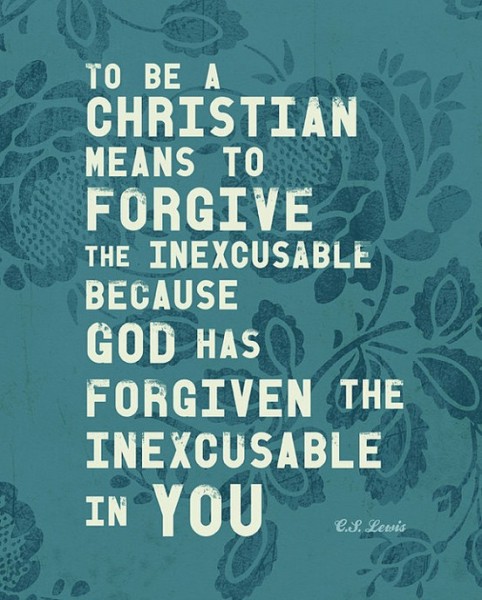
I spent some time thinking about forgiveness today. It's hard to forgive others; it's hard to forgive ourselves. But what a gift! He makes it possible. That's why we sing. That's why we shouted for joy!


Here are some of the things I was reminded of today, wandering Pinterest, and thinking about forgiveness.


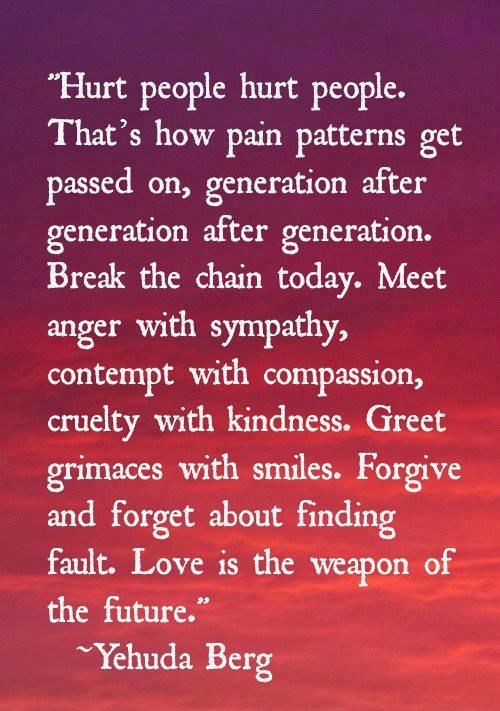
It's true. Hurting people hurt others - often without really even meaning to do it. Christ's love is the cure. "Mary, did you know?" Her sweet Baby Boy is the reason that forgiveness is meaningful.What a beautiful, healing gift He has given us!

I wrestled with this on and off all day. I've been feeling hurt - and I know that what I'm feeling can't hold a candle to what some of my very favorite people are feeling, and that hurts too. But I kept pinning, kept thinking about forgiveness.

Eventually, I came to this one, and for whatever reason, I clicked through and read the story. I never do that with these inspirational quotes. But I'm glad I did with this one. It's worth reading. I'll wait.


I've done some pretty thoughtless things. Some, not too unlike the thing that's hurting today. The Lord, in His mercy, has been working with me to let go of the blame and guilt I still feel over it... 20 years later... and He took the opportunity to teach me some more today.


 I needed to hear that. I was praying about it, a little later on, and apologizing. Again. "I'm sorry for being dumb-- " The Spirit stopped me. I wasn't supposed to say that. He gave me another word. "I'm sorry for being young." For not knowing what I didn't know before I learned it. And all the sudden, it was clear that I'd been holding myself to an absolutely impossible standard. And it made it easier to extend grace to myself -- and to others. My mistakes are not excusable. But they are human. I didn't mean to hurt anyone. I have a new appreciation for the hurt I dealt anyway. But the Lord fixed it. He fixed me, and He fixed the hearts I hurt. He can do it again - He'd like to.


By the end of the day, I was feeling much better. And I'd been able help to do and say things that started to bring healing to the situation that made us look for reasons to sing praises in the first place.


It's not just couples. It's relationships. And it doesn't have to be a hurt that grows out of a fight. But what happens after, that's what defines the future. It's the application of Grace that makes you grow stronger together. And there is absolutely no hurt too big for Christ. His Grace is sufficient. Sufficient for all hurts.

And that is something worth singing praises about!

This one is one of my favorites. Had us dancing all over the kitchen, and singing praises at the top of our lungs. 


Gloria in excelsis Deo. 

LinkWithin

Blog Widget by LinkWithin