Education is the Science of
Relations’; that is, a child has natural relations with a vast number of
things and thoughts: so we train him upon physical exercises, nature
lore, handicrafts, science and art, and upon many living books, for we
know that our business is not to teach him all about anything, but to
help him to make valid as many as may be of those first-born affinities
that fit our new existence to existing things.”
-Charlotte Mason, 12th Principle
When we begin to study a foreign language, we are beginning a whole
new set of relationships. The serious student of an additional language
will eventually open the door to relationships with a whole new culture
and the people who inhabit that culture both in the local community and
also, through technology, gain the ability to communicate with people in
the areas where the “foreign” language is the local community language,
even if they cannot travel there in person. The student learns new ways
of describing all sorts of things, and (perhaps more importantly) new
ways of thinking about the things they describe. No wonder learning a
language is a daunting task! Sadly, too often, students of languages
learn little, and retain less: even reasonable fluency is a distant goal
that few seem to achieve outside of those favored few able to spend
several years living in an area where the new language is spoken.
We use the traditional copywork method as our primary handwriting method; the kids first write letters, then phrases or sentences, and then longer passages, as their ability matures. In the beginning, especially, the amount of writing actually done is relatively small; handwriting sheets from outside of the Classical education philosophy typically are too long for the beginner. More importantly, they have too few models for the student to look at.
Set good copies before him, and see that he imitates his model
dutifully: the writing lesson being not so many lines, or 'a
copy'––that is, a page of writing––but a single line which is as
exactly as possible a copy of the characters set. -Charlotte Mason, 1:235
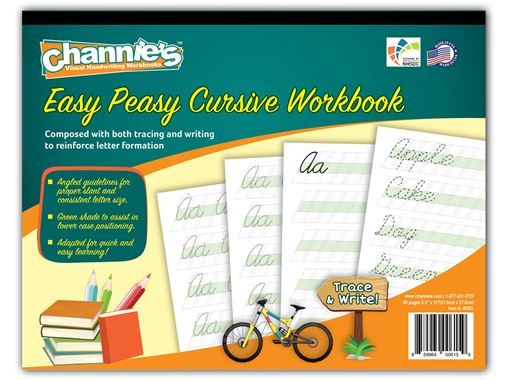
We were given the Easy Peasy Cursive book, from Channie’s Visual Handwriting & Math Workbooks to review. These are simple and straightforward: notepads full of letters to practice. There is a page of letters to trace, a page of trace-then-write, and a page for writing independently for each letter. At the back of the book there is one page, front and back, for practicing words.
We follow Charlotte Mason's classical education philosophy, and she says this about practicing handwriting:
Set good copies before him, and see that he imitates his model
dutifully: the writing lesson being not so many lines, or 'a copy'––that
is, a page of writing––but a single line which is as exactly as
possible a copy of the characters set. The child may have to write
several lines before he succeeds in producing this. -Charlotte Mason
I've found this to be good advice in the past, to focus on helping my kids to produce just a few beautiful letters, rather than going for a whole page. We've always started with letter formation first, then moved into words, and this workbook is great for the letter formation part of the process. It was no problem to use this book in a Charlotte Mason-friendly way: although the book is printed in a way that suggests that you could just sit down and write the whole page at a go, I chose to work on it line-by-line with him: we never work more than one line of any letter at a sitting. The large number of examples means that he's always got a beautiful sample to look at; it's just how I do it when I make up my own sheets. The first day I just opened it up to A, then let him choose what he wanted to for the second letter; he chose I. Completely open-and-go. I love that.
Finding a pen that works well for the pages was a little bit of a challenge: I felt like the mechanical pencil that we happened to grab the first day wasn't a good choice: the dots that you trace are pretty dark and quite close together, and I felt like it was hard to see the pencil lines. We tried ballpoint pen, but ended up settling on a very fine line Sharpie. The pages are just a little slick, and the letters close together, so our Crayola markers were out of the question: the ink would smear, and it's hard to make beautiful letters when your ink is misbehaving. But the ballpoint pen was adequate (can you tell I'm a pen snob??), and the Sharpie worked out pretty well -- I was worried that it would bleed through the paper, but it's not too bad.
The one thing that I wish they had done differently with these is that I wish that they had included more words to practice, or several blank pages so that I can give him models to practice. But the book is almost entirely letters. And that's good, as far as it goes, but where the paper is so very specific, it would have been nice if they had allowed for more than just letter formation.
As far as how I feel about these, I really want to like them. The idea is great, the slanted boxes to give spacing is brilliant -- and it should have been relatively familiar, because our Japanese also happens in boxes to get the spacing right, and Dragon(7) doesn't have any problems with that. But he's really struggling with this, in spite of having been excited to learn cursive when we got the book. It's not working very well at all: he can trace the letters, but when I ask him to draw his own, even right next to a model, immediately after tracing several, he just can't do it. I had him try a couple of things in his regular notebook, and it is just funky. That thing on the third line is a capital and lower case L, drawn immediately after practicing in the workbook. He's all over the place with it.
I suspect that the issue that Dragon finds cursive challenging, more than that the workbooks aren't a good system. While he hasn't completed all of the practice, I didn't anticipate that he should need that much repetition in order to be able to write with a model, rather than tracing. My plan at this point is to put away cursive for six months or a year, and then revisit it, and see if it makes more sense to him. His printing is still a little bit unsteady, and we're working on things like consistently getting upper case letters out of the middle of words -- there are a couple of letters where he strongly prefers the capital, and will chose A over a every time, even in the middle of the word, if I let him. So I wonder if this book won't work better for him later on, after his printing is a little more consistent and his writing a little more mature in general. Maybe I should get a Quick & Neat Alphabet Pad, and see how he does with that.
If you want to read more reviews of Channie's Visual Handwriting & Math Workbooks
- there are a couple of titles the Crew is looking at- click the banner
below.
In order to learn to read, new readers must internalize a number of skills. They have to recognize that letters represent sounds, and master about 44 sounds which are represented by a mix of individual letters and letter groups. As they learn to recognize which letters make the various sounds, they need to have enough practice to gain fluency with those words - research into how kids learn to read tells us that most kids need between 4 and 14 instances of seeing a new word before recognizing it becomes automatic. Give then number of words that kids need to learn to be able to read well, it is clear that they are going to need a lot of practice. Teaching kids systematic phonics helps them to progress through the various letters and letter combinations in an easier-to-harder order, and it also assists the teacher in knowing what kinds of words they know, so that we can find them books that are suited to their reading level. We want to consistently provide good books that are not too hard, not too easy, but just right.
At first, kids need books that are written with a limited vocabulary. I am a fan of the Bob Books because the first book requires only 4 letters to read successfully: kids are able to read a real book very early in the teaching process. We use a combination of Happy Phonics and The Ordinary Parents' Guide to Teaching Reading, and I have adapted the little stories in TOPGTR into little books that I made up for my kids. These homemade books are great because they continue with the limited set of sounds that the kids have already learned, and finding ready-made phonetic readers is difficult. Fortunately, they're not hard to make, and kids are not demanding as far as the pictures go: no amazing art skills are needed. Stick figures will do.
After that, I get out our box of "easy books". These are leveled readers, which I usually pick up at Half-Price Books. Because we're getting them used, they're not expensive, and that means that we can make sure that there are books in our box that are interesting enough to be worth the effort of reading. The jump from phonetic readers into Step 1 books has been a big leap for my kids. I will sit next to my kids and help them read these, but I do not read books from the Easy Box. I will help, and I will read our regular picture books, and we consistently keep a chapter-book read-aloud going, as well as various LibriVox titles that the kids ask for, but I do not read books from the Easy Box. If they want to know those stories, they have to do the work themselves. This incentivizes them to make that jump -- I am careful to make sure that there are books in our box that are worth their effort to read! For Hero, this meant that I located easy books about superheroes: nothing else was worth it. Dragon is much less demanding.
It's tempting to stop at this point, and consider the child a reader when they can read the leveled readers and start to branch out into the regular picture book collection. However, until they are reading chapter books fluently and voluntarily, they still need support and encouragement, as well as books that have a somewhat limited vocabulary and syntax.
Early chapter books sometimes get a bad rap as being twaddle, but I think that's overly harsh. I consider them a bridge. They are not literature, exactly, but neither are Bob Books. To me, books like Magic Treehouse , or D.C. Heroes that Hero loved when he was learning, are an extension of the same concept of the Step 1 readers: books written with deliberately limited vocabulary and syntax in order to facilitate early reading. For Hero, we had an additional step between the stepped readers and easy chapter books: graphic novels. Those helped him get used to a book-length work, and they have a larger word count than picture books, too.
None of them, Bob Books, Step readers, graphic novels, or easy chapter books are fantastic literature. But I won't call them twaddle, either. I looked much less at the style, syntax, or vocabulary used, and more at the type of story. He wanted heroes; I wanted stories that had a clear good vs. evil, where the good guys were square jawed heroes, and the bad guys were bad -- none of this grey, likable villain garbage. I wanted to see the heroes winning; justice being done. I liked to see ordinary people doing heroic things; I really like the older versions of Batman, and the kids' versions: he's a normal guy that works hard, thinks hard (oh, and he's filthy stinking rich), and that work, and his mind, those are what make him special. In the older Batman stories, and the kids' stories, then you see him when it's not so dark and gritty -- they haven't made him almost a bad guy himself, and he's much more relatable than some of the super heroes that are mutants. I think that, in a lot of ways, the superhero tales we have are the modern answer to fairy tale quests, and we have encouraged both superheroes and fairy tales. Superheroes were the only thing that Hero found to be worth the considerable effort of reading, there for a while. Now, Dragon is reading the hero books that I bought for his big brother, and they're helping him bridge into the more difficult literature that I've got in store for him.
An emerging reader needs support. Some take to reading quickly and easily. Others are more reluctant readers and they need works that help them. Building fluency can take time, and it plain old isn't fun to struggle through a book that's too hard. We want reading to be a pleasant activity that they do voluntarily, and giving kids books that are appropriate to their skill level, even as they move into chapter books, is an important support. For some, it's critical. Hero was a very reluctant reader for a long time. If I had not been willing to give him books that had a somewhat limited vocabulary and syntax and that he found interesting, he may have never made it over that hump. This is not to say that we put just any old thing into his hands; I still didn't give him books that are based on rude humor or other twaddle. Meanwhile, the feast on real literature continues in our read-alouds, same as always.
For my kids, I aim to get them reading well. Fluently and voluntarily. Without tearing apart the groundwork we lay in hundreds of hours of snugly stories from birth, establishing reading as a pleasant thing, a great leisure activity, I want to make that transition to voluntary reading, which means that my emerging readers chan have limited vocabulary & syntax for a time if they need that kind of support for a little while.
All this week, I'm going to be posting about books. Stop by again to read about:
The 5 Days of Books series is
part of the Homeschool Review Crew Annual Blog Hop: 5 Days of
Homeschooling. Click this graphic to see what other Crew members are
writing about.
One of my favorite homeschooling milestones so far is that point where they finally get good enough at reading that they discover that reading is delightful, and you start to see voluntary reading. Dragon is there. And it's just so much fun to see him read -- and read to his little sister -- and enjoy it so much.
We're learning about local frogs this year, in the hope of possibly recognizing them better when we're out and about. Our State has only about 12 of them, so I've slipped them in here and there on our schedule. Today's frog is a cutie: Blanchard's Cricket Frog.
This is the first time I've done a study
like this, and I'm not quite sure how to take it from our kitchen table
to being able to actually being able to identify frogs when we find them
next summer, but I figure the chances are better with a inexpert effort
than they are if we don't try at all! So right now, we're drawing them. And listening to some YouTube recordings of their song. And that's pretty much it. Today we did Blanchard's Cricket Frog, which is a cute little thing: fits on a fingertip with plenty of room to spare.
This is the drawing from Dragon(6). In addition to learning about these cute little guys, he's also learning to see well enough to draw. I have him sit on my lap (ufta! he's not little anymore!) and help him know what to look at, and how to really see it in a way that works for drawing:
He draws a circle for the eye, which is the most prominent feature.
"Look, the eye is cool, but it's easiest to start with the outline of the whole frog, and worry about the inside details later; let's save the eyeball for last, so you can tell more easily where it belongs. Look at the frog's nose, instead. See how this part is part of a circle?" -I run a pencil along the curve of the frog's mouth, showing him the circle-
"Next to that big circle part, there's this small curve, where the other eye is hiding. See how those connect?"
"Yes."
"Do you think you can draw the big circle part and the little one? Can you see how they go?"
"Yes." And he did it pretty credibly.
"Good. Now, look, first. Put your eyes up here on the picture. See how his back goes along like this, not super round, but not quite curvy, either?"
We went along like that, trying to help him to see what he needs, and reminding him to look at the picture before he draws, and at the end, his frog is pretty credible, particularly the front half, and the front leg, which he did entirely by himself. He's making good progress with his drawings, though judging from his comments after it was done, I don't think he can see his progress, yet. Unfortunately, his nature book is lost right now, so we didn't put this in there, just on regular paper, which makes it hard to look back and see how progress really has been happening. Hopefully, we'll find it soon and tape in this drawing.
Hero(10) is well past the point where he needs me to sit and hold his hand. He's been turning out stacks of ever-improving drawings for quite a while, now, and I didn't have to do any more than just show him the frog I wanted him to observe, and let him choose which picture he was going to do; he takes care of the rest.
It's been too busy a day for me to get this drawing into my own nature book, but I'm hoping that, here in the next little bit, I can put a cute little frog in my notebook, and possibly even paint him a little to show his lovely colors. I've got a cottonwood leaf pressed in my book that I'm finishing up this evening.
I've noticed that, among the many amazing Mother-Educators in the Charlotte Mason tradition, there are a ton of very smart women who hold Shakespeare in very high regard, but I've never cared enough about Shakespeare enough even to dislike him. None of his works I've been exposed to was at all interesting; they have been uniformly dull.
Part of this comes from appallingly bad teaching. In eighth grade, when we "did" Shakespeare, the teacher had been a remedial teacher, but, he regretfully informed us, they had gradually taken his remedial classes away from him, and so he was teaching us. (I always felt so sorry for the struggling learners with no escape, and no inspiration to love learning from a man like that.) He waxed poetic about the value of watching the play, then showed us the same 5 minutes 5 days running, and no more. I think we might have read a few lines, too, but can't remember for sure. I was so painfully bored in that class that I often would watch the second hand go around the clock, noting the time each time it passed 12. For the whole hour. Because watching the second hand was more interesting than the class. So that's how we did Act I. Then he told us that nothing of importance happened in the middle, and we skipped to the end, which he butchered in precisely the same fashion he had used on Act I.
This did nothing to endear the Bard to me, and if we did any other plays in school, I don't remember it.
But the Ambleside ladies insist that he's worth reading, repeatedly, and they are, particularly collectively, very, very smart, so we're giving him a shot. The Ambleside Online schedule has Taming of the Shrew on their list for this year, so that's what we started with.
Then, the consensus being that Shakespeare is meant to be watched, not read, we watched the movie. The boys loved it. I was not so sure, and went back to the Ambleside ladies and grumbled a bit, and asked for more encouragement, which they very kindly gave.
So we printed out a copy of the frame story's script, and we looked up some of the hard words, and read through it, using stuffed animals on a blanket "stage" to help us follow the action. That was kind of fun. Hero and I did all the reading, but Dragon and Peanut both participated too - I helped them to say a few lines each. (Don't you love the Jedi suit? It was his Halloween costume, but he wears it all the time.)
Then, we watched the play again. This time, I liked it lots more than the time before. I'd understood the words the first time -- but not the puns and plays on words. And, with the additional context from the frame story (which the movie version skipped), the whole thing was just funny. Hero's favorite part is the part where Patrucio kisses away Katherine's refusal to marry, and my favorite is where Luccencio's dad shows up, and he's almost the only person not pretending to be someone else, but nobody believes him!
The ladies on Ambleside say that Much Ado About nothing is a good play for beginners, so I think that's going to be the next one that we do. Because maybe Shakespeare is worth a little effort!
Dragon has been working with patterns for several days, now. The first day, we did a worksheet, and it was tough. Especially the ones where he was supposed to leave a blank spot. He needed a lot of help to figure out what was supposed to be happening. So we've been practicing.
So we've spent several days doing patterns of various sorts. Yesterday, we made rod shapes, which looked cool, but I forgot to take a picture. Today, he was already playing with the Duplos, so we used those to practice patterns.
It's still challenging, but with practice, he's making good progress.
Every so often, I like to do a section where we just play math, and it's just about time to have a couple of those days. Happily, we have some fun ideas that I've been finding, and I think that we'll be playing for the next couple of days. There's square numbers with pennies, and we tried hexaflexagons before, but they didn't work for us (we learned other fun things, though, and it wasn't wasted time), but a friend sent me the page that she found with templates. These will be on the agenda. Soon.
First, we played a cool multiplication game that I found on Pinterest. We rolled some dice, and colored in a matching rectangle: 2x4 gave us two rows of four. I made a rule that you had to color the correct rectangle, no breaking it up to fit better. At the beginning of the game, this was no big deal.
But as things went on, and our game board filled up, it became an important rule.
Not only did we each forfeit rolls that couldn't be placed on the board, but it also became very apparent that, although 2x6 and 3x4 both result in 12 squares, they are not exactly the same - the difference in those two rectangles could make the difference between scoring or not at the end of the game.
We played until we had 12 forfeits in a row; then we added to see who won.
Hero had never done extreme column addition before, and so this part was also challenging. I showed him how to break it up into manageable chunks, and how to carry when you need to carry a double-didget. It was fun! He wants to play again, and so do I.
Days where we play math are some of the best math days.
I think one of the most exciting milestones in learning to read is voluntary reading. That's the part when you can tell that they are gaining enough skill to begin to see what all the hard work of phonics is about, and it just might be my favorite part of teaching the kids to read.
Dragon is reading today, without being asked. He asked for a box of Bob Books, and started out reading to the Daddy, but when Daddy had to go do other things, Dragon kept going. There are several books from that set that are lost now, but what was there, he read.
Then he came looking for another box.
But I think the best part was when he commented that practicing the Bob Books will make it easier to read the scriptures.
Yes. Yes, it will. And that is a worthy goal for a little boy.
I've been able to write hiragana for years, now. Since college, when I first started learning Japanese in 1996. But there's always been something slightly "off" about the way I do it. I discovered a while back that the cool square paper they use in Japan really helps, but still, something isn't right.
These days, there are so many cool resources on Facebook. There's a grammar discussion group that's really friendly and helpful. And earlier this week, I found Japanese Language for Mama. Which, if it lives up to the name, is right up my alley. This evening, she posted this:
It has been so very long since I watched someone who knows what they are doing! And, watching, I was able to identify what it is that I'm messing up on a couple of mine. It's late, tonight, but tomorrow, as we're doing school, I definitely want to get my pens and square paper out and practice writing some more. I'm excited.
We've been doing Norman Rockwell for artist study, and it's going pretty well, in spite of the kids' protests that he's not interesting. I think they're just not quite old enough to appreciate some of the stories he's telling, because Rockwell is hilarious. One of the things that I've seen people talk about loving, as they're studying various artists, is copying the artist's work or style, so we're trying that. By calling it "art copywork" the kids knew right away what we were after: we were going to copy someone else's work in order to learn from it. I promised them that, once the copywork was finished, they could use additional papers to draw pictures from their own heads, which Dragon(5) was particularly excited to do.
First, we visited a Norman Rockwell exhibit here in town yesterday. Next, Hero(8) and I read a bit about Rockwell's techniques. My big takeaway was that he took his time and paid attention to details. Hero was introduced to the idea of planning your work before you put pen to paper, which he said he had never really thought about before.
Then, we all picked one of Rockwell's pieces off the internet, I printed out a little picture for referencing, and we all got to work.
It was about this time that I figured out why it is that people are spending time and money getting nice copies of works from their artist in binders: the little picture I'm working from is small. There is so much detail, but it's so hard to see - and worse after I put in a few lines to help me with the proportions, an aspect of art where I am notoriously weak. I looked at the internet, but it wasn't tons better there: things are still difficult to see, and I find myself wishing that I was at the museum again, where they had larger prints, so I could really see what I'm looking at. I don't know if I'll be able to do tons with printing things out right away, but going forward, it's definitely going to be something that's in the back of my mind.
Dragon and Tigress(2) painted with us, but they are still doing process oriented art: the painting is fun, but the product isn't so important, though it's fun to give it away as gifts. "Here, Mom! This is for you!" Dragon knows that I like it when they do art, and his work will go on our art wall when it's dried out.
But Hero and I had a good time with some more product oriented art: we were working toward a specific final goal. One way that our work is different from Rockwell's is that we're using our watercolors, and he worked in oils, which we don't have. And I don't know that we'll try those for a good while yet: I don't want to mess with all the thinners and cleaners and so on while I've got little kids. In the mean time, this is a nice opportunity to try to develop our skills working with watercolors.
I love the Story of the World and its Activity Guides, but I've always felt a little bit inadequate with the map work. Maybe because we frequently forget to do it. Maybe because I've always felt like my own geography is barely adequate, and I'm not at all sure what to do about it. Maybe because there are so many intriguing places, but it's not maps that speak to me - it's stories. So that's what we've focused on. But maps are important, too, and I've been realizing that they add to stories, even tell stories of their own, if you just look long enough.
However, figuring out what more there ought to be... that's not easy. Yesterday, I happened across the term "map drills" on the Ambleside Forums. I still have no clue what, exactly, map drills are, but I did find something that's improved our map work. This post has some fantastic ideas. We tried this part today:
Find a map of South Africa in this atlas (student does the work for
himself). Look at it closely. I’m going to pass out another map of South
Africa as well as two blank maps. Spend some time with the maps: look
at the colored, labeled map and spend some time with it. I’m going to
pass out a list of features and locations that I want you to pay
particular attention to, but notice whatever is of interest to you about
the map.” After ~5-10 minutes instruct the student to fill in one of
the blank maps, including everything that is on the list as well as
anything else of interest to him. After another 5-10 minutes: “Okay.
Please stop filling in your map now and let’s talk. Where is South
Africa? What countries border it? What rivers do you see? Describe the
country. What is the capital? Where is the capital? What mountain ranges
do you see? What other geographical areas do you see? What else? What
struck you about this map?”
We just read in Story of the World about Catherine the Great, of Russia, so we printed out a map of Russia. Then, I gave Hero our kids' atlas of the world, made sure that he knew how to use the table of contents (and pointed out that, Russia being so large, it's done in two different sections, so make sure to read them both), and walked away. That was hard to do, which is ridiculous. He's growing up, and he's ready. He can read it and then narrate it. But the micro-manager in me is resisting giving him responsibility. He did beautifully. I came back and re-read the post, so I'd know what I wanted to do next. When he was ready, I told him to find some interesting things on the maps, and also St. Petersburg. Then, I had him label those on his blank map. He looked around and colored in the water (I'd had Dragon do that on his, so he could tell it from the countries we were talking about), and colored in Germany (again, part of Dragon's exercise - it's where Princess Sophia came from when she married into becoming Catherine the Great). And he wrote a couple of city names on there, since he thought that the long Russian city names were the most interesting.
Hero's map.
Dragon did great with coloring Germany and the Baltic Sea, but when I traced out how big Russia is, he was stunned. And completely uninterested in coloring that whole big thing. Honestly, I can't say that I blame him; it's huge. So we got out a fat marker and drew big stripes. It still makes Russia pop, and emphasizes its bigness. Works for me.
Dragon's map.
Then, we talked about latitude a little, and how we, as close as we are to America's northernmost point, are at about the same latitude as Russia's southernmost area. So we listened to some Russian folksongs, and looked at pictures of Siberia. Siberia boasts the coldest inhabited place on earth. There's some pretty fantastic pictures. But they do, in fact, have summertime. Looking at our globe, I also realized that basically the whole of the Asian portion of Russia is Siberia - it's huge! Much bigger than I had realized. (I love that I get to learn with the kids.)
I'm still interested in learning about what these mysterious "map drills" are, but in the mean time, we had a good time learning about Russia. I really like doing the map work as its own section, rather than thinking of it as a history add-on. At the end of the work, Hero and I talked about it and agreed like we both felt that this was more effective than what we've done previously. Hero had already read a book of Russian fairy tales, and now he's got not only the history that we've been reading, but also a sampling of their traditional music and a better idea where they were in the world. Dragon also got a lot of the same, though at a less in-depth level, which is fine, since he's 5. At the end, they both have maps to file away to help them remember the work they did. Not too shabby.
A pretty typical day in our life. We have a 4th grader, a kindergartener, and a toddler.
9:00AM - Alarm goes off. I snuggle Tigress(2) as she asks me repeatedly, "Are awake, Mama?" and chat with the Daddy for a couple minutes.
9:15 - Getting up and out of bed. Dragon(5) pops in to say good morning, and the Daddy wakes up Hero(8). We're meeting some friends for Nature Study at "our" preserve this morning, plus I need to stop at the church to let someone in to do some cleaning. I head to the shower, and the Daddy chases people into day clothes and starts getting breakfasts.
9:55 - My person calls me to let me know he's at the church and ready. I thought we were meeting at 10:10...
10:12 - We pull into the parking lot at the chapel. I start to think that I've timed this too tight and underestimated the chatty nature of the person I'm letting in. Oops.
10:30 - Still at the church. My friend is at the preserve, and texts to find out if we're almost there. I call her and explain. We take off.
10:45 - Arrive at the nature preserve. I love it here. I've been reading Biology in a Day, and I'm excited to look at the plants. I've read about a couple of families so far: mints and parsley families, and I know a bit about the Asteraceae family from work in my Herb First Aid class that I'm still slowly working through. We've been doing swim lessons all summer, and lots of travel, and this will be my first chance in a long time to do nature study with the kids. I'm excited.
We find this gorgeous thistle. The kids don't care today - they're running and shouting and having a great time. I can tell it's been a while since we've done this. But they'll settle down after a few minutes. My friend and I admire the thistle anyway.
I'm extra interested in the Queen Anne's Lace, since it's one of the umbral flowers in the parsley family. I can tell it's not the Yarrow I'm hoping to see, because the leaves aren't Yarrow leaves, so I post to the Plant ID group I found on Facebook, checking to make sure it actually is Queen Anne's and not something else.
There's a lot of it, and I wonder if it spreads underground like Yarrow and Pando, and if it does, does that mean that all the Queen Anne's Lace in a given clump actually counts as a single plant? I don't know, and I'm not sure where to find out, but there's still plenty of botany to study. I shelve the question for later. Meanwhile, one of the toddlers pulls up a plant. I had been wanting to, because I want to draw it, so we tell him not to do that (it's a preserve, after all), and I quietly tuck the plant in my Nature Journal.
At the pond, we watch turtles, speculate on why the water is so low, and try to identify a new bird the kids find. Virginia Rail, maybe? I'm really wishing for my big camera with the telephoto, but all I have with me is the phone. It can't see that far. Some of the kids adopt a caterpillar and carry it around. When they loose the first, they find another, bigger one. We catch minnows in our net, inspect them, and turn them loose real quick. The littlest kids are pretty interested in the minnows. Even more fun, after we catch and show, they learn to see them in the water, and the toddlers are both pretty excited about that.
On the way to the "Stick Shack" we find this and wonder if it's a spent Milkweed pod. The Facebook plant people say it could also be a butterfly weed, and to look at the sap's color... but we've moved away into another section of the park. Maybe next week. Either way, it's pretty.
While the kids play in the dirt under the odd little roof/shed thingy they call the "Stick Shack" I hear bits from various of play building on some of the stories we've been reading (which I love), and I spend the next few minutes chatting with my friend while we stay out of the way of their game. We lament the absence of a bench, and I decide to sit down on the ground and start drawing the underside of the piece of Queen Anne's Lace. It's a delightful realization to think the kids are big enough now that I don't need to hover to keep them safe, so I can draw in my book! I get about 1/2 done while they play, before they want to go to the Tower and play hide-and-seek. We move, and while they play their game, I finish off my drawing. I'm surprised at how fast the flower is wilting, and have to kind of fudge the end of the drawing, because the flower has changed enough that it doesn't look like it did. It's starting to curl up and get limp. The pen in my pocket can't do justice to this work - I can't really do all the fine details on the little bitty flowers. But I'm happy with how it turned out, just the same. Dots suggest the little tiny flowers, even if they're not super detailed. I'm not sure that my drawing skills are up to any better than this, especially not in the time that I have: I don't want to take the plant off the preserve's property.
12:00 - Realize that we have my husband's car, and he needs it to go to work. Drat. I have to put an end to the good things going on in the park. We stop by the nature center for drinks and I ask the guy some questions about why the pond is so low (it hasn't rained much) and if they get very many Virginia Rails. They don't (he's never seen one at the preserve) so that's likely not the bird we saw, but he suggests that it might have been a Green Heron, which they get all the time. We look it up, and it looks like a probable match for what we saw at the pond.
12:30 - We're home again, and everyone seems to be famished. Frozen blueberries in yogurt I made yesterday, plus leftover pancakes, egg salad for the Daddy, and some apples. I guess this is lunch. We have our Japanese songs playlist going, and the kids are singing along part of the time.
1:40 - The Daddy leaves for work. The kids are playing with legos, and I am messing with my blog and reading some stuff on Ambeleside's Facebook page.
2:00 - We do our hymn (I Believe in Christ) followed by our folk song (Barbara Allen). I think that we can change folk songs as planned next week, but we're probably going to need another week to do justice to all the verses of our hymn. It's extremely pleasant: I love being gathered around the piano with the kids.
2:30 - Hero is reading a comic book, and I do some work with a number line with Dragon, counting backwards. I'm surprised by how hard it is for him. Guess we'll practice that some more. Then, more legos. And some play with our hiragana (Japanese alphabet) toy. Best talking toy, ever: it's helping build exposure to their second alphabet, which will (eventually) help build literacy in the second language.
3:30 - The kids want to finish off their lists on the markerboard, so that school will be finished. Hero vacuums the living room and the stairs. I set up to do calendar time. Dragon does his vacuuming - and with no tantrums today. Progress. Yay. I try to load the dishwasher, but get distracted.
4:00 - We're finally just about ready for calendar time. While they wait, Hero and Tigress play with Legos. It's just that kind of day. Then we do our calendar. It's a lovely section of the day that we do almost entirely in Japanese. We counted out the days of the month, added another straw to the pouch and practice counting and adding, and then sing the "Go-shu-shu Song." Loudly.
4:30 - We can't find Hero's memory work binder, so we substitute our Book of Centuries. He adds the Reign of Terror from yesterday's history work, and also Lexington and Concord from a little while ago. We're just picking back up with doing the timeline work, now that he's a bit bigger and can take care of it. We also get sidetracked with watching some of the videos in our Japanese playlist. Dragon brings me a cool Lego robot he built, then asks if he can play with our disassemblable body.
5:00 - I'm thinking that if we'd done less legos we'd be done. But we're not. Hero asks me to practice violins with him. I'm using the 1/4 size one, which looks comical, and at least today, sounds hideous. Not sure why I can't make a decent sound. But Hero sounds pretty ok. I get out the littlest one for Tigress.
5:30 - I ask Dragon about his lego creation and he tells me "Ka-BOOF!!" Tigress comes through with the body, "Bobby!" And starts riding it like a horse. I tell Dragon that it'll be his turn for violin momentarily. He grumbles.
After a few minutes, the grumbles turn into a full-out tantrum. He looses his legos, and I switch to story time with Tigress. Pretty soon, stories are more interesting than tantrums. By the end, Dragon is still grumpy, but he's snuggling and listening, not throwing a fit. I call it a win, check Hero's grammar work, and go work on the half-done dishes -- and dinner. Hero plays Minecraft for a while.
6:15 - The dishwasher is running and dinner's on the table. I read a few pages of Fellowship of the Ring while we eat; the Company of the Ring is about to be attacked by Wargs and flee to Moria. Very exciting! After dinner, Dragon takes a do-over, and practices beautifully. He asks me to play, too, so no pictures. He even asks me to help him practice every single day so that "when I am an old man I can play better than Lindsey Sterling!" Sure. Daily practice I can help with.
7:30 - Last thing on Dragon's list: phonics practice. He chooses to do it on the spelling tiles, and he does great. Hero's time on the computer is done, and he's looking for his book (The Empire Strikes Back). Dragon wants some Minecraft. Tigress wants a turn too, so I introduce her to the joys of Starfall. She's a happy camper. She loves the tiger.
8:15 - Tigress is dismayed to discover that it's her turn for the bath. She was pretty sad, until she noticed that I'd tossed in some Duplos (because there's not a enough legos in this day, yet). Then a bath was acceptable.
8:45 - Tigress is clean, Hero's headed in for his shower. I'm not sure what I've done with my Botany in a Day book (really, the "in a day" part is a misnomer, but I like the book anyway), so I decide to attempt to draw a Queen Anne's Lace seed pod in my nature book - they look really cool. Tigress is getting grumpy and clingy, though, so who knows how well this idea will work right now. I also spend a couple minutes trying to figure out if "seed pod" is actually the correct term for the thing I am drawing. So. Much. Vocabulary. I'm glad there's not a strict timetable or test for this stuff. That would not be very enjoyable, and I'm liking learning this stuff in my slow way. I read about seeds, but still don't know if I should be calling my thing a pod. I search some more, find little, and decide to try drawing instead.
9:00 - Dragon got off the computer and into the bath -- without throwing a fit. Give that boy a star; those are tough spots in his day. I haven't drawing anything in my book, yet, but I did learn that Queen Anne's Lace looks a lot like some poisonous cousins. That's useful to know. Maybe I'll look at them next. But, if you can tell them all apart, apparently you can make jelly. I'm pretty curious about that. But not so much so that I'd try it. Yet.
9:06 - The Daddy walks in the door. Yay!
9:20 - I've started drawing, but I think I should have done it in pencil. The pen I'm using today just isn't doing it for me. My seeds look painfully similar to ticks in a clump. But Dragon is just about ready to get out of the shower, and Tigress is melting down about ... I'm not sure what. It's definitely getting close to bedtime.
9:45 - Drinks for the kids, family scripture reading (we're in Mormon 2, and the story is getting so sad), and family prayers. Tigress passes out on my lap, and I snuggle her while the boys brush their teeth. At that point, she's far enough gone that I can park her on her bed.
10:10 - Upstairs for the rest of bedtime. Hugs, kisses, and prayers. Then, I read the boys' personal scriptures to them. Hero is in Numbers 32, reading about the entry into Caanan. Dragon is in Luke, and we discuss a couple of the parables of the Lord, and some of the tricky vocabulary. Both boys want extra tonight, and I happily comply until my voice is tired. Then they quickly fall asleep. Now I have to decide what I'm going to do with the rest of my evening. Study? Minecraft? Hmmm...
10:40 - Downstairs with the Daddy again. I like that. I grab a big glass of water and a little piece of toast, and work on my blog for a few minutes. Then, I look up Asclepias incarnata and Asclepias tuberosa and see what I can learn about that seed pod we saw this morning. Then, some Minecraft while I listen to some of my herb class, I'm thinking. Allergies and a big Creeper fountain. 12:00 - I'm so done. (Except for re-checking Facebook and posting the link I said I'd find before that conversation is irreversibly lost.) But then, sleep.