09 10
Showing posts with label goals. Show all posts

01 June 2017

Commonplace Book: May


A commonplace is a traditional self-education tool: as you read, grab a notebook. Write down things that embody Truth, Goodness, and Beauty. Write down notable quotes, with or without your own thoughts about them. Write down the questions you have as a result of the text you are reading. You will find the book becomes a record of your own growth, and it becomes a touchstone for memory of things you have studied in the past. These are a selection of the passages that I've included in my commonplace book this month:


Zina Diantha was deeply stricken by her mother's death on 8 July  1839. Months later,  her mother's words came into her mind and spoke comfort to her: "Zina, any sailor can steer on a smooth sea. When rocks appear, sail around them."Zina Diantha took comfort in these words and prayed, "O Father in Heaven, help me to be a good sailor, that my heart shall not break on the rocks of grief."
-Women of Nauvoo, 42


A testimony of the gospel is a personal witness borne to our souls by the Holy Ghost that certain facts of eternal significance are true and that we know them to be true. Such facts include the nature of the Godhead and our relationship to its three members, the effectiveness of the Atonement, the reality of the Restoration.

A testimony of the gospel is not a travelogue, a health log, or an expression of love for family members. It is not a sermon. President Kimball taught that the moment we begin preaching to others, our testimony has ended.
-Dallin H. Oaks, Testimony, April 2008


In the first place, I should like to remark that it is a mistake for any human being, and especially for a branch secretary, to be content with what he can get! He who aims at getting what he wants is pretty sure to be successful. The very thing you want is there, somewhere, most likely in your close neighborhood. ...in other words, determine to have a lecture on a certain subject, think of the people in your neighborhood whose thoughts are likely to have turned in that direction, ask for a lecture with a given title, and most likely you will get it. It should not be forgotten that one of the objects of the Union is to draw forth the educational thought of workers & thinkers who would not otherwise give expression to the lessons of wisdom which life and reflection have brought them.
-Charlotte Mason, Teaching in the Branches

This reminds me of the Church and our lay clergy: we take turns teaching. Somebody -- or one of their friends -- probably knows the thing you want to have a class or fireside about. And asking them to take a turn as the teacher gives both listener and the teacher a chance for growth.


"None of the communication technologies involved human touch; they all tend to place us one step removed from direct experience. Add this to control-oriented changes in the workplace and schools, where people are often forbidden , or at least discouraged, from any kind of physical contact, and we've got a problem," she says. Without touch, infant primates die; adult primates with touch deficits become more aggressive. Primate studies also show that physical touch is essential tot he peace-making process. "Perversely, many of us can go through and average day and not have more than a handshake," she adds. Diminishing touch is only one by-product of the culture of technical control, but Dess believes it contributes to violence in an ever more tightly wired society.
-Last Child in the Woods, 66


Frank Wilson, professor of neurology at the Stanford University School of Medicine, ... says "We've been sold a bill of goods -- especially parents -- about how valuable computer-based experience is. We are creatures identified by what we do with our hands." Much of our learning comes from doing, from making, from feeling with our hands; and though many would like to believe otherwise, the world is not entirely available from a keyboard. As Wilson sees it, we're cutting off our hands to spite our brains. Instructors in medical schools find it increasingly difficult to teach how the heart works as a pump, he say, "because these students have so little real-world experience; they've never siphoned anything, never fixed a car, never worked on a fuel pump, may not even have hooked up a garden hose. For a whole generation of kids, direct experiences in the backyard, the tool shed, in the fields and woods, has been replaced by indirect learning, through machines. These young people are smart, but they grew up with computers, they were supposed to be superior -- but now we know that something is missing."
-Last Child in the Woods, 66


As a champion for outdoor play, Moore has written that natural settings are essential for healthy child development because they stimulate all the sense and integrate informal play with formal learning.
-Last Child in the Woods, 85


You see, many people love bamboo. They love the bamboo trees, and they love the bamboo wood, but very few people understand the process of growing bamboo. You dig up the soil and make sure it is good soil, and then you plant a bamboo seed. You must then faithfully water it every day. After three months, guess what starts to happen?

Nothing! You see absolutely nothing happening. You keep watering it and watering it, but you continue to see nothing happening for one year, then two years, then three years. Do you know what happens after three years?

Nothing! You see absolutely nothing.

What you don't see happening is what is taking place beneath the surface. Beneath the surface, a massive, dense foundation of roots is spreading all throughout the ground to prepare for the rapid growth that the bamboo will experience. So you keep watering it and watering it, and eventually, after five years of seeing nothing at all happen above the surface, the bamboo tree shoots up to over ninty feet tall in just six weeks!

Most people want the ninety-foot-tall bamboo tree without the five years of the process. They want the bamboo to grow to ninety feet tall in six weeks, but without the five years of invisible growth, the bamboo wouldn't have a solid foundation, and it could never sustain the massive and rapid growth that occurs.
-Chop Wood, Carry Water, by Joshua Medcalf, quoted on a Facebook group.


Twenty froggies went to school
Down beside a rushy pool.
Twenty little coats of green,
Twenty vests all white and clean.

"We must be in time," said they,
"First we study, then we play;
That is how we keep the rule,
When we froggies go to school."

Master Bullfrog, brave and stern,
Called his classes in their turn,
Taught them how to nobly strive,
Also how to leap and dive;

Taught them how to dodge a blow,
From the sticks that bad boys throw.
Twenty froggies grew up fast,
Bullfrogs they became at last;

Polished in a high degree,
As each froggie ought to be,
Now they sit on other logs,
Teaching other little frogs.
-George Cooper


Unless I am convinced by proofs from Scriptures or by plain and clear reasons and arguments, I can and will not retract, for it is neither safe nor wise to do anything against conscience. Here I stand. I can do no other. God help me. Amen.
-attributed to Martin Luther


A complete cure fora  terrible disorder of the mouth commonly called "Scandal":
Take a good nature, one ounce; of an herb called by the Mormons "mind your own business", one ounce, to which add of the oil of benevolence, one drachim of brotherly love, two ounces. You must mix the preceding ingredients with a little charity for others, and few sprigs of "keep your tongue between your teeth". Let this compound be allowed to simmer fora short time in a vessel called circumspection, and it will be ready for use.
Symptoms: The symptoms are a violent itching in the tongue and roof of the mouth when you are in the company with a species of animal called "Gossips".
Applications: When you feel a fit of the disorder coming on, take a teaspoonful of the mixture, hold it in your mouth, which you must keep closely shut till you get home.
 -quoted in Women of Nauvoo, 115-116


To a person uninstructed in natural history, his country or seaside stroll is a walk through a gallery filled with wonderful works of art, nine-tenths of which have their faces turned to the wall.
-Thomas Huxley, quoted in Last Child in the Woods, 133


Man's heart, away from nature, becomes hard; [the Lakota] knew that lack of respect for growing, living things soon leads to lack of respect for humans too.
-Luther Standing Bear, quoted in Last Child in the Woods, 123


My heart was made to rejoice in the privilege of once more commemorating the death of him whom I desire to behold. Roll on ye wheels of time! Hasten thou long anticipated period when He shall again stand upon the earth!
-Eliza R. Snow, quoted in Women of Nauvoo, 169

13 January 2017

Reaching Your Goals

Finding time for Mother Culture by using a bullet journal to record and track my goals for the New Year.


I love setting goals in the New Year. There's a lot of talk in Charlotte Mason circles about the importance of Mother Culture, and this is how I get it done.  Last year I blogged about setting reachable goals, and I set up this chart, which hung on my fridge all year, and when I'd do something towards my various goals, I'd mark it off. Little ticks of incremental progress. My progress toward my goals is measured in baby steps. Little things, simple things, things that I can do in between all the mothering that happens in my day. There's a lot of ticks on the chart; I think this system really helps me to be able to accomplish things that keep me growing, rather than getting stagnant while I focus on my children, and that's important.

Finding time for Mother Culture by using a bullet journal to record and track my goals for the New Year.

Each category tracks my progress in some area where I want to see myself grow. I want to speak better Japanese; more podcast lessons, more flashcards. It's very hard to measure how well I speak or understand, but it's very easy to see how many lessons I've done or how many flashcards I created. And when I do the lessons or flip the flashcards, I'm making baby steps toward my goal. Life changes as we go along, and partway through the year, I found that I could handle more material from real Japanese people - there's Twitter, where I occasionally post in Japanese, and sometimes read in Japanese. In small, bite-size chunks. And there's that easy news place. And the kids' books I've bought are gradually getting read. And because there was more of that kind of thing, interacting with real language, there was less of the lessons; it's a good trade and I'm happy with my progress. My data helps me to see that progress, which is incredibly valuable. I deliberately make my goals ambitious, so it doesn't bother me at all that I didn't make it to finishing all of them: clear progress is what I am most interested. And I actually did reach a couple of goals: I listened to quite a few herbal podcasts, and the Japanese flashcards goal that I'd set, I really only missed by about 30 flashcards, which was way more than I really thought I'd be able to do.

I didn't read all the books I thought I was going to read. But I did read books, and listened to others. I love a paper book the best, but Librivox is my friend in this season of my life, when time spent sitting still, just me and a book, is so very scarce. It's not the same, but it feeds my soul nearly as well. And my soul likes "eating" books!

 This will be the third year that I do this style of goals, with checklist and so forth. Only, I have lots of goals; tons of things I want to accomplish, lots of things I'd like to see progress on:

I want my 4th degree black belt.
I want to play the banjo.
I want to dust off my piano and use it more.
I want to write my book, instead of just threatening to write it.
I want to read more books.
I want to learn more Japanese.
Welsh, too. I want some more of that.
Because I'm on the Review Crew, I have blogging goals this year that I've committed to.
I have aspirations to improve my watercolor painting and my drawing.
And to put stuff in my nature journal.
And learn more about botany and herbs.
And to write things in my commonplace book.
And do more of that Bible Geography class. 
And to read more books - especially fiction.
And I want to find some more of my ancestors and their stories.

And I'm kind of outgrowing the one page on the fridge method. Because all this stuff has to fit in the cracks of my life, in and around laundry and dishes and cooking and homeschooling and teaching Sunday School and everything else... so most of it is going to happen in 5 to 15 minute chunks: this season of my life is not a big chunks of time for my own study season. This season is a season of teaching and of snuggling and doing projects and sharing my time and myself with my children -- and it's going fast: I don't have any babies any more; we're done with that season. There won't be a do-over on this season with my kids; I need to do it now, while it's here. My books and projects are, for the most part, patient. But I can have little pieces of time, if I can harvest them.

However, to keep all those irons in the fire, or at least close enough that they don't cool off completely, I need something more than my fridge goal sheet.

Hurray for Bullet Journals.

I built me one, around a month ago. In a leftover composition notebook, covered with scrapbook paper and washi tape. And made tough enough to toss in my purse and drag from pillar to post by covering the whole works with contact paper. Comes to a grand total of something like $2, $6, if you count the pens that I bought. And it's pretty, which makes me want to use it. Tried it out before the New Year to decide if I wanted to go with that system.

Finding time for Mother Culture by using a bullet journal to record and track my goals for the New Year.


I love it.

I have resisted building a Bullet Journal for a long time, now, because you see these fancy pants journals on Pinterest, and ain't nobody got time for that! They're beautiful. But my goal keeper cannot be an art journal too, or the goals part won't happen. I needed something, and it turns out that the basic Bullet Journal concept is really simple and elegant.


Being unable to follow instructions, I didn't start with what the tutorials say to start with, I started with the thing that I am feeling pushed to do by the Spirit, but haven't been getting anywhere on: my book. And I made a tracker for that.

Finding time for Mother Culture by using a bullet journal to record and track my goals for the New Year.


Because you put the big golf balls in first.


My next priority was to get set up to track my study projects. Some of them I do frequently, some are only a couple of times a month. I like having them all on a single chart, because then I can see which ones are getting attention regularly, and which ones are getting neglected.

Finding time for Mother Culture by using a bullet journal to record and track my goals for the New Year.


Right about this time, I realized that the boxes on the video are squares because that's how the paper is marked, but I don't have to do it that way. So they've been skinny since then, which I like better. And I decided that I only like my grids on one page, not stretching across two. I've made a collection of charts to track various things since then. I stink at thinking up chores that need to be done around the house. I like a clean place, but I'm not at all talented at making it happen. Now, the thinking part is done, and the kids and I just do the stuff on the chart. It's amazing. I have a chart of daily and near-daily stuff, and one for monthly work too, right next to each other, so I see them both when I'm passing out family work.

Finding time for Mother Culture by using a bullet journal to record and track my goals for the New Year.


Finding time for Mother Culture by using a bullet journal to record and track my goals for the New Year.

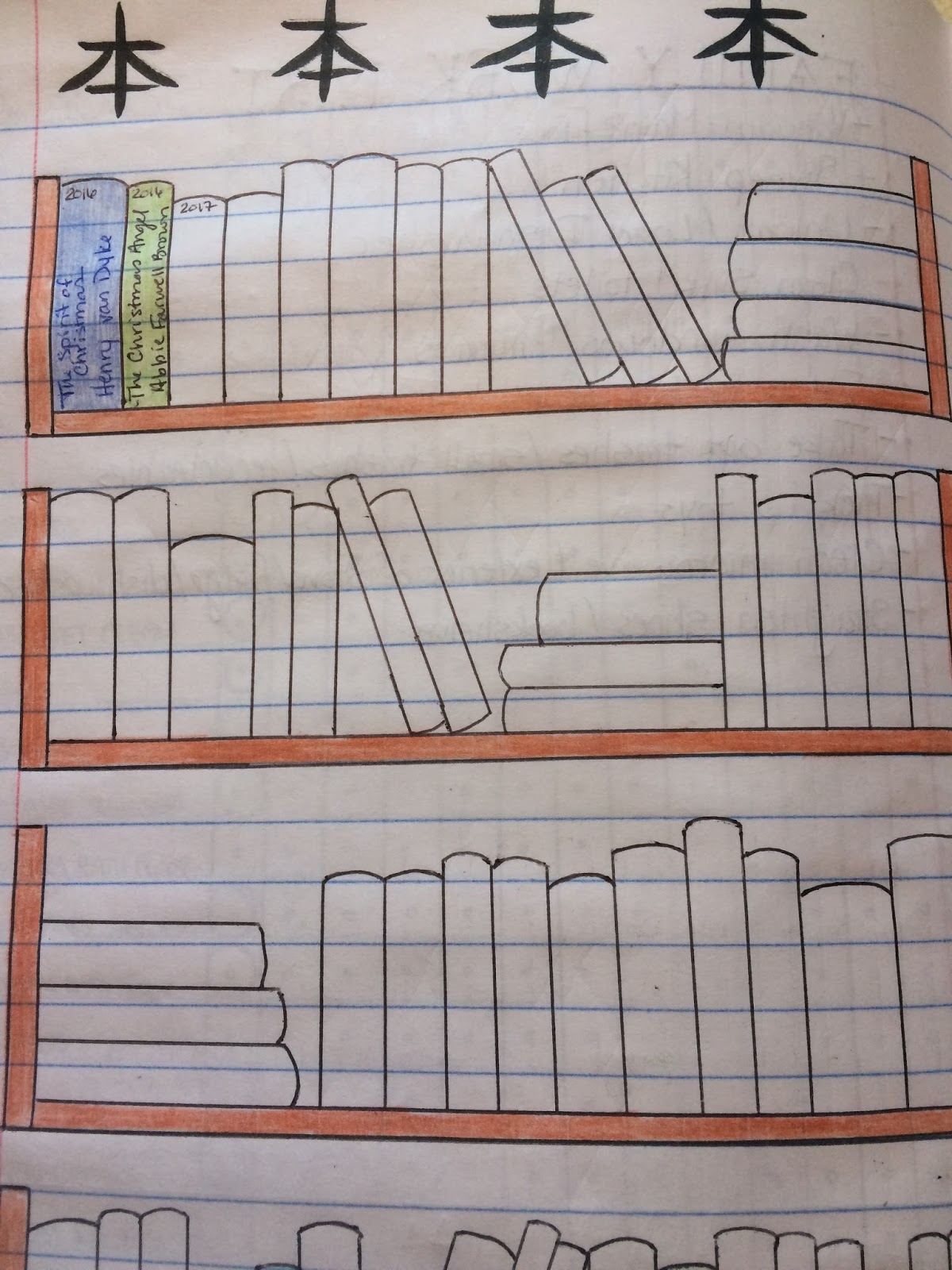
This is the one page where I really let myself get arty about it, partly because the idea is so fun (Thank you, Pinterest!) I have two books going right now, and I'm really looking forward to finishing one of them so that I can color in the next book... such a geeky thing to get excited over. I drew way too many books, but if I read short works in Japanese they're totally going on here, too. Even picture books.


Finding time for Mother Culture by using a bullet journal to record and track my goals for the New Year.

In this case, I can tell that I needed to tweak the way that I set up my chart. I want to do the Benjamin Franklin writing method, where he copied, sumarized, and re-wrote excellent writing. This one is really tough to break up into bite-size pieces, and it's not going as fast as I'd hoped at first, so I re-did the chart when the first one ran out of room. (Do you like my Japanese dates? It's the only thing that ever has helped me with learning to function in their dates at all: using them for my planner is great for that.)

Finding time for Mother Culture by using a bullet journal to record and track my goals for the New Year.

And the Bullet Journal method for daily stuff is awesome, too. This one is from December 17-19. I actually got all my Christmas cards sent this year, because it just kept being on the list, and I kept chipping away at it -- and it was awesome!

Finding time for Mother Culture by using a bullet journal to record and track my goals for the New Year.

I've been using the Bullet Journal for about a month. It took about a week for me to get it fully set up, and since then, it's just been amazing. It's a stripped down, only the basics kind of method, and it's working. I'm actually progressing at least a little bit on almost all my projects.

That's pretty amazing, actually. I've never done that before.
Gotta love finding the right tool for the job.


See what other homeschool mamas are doing with their goals:


07 January 2016

Self Education: How To Make Achievable Goals


 A long time ago, in a galaxy far, far away, I worked professionally with this brilliant behavioral psychologist named Dr. Sara, and she taught me some things about setting goals that have really been a blessing to me, so I thought I'd share them with you. Here's the secret to a good, achievable goal: 
A really good goal is concrete and measurable, both in terms of amount accomplished, and time to accomplish it in.

"Come unto Christ" is lousy, as a goal or New Year's Resolution, because it's vague, and you can't tell if or how much you did it. Much better to format it into several specific goals, like this: 

In 2016, I will come unto Christ by:

1. Getting a job where I do not work on the Sabbath. 

2. By reading the Book of Mormon cover to cover. 

3. I will learn to worry less by studying peace in the New Testament, and then writing 5 blog posts/journal entries about it.

In that way, you have specific, concrete and measurable goals that are bounded by a deadline - "in 2016". I've seen things like the phrases "Come Unto Christ" or "worry less"  suggested as goals, but these are inspiration for goals. It sets folks up for failure when they resolve to "worry less" as a goal. How do you even know if you're doing that in an afternoon, much less a year??

So, the next thing that Dr. Sara taught me about goals is that you need data. Preferably, including data from before you start, but I find that for New Year's Resolutions I can skip that step. It can be a really important step, though, and she showed me that using one of our residents as a case-in-point. I'll call him Bob. Bob was autistic and non-verbal. He didn't seem to understand much of what when on around him, and we had very little idea what was going on in his head; he just couldn't communicate much with us. Bob was a spitter. Dr. Sara had us track his spitting, and he was spitting on staff over 100 times in a day, often in staff's faces. It was gross. Bob was always in trouble. Some of the staff kept their perspective, but others really didn't like him; nobody likes to be spit on. So we counted his spit. Then we started a new behavioral plan for him. A week later, staff were complaining that it wasn't working, and wanted to change it, and Dr. Sara brought out the data. The spitting incidents had fallen from over 100 per day to around 50 a day -- at 50% reduction! That's huge progress, in a very short time, but because spitting is such an unacceptable behavior the perception was that there was no progress at all. If we hadn't had data, we might have abandoned a very successful intervention, thinking that it was an utter failure. Instead, we kept at it, and in a few more weeks he hardly ever spit. Bob's life and staff lives improved in meaningful ways. Data was at the heart of that success.

So good goals not only need to be written in a measurable way, they need to be measured as you're going on. For instance. I am working on learning Japanese and Welsh. Learning a language is a huge, overwhelming project. (Yes, I know. Two at once is crazy. What can I say? I can't choose between them.) But when you start looking for ways to make it measurable, then it gets better. I've tried a couple of different ways of measuring (I've been setting goals for Japanese for a number of years now), and my favorite is measure the podcast lessons. I use Japanese Pod 101 which has many short lessons, and a very reasonable subscription cost. One of my goals is to listen to 4 of them a week. It doesn't matter which ones - new ones, old ones, the same one four times: I just want to listen to four of them in a week. I know from experience that doing this moves my study forward at a pace I am happy with. If I do 4 in a week, in 52 weeks, that's 208 lessons listened. I know that I miss some, so I just round that down to 200 lessons in the year, which becomes my goal. Then, I write out the numbers 1-200 on my chart where I track things, and each time I listen, I cross it off. If I haven't finished by the end of the month, I'll just skip to February's numbers - see the little F where it changes color? - and start crossing out numbers there. I like how that feels when I look at the chart, late in the year, better than bunching them all up. But it doesn't really matter; the important thing is to set a goal and then track your progress.


I have several goals relating to Japanese. One is to attempt to read the Teaching of the Prophets lesson before it's taught in Relief Society. Doing the whole lesson is too hard; I usually only read two or three sentences. But when I have a go it stretches my ability to read those words, and even with only doing a couple of sentences in any one sitting, over time I can tell that it's getting more possible: I do 2-3 sentences now, rather than struggling to make it through one. Steady progress is what I'm after; Baby Steps. The flashcard goal is a new one this year, and I'm pretty excited about it. I have a cool flashcard app called Sticky Study that lets me make flashcards for not only words, but whole sentences. When I can understand and pronounce whatever is in the question, then I pass it. As I'm (attempting) reading stuff, I take the sentences that are hard, or the ones that I want to remember, and I put them in my flashcards. Then I learn the whole sentence, the way that a native speaker said it. It's awesome. So much good is coming from this. (You can read about this method here and here and here.) But to keep it going, I need more sentences to make more flashcards. That's measurable! So I want to make 1000 flashcards this year. Every 100, I get to mark a little thing off. Awesome. And those sorts of things make language learning very measurable. And (I can say this from experience), if you do those little measurable things, then there will be progress. You don't have to do Some Big Thing. Little stuff, consistently, will do the trick. Pick stuff that interests you, and try to do it in your foreign language. If you can't do a whole article about watercolors, then do the first sentence. Or the first three words. But come back tomorrow and do the  next bit. Pretty soon, you'll have some meaningful progress. Baby Steps are amazing.

Other areas can be done like this, too. Last year, I set a goal to do blog posts on the first 40 Psalms. I made it through 8 - obviously not a success. Except that when I looked at it, I realized that I'd done 20 blog posts about the Psalms -- not a failure, either! That's the other cool thing about measurable goals. I actually seldom hit the full goal that I set for myself. I tend to set big ones. I'd rather be ambitious: I'll certainly make progress, and if I should manage to make the full goal, then I'll make big progress. I like that. And I can live with the empty spaces that I know will happen on my chart-- there'll be enough there to show me that I did, in fact, make some meaningful progress towards fluency, towards watercolor competency, towards all the different areas that I track. Because I keep data, I will be able to see, in a real and measurable way, how I am better than I was a year ago. And you can keep a lot of data on a single sheet of paper! Check this out - it'll keep me busy all year:


So, make some goals! Cross off some numbers! Find a method that works for you -- and if you blog about it, or post it on Instagram or whatever, drop by and leave a link. I'd love to come cheer for you!

LinkWithin

Blog Widget by LinkWithin