We're learning Latin. I suppose this this shouldn't surprise me, but it kind of does. Still. Six months after we started: I hadn't planned to have the kids do Latin, much less to do it myself. God had other plans, so here we are.
Turns out, there's lots of resources out there.
The kids are using Latina Christiana I, which I still like.
I decided that I need to know a little more than they do, so I picked myself up a copy of Wheelock's Latin, which I also like. It's got a bit of a learning curve on it: Latin has a lot of grammar. A lot a lot. But I'm getting it figured out, and I think I'm going to really enjoy this, oddly enough. I'm looking forward to reading Horace, someday. That's where I want to go with this, now that I'm doing it.

Showing posts with label Latin. Show all posts
Showing posts with label Latin. Show all posts
15 May 2018
08 February 2018
This Week: Phenology Wheels


 Last week's excitement about English history continues, and the kids dug up a game that we played the very first time they studied the Battle of Hastings, which was several years ago. They're also still listening to the stories of the Saxons nearly every day. Just as I was thinking that I would suggest a documentary, the kids found one on YouTube by themselves. All this interest in Hastings and King Harold has displaced a little bit of our regularly scheduled lessons, but I'm ok with that, as it's a great foray into genuine self-education, and I'm excited to see that. I can adjust my plans a little in order to encourage this kind of interest!
The biggest project this week has been making a collection of phenology wheels and recording some nature observations. The first day, building the wheels was our math for the day, working with compass and protractor. This was challenging for the younger kids, but we all got it done. It was fun to take a break from our regular math and have a special project; we haven't done that for a while.

18 January 2018
This Week: Miss Kitty Turns Five

All year, we've been telling Miss Kitty how long it is to her birthday. She asks frequently:
"How long till my birthday?"
"It's a long time; about 9 months. Which means that it's about 36 Sundays."
I don't think she counts to 36 yet, but that seems more meaningful to her than the number of months.
"Is my birthday almost here?"
"No, it's still a long time. It's summer, and then fall will come, and we'll have Halloween, and Thanksgiving, and Christmas, and the New Year will come, and THEN it will be your birthday. It's around 24 Sundays."
"My birthday is far away, isn't it? How many Sundays to my birthday?"
"Still a whole bunch. First Daddy has his birthday, then Hero, then Jesus, then you. That's about 20 Sundays."
Sometime after Halloween, the number of Sundays got low enough that it started to be close enough to be numbers that are meaningful to her. This was pretty exciting. And then something even more exciting happened just this last Sunday night at bedtime:
"I only have ONE SUNDAY LEFT until my birthday comes!"
"Well.... actually, today was that last Sunday. There are no more Sundays before your birthday: your birthday is on Friday. That's only five Sleeps away!"
"No more Sundays? Only five Sleeps??"
Oh yes, this was an excited girl. And that's the biggest news of the week: Miss Kitty is turning five at the end of the week. And she's making Big Plans: she's having friends over to make crowns (made out of paper, with stickers) and play in a fort (a really big fort), and eat a cake (because we usually eat cake on birthdays) with ice cream.
29 July 2017
Odd Bits: Planning, Latin, and Burdens

::1::
We started doing Latin a while back, and I started wondering: once we've learned some stuff, what is there that we can read? I'm sure that I'll find some other, more traditional things, but there's this fun list of classic children's books that have been translated into Latin. Some of them are even picture books, which should make a good starting place for building a collection of Latin works. I think that, when you are serious about learning a language, collecting materials in that language should be a priority: literacy follows books, not the other way around, so I don't like to wait until we are already good at it before we start finding materials that are enjoyable to look at.
::2::
I love this story about the guy that got the Constitution amended -- who pushed and pushed until one of the Amendments that James Madison authored, one considered for inclusion in the Bill of Rights, but never actually ratified, was passed in 1992. Just as good is the way that the process affected the teacher that gave the poor grade that started it all.
::3::
It's time to make some lesson plans, if I can ever get my life to settle down and figure out how to get some uninterrupted time at my desk! This season isn't very good for that kind of thing. So here's a couple of homeschool links:
- narration for older students
- be frugal -- but mind copyright, too
- method vs system in planning: don't forget to think
- recitation is an art; learn it
::4::
05 June 2017
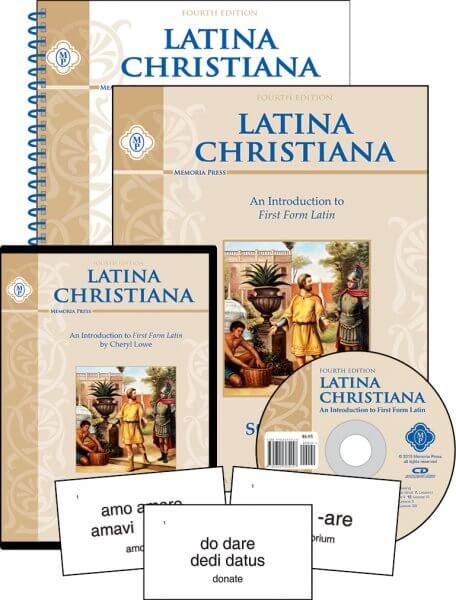
Latina Christiana {Crew Review}

The best approach to Latin grammar is to consider it a basic subject, like arithmetic, that is to be mastered by consistent effort over a period of years. If Latin is presented to students as a fun enrichment course, they will want to drop it when the novelty wears off and it becomes routine and hard.
-Teachers' Manual: Preface
Before we started trying to do the Latin with Hero(10), I sat down and spent some time looking over the materials and orienting myself to the course; there's quite a bit of material to look over, and I wanted to have a pretty clear idea of what a lesson would look like before I started. In reading the introductory materials in the Teachers' Manual, I found this:
There is much to memorize in the first few years of Latin, and because group recitation is a pleasant and effective way to accomplish this task, I strongly recommend the formation of a "class" for Latin study. You may have a ready-made class in your homeschooling family, or you may want to recruit some children from a neighboring family. Even preschoolers will want to chime in and merrily chant: amo, amas, amat...
-Teachers' Manual: Preface
I spent some time mulling this over and praying, and decided to order a second workbook for my younger son. At almost 7, he's a little bit younger than the recommended ages for the course, but looking at the materials, I think that we can support him so that he can handle it, and the benefit of having a "class" to do the work with looks like it's going to be significant. I also took a day or two to adjust my lesson plans to reflect that we'll be doing a little bit of Latin most days for the foreseeable future.
As we dived in, the prediction that preschoolers would happily chant along proved to be true: Peanut loves it. She is blissfully unaware that, officially, she is not taking Latin yet, and participates in every lesson. The one that needed some persuasion was Dragon: he thought that once he'd said it once, it was done, and resisted doing it again, until I explained to him that when he learns something new, there are new connections made in his brain, but they start out small. It's through repetition that the brain realizes, "Hey! This is important stuff -- I'd better remember this," and builds up the connections so they get strong. After that, he was all in: who doesn't want to grow their brain? His new-found enthusiasm was pretty cute, and I caught him saying parts of the Table Blessing on his own.
By the end of the first week we'd completed the first lesson, and both boys had a reasonable grasp on the things we'd been introduced to. As I had expected, Hero was very comfortable with the materials and presentation, and Dragon needed a little bit of scaffolding, but with the proper help he was successful, too. I felt like the amount of work the lesson entailed was really very do-able, even with our already busy schedule. The hardest part the first week was making sure that everyone understood the grammar involved - verbs and pronouns - since Dragon had not run into those concepts before; Hero has, through his English grammar and a little prior dabbling with Latin, but it was all new territory for Dragon.
 When we started the second lesson, it became apparent that, while we'd done well with learning the grammar, we had skimped on our work with the vocabulary. So we broke out the flash cards (I'd been slow to find a container for them). There's only 15 words in the first two lessons, so this is not a big deal. It looks like time spent drilling the vocabulary now should pay rich dividends later -- which is true in any language, really.
Lesson two introduced the concept of conjugation, and so we also started practicing chanting our conjugations. This works really well in the car, which was where we first tried it: I brought the boys' workbooks, so they could reference the vocabulary lists, and then told them that it was their job to keep me doing it right, since I'm learning too, but I can't look at the lists while I drive. It was hard at first, for all of us. Hero was quickly able to start looking at the verb we were working with and then closing the book, to work from memory. Dragon had to work harder to figure out what to do, but he was also able to be successful in figuring out how to conjugate the verbs and even lead our chant near the end. I thought it was cool how quickly we all improved; chanting really did help.
 I am really appreciating the very clear instructions in the Teacher Manual. This course is for the teacher who does not know Latin, and the instructions are clear and informative, but do it without talking down to the teacher, and without resorting to scripting every single sentence that you say, and they've just struck a very nice balance. Things like **Before you teach this lesson, re-read the Grammar Overview, page x.** are really helpful to keep me a step ahead of the kids in learning how this language is put together, and there are clear instructions about what to do and how to be prepared throughout the lessons. It makes it easy to present the material.
Looking ahead, there are review lessons built in, and the first one includes some encouragement for the teacher:
This philosophy is really nice to have emphasized. In our work with Japanese, I work hard to minimize my accent, and encourage my kids to do the same. I put in a lot of effort trying to create a semi-immersive environment to assist in learning that language, but those things are not possible with Latin. It's a good reminder to not worry so much about pronunciation. This is encouraging all by itself, but they're not done:
The oral work in Latin is to aid the memory in retaining vocabulary and grammar forms. It is not to develop speaking fluency as in modern languages. Oral recitation work is extremely important in learning Latin. There is too much to learn in Latin to rely on visual memory alone. Do not be overly concerned about whether your pronunciation is exactly right. Say Latin with confidence. Act like you know what you're doing. If you find out later that you are saying some words or sounds wrong, great! Correct yourself and go on. Remember, there are no Romans around to correct.
Teaching Latin is a real art. As your skills as a teacher grow, then the progress of your students will accelerate. The progress of my students was very slow the first year. As my experience and confidence increased, the rate of student learning increased also. Be content with a slow pace at the beginning, and lay a good foundation. Be grateful for what God has allowed you to learn and teach, and do not be dissatisfied with your rate of progress. Rome was not built in a day, and your knowledge of Latin won't be either.
Being content with a slow pace is hard for me, so this is a great reminder. I'd hoped to be able to do a lesson every week, but with supporting Dragon, we're just a little slower than that, at least for now. However, he's building a good foundation, and I am comfortable with where we're at. Hero could probably do faster, if I was going at his pace: he's really taking to this course.
By the third lesson, things were beginning to be more routine. The first concepts were much more familiar, the conjugations came much more readily, and everybody knows what to expect in a lesson. There is a lot of new material in each lesson, but I feel we are doing well with learning it. Each lesson has a video portion, which goes over new vocabulary and grammar. We end up pausing this a lot, and in lesson three, we even split it into two sessions, as I wanted to be sure that the boys understood what a direct object is: that was new to them both, and the video goes over it very quickly. There are breaks in the video intended for student responses, but they're a little short for our family's needs. What ends up happening is that I pause in those breaks, which works out nicely. After we watch the video, we work with flashcards, do the worksheet, and practice until I feel that they boys are pretty solid in what they're doing, and ready to add on. Then we move to the next lesson.
I really like the way it's easy to regulate the pace with these materials. It's tidy to plan to do a lesson a week, but with summer coming on, the pace we keep for school is slowing down, and book work gives way somewhat to more time outside, which we don't get a lot of in winter. These lessons are easy to adjust to that sort of thing, which is great. Overall, I think that this is a program that I can see is working for our family, and I'm looking forward to continuing and eventually completing it.
If you want to read more reviews of this and other Memoria Press products, click the banner below. There's other Latin materials, as well as two different science/nature study packages that Crew members have been looking at so they can share their thoughts with you.

I really like the way it's easy to regulate the pace with these materials. It's tidy to plan to do a lesson a week, but with summer coming on, the pace we keep for school is slowing down, and book work gives way somewhat to more time outside, which we don't get a lot of in winter. These lessons are easy to adjust to that sort of thing, which is great. Overall, I think that this is a program that I can see is working for our family, and I'm looking forward to continuing and eventually completing it.
If you want to read more reviews of this and other Memoria Press products, click the banner below. There's other Latin materials, as well as two different science/nature study packages that Crew members have been looking at so they can share their thoughts with you.
26 April 2017
Japanese Grammar Memory Work
In reading from our new Latin books, I found this in the preface to the teacher's manual:
Looking at the way that the Latin course is organized has inspired me to take some of the grammar materials that we've got and try organizing it into something that is somewhat similar, so that my kids can have a better grasp on the grammar of our new language. We're going to use some vocabulary that they're already somewhat familiar with, but expand the ways that they can do conjugations and declensions. The Latin book has the kids doing small, discrete units: a collection of forms for a single verb makes a set. I'm going to follow that example with these present tense verbs and adjectives:
To be - inanimate objects:
ある、 ない、 あります、 ありません、 あって
To be - animate objects:
いる、 いない、 います、 いません、 いて
To eat:
たべる、 たべない、 たべます、 たべません、 たべて
To sleep:
ねる、ねない、 ねます、 ねません、 ねて
To drink:
のむ、 のまない、 のみます、 のみません、 のんで
To read:
よむ、 よまない、 よみます、 よみません、 よんで
Big:
おおきい、 おおきくない、 おおきいです、 おおきないです、おおきくて
Small:
ちいさい、 ちさくない、 ちさいです、 ちさくないです、 ちさくて
Delicious:
おいしい、 おいしくない、 おいしいです、 おいしくないです、 おいしくて
Cute:
かわいい、 かわいくない、 かわいいです、 かわいくないです、 かわいくて
Scary:
こわい、 こわくない、 こわいです、 こわくないです、 こわくて
I'm really excited about this -- grammar sometimes gets a bad rap, but I think that, particularly for foreign languages, it helps to speed up the process, and knowing the patterns that are used, it's a lot easier to both understand what's being said, and also to be able to start to swap parts out of phrases and begin to be able to express yourself. I'm looking forward to continuing our Japanese journey, and also to this new Latin adventure!
This really resonates with me regarding our Japanese study for a couple of reasons. One is that, although my kids have been picking up a fair amount of Japanese from what we're doing, I've been feeling like the grammar that I studied while I was in college laid a really useful foundation for me, and that when I reached a point recently where both the grammar and my vocabulary hit a critical point, and my ability to understand both written and spoken Japanese has been really expanding the past few months -- but I'm also aware that my kids are not getting very little explicit grammar instruction right now, and I think that needs to change. We already have a number of grammar resources I've purchased, but nothing that's really kid-oriented, so I need to break down the information we've got into bite-sized pieces for them. Hopefully, this will be a pretty straight-forward process!
The modern approach to language study is the reading method, in which students are required to read text prior to instruction in the necessary grammar and vocabulary. Although this approach can be successful in certain limited circumstances, it is often very similar to teaching reading without phonics.
Looking at the way that the Latin course is organized has inspired me to take some of the grammar materials that we've got and try organizing it into something that is somewhat similar, so that my kids can have a better grasp on the grammar of our new language. We're going to use some vocabulary that they're already somewhat familiar with, but expand the ways that they can do conjugations and declensions. The Latin book has the kids doing small, discrete units: a collection of forms for a single verb makes a set. I'm going to follow that example with these present tense verbs and adjectives:
To be - inanimate objects:
ある、 ない、 あります、 ありません、 あって
To be - animate objects:
いる、 いない、 います、 いません、 いて
To eat:
たべる、 たべない、 たべます、 たべません、 たべて
To sleep:
ねる、ねない、 ねます、 ねません、 ねて
To drink:
のむ、 のまない、 のみます、 のみません、 のんで
To read:
よむ、 よまない、 よみます、 よみません、 よんで
Big:
おおきい、 おおきくない、 おおきいです、 おおきないです、おおきくて
Small:
ちいさい、 ちさくない、 ちさいです、 ちさくないです、 ちさくて
Delicious:
おいしい、 おいしくない、 おいしいです、 おいしくないです、 おいしくて
Cute:
かわいい、 かわいくない、 かわいいです、 かわいくないです、 かわいくて
Scary:
こわい、 こわくない、 こわいです、 こわくないです、 こわくて
I'm really excited about this -- grammar sometimes gets a bad rap, but I think that, particularly for foreign languages, it helps to speed up the process, and knowing the patterns that are used, it's a lot easier to both understand what's being said, and also to be able to start to swap parts out of phrases and begin to be able to express yourself. I'm looking forward to continuing our Japanese journey, and also to this new Latin adventure!
10 January 2017
SchoolhouseTeachers.com Yearly Membership {Crew Review}

The first thing I learned when I clicked over to SchoolhouseTeachers.com is that they're a division of The Old Schoolhouse Magazine. And what a great resource! They have so many interesting online courses as well as resources for homeschool parent support, including homeschool planners. Many of their resources that could supplement our Classical style of homeschooling. They have online courses designed for all ages, from preschool to parent; a number of the varied options they offer for high school looked interesting enough for me to want to do them, and they also have several offerings specifically for adults. This review is for their Yearly Membership, so there's enough time to do several of their offerings during one membership. Here are a few of the options that I thought sounded interesting on my first glance through their extensive list:
For the kids:
All About the Alphabet (Preschool)
Creation, Nature, and You (Elementary)
Keyboarding (Elem.-High School)
Beginning Latin (Elem. - High School)
Web Game Design (Middle - High School)
Checks and Balances (Elem. - Middle School)
Free Market Economics (Middle - High School)
Creative Storytelling (Elem. - Middle School)
Scientific Method (Elem. - Middle School)
For me:
Geography of the Bible (High School)
History of Christianity (High School)
How to Teach Elementary Math (Family)
Going Deeper: The Books of the Bible (High School)
Learning to Write the Charlotte Mason Method (Family)
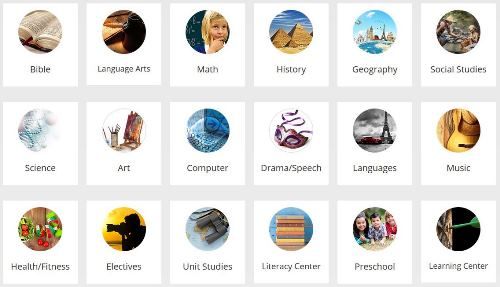
All of the courses that I looked at were either web-based, downloadable, or a combination of the two: watch a film, then download some additional work to do at home. The amount of prep work for the teacher varied considerably between the courses that I worked with, and there are so many more available than the ones that I looked at, so make sure you click through to check out courses that other Crew members used in their homes. Here's the categories that SchoolhouseTeachers offer:
And here are the three courses that I selected for our family to actually use:
Beginning Latin
Hero(10) had outgrown our old Latin introductory
course, so I was pleased to discover that SchoolhouseTeachers offers Beginning Latin, and when we tried it, we both like the simple no-frills style. It's an online course: we
watch movies, then he has some worksheets to fill out.

He says he likes "the way they bring in the words, with nothing else to pay attention to, so you can focus on just that." I like that he likes it, and that it's moving further into Latin, introducing conjugations and declensions, which he hasn't seen before; he's ready for it. The pace seems to be good for him, as well: not too fast, not too slow.
All About the Alphabet
I decided to try out All About the Alphabet with Peanut(4), to finish off learning her letters and sounds. This is a fun add-on course, a nice bonus in addition to the other courses that fit our family, but it's not enough to be worth the subscription if it's the only one you want. It's simple and straightforward: you get a PDF with activities to do for each letter, and ideas for making books for the letters. We jumped in at A.

There are several things that I really like about doing this course. One is that I don't have to think up all the things that begin with each letter; they have a nice list. And the activities they suggest are varied and interesting. However, the course didn't come with any printables, so I had to make up my own. It wouldn't have been very difficult to include those, and is disappointing that they chose not to. Printables would have made this course completely open-and-go, which would have been better. That being said, we're having a blast at it - Dragon(6) is even kind of jealous that he isn't in preschool anymore - and Peanut is learning both the names and the sounds, which is exactly what is supposed to be happening.

Geography of the Bible
The last course that I chose is the high school course Geography of the Bible for myself. The course is set up as a series of videos, each with a list of Biblical passages used. The first concern I always have with Bible material produced outside of The Church of Jesus Christ of Latter-day Saints and its membership is denominational differences: will it stick to just the simple text of scripture, or will it be overtly Protestant? I watched Moses: Exploring the Exodus, a 45 minute tour of the lands of the Israelite captivity and Exodus, and the movie was excellent. The script often quoted the exact words of the Bible's text. The scenery was beautiful. Similarly, Hebron: City of Promise was excellent. They told the story faithfully, but were also frank about the uncertainty in the archeological record. I didn't notice any interdenominational theology conflict problems at all, and found the video material to be quite interesting.The main thing I found odd for a geography course was that there are very few maps in the videos, and none in the additional materials, and that was disappointing. When I checked with customer support, they told me that, no, I hadn't missed anything, and that it's more of a "lands, culture, and people from the particular area of study," and not so much of map work. But the main reason I picked this course is that the geography -meaning the location of events and people- is all a mushy mess in my head, and I can't wrap my head around the nuances of what's happening with "lands, culture, and people from the particular area of study," -- until I put them on a map. I need to trace the course of events, myself, preferably on a blackline map, (and not a ready-made one, with everything all marked up) to really get what is happening. For me, this is a major omission; I had to find outside maps.
However.
I love this course. It is easily the best of the ones we've tried.
I actually drew and painted my own Exodus map (and there's nothing like drawing a thing to make you really see it), then went back and re-watched the video, pausing in places to write stuff down and look places and people up, I looked up some verses, and looked at some of the recommended archeology resources and research assignments, and the whole process was delightful and incredibly informative, and I absolutely would not have done my own map, nor thought nearly so hard about where things ought to be placed, and the relationships of places, and the impact that had on how the story went, had there been maps included. It makes a beautiful addition to my scripture journal, and I plan to put in some information about the various Pharaohs and other historical notes behind it. I'm pretty excited about the prospect of having a little collection of these in my notebook, as I look at various Bible stories; they have units covering all the major Bible stories, both Old Testament and New Testament.

Looking at their research assignments for the the two units that I've worked on in the time that I've had the materials to review, I feel like this is a course that a high school student is going to need some assistance with, unless all you want for them to do is just watch the movies, and they'd really be missing out if that's all they do. Both units come with a great variety of research topics - enough that you could almost turn either one of the units into a complete semester; it's not intended that the student will answer every question. In the Moses unit they're good about referring the student to research materials and I was readily able to find research materials for the topics they propose, but in the Hebron unit it's just... questions. And when I started trying to search for the answers, I found it tough going even as an adult: there are a lot of opinions out there on Bible archaeology, and if you don't have a guide, then it's hard to know how to judge between them. So that was a little bit frustrating. On the flip side, though, it did lead me to dig in deeper and think harder, trying to figure things out. But I do think that a high school student would benefit from having an adult mentor do the course with them. And that's not a bad thing: it creates tons of opportunities for discussing both geography and doctrine.
This course is something I am enjoying tremendously, and I would absolutely recommend it to my friends, and I really look forward to when I can work on it after the kids go to sleep. It can be tough to squeeze out time to work on this sort of thing when you're the Mom, but I'm going to keep chipping away at it, because it's just so interesting. I am learning so much and it is really enhancing my understanding of the stories covered in both these units. I'm excited to complete this course, and really glad that I'll have a whole year to do it.
In the course of working with these courses, I ended up talking to customer support twice (once to ask about the maps for the geography course, and once to ask about finding the worksheets for Latin when they were migrating to the lovely new-and-improved version of their site), and they make it so easy: there's a little chat box at the bottom of their pages anytime you're signed in, and so talking to a real person is quick and painless, which is a huge bonus. Customer service, and what happens when things aren't going perfectly, can be a really telling experience when working with a company, and in this case, I couldn't have asked for better. Schoolhouse Teachers is welcome addition to our homeschool day.
You can connect with Schoolhouse Teachers in their Facebook Group. To read what other Crew families have to say about the SchoolhouseTeachers Yearly Subscription, please click the box below.
Subscribe to:
Posts (Atom)
LinkWithin
