I was excited when I looked through the Á La Carte products from Home School in the Woods for review this time and realized that The War Between the States Timline was included in the wide range of products that they offered crew members: Hero(11) is just starting to study the Civil War era, and I wanted to include it in our Book of Centuries as a foldout. They have a whole collection of timelines available, but this one is just perfect for where we're at.
There's so much going on in the war, and in the events both before and after, that I think that it'll be good to have a special fold-out, which will leave room for other world events from that time on the main pages of our timelines. We don't have a lot of wall space, so our timelines have always been in binders. This has a number of advantages, including that they last really well, and so we can accumulate a lot of the different things we read about into the timeline over years of reading, so I was excited to have a space-efficient way to include a lot of information about this important period of American history.
Home School in the Woods has several Activity Packs, as well as the Project Passport that we reviewed previously, and many other offerings, but this time we've been given the Make-a-State Activity to review which was perfect timing for us: I had planned to do some work with Hero this year for Wisconsin state history. In addition to having Hero(10) do this lapbook, I also am doing it with Dragon(6), and even Peanut(4) is enjoying the coloring, cutting, and gluing -- because she is Big, like her brothers; ask her and see. Happily, while they are learning about our State, she is getting some nice practice in on her fine motor skills. It's a win all around.
One cool thing about this packet is that it's very simple. Once we set it up, we just added a little bit to it a couple of times a week. There are 20 projects in all, plus instructions for assembling them into a very nice lapbook, but while that sounds huge, it doesn't feel huge, working on it. The kit that you receive from Homeschool in the Woods had materials for doing all 50 States, which is nice. When I was a kid, our family moved around, but I considered Utah to be our home. We had just moved to Wisconsin, and so when my 4th grade teacher announced that we were going to be learning about our "home state" I raised my hand and asked, "So, will I be learning about Utah? Because Wisconsin is not my home state." That was one of several times when that teacher did NOT smile at me; I had a difficult year that year. But if your family has similarly strong ties to several States, it would be a simple thing to use this Activity-Pak to learn about whichever States your interest draws you to, and at no extra cost for the additional States. In fact, because we do have a lot of family and church history that takes place in Utah, I'm considering asking the kids if they are interested in doing a second lapbook for Utah, when we have finished Wisconsin. There are several other States that our family has ties to that would be candidates for that kind of activity at some point, either in doing the whole project again, or in doing selected booklets.
It's really easy to adapt to the various levels the kids are ready for: Peanut is primarily cutting and coloring, which is great for her fine motor skills and her need to be included when we do school. Dragon is getting his first exposure to some of the State trivia (our bird is a Robin, and our flower is a Wood Violet), and Hero is getting all that, plus he's getting practice at searching for information that he needs for this kind project: I'm having him do his own googling for most of the things, and helping him to figure out how to extract information from his search results: What are the biggest cities in the State? What was the population at the last census? Part of what I intend for him to gain from the activity is an increased ability to find this kind of information. Make-a-State's adaptivity is one of my favorite features about it.
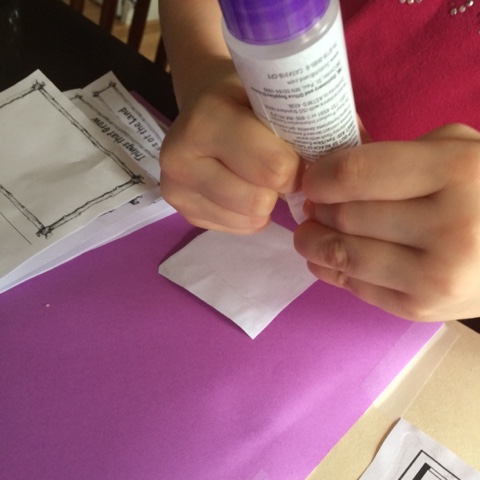
Activity 7, the wildlife and plants of Wisconsin booklet (pictured left), is supposed to be printed front to back. My printer doesn't do that very well, and the instructions for how to do it are somewhat lacking on how the alignment ought to be, so putting that particular book together was something of a headache. We ended up printing two pages and gluing them back to front, and then assembling the booklet from there, rather than printing it doublesided. That being said, that booklet ended up being one of my favorites as the kids filled it out. I had the boys select and draw plants and animals from Wisconsin, and it was fun to see them draw on the things they have learned from our time doing nature study to fill this out. So far, this has been the only booklet that gave us trouble in assembly, and I've worked on 13 of the 20 included projects. All the rest of the instructions have been clear and easy to follow, and even the four year old can do a large amount of the cutting and assembly successfully.
Putting our own rivers on the State is challenging; I'm glad we don't have very many major rivers, and no mountains to try to depict! We ended up with some geographically suspect city placement, even with coaching on how to go about locating cities relative to several points on the border, but I feel like it was a good exercise anyway, and that even with some inaccuracy there's been good learning that went on here. It's also showed me that in our art instruction we need to talk about how to measure and look at some tricks to help my oldest be more aware of proportion. This is good information, and I really handn't suspected it before, so I'm glad that this project is set up the way that it is.
Lapbooks are, by nature, fiddly fussy projects. We don't do a lot of them for exactly that reason. I found that this worked better when we did a section once or twice a week, rather than when I tried to do several in a day. There's a lot of time spent in cutting and gluing. We used some of that time listening to an audio drama, and some of it listening to native drums, but by the middle of the lapbook, it still was feeling like a whole lot of cutting and pasting. However. I think that we did a better job of learning about our State than we would otherwise have done without this project. It really gave a lot of form and structure to "learn about Wisconsin", and they made it easy to know what things to look up. I've lived here most of my life, but in the process of filling out the little books with the kids I learned new things, too. I don't do a lot of lapbooks because they're a lot of fuss and a certain amount of busywork, but it really is a nice format for this kind of study. We need to learn about Wisconsin, and there's a lot of little disconnected bits of trivia that it's nice to know -- which seems less trivial when they're all connected in the lapbook. And the books are really cute as well as they come together. Homeschool in the Woods has even recently started offering À La Cart Projects, so that you can include just what interests you.
If you want to read more reviews of this and other Home School in the Woods' hands-on history
products, click the banner below. There's other State lapbooks that are being shown, as well
as a variety of American History packages, Old and New Testament materials, helps for composer and artist studies, and some really beautiful timelines that Crew members have
been looking at so they can share their thoughts with you.
William Brassey paining Monkey chose for his
Book of Centuries entry on Moses.
We're still working on the Moses lapbook. (More parts of our Moses lapbook are here and here.) It's been a wonderful thing to spend this time studying Moses. This is the most closely I have ever studied the Exodus, and it's a fascinating story. I'm learning and realizing all sorts of new things. For instance, as we were talking about the plagues this morning, I realized how sharply the Lord distinguished between those who believe (even Egyptians-see the hail storm) and those who didn't. And that is comforting, particularly in light of the prophecies of the judgments we can expect in the last days.
Another cool insight comes from this post, Athletes with Shuffling Feet. They also have an awesome picture of the sea parting that I'd love to use in my lapbook, but I have no idea what the copyright status is on that, so I'm still looking. {sigh}
We're at the point of looking at the crossing of the Red Sea now, and again, Heart of Wisdom has some great resources. I've already printed out their minibook. I'm also planning to do some with looking at how the parting of the Red Sea is a classic example of how we get revelation. I spent some time studying that a few years ago, as I was spending time looking at Doctrine and Covenants 8:2-3. Jeffrey R. Holland gave a great talk about it in BYU Devotional, called "Cast Not Away Therefore Thy Confidence." One of my favorites. I've come back to that talk several times from a couple of different angles, and now I'm going to share part of it with my Monkey.
From Brother Holland:
Why
would the Lord use the example of crossing the Red Sea as the classic
example of “the spirit of revelation”? Why didn’t He use the First
Vision? Or the example from the book of Moses we just used? Or the
vision of the brother of Jared? Well, He could have used any of these,
but He didn’t. Here He had another purpose in mind.
Usually
we think of revelation as a downpour of information. But this is too
narrow a concept of revelation. May I suggest how section 8 broadens our
understanding, particularly in light of these “fights of affliction” we
have been discussing.
He goes on to identify some thngs we can learn about revelation from the Red Sea crossing:
The process usually starts with a question, often an urgent one.
Fear is destructive. Don't fear. Go forward.
God will help us; trust Him.
We're going to do a minibook for this.
Cut out and fold on the lines to make an accordion book.
Not too long ago, the kids had a lesson on the Sermon on the Mount, and the sister who was teaching did a great job of explaining what it is to "hunger and thirst for righteousness." Since then, that idea has come up several times, and in several ways. Tomorrow, we'll be looking at it from a Christ as the Bread of Life angle as we learn about the manna from heaven. Monkey caught me looking at a relatively complicated idea for a "squash book," and he liked it and wants to do it, so I guess that's what we'll do. I was watching this video clip:
And these are the elements that I came up with for building the book:
Print on cardstock and cut out. Assemble with video's instructions.
Here is the template for the squashing pages. To do one the size of the video, you'll need 3, though the last one you'll probably want to glue on there upside down, and the "glue area" ought to show where to glue the thing to your lapbook. Also, note that the "glue area" is slightly smaller than half, so it won't show. That also means it can't be used to guide your folds. We'll be printing the cover on cardstock, and the pages on regular printer paper. I do not plan to do the chipboard cover, just glue the over on as-is.
Cut on the black line; fold in half. Write inside.
Finally, this is the last one for today: the story of the battle with Amalek, where Aaron and Hur hold up Moses's hands (Exodus 17). I think that for this one, we'll just tell the story, and I'll follow Monkey's lead as to how far to take it in applying it to our lives. Moses has a lot of cool stories, and I want to tell a bunch of them before we move on, but there'll be plenty of days, when he's a little older, to explore more of the applications for this one, I think.
Incidentally, there are a lot of amazing paintings depicting the events of Moses's life. I found quite a few of them here. I'm thinking that we'll put several into our art books next week. It'll be a nice review of some of the stories.
It's been a zoo of a week: everyone is a touch under the weather, and our roof is leaking. (Someone's coming tomorrow to help us figure out a fix for that lovely issue.) I'm hoping tomorrow will have enough room in it to teach Monkey about the Passover, since my history schedule is ambitious, and requires that we start learning other stuff next week. So, tonight I'm trying to gather up some stuff to teach about the Passover. It's interesting. Very interesting. One great thing about teaching is all the cool things I get to learn. For instance:
Heart of Wisdom has this cool .pdf that they've shared. I've actually only read about 8 pages so far, but those first eight pages include a great chart of ways that the Passover lamb symbolizes Christ, as well as some fascinating commentary on symbolism in the plagues. Heat of Wisdom has also shared a little Passover booklet and a nice one for the 10 Plagues that we'll be adding to our lapbook.
I also spent some time browsing around at LDS.org, and they've got some good stuff there. For instance, Passover - Was It Symbolic of His Coming? has some great observations about the phrase, "meridian of time" and other things dealing with time, as well as actual Passover symbolism. Moses and the Passover has a little simpler explanation, which may be better suited to Monkey, though he surprises me often enough with the things he can understand! This coloring sheet from the Friend may be just what we need for the front cover of our book.
Then, it's back to Heart of Wisdom for another lapbook component, God Leads His People, which deals with the pillar of fire and cloud.
Seeing as the Old Testament
is such a huge part of the gospel, and so much refers back to it, we want to make sure that we do a good job of teaching Old Testament history as we're teaching, which is of particular interest this year while we're covering ancient history. It's important, but it's not simple. Not even close. Dates are a huge headache. Because there's a whole lot of disagreement on basic things like how old the earth is (4 billion years to only a couple thousand), and how long man have been on it (evolution vs creation), and it all gets more interesting from there. Frankly, I don't find the topic of the exact age of the earth all that interesting, but the perfectionist in me NEEDS a date at the top of my timeline.
More to the point, I want to somewhat coordinate the Old Testament stories with the materials in Story of the World 1. So I'm having a look at SOTW, and at the Old Testament chronology in the Bible Dictionary, and at this website that one of the Moms at the Hive helpfully pointed out. We are currently working on chapter 14: Moses and the Exodus.
SOTW 14: The Israelites Leave Egypt.
Most of our reading from this will actually come from the Old Testament Stories book the church puts out, and the boys like the movie version, so we'll probably watch that too. There are quite a few "chapters" about Moses, but they're short and Monkey loves them, so it's not a problem. We're also still reading miscellaneous bits about Egypt.
We're doing a lapbook for Moses, because his story is so important and turns up so often. I have several different sites I'm pulling from, saved on Pinterest. I couldn't find anything I liked for some of the events, so I made these. If you use it in your lapbook, I'd love to see a link to a picture in the comments!
Cut along the lines, then attach with a brad at the circles.
Cut on the lines, the connect the pages with a brad.
Glue tabs to make a pocket, then write plagues on the pages.
We're just about done studying animals for now, and I offered Monkey the option of doing a lapbook for birds of prey, since they are his favorite. He thought that was a good idea, so I'm gathering up the parts and pieces I'll need. Since we spent so much time on them, and this is intended to be a review activity, I'm planning to do a larger book than we've done for our first two. He goes back to look at the frog lapbook we did, and thus it gets reviewed and remembered better than it would otherwise have done - I like that. And he likes to look at his completed work. Lapbooks, as a type of narration, make me happy.
Birds of Prey lapbook parts - they have a great cover sheet, and I Printed several of their lapbook elements.
We found this great owl mosaic idea that I think we might have to try; it's right up his alley!
We're be switching chapters six and seven in the Story of the World, because the Tower of Babel(ch. 7) ought to come before Joseph in Egypt(ch.6). While we do Babylon, the Ziggarauts, and the Tower of Babel, we'll also add in the Brother of Jared from Book of Mormon history. Here are some of the resources I've found to do all that, as well as some lapbook elements I made for a Brother of Jared lapbook.
Here is the Tower of Babel accordion book lapbook element that I made up. According to this Science Fair site, it's thought that it could be the Tower of Babel, so that's the drawing that I'm using. If you'd like to use it, feel free to right-click. It should copy/paste into your favorite editor nicely.We'll also include the Ziggaraut in our Book of Centuries, by printing this again but cutting off all but the last rectangle.
The second lapbook element I made Is a little fish book. I plan to have Monkey do a section for the foods the Jaredites took with them on their journey. We'll cut them out and connect them with a brad, the way the "Frog Facts" book is done on this completed book we did. This element should fit on a regular piece of paper, so click it, then copy/paste into your word processor. This set, I printed on cardstock, so it would stand up to the turning and use a little better.
The Last thing I did was a representation of the barges, to be folded into a "matchbook." Fold the top down and the bottom up and the boats should be right side up when you flip it over. I also printed out smaller copies to put into our Book of Centuries near the entries we'll be putting in for Hammurabi and the Ziggaraut. The timing isn't exact, but so much of the timing of when precisely things happened this far back into the Ancients is educated guesstimates that it doesn't bother me (too much). Though the dates on the pages we'll be using are definitely guesswork, the sequence of events should be correct,and I think the value of putting sacred history right in there with the secular history is pretty high.
This little cutie has been pretty miserable all week. I figured that was long enough and took him in today, then we stopped at our favorite pharmacy and brought home a collection of medicines to help him feel better. I'm looking forward to that "feel better" part! Though he's such a sweetie, even feeling rough. With him feeling icky, and it's been raining, we didn't really get outside all week. Everyone is a little stir-crazy, but some weeks are like that.
We finally have success with a lapbook! Monkey did a frog lapbook. This is the front and back sides, below that is the inside. The folder is hole-punched, and I trimmed the top and bottom just a bit, so it will fit in our science binder with all the rest of his work. He's pretty pleased with it - particularly that "Frog Facts" book that spins. I think he'll like this sort of thing even better when he can read the stuff himself. He asked me to read it to him over and over.
This week, in history, we were reading about ancient agriculture, and the book was talking about the benefits of shattering vs. non-shattering wheat. And Monkey wasn't getting it. We clearly needed something a little more hands-on than what we were getting from the book alone. So I drew a picture, so he'd know what a stalk of wheat looked like. Then, I took a little bit of our wheat kernels and dropped them on the floor. The mat was in need of sweeping, so I dropped them there, and I asked Monkey to pick them up. He thought it was pretty funny. We talked about how, if we had lived in those times, it might have been one of his jobs to help pick up the wheat kernels that fell so that our family could eat. He thought playing with legos sounded nicer, but now I was pretty sure that he was understanding the material, and understanding what a good thing it would be to start to have wheat that would stay on the stalk!
Another thing that is going extremely well this week is math. This week is the first week that we're doing more, officially, with the cuisenaire rods than just playing with them. And I love them more each time we have them out! This sheet is similar to one that Math Expressions uses: you take turns dropping a paperclip or something (today it was a Power Ranger) on a problem. Then you solve it, and each person has a wheel they color the answer on. First person to color all their spaces "wins." Monkey has asked for these "water wheels" for three days running now. I'm OK with that: they're great practice on his addition facts. And, since he's doing so well with the regular stuff, we're starting to explore "tricky" ways to do things. I was so pleased when the second problem he made up ended up being 8+1=3+6!
I visited several blogs from the Weekly Wrap-up this week, and Nicole at Mama to 3 Blessings had spent the week studying the human body. I don't have all the books that she used, but I think we can put together some similar activities, and Monkey's already told me he thinks it sounds like fun. So far, here's the materials that I'm looking at:
We'll probably use this book again, and revisit the fingerprint art. Monkey asks to do that again pretty regularly.
There's also this lapbook template, on Homeschool Share, that looks like it could be fun. Some of it may be beyond Monkey, but I think we can do parts. It uses a couple different sections of another book we've got:
Human Digestion Chart for a lapbook. We'll probably use the one that's already colored, and just have Monkey cut it out and glue it in.
Nicole also included an ABC Exercise activity in their lapbook that her little guy loved, which I'm hoping my little guy will also enjoy.
Nicole printed out some cool body parts charts from a book that I don't have, but I'm hoping that I can find something similar with further searching.
And, it's unrelated, but this page on Homeschool Share has some fun art activites that go with what looks like a cute book: I Will Never NOT EVER Eat a Tomato.
We just finished reading Little House on the Prairie this afternoon. Monkey really enjoyed it. I'm still picking out what's going to be our next read-aloud. I got a beautifully illustrated version of... well, I can't find it. I think it was A Christmas Carol, and I was thinking about looking it over for our next read-aloud, but I can't find it this afternoon, which is a bummer. But I've also got the Boxcar Children and Charlotte's Web that are possibilities. I'll have to keep looking for that Christmas story though. I was thinking (before I knew my book was lost) that it would be nice to do something short, and then start the Christmas book right after Thanksgiving next week. (Yikes! Next week already!) One thing I was pondering was doing a Little House lapbook. That one looks like it would have been better to do it as we went along though. I'm still debating though. I need to look more closely at those activities. I'll bet that Monkey's just a little young still.
Lapbooks look like so much fun, but I think that Monkey is just a bit young for this still. So I'm collecting links for later.
This one is a huge list of labbook ideas, including a number of different shapes and binding techniques, as well as some graphics and orginisation links.
Our Homeschool Style: Lapbooking. It's a blog. Looks like it's not being updated anymore, but it also looks like there are a LOT of great ideas on there already.


 I was excited when I looked through the Á La Carte products from Home School in the Woods for review this time and realized that The War Between the States Timline was included in the wide range of products that they offered crew members: Hero(11) is just starting to study the Civil War era, and I wanted to include it in our Book of Centuries as a foldout. They have a whole collection of timelines available, but this one is just perfect for where we're at.