09 10
Showing posts with label geography. Show all posts

10 July 2017

Make-a-State {Crew Review}


Home School in the Woods has several Activity Packs, as well as the Project Passport that we reviewed previously, and many other offerings, but this time we've been given the Make-a-State Activity to review which was perfect timing for us: I had planned to do some work with Hero this year for Wisconsin state history. In addition to having Hero(10) do this lapbook, I also am doing it with Dragon(6), and even Peanut(4) is enjoying the coloring, cutting, and gluing -- because she is Big, like her brothers; ask her and see. Happily, while they are learning about our State, she is getting some nice practice in on her fine motor skills. It's a win all around. 
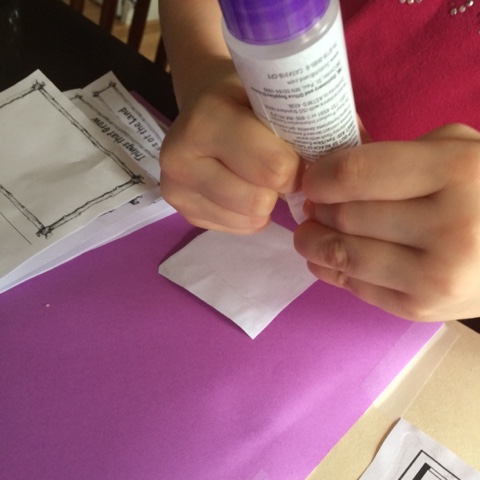
One cool thing about this packet is that it's very simple. Once we set it up, we just added a little bit to it a couple of times a week. There are 20 projects in all, plus instructions for assembling them into a very nice lapbook, but while that sounds huge, it doesn't feel huge, working on it. The kit that you receive from Homeschool in the Woods had materials for doing all 50 States, which is nice. When I was a kid, our family moved around, but I considered Utah to be our home. We had just moved to Wisconsin, and so when my 4th grade teacher announced that we were going to be learning about our "home state" I raised my hand and asked, "So, will I be learning about Utah? Because Wisconsin is not my home state." That was one of several times when that teacher did NOT smile at me; I had a difficult year that year. But if your family has similarly strong ties to several States, it would be a simple thing to use this Activity-Pak to learn about whichever States your interest draws you to, and at no extra cost for the additional States. In fact, because we do have a lot of family and church history that takes place in Utah, I'm considering asking the kids if they are interested in doing a second lapbook for Utah, when we have finished Wisconsin. There are several other States that our family has ties to that would be candidates for that kind of activity at some point, either in doing the whole project again, or in doing selected booklets.

 It's really easy to adapt to the various levels the kids are ready for: Peanut is primarily cutting and coloring, which is great for her fine motor skills and her need to be included when we do school. Dragon is getting his first exposure to some of the State trivia (our bird is a Robin, and our flower is a Wood Violet), and Hero is getting all that, plus he's getting practice at searching for information that he needs for this kind project: I'm having him do his own googling for most of the things, and helping him to figure out how to extract information from his search results: What are the biggest cities in the State? What was the population at the last census? Part of what I intend for him to gain from the activity is an increased ability to find this kind of information. Make-a-State's adaptivity is one of my favorite features about it.

Activity 7, the wildlife and plants of Wisconsin booklet (pictured left), is supposed to be printed front to back. My printer doesn't do that very well, and the instructions for how to do it are somewhat lacking on how the alignment ought to be, so putting that particular book together was something of a headache. We ended up printing two pages and gluing them back to front, and then assembling the booklet from there, rather than printing it doublesided. That being said, that booklet ended up being one of my favorites as the kids filled it out. I had the boys select and draw plants and animals from Wisconsin, and it was fun to see them draw on the things they have learned from our time doing nature study to fill this out. So far, this has been the only booklet that gave us trouble in assembly, and I've worked on 13 of the 20 included projects. All the rest of the instructions have been clear and easy to follow, and even the four year old can do a large amount of the cutting and assembly successfully.

Putting our own rivers on the State is challenging; I'm glad we don't have very many major rivers, and no mountains to try to depict! We ended up with some geographically suspect city placement, even with coaching on how to go about locating cities relative to several points on the border, but I feel like it was a good exercise anyway, and that even with some inaccuracy there's been good learning that went on here. It's also showed me that in our art instruction we need to talk about how to measure and look at some tricks to help my oldest be more aware of proportion. This is good information, and I really handn't suspected it before, so I'm glad that this project is set up the way that it is.


Lapbooks are, by nature, fiddly fussy projects. We don't do a lot of them for exactly that reason. I found that this worked better when we did a section once or twice a week, rather than when I tried to do several in a day. There's a lot of time spent in cutting and gluing. We used some of that time listening to an audio drama, and some of it listening to native drums, but by the middle of the lapbook, it still was feeling like a whole lot of cutting and pasting. However. I think that we did a better job of learning about our State than we would otherwise have done without this project. It really gave a lot of form and structure to "learn about Wisconsin", and they made it easy to know what things to look up. I've lived here most of my life, but in the process of filling out the little books with the kids I learned new things, too. I don't do a lot of lapbooks because they're a lot of fuss and a certain amount of busywork, but it really is a nice format for this kind of study. We need to learn about Wisconsin, and there's a lot of little disconnected bits of trivia that it's nice to know -- which seems less trivial when they're all connected in the lapbook. And the books are really cute as well as they come together. Homeschool in the Woods has even recently started offering À La Cart Projects, so that you can include just what interests you.

If you want to read more reviews of this and other Home School in the Woods' hands-on history products, click the banner below. There's other State lapbooks that are being shown, as well as a variety of American History packages, Old and New Testament materials, helps for composer and artist studies, and some really beautiful timelines that Crew members have been looking at so they can share their thoughts with you.


Click to read Crew Reviews


Crew Disclaimer

20 February 2017

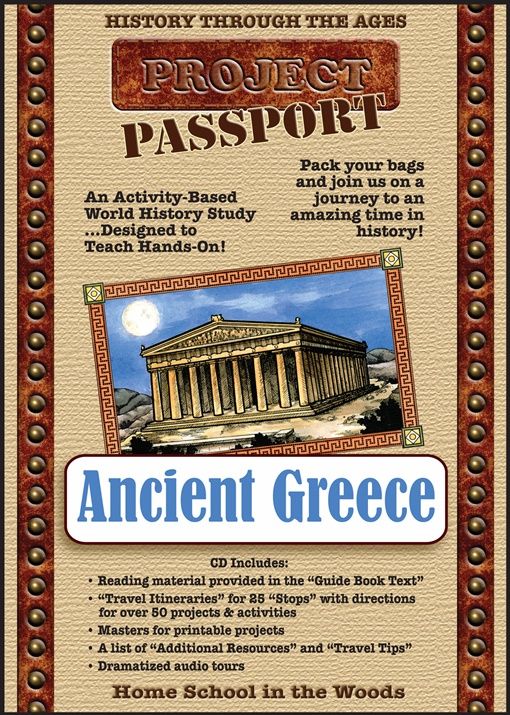
Project Passport World History Study: Ancient Greece {Crew Review}


We love  history, and learning about ancient civilizations is a particular favorite, so when we were asked to review HISTORY Through the Ages Project Passport World History Study: Ancient Greece, everybody was excited.

HISTORY Through the Ages Project Passport World History Study Reviews


Home School in the Woods has done a really beautiful job creating this history study pack. We were given the downloadable version, which was really easy: download, double click the file called "start" and it came right up in Firefox like a webpage: everything I need, all right there. The Project Passport is organized into 25 "stops" or lessons, and the first one is longer, because it's a lot of set-up. For the first stop, we made some "Scrapbook of Sights" binders, and printed out the included timeline to start them out. The included printables are uniformly beautiful, generous, and well-organized, so that finding them when you need them is a snap. Both Hero(10) and Dragon(6) are doing this. It's designed for kids in grades 3-8, but there is no way that Dragon is going to sit this one out, so I didn't even ask him to, even though he's only in first grade. Hero even went to the trouble of looking up Greek-style lettering for the front of his folder, which I thought was really cool.


A Homeschool Review Crew review of the Ancient Greece Project Passport World History study offered by Homeschool in the Woods.
Binders with printed "scrapbook" covers from the Passport Project.

Peanut(4) gets a scaled-down version for similar reasons: if we are painting, coloring, cutting, and pasting, she needs to be in it, doing school (ask her and see). So the boys both got binders, according to the directions, and I sewed the timeline into a file folder for her with my sewing machine, and let her do a map, which we glued into the folder. Just enough for her to feel included. That ended up working out really well, because I did most of the work on it, so it became a sample for the boys to look at. (It did cause some problems later, as she "participated" but had no where to put things; I discretely recycled a few pages later on in the project.) The maps took us a long time, because the kids all decided that they wanted to paint them. We love maps, and the Project Passport has two maps right at the start: one a close-up of Greece, and one larger that shows most of the Mediterranean Sea. We also had a look at our globe at this point, to place Greece on a global scale. There are several additional maps later in the stops, as well. Dragon has done some map work on Egypt, as he'd also been learning about ancient Egypt recently, and it was especially fun to see him make connections, and begin to realize that the Greek stories and the Egyptian stories have places where they touch and connect.

A Homeschool Review Crew review of the Ancient Greece Project Passport World History study offered by Homeschool in the Woods.
One of the days we when worked on the maps that detail just Greece.

The process of doing the maps and building the binder this way took a long time - we probably worked on them 2-3 times a week for 2 weeks, but I feel like it was time well spent: the boys had enough time to really see the maps. And it was so pleasant; one week we even looked up "Ancient Greek music" on YouTube (not part of the stop) and listened to what various artists think their music might have sounded like while we worked on our maps, which lead to some really great conversation. Because the various maps all got labels on different days, the names and locations are becoming familiar: if we talk about the Aegean Sea, they know exactly what I'm talking about and can find it pretty readily on both maps. They have taken a lot of ownership of and pride in these projects, and the beautiful printables really encourage that.


A Homeschool Review Crew review of the Ancient Greece Project Passport World History study offered by Homeschool in the Woods.
Working on our collection of maps - this shows both boys work, plus my sample.
Dragon's work is the binder at the top; Hero's is on the right. Mine is at the bottom.

I had Dragon use the included labels, and glue them onto his painted map. I was a little concerned about all the labels that needed to go on the map, but with the printed labels, it's not a big deal, even though he's a little young for the project. I painted Peanut's, but she was excited to do the label gluing herself. There are actually quite a few labels, and instructions in the teacher notes about when to add them to the map. These pictures were taken after the first stop, so the maps are still pretty simple. I like that we'll add things as we talk about them, rather than doing it all at once in a barrage of strange place names without meaning. This way, they only add a place after it's been discussed in the text and has some meaning for them.

A Homeschool Review Crew review of the Ancient Greece Project Passport World History study offered by Homeschool in the Woods.
This is Dragon(6)'s detail of the Greece area, showing the map and the labels.

A Homeschool Review Crew review of the Ancient Greece Project Passport World History study offered by Homeschool in the Woods.
This is Hero(10)'s version, with the hand-written labels.

There was a reading -there's one for each stop- with narrations from both boys. The readings we typically do are more narrative than factual, but that wasn't a problem. Both of them did great with a more nonfiction type of reading, and the level was great for them both. We laid some great groundwork, and some good conversations about the geography, and the whole first stop was extremely pleasant.

One feature that I especially liked from the reading was that they discuss the traditional settlement of Noah's sons following the flood being in ancient Greece. Having been educated in the public schools myself, I often don't know about connections like this between Biblical history and secular history, but the distinction between "Biblical history" and "secular history" is artificial. There is only history; real history includes both aspects. I love it when the materials we use treat it as the one interconnected whole that it is. One of the booklets we made for the lapbook is a family tree of Deucalion/Noah's son Hellen, and we built it to be color coded to the map of the areas that they settled, which was pretty interesting to see. I had never realized that Greece had "tribal" areas before. The booklet was fiddley to put together - well beyond what Dragon could assemble on his own, though he did get some fine motor practice in helping to cut things out, but I felt like, once I'd made it, it enhanced his understanding of what was going on, and he is two years younger than the recommended age for the project. He thought it was pretty cool that you could make a little book like that, and was able to explain the family structure when it was finished. We came back a different day and added the various places mentioned to our other maps. Hero did his a different day, and much more independently, because he was sick again when Dragon and I did this. These booklets will be assembled, with several others, into a lapbook later in the Project. For now, we just tucked them into the front of the binder to keep them safe.


A Homeschool Review Crew review of the Ancient Greece Project Passport World History study offered by Homeschool in the Woods.
Dragon(6) with booklet of Hellen's family and their tribal areas in Greece.

Periodically through the project, the kids receive "postcards" from ancient figures. When I first saw these, I was pretty skeptical about their value, and almost decided to skip it. However, after the boys received the first one, from Agamemnon, they had turned on a Librivox recording of a retelling of the Trojan War, and both boys immediately recognized Agamemnon in the story, and were excited to hear what happened to the character that had sent them their first postcard. I was pleasantly surprised at how well this simple activity laid the groundwork for getting more out of the literature they were listening to. There's an option to print these with a border on the back and have the kids draw on them, but my printer hates to print double-sided, so I skipped that. So far, it's the only activity that my cranky printer has made problems for. The printables are uniformly well-done and beautiful, and all the assembly we've done so far (such as the post card rack here) has great instructions. Older kids probably would be able to do it pretty independently; my younger kids were able to do it with minimal instruction.


A Homeschool Review Crew review of the Ancient Greece Project Passport World History study offered by Homeschool in the Woods.


Another project that gets assembled early on then added to as you go along is the "Greek Weekly" newspaper. I decided that only Hero would do this section, but because he's been quite sick, he hasn't started it yet. Although it's geared for grades 3-8, there's a lot of things in the Project Passport that are easily adaptable to younger kids, but my first grader just isn't ready for this kind of activity. The instructions have some cool ideas for assembling it to look like a real newspaper, and suggest printing on fancy paper, front to back, so that you can turn the pages properly, but in the end I decided to just keep it simple: a file folder cut down a little became a divider in the Scrapbook of Sights binder, and I just hole punched the pages and put them in his book. I like that there's a place for writing in this, and I also like that the areas given on the pages are small enough to not overwhelm my reluctant writer. I think that, if you had a more enthusiastic writer or an older student, it would be a simple thing to make up a few pages for the stories to continue, as newspapers frequently say, "Story continued on B-13" in real life. There is no included printable for that, but finding lined paper, or even printable lines if you're using fancy paper, shouldn't be a difficulty at all.


A Homeschool Review Crew review of the Ancient Greece Project Passport World History study offered by Homeschool in the Woods.


One thing I would love to have seen more of is links to museums for samples of scripts and art, though they do include some line drawings of various artifacts and clothing. However, the text includes some great vocabulary that could easily become key-words for searching online collections that so many museums have generously put out there. Additionally, I wish there was more literature or Librivox (or other audiobook) recommendations that line up with the "stops" on our trip. There are a book titles mentioned in the "Additional Resources" section, but a "this story fits here" where those resources belong in the timeline would be really useful. (I think there is some of that, in later stops, but because we spent the bulk of February fighting influenza, we haven't gotten as far in the project as I had hoped, and if it's there, I haven't found it in the later materials that I've looked through so far.) We love stories: literature is so much more memorable than the textbook-style text that's included; it's personalities that stick, not places and dates, and so literature tends to impact the student far more strongly than texbooks, and it would be nice to have more recommendations. On the other hand, I feel like the activities helped build some framework for where the stories belong, both in terms of on the maps, and also in the discussion of their government, housing, and clothing, and quite a few others, which all have a place in the many included activities. There's even some recipes to try. Our regular studies include quite a bit of Greek myths and epic tales of all sorts are a favorite that my kids go back to repeatedly whether I assign them or not. The activities at the stops are adding a whole lot of depth and context to what they learn in the stories as they are exposed to them. 

With 25 stops, this Project Passport is really packed, and to really do it justice, it needs to be planned a couple times a week over a longer of time, probably several months. I don't want to rush things. We learned quite a bit during the review period, and had a lovely time doing it. My kids are excited when they see Greece on the schedule, and we are all -including me- learning a whole bunch of new things.


HISTORY Through the Ages Project Passport World History Study

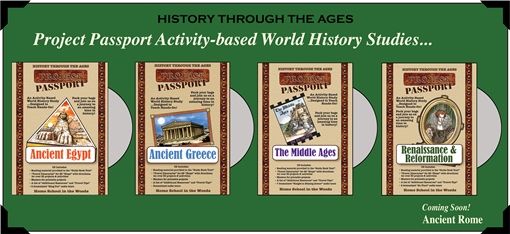
This is one of several different Project Passport kits that Homeschool in the Woods offers, and the Review Crew members were fortunate to be able to try all of them, so if  you want to know what other families thought of Ancient Greece, or any of the other Projcet Passport kits, click on the banner below to read about it.

Click to read Crew Reviews


Crew Disclaimer

27 April 2016

Cookie Map of the Fertile Crescent


I saw cookie maps on Pinterest ages ago, but we've never done one -- until now. Honestly, I wasn't too excited at the start: cooking with all 3 kids is a Job, and I much prefer to do it one on one these days. They did better than I expected; it was fun!

First, I copied the recipe in cursive and gave it to Hero. He needs practice with cursive and recipe reading, so that's where we started. So he was kind of in charge, even though it was officially Dragon's project, to go with the history he's been learning. I think it was not worrying so much about the recipe and the little kids' that made doing the project more fun for me: not as much to track in my head, or to worry about. Plus, they shared and took turns really well this time, which was nice.


Dragon and Peanut did most of the adding of ingredients. When it was all mixed, everyone helped with beater and spoon licking-- probably the most important jobs! Then we made the map. The recipe says to cool the dough, but it was great for this project when it was fresh. 


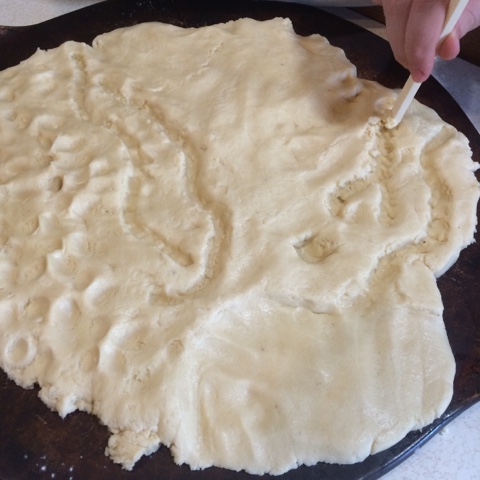
We squished it out to be a blank canvas, grabbed a map, and used the fat end of a chopstick to tap in the Tigress and Euphrates. I did one, then Hero did the other. 


After that Dragon added the Dead Sea. I helped him figure out where it belongs on the map, but he did most of the putting it in, while I tapped in the Mediterranean Sea with my fingers. Then Dragon did the Nile and Hero did the Red Sea. Peanut helped pinch in some mountains above our rivers. 


Then we baked it. I reduced the temperature to about 300F, since it was one large cookie, and then took it out when it smelled good and was a touch browned. I think it was around 20 minutes, but I'm not actually sure. If we do this again, I'll take it out slightly less brown; it's just a touch too dry.


It was hard for the kids to wait for the whole thing to cool completely! But once I told them hot cookies melt icing, they were relatively patient. I split the frosting jobs by difficulty; Peanut went first. The kids mixed their own color; she got brown, for the mountains. 


Then Dragon started working on the green fertile areas. We used the grass tip, though he said that it didn't much look like grass. That's partly because I'm a bit out of practice with the frosting toys, and made the icing too soft. But it worked well enough, so we kept going.


Hero got the blue. The various water sections needed to be done last, and snaked around. He even filled his own frosting bag. 


When it was all done, it looked pretty cool! We talked about where the different things are, and what everything is called, and it was fun!


17 September 2015

Growing into Map Work

Growing into Map work: homeschool geography ideas


I love the Story of the World and its Activity Guides, but I've always felt a little bit inadequate with the map work. Maybe because we frequently forget to do it. Maybe because I've always felt like my own geography is barely adequate, and I'm not at all sure what to do about it. Maybe because there are so many intriguing places, but it's not maps that speak to me - it's stories. So that's what we've focused on. But maps are important, too, and I've been realizing that they add to stories, even tell stories of their own, if you just look long enough.

However, figuring out what more there ought to be... that's not easy. Yesterday, I happened across the term "map drills" on the Ambleside Forums. I still have no clue what, exactly, map drills are, but I did find something that's improved our map work. This post has some fantastic ideas. We tried this part today:

Find a map of South Africa in this atlas (student does the work for himself). Look at it closely. I’m going to pass out another map of South Africa as well as two blank maps. Spend some time with the maps: look at the colored, labeled map and spend some time with it. I’m going to pass out a list of features and locations that I want you to pay particular attention to, but notice whatever is of interest to you about the map.” After ~5-10 minutes instruct the student to fill in one of the blank maps, including everything that is on the list as well as anything else of interest to him. After another 5-10 minutes: “Okay. Please stop filling in your map now and let’s talk. Where is South Africa? What countries border it? What rivers do you see? Describe the country. What is the capital? Where is the capital? What mountain ranges do you see? What other geographical areas do you see? What else? What struck you about this map?”

We just read in Story of the World about Catherine the Great, of Russia, so we printed out a map of Russia. Then, I gave Hero our kids' atlas of the world, made sure that he knew how to use the table of contents (and pointed out that, Russia being so large, it's done in two different sections, so make sure to read them both), and walked away. That was hard to do, which is ridiculous. He's growing up, and he's ready. He can read it and then narrate it. But the micro-manager in me is resisting giving him responsibility. He did beautifully. I came back and re-read the post, so I'd know what I wanted to do next. When he was ready, I told him to find some interesting things on the maps, and also St. Petersburg. Then, I had him label those on his blank map. He looked around and colored in the water (I'd had Dragon do that on his, so he could tell it from the countries we were talking about), and colored in Germany (again, part of Dragon's exercise - it's where Princess Sophia came from when she married into becoming Catherine the Great). And he wrote a couple of city names on there, since he thought that the long Russian city names were the most interesting.

4th grade homeschool mapwork
Hero's map.
 Dragon did great with coloring Germany and the Baltic Sea, but when I traced out how big Russia is, he was stunned. And completely uninterested in coloring that whole big thing. Honestly, I can't say that I blame him; it's huge. So we got out a fat marker and drew big stripes. It still makes Russia pop, and emphasizes its bigness. Works for me.

1st grade map work idea
Dragon's map.

Then, we talked about latitude a little, and how we, as close as we are to America's northernmost point, are at about the same latitude as Russia's southernmost area. So we listened to some Russian folksongs, and looked at pictures of Siberia. Siberia boasts the coldest inhabited place on earth. There's some pretty fantastic pictures. But they do, in fact, have summertime. Looking at our globe, I also realized that basically the whole of the Asian portion of Russia is Siberia - it's huge! Much bigger than I had realized. (I love that I get to learn with the kids.)


I'm still interested in learning about what these mysterious "map drills" are, but in the mean time, we had a good time learning about Russia. I really like doing the map work as its own section, rather than thinking of it as a history add-on. At the end of the work, Hero and I talked about it and agreed like we both felt that this was more effective than what we've done previously. Hero had already read a book of Russian fairy tales, and now he's got not only the history that we've been reading, but also a sampling of their traditional music and a better idea where they were in the world. Dragon also got a lot of the same, though at a less in-depth level, which is fine, since he's 5. At the end, they both have maps to file away to help them remember the work they did. Not too shabby.

21 December 2012

Weekly Wrap-up: illuminated

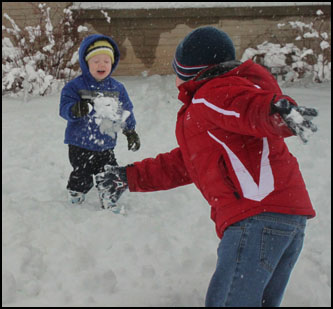
We started out the week pretty sick, particularly Dragon and me. As a result, on Monday and Tuesday there was a lot of sitting around doing not much! But by Tuesday afternoon I was starting to feel somewhat better, and we started to be a little productive again. Hero practiced his math facts, did a little writing, and some reading that evening. Wednesday was much more normal. Thursday, winter finally arrived. About time, too!


After the snow play was done we started a big history/art project. Last week, we read about illuminated manuscripts in Story of the World 2. This week, we looked at some scans of real ones, at this cool site I found from the British Library. Primarily, we looked at the Luttrell Psalter, but we also had a look at a few pages from the Lindsifame Gospels before Hero's attention for the site was used up. We each picked out a few pages to do screen captures from, and those we talked about what we liked, then printed them out for reference in our art project.


Next, we had a look at the directions from our art project. I showed him the various fonts they suggest, and he picked out what he wanted. He's still learning to do regular letters, so I did the outline letters for him. He did all the rest, and I'm so pleased with what he did!


I love the way that the decorations on his letters are so similar to the detail work on the models we looked at. It's always fun to see that sort of comprehension. I'm hoping that by doing a big art project like this he'll remember the real illuminations better. He's already wanted to go back and look at the British Library site again, which is a good sign. The idea with our project had been to do crayon resist, but I didn't explain it very well and I told him about the painting part too soon, so he didn't put enough crayon on the picture for it to actually resist when we painted. Next time, I'll have him do the crayon part, and then I'll tell him about the paint.

This was Hero's first experience with water colors, I believe, and nearly my first as well. Dragon lost interest with the project and went to "help" the Daddy long before we got to the paints, so he doesn't have one to show. Hero tells me that he's not done, which is fine with me; the real illuminations were big projects and often art takes more than one sitting to do well. But this is a sample of what he has so far.


Once I got him going, I was able to do one too. I didn't get to the painting part, and the crayons were too dull to do what I had in mind when I started, but it's still a fun project. When Hero does his painting next I'm hoping to do a little as well.


I'm getting a bit of historical whiplash, switching from Ancient Rome to Medieval Europe like this, but when I looked at the dates, they aren't that far distant in time. I always thought that togas and knights were further distant from each other, but it turns out that's not so much the case. Studying history chronologically makes so much more sense than the piecemeal way that I got what little I did learn about history. It's pretty amazing how much I'm learning, even though we're really only using the most basic of resources since Hero is still so young. So this Friday afternoon Hero and Dragon got their first exposure to King Arthur and his knights with our new read-aloud. This version has some amazing illustrations, which they both love, and when we started it my voice gave out just as the Green Knight burst in on the New Years' Feast at Camelot-- cliffhanger!! The boys and I are all anxious to read some more of this one.


Now that Hero is reading better, I tried stepping back a little bit with our map work, and helping him less. Instead of pointing to the map and telling him what he's looking at, I stood back and told him what he was looking for, as well as some clues as to where he should find it. This is one place where I struggle not to be a bit of a helicopter, so it worked well that we did this while I was getting dinner and I kept having to cross the kitchen to check on the food. Physical distance. Makes it hard to hover. Then, he did the coloring (except that I helped a little with the water). It went really well, and we'll be doing more like this. I was, however, pleasantly surprised at how easily he found Rome. I hadn't been at all sure how much of the other style of map work he was remembering, and apparently it's at least some.


That's the highlights! We did some other stuff; he's made good progress on filling in the Book It! chart, and will probably be ready for his next coupon by the end of the month. Dragon loves to practice reading his CVC words, and comes flying across the room if I ask him if he wants to do it, all little kid excitement. It's so much fun to see him so excited. I hadn't really intended to start him this early, but he's been showing signs of starting to remember some sight words, and he's so excited about it, so we'll do it a bit and see where it goes. It's awful cute to hear his little toddler voice work on making the blends. I love teaching my kids!

To see what other folks are doing this week, head on over to Weird Unsocialized Homeschoolers and check 'em out!


LinkWithin

Blog Widget by LinkWithin