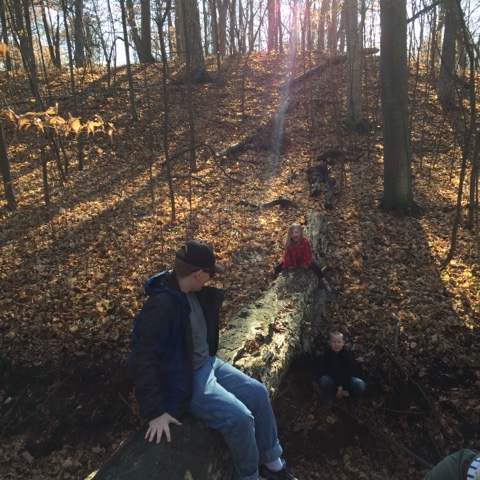
Honestly, I was pretty skeptical about the whole Nature Journal Thing when I started. I mean, Nature Study, yes, that makes a lot of sense, and I was excited. We started to do it pretty early, after a fashion: we'd go outside and look for Interesting Things. It wasn't until much later that we started to carry sketchbooks with us, and even then, there was a while where dragging them around was pretty much all we did. But I'm halfway through my second volume now: the first one filled up. And it's gradually become something that I absolutely love doing. There are so many Interesting Things, and drawing them is both fun and educational: it helps me remember what I've learned. (Bonus points for getting some watercolor on the page!)
So this past week, I went to Cub Scout daycamp with Dragon, and we had a good time. We had to drive a little way to get there, and the environment was just a little bit different from what we see closer to home. Amazing how a relatively short distance can change things! It was a little different, except for one area: they have a bog.
The bog was very different.
And so very fascinating: I could have gone in there with my nature book every day for a long time and not been done looking at All The Things.
This isn't exactly the same as the place that we visited, but it was similar: our bog was a "quaking bog": when the guide told the boys to jump, the trees and everything around us shook. It was pretty amazing.
So I took some pictures, and I've been putting the stuff that I saw in my book in the past week since I got home. I started with a page about Monarch butterflies. Didn't see those in the bog, but I did get a picture, and I'm glad I did: it was fun to paint, and very interesting to learn about their migration patterns.
But once I'd finished learning about Monarchs, then I wanted to know more about bogs. Because that place was amazing. Turns out, I've had to work a bit to find out much about them.
And this crazy bit of news about a "wandering bog" came up in one of my searches. I would never have guessed that was possible!
I've got some cool photos of carniverous plants to include as well: it's likely that this project of recording what I saw in our 30 minutes or so in the bog will take more than one page to get into my book, because it's just so different from "regular" ecosystems. I'm excited to see what I can learn about it all.
Early this month, I saw a post on Facebook from a lady that was doing something to track wildfires in her nature journal; I wasn't real clear on what it is that she was doing: wildfires are not a thing in our neck of the woods. But she had it in a circle, and it was colored different shades of red, and it was really quite striking.
I thought, what if I did that with the daily temperatures?
So I built a chart.
In a circle, because I loved how that looked.
And, because it was already the fourth, and because I don't actually have an outdoor thermometer to look at, I grabbed some data from the Weather Underground. Which is pretty cool, actually, because that means that I've got the actual high and low for the day, rather than just whatever it is whenever I remember to look at the thermometer. This also meant that I have a range of colors to represent each day, which turns out to be quite striking, even after only a couple of days of data. I got the kids into the project; it totally counts as math!
We headed to our current favorite park yesterday. I misjudged how chilly it was, so we grabbed the leaves for our nature books and jumped back into the car to do the actual drawing. And then we took a walk. It was a breezy day, and there were all these fluffy white seeds flying everywhere. The kids assumed they were cottonwood seeds, and while I had my doubts (aren't those earlier in the year than this?) I couldn't say for sure that they weren't, so I didn't say anything. But I'm really glad we went on the walk, rather than just wimping out and going home. Turns out, it wasn't cottonwood fluff, it was from milkweed.
And not only is it really soft, but we found one on the ground that had fallen out in a clump.
It feels like it's been such a long winter, but it's finally getting to be Spring again; hurray!! One of the early signs of Spring is that the nest cams start to be available, and we are big fans, particularly since getting outside has been happening... but not not consistently yet. Winter can be done any time.
Last week's excitement about English history continues, and the kids dug up a game that we played the very first time they studied the Battle of Hastings, which was several years ago. They're also still listening to the stories of the Saxons nearly every day. Just as I was thinking that I would suggest a documentary, the kids found one on YouTube by themselves. All this interest in Hastings and King Harold has displaced a little bit of our regularly scheduled lessons, but I'm ok with that, as it's a great foray into genuine self-education, and I'm excited to see that. I can adjust my plans a little in order to encourage this kind of interest!
The biggest project this week has been making a collection of phenology wheels and recording some nature observations. The first day, building the wheels was our math for the day, working with compass and protractor. This was challenging for the younger kids, but we all got it done. It was fun to take a break from our regular math and have a special project; we haven't done that for a while.
All year, we've been telling Miss Kitty how long it is to her birthday. She asks frequently:
"How long till my birthday?"
"It's a long time; about 9 months. Which means that it's about 36 Sundays."
I don't think she counts to 36 yet, but that seems more meaningful to her than the number of months.
"Is my birthday almost here?"
"No, it's still a long time. It's summer, and then fall will come, and we'll have Halloween, and Thanksgiving, and Christmas, and the New Year will come, and THEN it will be your birthday. It's around 24 Sundays."
"My birthday is far away, isn't it? How many Sundays to my birthday?"
"Still a whole bunch. First Daddy has his birthday, then Hero, then Jesus, then you. That's about 20 Sundays."
Sometime after Halloween, the number of Sundays got low enough that it started to be close enough to be numbers that are meaningful to her. This was pretty exciting. And then something even more exciting happened just this last Sunday night at bedtime:
"I only have ONE SUNDAY LEFT until my birthday comes!"
"Well.... actually, today was that last Sunday. There are no more Sundays before your birthday: your birthday is on Friday. That's only five Sleeps away!"
"No more Sundays? Only five Sleeps??"
Oh yes, this was an excited girl. And that's the biggest news of the week: Miss Kitty is turning five at the end of the week. And she's making Big Plans: she's having friends over to make crowns (made out of paper, with stickers) and play in a fort (a really big fort), and eat a cake (because we usually eat cake on birthdays) with ice cream.
A commonplace is a traditional self-education tool: as you read, grab
a notebook. Write down things that embody Truth, Goodness, and Beauty.
Write down notable quotes, with or without your own thoughts about them.
Write down the questions you have as a result of the text you are
reading. You will find the book becomes a record of your own growth, and
it becomes a touchstone for memory of things you have studied in the
past. This is what Mother Culture is all about: self-directed, conscious self-education. These are a selection of the passages that I've included in my
commonplace book this month:
一万回分かり始まります。(10,000 times; then begins understanding.)
Repeptito mater memoriae. (Repetition is the mother of memory.)
All abuse of power is essentially a rejection of
feelings too painful for the perpetrator. Each insult, each trespass
helps him see the fear of these negative qualities outside of himself,
once again proving that he is not the worthless one.
Attachment to status is based on fear.
Status serves as a fighting machine around a vulnerable, hurt part of the self. Empowermet
brings that part to light, safely, by acceptance and nurturance. Power
hides that part, perversely showing the world aggression instead of
strength, control over others instead of self-control, and
dehumanization instead of respect.
I would remind you “walking bundles of habits” that there is a relationship between thoughts, actions, habits, and characters. After the language of the Bible we might well say: “Thought begat Action; and Action took unto himself Habit; and Character was born of Habit; and Character was expressed through Personality. And, Character and Personality lived after the manner of their parents.”
A more conventional way of linking the above concepts is found in the words of C. A. Hill: “We sow our thoughts, and we reap our actions; we sow our actions, and we reap our habits; we sow our habits, and we reap our characters; we sow our characters, and we reap our destiny (Home Book of Quotations, p. 845)."
-Carlos E. Asay, Flaxen Threads
There is no reason why the child's winter walk should not gbe as fertile in observations as the poet's; indeed, in one way, it is possible to see more in winter, because thethings to be seen do not crowd each other out.
-Charlotte Mason, 1:86
Our deepest fear is not that we are inadequate. Our deepest fear is that we are powerful beyond measure. It is our light, not our darkness, that most frightens us. We ask ourselves, Who am I to be brilliant, gorgeous, fabulous? Actually, who are you not to be? You are a child of God. Your playing small doesn't serve the world. There's nothing enlightened about shrinking so that other people won't feel insecure around you. We are all meant to shine, as children do. We are born to make manifest the glory of God that is within us. It's not in just some of us; it's in everyone. And as we let our own light shine, we subconsciously give other people permission to do the same. As we're liberated from our own fear, our presence automatically liberates others.
-attributed to Marianne Williamson
We went to one of the "wilder" of the parks -- less sculpting by the big machines, less manicured, more natural, because I wanted to see if we could take some of the things that Hero and I have been reading in Madam How Lady Why, about how water sculpts the coasts of England, and find some of the same kinds of action happening a bit closer to home. The outing was successful beyond my wildest expectations.
First of all, we found the stream that I thought that I remembered -- and it being fall, it's done like a number of the small water ways around here, and it's mostly dried up. Which was perfect: we could climb right into the stream bed, and with a little care the kids stayed out of the water (I threatened that if they got soaked we'd immediately go home) and had a good time checking out the stream's banks. We saw where water had undercut, and followed the stream bed a little, just fooling around exploring. It's amazing how often fantastic things happen when we look like we're just playing outside: the trick is to learn to be observant and to ask good questions while you play. (John Muir Laws is great for learning good observation and question skills.) The importance of play is easy to overlook, but it's during play that you see the serendipitous discoveries that happen as the kids explore the environment.
And that's how it happened this time. First, I asked Hero a few questions to help him see the way that water works on our land, and find connections between his reading and the real world, so that we could learn to see in new ways, the way that our book is teaching. The book is suggesting the possibility of a type of intense learning through careful observation that I'd never thought was possible, and I'm really loving the way that it's starting to shape our thinking. So I asked a few questions to get encourage the connection between our environment and the book. It took maybe 5 minutes. Then, I stepped back and they started playing. They found a log that had fallen across the stream, bridging the gap, which was a lot of fun.
I didn't take pictures of the digging process (I wish I had, but I didn't realize anything important was happening, at the time), but Dragon got down under that log, and started banging and digging away at the bank, while my friend Mrs. T. and I chatted and played with her baby, and the other kids did other things -- and pretty soon both boys were digging, because they'd found this amazing clay -- it felt more than a little bit like play-doh, straight out of the ground. They brought over some for the baby to play with; she wasn't having anything to do with it at first, but Hero was persistent and she did eventually check it out. Which meant that the moms got to check it out, too. I didn't get a picture of the clay balls that I told the kids they could bring home, but I did think to get a shot of Dragon's feet. He was impressively muddy; this kid is an all-in type of kid!
Happily, a lot of that came off as we walked over to the playground and back. So it's not all on my kitchen floor, needing to be swept up!
So, this morning, we got it out and started playing with it. The kids wanted to make something from it. I knew just enough to know that it probably needed to be cleaned up somehow, to make it more usable. Hurray for Google, right? I found instructions pretty easily: dissolve the clay in water, and pour it off.
The clay floats, forming a solution with the water, and the dirt sinks. So you can pour off the good stuff, and dump the parts that aren't usable.
Once we got into the process, I was feeling a little unsure about how to go about getting the clay back out of the water, so I turned to YouTube to see if I could find an example of what it looks like when it's done, and I'm glad I did: turns out that, you can do a lot of pouring in this process. You pour the clay-water off pretty quickly, and that leaves behind your sediment. We had a lot more sand that I'd been expecting.
Then, you let it sit some more and the water starts to separate back out, and you can pour that off too. It starts pretty quickly: this picture was taken after maybe 10 or 15 minutes, and you can already see the clear water layer forming on top.
After it had sat for a few minutes -- I think it was maybe half hour, but it could have been a little more -- there was quite the layer of mostly clear water. Pouring it off turned out to be a little tricky, so I left it to sit a while longer and tried a scoop the second time.
We had two containers, and the larger one looks like it's going to take just a little bit longer. It's interesting to see the variation between the smaller batch and the larger. The ball of clay in the big bowl was considerably larger than what went into the mason jar, and so the solution was a fair amount thicker, and it seems like it's taking a little longer to separate. Or it could be that the water is spread out over the larger surface. I don't really know. But I think that getting the water off this one will be a bigger challenge.
We spent a while, pouring, waiting, scooping, and pouring again, trying to get as much water out as possible, while losing as little clay as possible. It's pretty tricky: if you disturb the clay layer, it sends up clouds of clay particles into the water layer. And it's really easy to disturb it. I think that the clay particles must be pretty lightweight. But after a while, we'd made some progress, and I started thinking about what I wanted to sacrifice to be a filter for these. They need to stay separate, because Hero had a larger lump, and had done nearly all the work with his, and the little kids had combined theirs and had a lot more help with the process, agreeing that whatever clay comes out at the end, they will split evenly. So it's problematic to just put the two containers together and work with a single lump, although that would simplify things.
I wish I knew how well this stuff is going to wash out of the clothes and fabric we use.
I need to check if we're freezing tonight... I wonder how that would affect things.
The kids want to get some more clay, and have been debating if they think it would be best to go back soon, in spite of the cold, or wait until spring, and risk the water being in the way. I've never paid enough attention to the stream to have any idea how full it gets in the spring and summer. We'll have to wait and see on that one. I am not super excited about digging in the cold, myself, and the filtration process is going to be tough the more we get below freezing, which should happen any time here. Whenever it is we go, I'm loving the way that they're learning to think things through and plan how to do what they want to accomplish.
I also started to study how to get the clay to a point where it's usable, and figure out how to go about making it into a thing. Nobody's really decided what they want to build yet, but before we can make a project, we need to have workable clay. Looking at this tutorial for using local clays, it looks like it may be worth our while to call the local pottery shop and see if they can help us out at all with firing our projects. I don't think that the oven is going to be enough. But the site does have a procedure for getting the clay ready to work. This process is going to take a while, I'm thinking. Lots of evaporation that needs to happen.
Which is what the guy said when I called the local pottery shop: get it wet and remove the impurities, then work on drying it out. And the drying process isn't quick. Unfortunately, it doesn't sound like we're going to be able to have it fired at the pottery shops, so whatever we do will still be just messing around. Or maybe we'll learn from the survivalist websites how to fire things in the backyard. I don't know. But we've had a good time learning about this process. It's pretty interesting to see what we can do with fancy dirt that the kids dug up while they were playing!
We headed outside this afternoon on an errand, and found that we had a
guest. She's taken up residence under the kitchen window, and built a
spectacular web. Which, unfortunately, is almost exactly the same
color as the house. It's probably the biggest garden spider I've ever
seen. And it's eating my bugs. Big ones eat more? I can't say that I'm
sorry that it's so fat and sassy!
The kids all came over and checked her out. It was only a small delay to let them come and see, and I love how nature study has become such a regular part of our family culture that they'll not only drop what they're doing and watch when something interesting is going on, but they'll also call for the rest of us to come and see what's going on.
That happened the other day when Hero(11) was reading in my chair by the living room window, and this squirrel caught his eye. "Mom! Come quick!" And I was glad that I did: the squirrel was hilarious. It had some kind of acorn that it was dragging around, almost as big as his face. And he'd hop-bounce around the neighbor's yard a bit, then dig some. One time, it looked like he was trying to shove the acorn into a little hole that he'd dug... it didn't fit. The squirrel's whole body arched and it bounced on the acorn, not unlike that squirrel in Ice Age, actually. And we watched and laughed. The thing didn't go into the ground. So, being a sensible squirrel, he sat up on his haunches and gnawed on it a little. And then bounced around a bit more, before selecting a new spot to dig. None of them was ever quite suitable, and eventually he bounced off behind the car where we couldn't see his antics any more. It was much more pleasant than doing the laundry, which is what I'd been working on until Hero hollered for me.
This time, it was the Daddy that found the specimen that we got to observe. I wished that it would turn around so that I could see the front side, but the bottom view is pretty impressive.
It's not cooperating with getting a full ID, since it stubbornly remains belly-out, and won't show me its back. But it's some kind of harmless orb weaver, they tell me. Miss Kitty is a bit freaked out about it, but I thought that watching it eat lunch was pretty cool.
It's been a while since we had an official nature study outing because the kids are taking turns at being sick, but we're still seeing things and learning stuff. Can't argue with that!
Found the coolest bug the other day; it freaked me out. I mean, check out that "stinger" -- the thing looks like a scorpion, for crying out loud! I almost didn't take the picture, but it was just sitting there, and had been sitting there, and I was feeling a bit brave. So I risked getting close to that thing to get the picture. And it didn't even wiggle when I put my phone up (kind of) close. Turns out, I didn't need to worry: they don't sting, crazy hind end notwithstanding.
Then I didn't think too much more about it for the moment, because I was watching kids. And the kids were watching the animals in the little farm thing in the park. And it was good. We pondered llama fur and frolicking piggies. Discussed why we shouldn't try to feed them. The llamas are new to the little zoo thingy, and we happened to stop by a while back when they were brand new, and you could see how uncomfortable they were, last time we visited. This time, they were chill. One of them was sitting down. The other was snacking. Neither one gave us a second glance. It was cool to see how nicely they'd adjusted to having kids come and ooh and aaaah over them. Mine sure did!
Later, we saw this cool caterpillar. He could really move! I forgot to ask Facebook what kind he is, but I think he's cool, even not knowing what he'll grow up into.
I did go find out about the big black scorpion-looking wasp thing. The nice folks on the Facebook bug group told me it's an American Pelecinid Wasp. And it does not sting. Which blew my mind, what with a huge singer-looking thinger there at the back. The one I saw is a female, and that huge abdomen is for probing the ground-- she's looking for grubs, and if she finds one, she nails it with an egg. I don't feel sorry for the grubs. Eww.
Turns out, Pelecinids are cool wasps: the overwhelming majority of them are female. (Can I just say here how little I ever expected to think that any wasp is cool??) The nice folks who gave me the ID also pointed out this site, which says that there are so many females that scientists wonder if the species manages to mostly reproduce without the males. Apparently, you mostly see them in late summer. And that's when I saw mine. At a city park. The article makes it sound like that might be less likely, but it's one of several "wild" parks in our area, with a lot of trees, so it probably looks like "woodland edges" to the critters that live there. I love our wild parks: just perfect for our nature study.
I haven't done it yet, but I'm planning to use this photo to put the Pelecinid Wasp in my nature book. It's just too cool to forget, and drawing it will help me to remember. Our walks are so nice. Even when we don't get our notebooks out, I always feel like it's time well spent when we get out and go look at nature.
But ask now the beasts, and they shall teach thee; and the fowls of the air, and they shall tell thee: Or speak to the earth, and it shall teach thee: and the fishes of the sea shall declare unto thee. Who knoweth not in all these that the hand of the Lord hath wrought this? -Job 12:7-9
I've seen people talk about having mornings reserved for lessons, and long afternoons for kids to enjoy their own pursuits... and I've often wondered how people get all the work done in the morning! For a long time, I thought that maybe it was our odd schedule -- my husband's previous work was on a second shift schedule, and he held that position for over a decade, so we had very short mornings and late nights, in order to facilitate the maximum "daddy time", and allow him to participate in our bedtime routine. Had we been doing public school during those years, the kids would have only seen their dad on the weekends, which was not an acceptable alternative! So we had this odd, late schedule. And while it's been more than a year since he changed jobs and schedules, it's proving difficult to fix the schedule that the kids and I keep. So I assumed that part of the problem with our inability to get all our school work done in the mornings was lingering schedule issues. And probably some of it is.
However.
I was reading the Introduction to A Philosophy of Education today. I've read a fair amount of this volume before, but I typically skip introductions, so I missed this last time. This is what Miss Mason says:
This scheme is carried out in less time than ordinary school work on the same subjects. There are no revisions, no evening lessons, no cramming or "getting up" of subjects; therefore there is much time whether for vocational work or interests or hobbies. All intellectual work is done in the hours of morning school, and the afternoons are given to field nature studies, drawing, handicrafts, etc. Notwithstanding these limitations the children produce a surprising amount of good intellectual work. No homework is required. -Charlotte Mason, 6:9
I turns out that Miss Mason and I define "academic work" very differently, and that's part of the "problem" that I've been puzzling over: she appears to be dividing the students' work in to academic and non-academic work... and I haven't been: it's all school work to me. Miss Mason includes Nature Study in non-academic work, done in the afternoon. I like to go out in the morning; the weather is typically better. We also need to travel to our Nature Study area -- not far, it's just a local park -- but the need to travel to get there means that we don't do a little bit every day, we tend instead to do it once a week, and use about three quarters of our school day on it when we go out. Drawing and art work in general is another thing that I tend to do at less frequent intervals for larger chunks of time because that works better for our family.
Additionally, I love this idea:
When a child grows stupid over a lesson, it is time to
put it away. Let him do another lesson as unlike the last as possible,
and then go back with freshened wits to his unfinished task. -Charlotte Mason 1:141
The idea of arranging the day so that we typically move to a lesson that is unlike what we are currently doing is very appealing to me. In practice, what I actually do is put all our lessons on a markerboard, and let the kids choose what they want to work on next. It doesn't actually matter to me what order they do them in the majority of the time, so long as they are done at the end of the day, and the kids relish the opportunity to make those small choices. The distinction between lessons with Mom and independent lessons is, practically speaking, far more important in our day that Miss Mason's divisions of academic vs. nonacademic work. Independent work tends to be what we finish before lunch, simply because they don't have to wait turns to do it. Interestingly, when left to chose their own order, the kids nearly always order their days so that the next lesson is quite unlike the one just finished.
So it's really instructive to see what, exactly, Miss Mason is including in her afternoon work, because it makes me aware that the largest reason that we're "unsuccessful" at doing our lessons in the morning is because I don't make that kind of academic/nonacademic distinction, and in fact, leaving "nonacademic" projects for the afternoon would not work well for our situation for a variety of reasons. I am inclined to think that changing up the categories of lessons is not a critical alteration to the method: things like solid habits of attention and narration, the broad feast being spread, the respect of the individual student, and attention to the development of student character all strike me as being far more central to the classical education methods and philosophy that Miss Mason was teaching. While the specifics of our schedule doesn't exactly match hers, the principles that underlie: making sure that the important, but less academic, perhaps less obviously "educational" schedule items get adequate time, that is something that we both have in common on schedules that work for our specific situations.
Makes me glad that I read from her volumes; it's easy to start to worry that I'm somehow doing it wrong. But Miss Mason's ways are so gentle and lovely, it's well worth the effort of reading them yourself.
A commonplace is a traditional self-education tool: as you read, grab
a notebook. Write down things that embody Truth, Goodness, and Beauty.
Write down notable quotes, with or without your own thoughts about them.
Write down the questions you have as a result of the text you are
reading. You will find the book becomes a record of your own growth, and
it becomes a touchstone for memory of things you have studied in the
past. These are a selection of the passages that I've included in my
commonplace book this month:
The best dividends on labor invested have invariably come from seeking more knowledge rather than more power.
-Orville & Wilbur Wright, quoted in The Wright Brothers by McCullough, 125
Darkness cannot persist in the presence of light. I do not know, I do not know anybody who does know, how to put darkness into a room to make light vanish.
-Boyd K. Packer, quoted on Instagram
Madam How is never idle for an instant. Nothing is too great or too small for her; and she keeps her work before her eye in the same moment, and makes every separate bit of it help every other bit. She will keep the sun and the stars in order, while she looks after poor old Mrs. Daddy-long-legs there and her eggs. She will spend thousands of years in building up a mountain, and thousands of years grinding it down again; and then carefully polish every grain of sand which falls from that mountain, and put it in its right place, where it will be wanted thousands of years hence; and she will take just as much trouble about that one grain of sand as she did about the whole mountain... Most patient indeed is Madam How. She does not mind the least seeing her work destroyed; she knows that it must be destroyed. There is a spell upon her, and a fate, that everything she makes she must unmake again; and yet, good an wise woman as she is, she never frets, nor tires, nor fudges her work, as we say in school... Madam How is wiser than that. She knows that it will come to something.
-Madam How and Lady Why, 9-10
If no other knowledge deserves to be called useful but that which helps to enlarge our possessions or to raise our station in society, then mythology has no claim no the appellation. But if that which tends to make us happier and better can be called useful then we claim the epithet for our subject. For mythology is the handmaid of literature; and literature is one of the best allies of virtue and promoters of happiness.
-Bullfinch, Age of Fable, vii\
Perspective is to painting what the bridle is to the horse, the rudder to a ship... There are three aspects to perspective. The first has to do with how size of objects seems to diminish according to distance; the second, the manner in which colors change the further away they are from the eye; the third defines how objects ought to be finished less carefully the farther away they are.
-attributed to Leonardo DaVinci
... we must continue to understand and educate ourselves if we wish to have success in educating our children.
-Dean & Karen Andreola, Introduction to the Original Homeschooling Series, Charlotte Mason, 6:iv
We fail to recognize that as the body requires wholesome food and cannot nourish itself upon ANY substance so the mind too requires meat after its kind. If the war [WWI] taught nothing else it taught us that men are spirits, and that the spirit, mind, of a man is more than his flesh, that his spirit IS the man, that for the thoughts of his heart he gives the breath of his body. As a consequence of this recognition of our spiritual nature, the lesson for us at the moment is that great thoughts, great events, great considerations, which form the background of our national thought, shall be the content education we pass on.
-Charlotte Mason, 6:5
We've had such a lovely time learning from John Muir Laws that when that Natural History Illustration course asked people to share their local naturalist-artists that I thought I'd make a list, so that I can browse through them at my leisure. I'm hoping that some of them will also have teaching materials to look through, like he does. But just browsing their art would be fun, too.
Another resource recommended by the course is this set of measuring techniques. I've looked at one, and though I haven't had a chance to do any of the things they suggest, it looks like a good and useful exercise.
I love this quote that they included from DaVinci:
"Perspective is to painting what the bridle is to the horse,
the rudder to a ship . . . There are three aspects to perspective. The
first has to do with how the size of objects seems to diminish according
to distance; the second, the manner in which colors change the farther
away they are from the eye; the third defines how objects ought to be
finished less carefully the farther away they are." -Leonardo da Vinci
My first attempt at doing the homework for this course was a bird. Should have been a landscape... oops. But it's the best drawing I've done to date, so I'm still feeling pretty successful. I'm hoping to do some more with this, and to collect some more of the instructions to continue to work on after the course is finished, so that I can continue to improve. It's pretty exciting to see my work improving as much as it is.
There's this Natural History Illustration course going on, and I'm trying it out. I think it's going to be lots of fun. They recommended getting a few of the fancy pencils - the HB, 2B, different types of softness fancy ones, and I did, and this time they actually make sense to me. That's fun. So I'm starting to play with them. Nothing fancy yet, just doodling around to get to know the new toys.
I like them.
I'm looking forward to being able to do my nature journal better. That has become one of my favorite parts of homeschooling, and an important part of some of my self-education projects, and I'm excited to be learning to do it better, so it's an even better asset to my learning than it already is.
I've been working on improving our Nature Study, and we've been watching a number of videos from John Muir Laws to help us learn to be better observers. It's fun when the things that we've watched start to turn up naturally in the way that we look at things - in this case, just the birds that turn up around the house.
This Robin, for example. He turned up in our front yard, and the kids called me over to watch with him. We did a much better job of observing him - Hero spontaneously started using some of the techniques we've learned recently - and it was really cool to see how much more we could notice about him than what we did before.
We saw him run around the grass a while looking for food. They especially like the spots on his back, and thought that they look like a Creeper's face, so we dubbed him "Creepy". Which cracks me up, because he's so not creepy.
In addition to noticing his coloring, we also got to watch him eat, and (we think) mate -- with two different birds! And the kids were much more aware of the way that he moves: he was doing more running than the hopping that many of the other birds in our yard do. It was really interesting to watch both the bird, and also my kids as they applied the things that we've been talking about and learning over the past little while. I think that was my favorite part: seeing the growth that we're all having in this area right now.
Science is a big deal. So much in our day depends on science, and there are so many ways in which it touches our lives. So how do we teach so that our kids are prepared to do science?
First, we go outside. Science is the study of God's creation: of the world around us. So we let them explore. Touch. Enjoy. Build a relationship with their world. That's the beginning.
The child who does not know the portly form and spotted breast of
the thrush, the graceful flight of the swallow, the yellow bill of the
blackbird, the gush of song which the skylark pours from above, is
nearly as much to be pitied as those London children who 'had never
seen a bee.' -Charlotte Mason 1:60
Miss Mason lived in England, so perhaps her common sights of nature were a
little different from ours, but the sentiment applies as well to our
"Red-belly Robins" as my kids call them, House Sparrows and their little
black bibs, and the warbling cry of a Red-wing Blackbird over the marsh
as it did to her local birds.
Dragon climbed this cedar tree recently. It's the first tree that he's been able to climb. In a very visceral way, he knows this tree -- and he's not likely to forget it. Not only was it the first one he ever climbed, but it's so imposing that the kids named it "Thalia's Tree", after a character in the Percy Jackson books: Thalia had been changed by Zeus into a massive tree, and our cedar reminded them of that because it's so much larger than any other tree in the whole park.
On another visit to this park, we walked a "White Cedar Trail" and saw a bunch of younger cedars, which the group observed were "like Thalia's Tree". Because they knew the one tree well, having been all over it, they were immediately able to recognize the younger trees of the same species, even though they were not nearly so massive as Thalia's Tree. They were delighted to make the connection.
John Muir Laws, a naturalist and field guide author, spends a lot of time talking about science and kids, and how to help kids (and adults) do science through being in nature and using nature journals. He shares some interesting information about the Scientific Method in this lecture, starting at about 45:30. This is what he says:
"Now this is where things get really really interesting, and the reason that there is a lot of confusion about it is because we have all been indoctrinated with this: THE Scientific Method. ... There's different forms of it in different places, often with cool graphics, but they all are saying, you've got your question, and over here you are going to draw your conclusions, and you'll refine your hypothesis. This is missing several things. "How long has this system of exploration been around? 500 years? Does that sound about right? This might go back to Aristotle? So why am I dissing this, if Aristotle started this? Turns out this 'Scientific Method' started in the 1940s: 1945. And what happened is that Kesler to a bunch of scientists, had people write in a bunch of things, "These are things that scientists do," and scientists looked at it and said, "Yes. These are the sorts of things that scientists do," and Kesler took that list, and put some of them that fit into a nice little neat narrative, and put them in order and said, "This is the Scientific Method," and this got picked up on by scientific textbooks. And it's been with us as THE Scientific Method. There are lots of scientific methods! Could you do that method? Sure. But a lot of science is sort of mucking about, tinkering with things. And even that, the Scientific Method, leaves out the bigger picture of what's going on." -John Muir Laws, Nature Journaling, Phenomenological Science, and Creative Thinking
He then goes on to discuss the use of nature journals in science, as tools to help students of all ages learn to really see, because good observations are at the heart of real science, but good observations are not at all intuitive: we have to learn how to see well. And he shares a number of pages from his own nature journal, and how they helped him to attempt to answer questions such as, "Do woodpeckers close their eyes when they peck?" and "Why are the ducks in this pond dying?" The video is great; probably the best part is that he gives practical tips on simple things that we can do with our own nature journals, and teach our children to do, so that we begin to think like a naturalist: we can begin to use our journals to do real science, today, and do it in many branches of science: botany, ornithology, entomology, astronomy, geology, and a wide variety of other branches of earth and life science; science is much more broad than the chemistry and physics that most of us took in high school. If we use it mindfully to train the attention and curiosity, nature study can be a very broad course of scientific inquiry, and lay an excellent foundation for even those branches of science that do not fall into its scope.
Laws is not the only person to suggest that nature walks and nature journals can be a powerful vehicle for introducing kids to science.
[Elaine Brooks] believed that people are unlikely to value what they cannot name.
"One of my students told me that every time she learns the name of a
plant, she feels she is meeting someone new. Giving a name to something
is a way of knowing it."
-Last Child in the Woods, 41
Isn't knowing our world what science is, fundamentally, about? A nature journal not only encourages us to know nature - and more than just seeing a thing and knowing the name of its species, but to really know it - learn to be able to tell one Robin from another - and also to remember the experience, because they encourage us to flip back through them, to re-read the notes we made, re-look at the sketches. So they help us to see more deeply and more truly, and then they help us to remember what we saw, which leads to making more connections with the things that we learned.
A year ago, I saw these wasp galls on some of the grasses at our favorite nature park. I wondered what they were, so I drew them in my nature journal. In drawing them, I noticed that there's a hole in the top, which was a clue to what they were, and something I never noticed until I drew it, even though they're all like that, and these are all over the place in our park, and we'd been visiting that park nearly weekly for over a year. My friend and I had a whole conversation about them, and then moved on to other things -- but when one of us found out what they were, we remembered and had another conversation. Since then, I've noticed conversations online about wasp galls that grow on a variety of different plants, most recently someone showed pictures they'd taken of galls that had blown down in a storm, probably from an Oak Tree. I walked past the galls in our park many times, hardly giving them a second glance. It wasn't until I started wondering about them and put them in my nature journal that I started to learn about them. Once I started learning, though, it's given me both an awareness that I didn't have before, and also a "peg" to hang new information on as I ran into it. I still don't know exactly what wasp it is that makes these galls, but I know a lot more about wasps and their galls in general -- because I added it to my journal.
Nature-study is for the comprehension of the individual life of the bird, insect, or plant that is nearest to hand. ... [It] does not start with the classification given in books, but in the end it builds up in the child's mind a classification which is based on fundamental knowledge; it is a classification like that evolved by the first naturalists, because it is built on careful observations of both form and life. -Anna Botsford Comstock, Handbook of Nature Study, 7-8
And that is what we were doing when the kids fell in love with Thalia's Tree: building fundamental knowledge. No reading about Cedar Trees could hope to convey half of what the kids learned when they spent a half hour up in the tree itself, touching the bark, smelling the tree, seeing the leaves -the ceders were the only ones with leaves that early in spring: it would be more than a month before the deciduous trees put their leaves on- and using the strong, well-spaced branches as ladders. In contrast, Dragon tried to climb a Blue Spruce yesterday afternoon. I drew his tree in my journal while I was watching him -- at least, I drew the top part of it. It was a very large tree, and I didn't fit it to my page correctly, so I ran out of room before I got to the part where I'd wanted to add in a small boy for scale. I ended up measuring his height against it with my eye and noting about the same proportion of tree at the top with a bracket. Although he was persistent, climbing the Spruce didn't work very well at all for him: the branches are flimsyand crowded, the needles sharp, and even the bark is less than inviting. He won't quickly forget the differences between the two types of tree! Interestingly, the Spruce is located at the edge of a playground, and he chose to wrestle with the tree rather than play on equipment that is designed for climbing: he chose nature.
"…It would be well if we all persons in authority, parents and all who
act for parents, could make up our minds that there is no sort of
knowledge to be got in these early years so valuable to children as that
which they get for themselves of the world they live in. Let them once
get touch with Nature, and a habit is formed which will be a source of
delight through life. We were all meant to be naturalists, each in his
degree, and it is inexcusable to live in a world so full of the marvels
of plant and animal life and to care for none of these things." -Charlotte Mason
There is another part of the gift we are giving our children: when
we learn about nature and science, we are learning about God. People have turned to nature for solitude and communion with God since the earliest times - a number of scripture stories start with a prophet who goes into nature to be alone. Perhaps this is because nature -our world- is made by Him, and when we are alone among His works it's easier to feel His presence and communicate with Him. What a beautiful thing it is.
Materials for the Webelos Into the Wild pin, requirement 8: Learn about aquatic ecosystems and wetlands in your area. Talk with your Webelos den leader or family about the important role aquatic ecosystems and wetlands play in supporting life cycles of wildlife and humans, and list three ways you can help.
Learn about aquatic ecosystems and wetlands in your area:
Watch a quick introduction to wetlands through the year: