Last week's excitement about English history continues, and the kids dug up a game that we played the very first time they studied the Battle of Hastings, which was several years ago. They're also still listening to the stories of the Saxons nearly every day. Just as I was thinking that I would suggest a documentary, the kids found one on YouTube by themselves. All this interest in Hastings and King Harold has displaced a little bit of our regularly scheduled lessons, but I'm ok with that, as it's a great foray into genuine self-education, and I'm excited to see that. I can adjust my plans a little in order to encourage this kind of interest!
The biggest project this week has been making a collection of phenology wheels and recording some nature observations. The first day, building the wheels was our math for the day, working with compass and protractor. This was challenging for the younger kids, but we all got it done. It was fun to take a break from our regular math and have a special project; we haven't done that for a while.
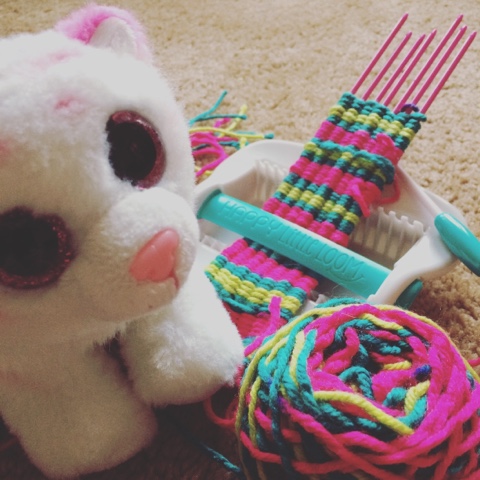
For her birthday, Miss Kitty received a visit from her grandparents, and they brought a cute little loom. Which she loves. She got her Grandpa to help set it up, and to teach her what to do. After that, when I presumed too much (didn't take much!) then she would remind me: "Grandpa already taught me this." She turned out her first woven item... and we promptly lost the tool that she's supposed to use to make the weaving happen. Bummer. But she has created her first object, a six-inch long "scarf" for Pinkus, which she is extremely proud of! And the tool did turn back up, and was promptly put into service working on a second project, which she also finished this week.
I finished reading The Gospel at 30,000 Feet, and I'm getting back into the swing of pre-reading. Which is good because I'm behind... again. Oops. I wish that I'd thought to start this last year. Pre-reading Hero's hardest books (and narrating them, because my brain needs training too, and that also gives me a record to jog my memory with Dragon comes through in a few years) has consistently been challenging. But I feel like even an imperfect attempt is helping me to grow, and making me a better teacher --even when I'm trailing behind him, rather than going before. We're playing leapfrog through this book. I think that I'm going to try to get all the way through one book at a time, rather than trying to keep up with all his books close to his schedule. I suspect that I will have more success this way, even though I will give up some of the benefits of slow reading. Doing a written narration on each chapter is challenging: the kids have grown into doing narrations of gradually longer passages with a single reading... but I have not. I'm getting better at it though!
Lift up your eyes on high, and behold who hath created these things, that bringeth out their host by number: he calleth them all by names by the greatness of his might, for that he is strong in power; not one faileth. -Isaiah 40:26
Charlotte Mason has a reputation for being heavy on literature, and perhaps somewhat light on science, but I increasingly thing that this does not do justice to her methods. I do think, however, that her approach to science is going to be somewhat strange to modern parent-educators, as it's so very different from the model we grew up with in our public school education. But she herself gives no justification for the idea that you must choose a literary or a science education.
It is a wide programme founded on the educational rights of man;
wide, but we may not say it is impossible nor may we pick and choose
and educate him in this direction but not in that. We may not even make
choice between science and the 'humanities.' Our part it seems to me is
to give a child a vital hold upon as many as possible of those wide
relationships proper to him. Shelley offers us the key to education
when he speaks of "understanding that grows bright gazing on many
truths." -Charlotte Mason 6:157, emphasis added
In fact, Miss Mason frequently marries the humanities and to science: she leans heavily on the nature journal, blending art and writing with the training of the capacity for observation and questioning that stands at the heart of scientific inquiry. She's not the only one.
Crazy weather! First, we got warm enough to actually play outside. Which two of the three could do: there's an ugly cold going through the household right now, and Hero's still in recovery, so the poor guy had to watch through the window while the first days of decent weather... went by without him peeping a nose out. Bummer. It's supposed to not only stay above 0F, it's supposed to peak out at 45F... followed by freezing rain and a plunge back to 11F. Oi. Crazy weather.
Inside, there's been lots of science this week. We got a microscope for Christmas from Nana and Grandpa, and the kids are all over looking at both the couple of slides that it came with, and also checking out different things around the house.
Or something. We've sort of drug ourselves back through a sea of snot and stress. Oi. Not our best week. We got stuff done, but nothing flowed easily; everything required powering through and plenty of will power. But... it wasn't our worst. No major tantrums or fights. That's something. We're gradually finding our groove again.
I did my first phenology wheel over the Christmas break. It was fun. I plan to do one again... after this ridiculous below zero weather quits for a while. I don't want to mess around outside, particularly not since we found that some mildew got into my scarf and hat: they're the only ones in the box so far that didn't stop stinking when washed. Bummer. But I didn't love them, and now maybe I can find something that I actually like to wear. The search is on! But we're not doing nature study, not outside anyway, until the weather gets at least slightly more decent. Temps rising enough that windchills are above 0F would be a good start.
They're so pretty, though, and I'm looking forward to building another one. The Charlotte Mason Nature Journaling group is all a-buzz about these. I'm debating doing a big one that would (theoretically) be filled out once a week all year. That would be fun. If I could stay on top of it. It's hard to give myself permission to have blank spaces.
Things we accomplished this week:
We read things.
We did some math.
We did a little art.
We practiced the violin a little.
We kept trying, even when it wasn't perfect.
We checked out the new microscope that Nana and Grandpa gave us for Christmas. It's pretty awesome. I figured out how it works (after the Daddy figured out how the batteries are installed), and got it set up. It's been a while since I did anything with one of these! The kids started learning, not only how cool it is to look at stuff under magnification, but also:
Don't Touch The Slide
That's an important lesson, as they discovered. Particularly the littler ones. Dragon was so excited about the microscope. He was the one that kept at me the most, while we waited for all of this year's holiday crazy to settle down, and he looked the longest, and took the more turns after the others had their fill. And he was the one that woke up this morning wanting to get it out and look at MORE STUFF through it. He suggested we go outside and get some leaves... I love his optimism. Not a lot of leaves around here right now!
In addition to his regular school work, I caught Hero reading the big book of fairy tales he asked for a while back, but then didn't get around to for months. That was fun. He's made some pretty good progress through it in not much time. It made me smile to see him seeking out good literature on his own. I'm glad that I didn't push him, when we got him the book: his relationship with these stories will be different for them being entirely voluntary.
Miss Kitty roared back into her phonics work. We reviewed the Learn to R.E.A.D Notebook and its Review Pack last July, and I discovered that she was not quite as ready as I'd thought: she was unsure of almost all the letter sounds when we started that. And she had to work to get them all. It's taken some time, but she's finally completed five lessons, and we're finally using the cute little books from the Review Pack. She was pretty delighted by them: first coloring, then reading silly things. I'm pleased with her progress: she'll be 5 in a few days, and she's doing quite well with her reading.
Observation is the heart of science, so I think the line between art and science is very porous. We practiced both observation and recording our observations with our watercolors. It's the second time we've done this kind of activity, and I'm very pleased with how it's working.
Altogether, we're ending the week on a pretty positive note. We didn't freeze to death (in spite of windchills down to -24F, and a couple of days where it never got above 0F real temps -- and then the wind blew. It's been chilly. Just as well that we didn't have much in the way of outside commitments this week. At the end of the week, we're getting back into our routine, and remembering how school goes, and how to make this thing work.
My chicken timer died. Quite a while back, actually. We turned it into a homeschool science project.
It occurred to me that it could be useful one last time.
So we took it apart. The kids did almost everything. Little things like this build confidence and skills using real tools, so I tried not to do any more than absolutely necessary.
It was pretty surprising how many little bits and pieces there were inside.
And how many of them were super fragile; no wonder it didn't last real long.
We didn't know enough to be able to make it ring on purpose.
Or even to really tell what parts the different thingers played. There seemed to be two springs, which surprised me. I think that this larger one was the one that would coil when we'd set the time.
The second spring was really just a tiny wire; I have no idea what it did.
But the other was much more substantial.
It wasn't very happy when we tried to pull it off: it was attached firmly at both ends.
Looked cool, though, uncoiled. And it stayed attached.
It took a few minutes; more time that I'd suspected it would. But it was a lot of fun. It's a little tempting to get a working one, and see if we can't figure out more about it if we take apart one that works properly still.
We were excited to receive the 2-year subscription to Thinking Like an Engineer from Innovators Tribe for this review. The course is designed for kids in 6th to 12th grade, so Hero(11) is on the young end of the spectrum, but he was very interested in learning more about engineering.
When you log in, there's a lot of information right at your fingertips. There's a 4-page pdf syllabus that outlines what you can expect your student to learn during the course.
The supplies needed for the course are all common household items, except for a small carpenters' level, which is not expensive at all, and a great addition to the toolbox that we're helping Hero stock for when he leaves home. Other than that, it's paper, card stock, scissors, and tape: no hidden costs in supplies, which is great.
The user interface is intuitive and easy to navigate: your menu is in a sidebar on the left, and the class content is one the right. Each time you log in, it asks if you want to start with the slide you left off with.
The very first project turned out to be quite challenging for Hero -- and for me, once I started to help him. Part of this is that he misunderstood the directions -- and I didn't double check on him until after we had struggled with a much more difficult project. What we were doing was building a five foot tall tower, built from only 4 sheets of paper and a foot of masking tape. But he thought it was only an inch. Ouch. That's a big difference. We worked on this considerably longer than the 1 hour that it was scheduled to take. Note to self: I still need to keep a closer eye on the directions for "independent" work!
I'd budgeted 1-2 hours per week for this course, so the misunderstanding in the instructions kept us scratching our heads for a couple of weeks. He first tried a round tower, built from rolled papers. But with so little tape, they wouldn't stay together, much less stand up.
He tried a few other things, and then I started helping: I thought that triangles might work better than tubes, so he cut pages and folded them into various types and sizes of triangles. He's really been a trooper, and I feel a bit bad for not thinking to check the instructions a little bit sooner... oops. I guess that part's also going to be a learning experience! The triangles worked better than the tubes: we got a couple different towers over three feet. But in the end, they were too unstable to do with only 1 inch of tape helping us hold things together: it meant almost all our joints had no tape at all.
By this point, we'd spent a number of hours on the project, and the post it note that I put on the doorframe marking where the tower was supposed to reach seemed a little bit mocking, so I started searching online to see what kinds of resources there are for this kind of project -- because it still hadn't occurred to me to check the instructions. But I'm only slightly sorry, because there's been some good lessons in persistence, in resilience, and a whole lot of hard work that's gone into the project so far, and those are character lessons that far outweigh any "being behind" that I might be worrying about. Plus, with a generous 2-year subscription, I'm not sweating over if we'll be done before I have to pay for a renewal: it's ok if the project takes longer than anticipated. It's ok if my student needs to grow into the requirements of the course as he goes along, or takes a little longer than anticipated. There is room for exploration, should something be extra interesting, and still be able to finish. And, if you have multiple students using the course, it's ok if they don't work at exactly the same pace. They estimate that there is about 30 hours of course work, so we still have plenty of time to complete this before our subscription runs out, even if we have several projects that run long.
Once we make it into Unit 2, there's some design software that's included in the course, and instruction on how to use it to "get ideas out of your head". I'm looking forward to when we get to that point in the course; I think that Hero is going to love that aspect of things.
There's a great balance between hands-on projects, instruction on what engineering is, introduction to the tools of the trade, and examples from real life of feats of engineering and a whole section of units on "Grand Engineering Challenges of the World". Even the paper tower project that has taken us so long has a little bit of information about real-world engineering feats: the blue tower on the graphic is the Burj Khalifa, the tallest tower in the world. He tells just a little bit about it as an introduction to the paper tower project.
A first condition of this vitalising teaching is
that all the thought we offer to our children shall be living thought;
no mere dry summaries of facts will do; given the vitalising idea,
children will readily hang the mere facts upon the idea as upon a peg
capable of sustaining all that it is needful to retain. -Charlotte Mason 2:277
This course is full of the vitality and enthusiasm of the instructor, Mr. Kroeplin. And he does a great job of illuminating the relationship between the instructional work, the hands-on projects, and real life. Because of our misunderstanding of the instructions, Hero's not very far into the course yet, but I think it's going to remain something that he looks forward to seeing on his schedule each week all year as we work through it.
To read more reviews of Thinking Like an Engineer, or to read about Thinking Like an Architect, and see what other members of the Homeschool Review Crew thought of these materials, click the banner below:
My kids, particularly Hero(10), who loves all things airplanes, were really excited when I told them we would have the opportunity to learn about aviation history while we review Doctor Aviation. It's a six-month aviation course that consists of 15 video lessons, each with an accompanying PDF with all kinds of extras: readings from a variety of books and magazines, YouTube videos, links to virtual tours, and suggestions for relevant places to visit if you happen to be local, as well as activities to do. We are doing it as an enrichment course, but there's enough here that you could easily do it for a high school full credit course, or as a continuing education project for adults. It's really flexible, though, and I've been able adapt and springboard off of the suggested activities for my younger kids as well, even though they are not at all the intended audience. I find the videos to be informative, with plenty for me to learn -- and they hold the attention of both Hero(10) and Dragon(7).
When you log in there's a nice dashboard that shows your current lesson and your progress through the course. It's easy to navigate; the video is at the top, with a list of right under it, and the PDF resources below that.
The lessons are all structured so that, first you learn about "Technical Trivia", where he explains the parts and pieces of aircraft, and how they work, then he covers "Notable Innovators" where he talks about major contributors to the field of aviation, and finally "Legendary Aircraft" where he covers particular airplanes. The videos are each about an hour long, and Dr. Aviation himself is easy to listen to and informative. He alternates between lecturing next to a small aircraft, and showing pictures of the planes and people that he's teaching about.
As soon as we started doing the course, a couple of things started happening in our family. One is that a large percent of the many Lego creations that my boys turned out since we started the review are airplanes. As they'd learn about things, this would be incorporated into increasingly realistic replicas, limited more by the pieces available than anything else: the kids clearly understand what they're doing well enough that it could have been better if they'd had the parts. The other lovely result is the boys, in addition to devouring the materials from the course, would look at all kinds of additional aviation documentaries on YouTube in their free time. I love it when learning inspires enough enthusiasm that the kids seek out more on their own! There has definitely been a lot of self-directed learning that has expanded and explored on these topics.
In addition to the videos, the PDFs for each lesson also always includes recommended books for further reading. This was one area where the course really shines. While my boys love airplanes, and want to know all about how they work, I've always been content that they do work. But the books recommended include several biographies, of notable aviators, and I love those. So this course has a fair amount to offer, even if you're not really into airplanes, because the people around airplanes are really interesting people, and the books I've read have been very interesting. Hero is a strong reader, so in addition to watching the videos, I've had
him choose several books from the suggestions to read. Hero and I didn't always read the same ones, but he's also been very happy with the titles he chose. Keeping the
videos at the pace of his reading has slowed things to somewhat less
than the intended schedule, so we will probably not do the readings for
all the units in order to see all the videos before our subscription runs out, but it's been very beneficial to him to do the readings
that he has done. Although our library has occasionally not had the exact titles recommended, we've been able to find ones by the same author, or on topics that we would not have explored if we hadn't had the book list to help me know what to look for. Finding Dragon a few age appropriate titles on the same topics has also
been easy, even though these are not included in the materials.
In addition to additional reading material, the PDFs also include activities that you can do. One of the ones that I would like to do with the kids, but haven't yet, is to chalk out the outline of the Wright Flyer on the ground in order to get an appreciation of the scale the Flyer was built on. It's too large to draw on our driveway, and I haven't made it up to the church to borrow the parking lot, but I think that's a really cool way to bring home the scale of the thing. There are also additional resources for finding videos, websites, and virtual tours related to the lesson topics. For the high school or adult learner, you could really go quite in-depth with the materials provided.
Feeling, as I do, that education ought to be thoroughly Christian, there are a number of things I appreciate about this course. Dr. Aviation does not shy away from mentioning God and His involvement in history. Perhaps it is because I grew up with education and faith so strictly compartmentalized by the strong anti-religion taboos in public schools, but I always appreciate it when He is acknowledged as naturally as occasionally is the case in these videos. After reading the recommended McCullough biography on the Wright Brothers, I was as much or more impressed by their character as I was by their genius, and have added that one to my wish list as one I would like to add to our home library. The videos have also emphasized the positive character of other aviators. It's nice that my kids can learn about aviation, but I love that the course is holding up such great role models for my kids; character is the true aim of education.
This course has been great for us. It's extremely adaptable to meet the needs of a wide range of ages, and my kids hang on every word.
If you want to read more reviews of the Doctor Aviation program -some Crew members used as a high school credit- click the banner below.
Science is a big deal. So much in our day depends on science, and there are so many ways in which it touches our lives. So how do we teach so that our kids are prepared to do science?
First, we go outside. Science is the study of God's creation: of the world around us. So we let them explore. Touch. Enjoy. Build a relationship with their world. That's the beginning.
The child who does not know the portly form and spotted breast of
the thrush, the graceful flight of the swallow, the yellow bill of the
blackbird, the gush of song which the skylark pours from above, is
nearly as much to be pitied as those London children who 'had never
seen a bee.' -Charlotte Mason 1:60
Miss Mason lived in England, so perhaps her common sights of nature were a
little different from ours, but the sentiment applies as well to our
"Red-belly Robins" as my kids call them, House Sparrows and their little
black bibs, and the warbling cry of a Red-wing Blackbird over the marsh
as it did to her local birds.
Dragon climbed this cedar tree recently. It's the first tree that he's been able to climb. In a very visceral way, he knows this tree -- and he's not likely to forget it. Not only was it the first one he ever climbed, but it's so imposing that the kids named it "Thalia's Tree", after a character in the Percy Jackson books: Thalia had been changed by Zeus into a massive tree, and our cedar reminded them of that because it's so much larger than any other tree in the whole park.
On another visit to this park, we walked a "White Cedar Trail" and saw a bunch of younger cedars, which the group observed were "like Thalia's Tree". Because they knew the one tree well, having been all over it, they were immediately able to recognize the younger trees of the same species, even though they were not nearly so massive as Thalia's Tree. They were delighted to make the connection.
John Muir Laws, a naturalist and field guide author, spends a lot of time talking about science and kids, and how to help kids (and adults) do science through being in nature and using nature journals. He shares some interesting information about the Scientific Method in this lecture, starting at about 45:30. This is what he says:
"Now this is where things get really really interesting, and the reason that there is a lot of confusion about it is because we have all been indoctrinated with this: THE Scientific Method. ... There's different forms of it in different places, often with cool graphics, but they all are saying, you've got your question, and over here you are going to draw your conclusions, and you'll refine your hypothesis. This is missing several things. "How long has this system of exploration been around? 500 years? Does that sound about right? This might go back to Aristotle? So why am I dissing this, if Aristotle started this? Turns out this 'Scientific Method' started in the 1940s: 1945. And what happened is that Kesler to a bunch of scientists, had people write in a bunch of things, "These are things that scientists do," and scientists looked at it and said, "Yes. These are the sorts of things that scientists do," and Kesler took that list, and put some of them that fit into a nice little neat narrative, and put them in order and said, "This is the Scientific Method," and this got picked up on by scientific textbooks. And it's been with us as THE Scientific Method. There are lots of scientific methods! Could you do that method? Sure. But a lot of science is sort of mucking about, tinkering with things. And even that, the Scientific Method, leaves out the bigger picture of what's going on." -John Muir Laws, Nature Journaling, Phenomenological Science, and Creative Thinking
He then goes on to discuss the use of nature journals in science, as tools to help students of all ages learn to really see, because good observations are at the heart of real science, but good observations are not at all intuitive: we have to learn how to see well. And he shares a number of pages from his own nature journal, and how they helped him to attempt to answer questions such as, "Do woodpeckers close their eyes when they peck?" and "Why are the ducks in this pond dying?" The video is great; probably the best part is that he gives practical tips on simple things that we can do with our own nature journals, and teach our children to do, so that we begin to think like a naturalist: we can begin to use our journals to do real science, today, and do it in many branches of science: botany, ornithology, entomology, astronomy, geology, and a wide variety of other branches of earth and life science; science is much more broad than the chemistry and physics that most of us took in high school. If we use it mindfully to train the attention and curiosity, nature study can be a very broad course of scientific inquiry, and lay an excellent foundation for even those branches of science that do not fall into its scope.
Laws is not the only person to suggest that nature walks and nature journals can be a powerful vehicle for introducing kids to science.
[Elaine Brooks] believed that people are unlikely to value what they cannot name.
"One of my students told me that every time she learns the name of a
plant, she feels she is meeting someone new. Giving a name to something
is a way of knowing it."
-Last Child in the Woods, 41
Isn't knowing our world what science is, fundamentally, about? A nature journal not only encourages us to know nature - and more than just seeing a thing and knowing the name of its species, but to really know it - learn to be able to tell one Robin from another - and also to remember the experience, because they encourage us to flip back through them, to re-read the notes we made, re-look at the sketches. So they help us to see more deeply and more truly, and then they help us to remember what we saw, which leads to making more connections with the things that we learned.
A year ago, I saw these wasp galls on some of the grasses at our favorite nature park. I wondered what they were, so I drew them in my nature journal. In drawing them, I noticed that there's a hole in the top, which was a clue to what they were, and something I never noticed until I drew it, even though they're all like that, and these are all over the place in our park, and we'd been visiting that park nearly weekly for over a year. My friend and I had a whole conversation about them, and then moved on to other things -- but when one of us found out what they were, we remembered and had another conversation. Since then, I've noticed conversations online about wasp galls that grow on a variety of different plants, most recently someone showed pictures they'd taken of galls that had blown down in a storm, probably from an Oak Tree. I walked past the galls in our park many times, hardly giving them a second glance. It wasn't until I started wondering about them and put them in my nature journal that I started to learn about them. Once I started learning, though, it's given me both an awareness that I didn't have before, and also a "peg" to hang new information on as I ran into it. I still don't know exactly what wasp it is that makes these galls, but I know a lot more about wasps and their galls in general -- because I added it to my journal.
Nature-study is for the comprehension of the individual life of the bird, insect, or plant that is nearest to hand. ... [It] does not start with the classification given in books, but in the end it builds up in the child's mind a classification which is based on fundamental knowledge; it is a classification like that evolved by the first naturalists, because it is built on careful observations of both form and life. -Anna Botsford Comstock, Handbook of Nature Study, 7-8
And that is what we were doing when the kids fell in love with Thalia's Tree: building fundamental knowledge. No reading about Cedar Trees could hope to convey half of what the kids learned when they spent a half hour up in the tree itself, touching the bark, smelling the tree, seeing the leaves -the ceders were the only ones with leaves that early in spring: it would be more than a month before the deciduous trees put their leaves on- and using the strong, well-spaced branches as ladders. In contrast, Dragon tried to climb a Blue Spruce yesterday afternoon. I drew his tree in my journal while I was watching him -- at least, I drew the top part of it. It was a very large tree, and I didn't fit it to my page correctly, so I ran out of room before I got to the part where I'd wanted to add in a small boy for scale. I ended up measuring his height against it with my eye and noting about the same proportion of tree at the top with a bracket. Although he was persistent, climbing the Spruce didn't work very well at all for him: the branches are flimsyand crowded, the needles sharp, and even the bark is less than inviting. He won't quickly forget the differences between the two types of tree! Interestingly, the Spruce is located at the edge of a playground, and he chose to wrestle with the tree rather than play on equipment that is designed for climbing: he chose nature.
"…It would be well if we all persons in authority, parents and all who
act for parents, could make up our minds that there is no sort of
knowledge to be got in these early years so valuable to children as that
which they get for themselves of the world they live in. Let them once
get touch with Nature, and a habit is formed which will be a source of
delight through life. We were all meant to be naturalists, each in his
degree, and it is inexcusable to live in a world so full of the marvels
of plant and animal life and to care for none of these things." -Charlotte Mason
There is another part of the gift we are giving our children: when
we learn about nature and science, we are learning about God. People have turned to nature for solitude and communion with God since the earliest times - a number of scripture stories start with a prophet who goes into nature to be alone. Perhaps this is because nature -our world- is made by Him, and when we are alone among His works it's easier to feel His presence and communicate with Him. What a beautiful thing it is.


 Last week's excitement about English history continues, and the kids dug up a game that we played the very first time they studied the Battle of Hastings, which was several years ago. They're also still listening to the stories of the Saxons nearly every day. Just as I was thinking that I would suggest a documentary, the kids found one on YouTube by themselves. All this interest in Hastings and King Harold has displaced a little bit of our regularly scheduled lessons, but I'm ok with that, as it's a great foray into genuine self-education, and I'm excited to see that. I can adjust my plans a little in order to encourage this kind of interest!