09 10
Showing posts with label TWTM. Show all posts

29 September 2014

My Commonplace Book

I got asked, today, how I organize my commonplace book, so I'm sharing my system. This is the same system I've used for years; this notebook is more than1/2 full, and I have another two like it stashed. 
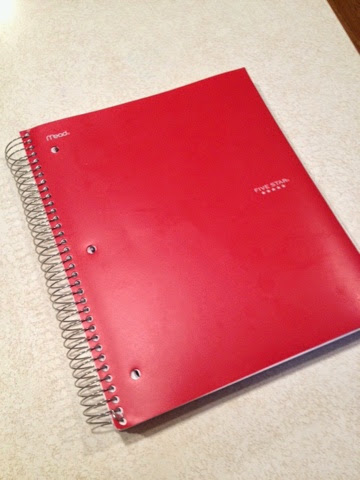


The notebook itself is pretty ordinary. I do sping for the plastic cover, since that's more durable. It's a 5-subject notebook, and I like the big ones because they last. I'm not very good about going through old ones and reviewing what I learned, so I like a big sturdy one that lasts. 
One of the challenges, with a book like this, is organizing it. I decided that, in the top right corner of each page, I'd write the topic and the date. When I run out of room on the back of this page, I turn to the next clean page and label it, and continue as if there was no interruption -- even if there is a huge distance between the pages. Since I tend to have several books going at once, and often other projects as well that get tucked into my notebook, this system seems to work out well.

Figuring out what to put in my book was a bit of a challenge, at first. I learned about it when I was reading The Well-Trained Mind, and then later read this online:

"Commonplacing is the practice of entering literary excerpts and personal comments into a private journal, that is, into a commonplace book or, to use a 17th century synonym, a silva rerum ("a forest of things"). Typically the excerpts were regarded as exceptionally insightful or beautiful or as applicable to a variety of situations, and so as such they are often especially quotable. . . . The practice of commonplacing can be traced back in the European tradition to the 5th century B.C.E. and the Sophist, Protagoras.
-Norman Elliott Anderson, quoted by Lucia Knoles


My own personal style is a blend of literary excerpts, note-taking, essays I write for my blog, and even lists for long-term projects and goals. Since the notebook is large enough to last for several years, it has been a particularly effective place to lists of house and yard projects. It's not, classically speaking, something that belongs in a commonplace book, but it sure works well for me, so I keep it there. It's actually really nice to periodically review what commonplacing is, at its core, about. For whatever reason, the literary excerpts and quotes are easy to let fall by the wayside somewhat. Reading this reminded me that I need to do more of that again.

Here are some pictures of several different pages from my current notebook:

The quote in the box I actually copied from a friend's facebook post, explaining how formality/humility works in Japanese. I'd been studying this for years, and she made it all come into focus in about 3 sentences.  (Ah, the advantages she has for that sort of thing, living in Japan!)


This page is a segment of an essay that I wrote a while back, 7 Lessons From the Bad Guys. That post grew out of noticing a several month pattern in what the Spirit pointed out to me, and then several weeks of trying to coax it into words. I wanted to remember it, even if the blog disappeared.


This one is actually an excerpt and commentary. My sister and her husband gave me a lecture series, The Great Debate, a while back, and because I can't just listen to it, I have to read every single extra reading they list, and that slows down the process greatly. It's slooow... but I'm such a happy camper.


 Several times, in doing the work for The Great Debate, I found that I needed to know more about the geography of the early States. (No fancy markers; I'm pretty sure I just used the kids' crayolas from their art box.) This time, I drew a picture. I found that I couldn't write on the back of the page, and that bothered me, so next time...

I printed and glued in maps. This has some plusses, but also some drawbacks. I may do both techniques again. (Don't you love the Angry Birds Star Wars sticker? It was a gift from my seven year old, who asked that I put it in my notebook.)

This page has both a quote, and a practice art for my scripture journal, with which I get a lot more fussy about the artsy elements.


I love my notebook. I read more deliberately, and remember more consistently since I started using it, and I highly recommend the practice. I don't have too many rules for myself. If it strikes me (and I have time), it goes in. Sometimes I make a point of practicing writing, particularly with the literary excerpts, in a particular style, and in that way I've developed a couple of options for beautiful handwriting. And sometimes I just use everyday printing, or even occasionally all caps. It's very mood-driven. I'm a pen snob (my husband teases me about an over-fondness of the office supplies isle), and so the pens around the house tend to be ones that write well, but other than the pen has to be pleasant to write with, I use whatever pen comes to hand.

Hopefully that helps. Enjoy your own commonplace journal journey!


P.S. I'm so glad you stopped by to read about the adventures at our house! If you want more, "Like" my blog on Facebook to get posts (and the articles n things I wish I had time to blog about) in your feed. Wanna see all the projects and ideas that I may or may not get around to? Follow me on Pinterest. Thanks for stopping by!

16 August 2013

Chatting in Japanese

I majored in Japanese in college, but I didn't do very well, owing to the fact that I hadn't the foggiest idea how to study. I never needed to do it before then, not even in the Spanish or German classes that I fooled around with prior to going to college. It wasn't until I encountered the concept of a commonplace book that I learned how to study, and that idea I ran into just about 6 years ago when we were deciding to homeschool and researching how to go about doing it. If you glance through my comments on President Benson's Proper Role of Government essay, you can see the changes as I learned to study and practiced this new skill learning about the Founding. My study of the Constitution was the first place I ever successfully studied anything on a long-term basis. I've been fooling around with Japanese longer, but it never amounted to anything.

About a year ago, that started to change, and there's a couple reasons for that.

A while back I was on the Well-Trained Mind message boards (I think that's where it was, anyway. I like it there. Go by "Ritsumei". Wave if you see me!) and someone gave me permission to mix languages. See, I had this idea that I couldn't speak Japanese until I could really speak it, all the way. In college they had this great Japanese conversation group. The TAs, the students, the folks who had been over to Japan teaching English, anybody who had two words of the language to show off, they were all invited to invade this great little coffee shop, and they'd just take over the loft and chatter away in Japanese. The TAs that did all the teaching basically demanded that we show up the first few times, and I felt like such an imposter. I couldn't follow the conversations,  I couldn't say anything that was in my head, and the "dialogs" we memorized weren't very useful. (Are those socks nylon? No? Oh, they're cotton. I'll take it. Put it in a bag, please.) So I never said anything. And I only went occasionally, and I missed out on a fantastic opportunity to use the language in an incredibly supportive environment.

But it's OK to mix languages. You say what you can in the language you're learning, and you say the rest in the one you know, and no kittens will die. Particularly not when you're sitting in your living room - or a cozy coffee shop - in America's Midwest. Not only will nothing bad happen, but something good will happen: practice with the words you do know. This is so simple, but it was such a revelation to me! I don't have to be able to discuss politics and philosophy to be able to start speaking!

So I'm teaching my kids Japanese now, and I talk to them in a strange pidgin nearly every day. And it's working. They are understanding more, and they're starting to throw in a word here and there, or a phrase. Our Japanese is a mess. It's full of Dragon's toddler lisps, Hero's uncertainty (he's like me, and inclined to wait till it's just right before allowing it to pass his lips), and my wobbly and incomplete grammar. Our levels of formality are all over the place. But it's happening. I get thanked in Japanese as much as in English. I tell Dragon, 「来てください。」 and he runs over as readily as if I'd said, "Come here, please." It's small stuff still, but it's a start. And since I'm studying, the quality of Japanese I can give them is improving.

Another thing I've learned is that little bits add up. I try to spend a little bit of time practicing, reading about grammar, studying my vocabulary, something, every day. I don't reach that goal, but since I keep trying, I generally get a little something in most days. Often it's no more than 5 or 10 minutes, though I like it when I can spend 30 or even more while I'm nursing, or after the kids go to sleep a couple times a week. It's soothing. Since I've given myself permission to be where I am, and stopped beating myself for not being perfect Right Now, it's fun. If I spend some time studying grammar, then practice making up phrases or sentences using the new construction, odds are good that when I go read the Book of Mormon I'll find something using that, and my understanding will broaden.

Which brings me to the other thing that has made a huge difference: my iPhone. I'm not an Apple person most of the time, and there's things about my phone that make me roll my eyes pretty regularly, but I love my Japanese apps. I've tried more than a few in the past few years, and have settled into a system with some favorites. Being able to cut-n-paste an unknown word from the scriptures into a dictionary and my flash card app has made a huge difference. I love that I can carry a basic grammar reference, a couple sets of flash cards, several dictionaries, and The Book of Mormon and Bible -- in my pocket! Kids playing nicely in the backyard, and nobody needs attention? Awesome. I can flip up to ~60 flashcards in 5 or 10 minutes. Or try to read a verse while I'm waiting for Andy to run into the post office, including copy-n-pasting unknown words into a dictionary. This morning we practiced body parts. At least, that's what I told myself we were doing. I tickled the boys, and names the part I was attacking. And when I didn't know the word for "back," I looked it up without breaking the game! My phone will has a recording of a native speaker reading all the scriptures, so any chapter I want, I can have it read to me. I have an app that puts the English and Japanese (and 3587565436 other languages, if I want 'em) side-by-side, with the verses lined up, so I can easily reference them. We have some kid songs on my phone that I can bluetooth onto the speakers in the car, and off we go, singing the same stuff (kinda) in both languages. Technology is amazing stuff, and it's making a huge difference.

So, more and more all the time, we are chatting it up in Japanese. It's pretty amazing.


P.S. Wanna read more about the adventures at our house? "Like" my blog on Fscebook to get my posts (and the articles n things I wish I had time to blog about) in your feed. Wanna see all the projects and ideas that I may or may not get around to? Follow me on Pinterest. Thanks for stopping by!

18 April 2012

Making Memories

When Monkey was a baby and I first read The Well-Trained Mind, I loved Bauer's suggestion that talking to your child will help them to aquire language faster, and thus to read sooner and more easily. Plus, I like talking to my kids, and it was a great excuese to go through the day telling them what's going on. Turns out that sort of parenting probably also helps them develop their memories, and kids that get talked to a lot - especially about the past - remember earlier and more than other kids. Who'da thunk?
 

16 September 2011

It's Not What I Thought

Numbers and counting. Throw in some rather arbitrary and abstract rules for moving those numbers around and you've got algebra. Advanced algebra's sine and cosine stuff was pure gibberish, but I remembered enough formulas long enough to do alright in the class. Geometry's proofs at least made sense. They had no practical value, but at least they made sense. I enjoyed the challenge posed by getting all the steps right in the long proofs. Trig completely defeated me.

This is math.

It all started over with teaching Math to Monkey. Only he didn't get the memo, so he had no idea that math is a "chore." That boy just inhales everything I show him about numbers. Has since he was pretty little. And because he was (is) so little, I've been careful to keep plenty of physical objects around to play with as we discuss the numbers. We've been as much playing as anything, often the numbers have been relatively incidental. For a while we were moseying through the book - we're working with Math Expressions - but lately I've been feeling like a skipped stone: no sooner do I land us in a section of the book than he comprehends it and we're off again, trying to keep up with where he's at. I asked him the other day if I'd even given him "hard math." He said no. So off I went to my forums. What do you do with a mathy kid anyway??

Turns out, you change your thinking.

I'd seen, and felt drawn to, cuisenaire rods whenever I saw them mentioned in the forums. Some people that are clearly very mathy seem to like them. A lot. But I never could figure out what you are supposed to do with them. They're sort of mysterious. So you build a staircase. That's nice. Now what?


I dunno. So I never bought them. But when Monkey started moving so quickly through our math book that I started feeling like a skipped stone, I went and searched the forums for information about them. There's plenty. I ended up reading a thread from last January.

One of the women asked her daughter, "Define 8." Now, me, I would have said something absolutely brilliant, had someone asked me that: "8 is... 8." That's all it is, what's to define? Her daughter said a whole lot more:


5+3, 6+2, 7+1, 8+0, 4+4 ("and all the opposites"), 1+2+2+3, 2x4, 4x2, 16/2, 24/3, 32/4, 40/5, 18-10, and eight ones.


It blew my mind, as did the discussion of "sixness" and how to go about teaching it - or if it was even necessary to fully explore "sixness." These people were discussing, as givens, ideas I'd never encountered, and the whole shape of my perception of math and numbers started to change as I was reading. I had some questions, so I started my own thread and learned some more.  The people who responded were as concerned about the relationships between the numbers as they were about the answers to the questions. What a different attitude from the "show your work - and it better be the same as the book or it's wrong" type instruction I received! Then they offered me a link to a mathematician's comments on the matter. Being a musician, the opening had my attention right away:


A musician wakes from a terrible nightmare. In his dream he finds himself in a society where music education has been made mandatory. “We are helping our students become more competitive in an increasingly sound-filled world.” Educators, school systems, and the state are put in charge of this vital project. Studies are commissioned, committees are formed, and decisions are made— all without the advice or participation of a single working musician or composer.

Since musicians are known to set down their ideas in the form of sheet music, these curious black dots and lines must constitute the “language of music.” It is imperative that students become fluent in this language if they are to attain any degree of musical competence; indeed, it would be ludicrous to expect a child to sing a song or play an instrument without having a thorough grounding in music notation and theory. Playing and listening to music, let alone composing an original piece, are considered very advanced topics and are generally put off until college, and more often graduate school. ...

In their wisdom, educators soon realize that even very young children can be given this kind of musical instruction. In fact it is considered quite shameful if one’s third-grader hasn’t completely memorized his circle of fifths. “I’ll have to get my son a music tutor. He simply won’t apply himself to his music homework. He says it’s boring. He just sits there staring out the window, humming tunes to himself and making up silly songs.” ...

“To tell you the truth, most students just aren’t very good at music. They are bored in class, their skills are terrible, and their homework is barely legible. Most of them couldn’t care less about how important music is in today’s world; they just want to take the minimum number of music courses and be done with it. I guess there are just music people and non-music people. I had this one kid, though, man was she sensational! Her sheets were impeccable— every note in the right place, perfect calligraphy, sharps, flats, just beautiful. She’s going to make one hell of a musician someday. ...”


This I can understand. Music as an art, as something that must be felt, experienced, and enjoyed is a concept I readily understand and agree with. Lockhart goes on to say that Math is the same way.


The first thing to understand is that mathematics is an art. The difference between math and the other arts, such as music and painting, is that our culture does not recognize it as such. ... Nevertheless, the fact is that there is nothing as dreamy and poetic, nothing as radical, subversive, and psychedelic, as mathematics. It is every bit as mind blowing as cosmology or physics (mathematicians conceived of black holes long before astronomers actually found any), and allows more freedom of expression than poetry, art, or music (which depend heavily on properties of the physical universe). Mathematics is the purest of the arts, as well as the most misunderstood. (pg 3)


Ah-ha! This is what motivates my brother when he talked about solving a millennium problem. This is what makes people major in math! They're playing! (Incidentally, I saw one of those math people commenting on how much she enjoys her homework now. I believe that she just changed her major to mathematics, rather than math education.)This is what brings my brother-in-law so much enjoyment that he learned how to move a number to base 3 and then base 2... in his head. (He did that the day that I was teasing him about having a huge number of kids. If you change bases, then 8 isn't so many!)

The trick, then, is to discover how this is done so that Monkey and I can do it together.

I think this lady is onto something:


03 August 2011

Learning to Self-Educate

Shortly after I got married, we moved from the campus of UIUC where I had been studying Japanese, to Purdue, where I planned to get an elementary education degree while my husband finished his education in engineering. Before classes started we felt strongly that I should not attend the university at that time. I cried, and then canceled my registration. I loved school, I loved learning, and mourned that the Lord was directing me away from the only way I knew to "become educated."


Read the rest of my discovery of self-education over at LDS Parenting.

25 March 2011

Links Links Links

An interesting take on teaching good writing - using very short essays: Teaching to the Text Message.

I'm thinking about doing this oil-on-the-paper experiment to explain about birds staying dry when they're on the water. Also, it just sounds cool. They said they couldn't stick their fingers through wet paper if it had oil on it. I want to try!


A pair of very good questions from the Representative from Texas:
"We have to remember, a no fly zone is an act of war. Now what moral right do we have to participate in war activity against Libya?" AND
What would we do if someone slapped our United States with a no-fly zone and sanctions, and then started bombing to enforce it?

Additionally, if we ARE going to go to war, it's Congress's job to decide, NOT the president's. He's commander once we decide to go to war, but the decision is not his to make.


Also, here is Susan Wise Bauer doing a dictation with her 13yo son. While it's not an exciting pair of videos (you spend a lot of time watching him write), I found it very instructive as to what dictation actually looks like. I didn't expect that there would be so much grammar instruction in the process. And she basically had him do the problem orally before wrote it, which surprised me because I'd conceived dictation as a primarilly written sort of thing. And that, altogether, is very interesting.


For further reading on why this matters, try the message boards here first and then here.

30 September 2010

Classical Education Musings

The newest edition of the Charlotte Mason carnival is just a few days old, and I'm browsing. They've got some good stuff this time! Here's some of what caught my eye this afternoon, both on and off the carnival.

Settled in my Home has a great idea for slipping in a little art & music appreciation, nice & easy. I followed one of her blogroll links & found an awesome quote, which went right into my commonplace book.


I would be most content if my children grew up to be the kind of people who think decorating consists mostly of building enough bookshelves. - Anna Quindlen, "Enough Bookshelves," New York Times, 7 1991


Over at Practical Pages she's got a post about using puppets in narration that's got me thinking: maybe if we did something like that we could start to ease into narration. The Well-Trained Mind suggests starting narrations in 1st grade, which I'd like to start a year, maybe a little more, from now. This would be a good way for me to practice up a bit. And it would be fun. What's not to like?


Narration is a way to develop the child's understanding and storytelling skills. The process is simple: the child tells you what he's just heard or read. You started this process in preschool, when you asked your child questions about the stories you were reading together. In first grade, you begin to ask the child to summarize the plots of short simple stories...

Narration lets you know how much a child retains and understands. It also develops vocabulary and powers of expression, and lays the foundation for good writing later on. A short essay is a cinch for a child who's become accustomed to narration.
The Well-Trained Mind, 55


Finger puppets seems like a lovely kindergarten intermediate between just asking questions, and outright plot summary. Monkey's been telling us stories - often (somewhat garbled versions of) stories we've read to him. This might be just the thing for us. Practical Pages also has a great post on Mom as a "Narration Scribe."

08 September 2010

Habit vs. Nature

While the power supply on my computer was dying a lingering, stinky death, I've been thinking about my blog. Specifically, I've been wanting to blog about some of Charlotte Mason's ideas. I was given a copy of Laying Down the Rails about 2 weeks ago, and I'm loving it! I have the original series, but it's a tough read, and it got put into storage a while ago. Not doing me much good there. The thing I'm loving about this new book is that it's got Miss Mason's ideas grouped by topic. I kept getting bogged down in trying to read the original series, but this book makes me think AND keeps me turning the page. Can't argue with that combination!

Right off the bat, Mrs. Shafer, who compiled the book from Miss Mason's original writings, with some additions of her own, starts with a section on the importance of habits. A lot of this is section is stuff that I'd read from the original already, but having it all together like this, arranged topically, I saw it differently, and understood better what Miss Mason was getting at.


'Habit is ten natures.' If that be true, strong as nature is, habit is not only as strong, but tenfold as strong. ... But habit runs on the lines of nature: the cowardly child habitually lies that he may escape blame; the loving child has a hundred endearing habits; the good-natured child has a habit of giving; the selfish child a habit of keeping.

But habit, to be the lever to lift the child, must work contrary to nature, or at any rate, independent of her.
(Page 12, emphasis added)


The idea of habit as a lever really caught my attention; it made me sit up and think. Of course, Miss Mason's emphasis is on education, and as Monkey gets closer to "school age" my desire to practice being consistent with doing school has increased. That is, I want to make sure that my habit of attending to my children's education is firmly in place before we get to our state's compulsory school age.

We're not doing too badly in that department, I don't think. It's a rare day that slips by without reading several stories at some point in the day. Allowing a little more wiggle-room for my efforts to NOT go into preterm labor this summer, I think we really did pretty well. Monkey is in the early stages of becoming a reader, and although there was very little forward progress in his reading this summer, we did well enough that there wasn't really any loss of skill either. Now I need to shore up the habit of doing school and I think we'll see some nice progress over the next few months.

However, the interesting thing about Miss Mason is that so much of her emphasis is not on the subjects one learns in school, such as reading and math, but rather on the virtues that make education possible and effective. Laying Down the Rails divides them into several chapters: Decency and Propriety Habits, Mental Habits, Moral Habits, Physical Habits, Religious Habits, and the book gives a whole chapter to the family's habit of reading aloud. She talks about habits of cleanliness, attentiveness, remembering, integrity, and many others. I've scanned through some of the sections already, and I'm looking forward to reading more!

One thing that surprised me when I first started looking through this book is the emphasis on character development in an educational philosophy. Many, perhaps most, of the habits she touches on are things that I would have placed under a religious, not an educational, heading, were I to have made a list of things that I'd like to teach my children. Perhaps this is a result of my own public school education, where the focus was, of necessity, on subjects such as reading, math, science, and music, rather than on the formation of character. Good character is closely bound up in religion and morality, and thus a sticky, dangerous topic when dealing with public education. But I'm beginning to realize that this is a false separation.


The old classicists called theology the "queen of sciences" because it ruled over all other fields of study. Theology still does, either in its presence or its absence. In it's most honest form, the debate over the teaching of creation and evolution in public-school science classes is not about whether the species evolved over unimaginable years or were created in the span of one word. ... the debate is over the presence of absence of a Creator. This presence of absence has immense implications for every area of the curriculum: Are we animals or something slightly different? Do math rules work because of the coincidental shape of space and time or because God is an orderly being, whose universe reflects His character? Is a man who dies for his faith a hero or a fool?

Public schools, which have the impossible task of teaching children of many different faiths, must proclaim neutrality.
We don't deal in matters of faith, the teachers explain. We're neutral.

Think about this for a minute. Arguing for the presence of God is generally considered "biased." Assuming His absence is usually called "neutral." Yet both are statements of faith; both color the teacher's approach to any subject; both make a fundamental assumption about the nature of men and women.

To call this neutrality is intellectually dishonest. ...

Let's take biology as an example. Mammals are characterized by, among other things, their tendency to care for and protect their young. Do mothers love their babies because of sheer biological imperative? If so, why do we come down so hard on fathers who neglect their children? It's a rare male mammal that pays much attention to its young. Do fathers love their children because fathers reflect the character of the father God? How should a father treat a defective child? Why?

We don't blame the public schools for sidestepping these sorts of questions. In most cases, it's the only strategy they can adopt.

Yet this separation of religious faith from education yields an incomplete education. We're not arguing that religion should be "put back" into public schools. We'd just like some honesty: an education that takes no notice of faith is, at the very least, incomplete.

The Well Trained Mind, pages 204-205


Morality, the contents of a "good character," these are things that are unavoidably bound up in questions of faith. My own Christian faith teaches that "men are that they might have joy." This is in direct opposition to the first of Buddhism's Four Noble Truths: "Life means suffering." Which you believe will unavoidably impact what you value in a good character. It will most certainly affect what sort of habits you want your children to acquire.


But habit, to be the lever to lift the child, must work contrary to nature, or at any rate, independent of her. (Page 12, emphasis added)


For the natural man is an enemy to God, and has been from the fall of Adam, and will be, forever and ever, unless he yields to the enticings of the Holy Spirit, and putteth off the natural man and becometh a saint through the atonement of Christ the Lord, and becometh as a child, submissive, meek, humble, patient, full of love, willing to submit to all things which the Lord seeth fit to inflict upon him, even as a child doth submit to his father.
-Mosiah 3:19


Education is the formation of habits. (Page 12)


The habits of the child produce the character of the man. (Page 14)

12 July 2010

Weekly Wrap-up: A Bit Late


Monday: We took as a holiday. Monkey's Daddy had the day off for Independence Day, and we thoroughly enjoyed having him around. Monkey had been asking to do "tire painting," which we did, and we set off some fireworks in the driveway Monday night.


The rest of the week was pretty productive. I put together another game from Happy Phonics, the Castle Game, which Monkey enjoyed. We also spent some time working on the Reading House. With Monkey's fine motor skills improving, we're doing more with Math - and he's loving it. All week I kept hearing, "Let's do Math!" OK. We can do that. Some of the stuff we did went into the binder I made. Some of it was sidewalk chalk and other temporary mediums.


One of the great difficulties I've had in moving forward in the Math Expressions book we bought a while back has been figuring out how to deal with Monkey's fine motor skills. He enjoys math, but this book (and all others that I'm aware of) assumes that the kids learning are older than 3 1/2, and thus that their fine motor skills are considerably more developed. In using Happy Phonics, we've avoided him needing to write at all in order to learn to read. But in math has been more difficult to avoid writing. This week, it occurred to me that the gradual process recommended in the Well-Trained Mind for moving narrations from my writing them to him writing them should also work with Math.


For first grade, you write the narration down, have the child read it back to you, and then place it under My Reading. ... By second grade, most children can dictate short narrations to you and then copy these narrations themselves. The second grade notebook should contain less of your writing and more of the child's. ... By third grade, your student should be able to narrate the plot back to you and write it down himself without the intermediate step of dictating and then copying. In short, he'll have gradually worked his way up to doing book reports. (TWTM, pg 59-61)


Obviously, Monkey's not doing 1st grade work yet: we're doing a mix of preK and K work. But it occurred to me that this gradual transition from my writing to his would work for math as well. We tried it out this week, and I am pleased with the result. This is the "scene of two" we worked on together:


Kumon went mostly well this week. Memorization was a bit shaky: we usually do that at bedtime and Monkey kept falling asleep before we got it done. Our Scripture reading went great again; two weeks in a row! We'll likely finish the Book of Mormon this week and start the Gospels. Monkey is very much looking forward to reading all those stories about Jesus!

We also took a tour of the Hospital on Thursday, which I think I enjoyed more than Monkey did. They've remodeled since I had Monkey, and the nice environment they had then has been improved upon. I'm getting very excited for this baby to come!

Saturday, Monkey got a special treat: we took him to the Children's Museum near the temple, where he played with his Aunt while we did a little temple work. He was sooo tired when we picked him back up, but it sounds like he had fun! Aunt Kate has promised to share pictures with us soon.

29 October 2009

A Notebook for History

Whereas there is nothing quite so likely to make me feel half-educated as reading The Well-Trained Mind (TWTM), and Whereas I have never actually studied world history in either High School or College, I Am Resolved to begin the process of remedying my own ignorance by studying World History.

Additionally, it strikes me as useful to know something about history in prior to teaching it. Now seems like a good time to do something with this project because I know that it's going to be a very long, slow project.

I began by setting up a binder. First I made it pretty. Because pretty is important. Then I put tabbed dividers into it and labeled them the way that TWTM suggests for the logic stage. I chose the logic stage because it seemed like that's where most of my education would have fit, more or less, if I were to categorize it into the Trivium.

These are my labeled sections:

*Outlines
*Great Men and Women
*Wars, Conflicts, and Politics
*Inventions and Technology
*Religion
*Daily Life
*Cities and Settlements
*Primary Sources
*The Arts and Great Books

Since I have the Usborne Encyclopedia of World History (found it at the thrift shop for half-price; looks brand new), I'm using that. The Kinfisher History Encyclopedia is on my wish-list, since that's the actual spine that TWTM suggests for the logic stage, and the Usborne is a little elementary. But the Usborne has all those lovely internet links, and with that and a little help from Wikipedia I'm getting along.

I started with Jericho. The Book of Joshua clearly goes under "Great Books." I read about Çatalhöyük. Fascinating stuff. Again, pretty easy to file away, under "Cities and Settlements." Next came Sumer. I thought I'd push through it quickly so that I could get on with Egypt, which sounds very interesting for a number of reasons, not the least of which is my Egyptian friends from college. Plus, ancient Egypt has mummies. How cool is that? Only, Sumer turned into a bigger, more interesting project than I thought it would be. And it posed some interesting challenges.

For instance, I didn't have a very clear idea of where Mesopotamia was. So I looked it up and printed out the map, along with a map of that same area today. It's basically Iraq. Now, where do I put this in my book? I ended up converting the "Primary Sources" section to "Primary Sources and Maps." Though there will likely be some maps that find their way into the cities section.

For some reason, this whole "where do I put the maps" question was very stressful to me, and I consulted on the TWTM's message board, AKA the Hive Mind. After an interesting discussion about the merits of a sectioned notebook vs. chronological notes vs. a commonplace book arrangement, one of the ladies made this very interesting observation:


TWTM has you study things chronologically and keep a timeline, but file them non-chronologically. That way you get to look at things both ways. Having sections makes you choose which is the most important aspect of something. Choosing makes you think about it.

Read her whole comment.
Read the whole thread.


Seems to me that having things set up in a way that forces you to think is an excellent way to go, so I'm sticking with the sectioned notebook for my history. Plus, this has the added benefit of letting me try out TWTM's suggested sections before Monkey needs to use them so I can have some idea of how they work in practice. I like it!

23 October 2009

Friday Again


This week's big change was adding in some more math. Monkey's doing really well with it! Right now we're counting in all the new and creative ways that I can think of. These are pennies we counted out this morning. Monkey wanted to make stacks, so that's what we did: 5 plus some more, in the second row is what you're looking at, though it's hard to see. I made some flannel board pieces and he made me pictures of one and two pretty successfully. When we tried to show this to Daddy he wanted to do four, and that didn't go quite as well. So there's still some solidifying to be done on these number concepts, but it's coming along nicely.

We continued with the Happy Phonics games, as well as the file folder games, and he's definitely improving in his ability to discern between "b" and "d," though I've realized that we must be missing certain letters because he's got some that he really struggles with - V, W (he wants it to be an M), he mixes up the sounds for G and J, that sort of thing. I was a little surprised, but it should be easily remedied with some more games focused on those letters.

About midweek, Monkey discovered this book on our shelves. I found it at the thrift store a while back, and he periodically finds it and looks all though it. It's one of those cool ones with the see-through panels that shows all the different things going on in the body. The first organ they discuss is the skin, and we spent a good chunk of time this week talking about skin and fingerprints. We got out my scrapbook inks and made some fingerprint art. That was fun, so Monkey wanted to do it again a couple days later! When we took our trip to the library one of the books I grabbed was about the skin and I read just a little bit to him. It's a bit old for him and enough over his head that it didn't seem to be grabbing his attention very well, but we did look at some of the pictures and talked briefly about cells and microscopes that make things MUCH bigger, like his magnifying glass, only more. It was nice, but the "finger painting" was much more fun.


We're making good progress in our read-aloud right now as well: we're doing Little House on the Prairie, and Monkey asks for more each time I read it. Since we're doing it at naptime I seldom give it to him, though I'll probably read a second chapter this evening since he's a bit under the weather and in on the couch enjoying some Bob the Builder, looking a bit pathetic. You know a three year old isn't feeling quite right when they ask for a nap and then sleep for 3 hours!

Nature Study, we more or less skipped, though Monkey did come out and help one day with garden clean-up. But with him under the weather, I haven't felt like I could take him out in the cold rain we've had most of the week.

Mom's Ed:
Not as much this week (not that there's tons in any week), but I did spend some time studying a great article on unity and charity, as well as some re-reading of parts of The Well-Trained Mind.

08 October 2009

Weekly Wrap-Up


So! This week, in school, we've done some fun stuff. Monkey and I played several phonics games. I made tried out my first file folder game, and we're getting the hang of playing it. This game is a capital and small letter matching game. Happy Phonics has 8 steps. We're working on steps 2 and 3 (big letters & small letters match; letters have sounds). He's had the sounds of the letters down for a while now, but the matching of the letters is proving a little difficult, once they are separated. Particularly those pesky b's and d's. I made another folder game for this and after only playing once or twice he's doing better. This is good since he's starting to show interest in step 4: blending. One thing that I love about the Well-Trained Mind is this:


Many of the phonics programs we examined insist that you combine writing with reading. In other words, teach the child the consonants and the sound of a, but don't go on to the next step until the child is able both to read and write sat, cat, fat, bat.

We think this tends to frustrate very young readers. Remember, you want the child to read quickly, easily, and early. Many children are ready to read long before they have the muscular coordination to write. Why delay reading until the muscles of the hand and eye catch up? (Well Trained Mind, 38, emphasis added)

That's very much been the way of it at our house. Monkey loves to read, and he likes to play the letter games. If the interest is there, I say do it. The folder games are extras for more practice and variety; we also did some of the "official" games from the program. In addition to the intended use of the folder games, we have discovered that they double nicely as "computers" and he's been "typing" lots of "letters" to various family members. Oh - and we've very nearly finished up our "D Book." I'm running short on good d words, so if you've got a good one, leave me a comment please! Monkey keeps gluing them on pages that already have a word or two, so it's taking lots more words than I anticipated to fill the book.

For math, I'm struggling to come up with any particular plan. This doesn't seem to bother Monkey much at all. He's getting pretty good at counting to 10, and regularly continues on past 10: "11, 12, 14, 16, 17, 20, 30, 40..." What I want is a copy of the text my Mom uses in her Kindergarten classroom. She loves it, but she didn't think it was available for homeschoolers. I need to check on that. I don't know that I'd use it in a sit-down-and-do-page-3 sort of way, but more in a turn the principle into a game sort of way. Monkey's too little for worksheets! But I'd like to do some more math with him.

We didn't do any outdoorsy nature study things this week. Well, he did go to the orchard with his daddy to pick up more apples for me, but they were just deer apples, not the ones that you pick yourself, so it hardly counts. However, he DID do an impressive amount of apple peeling in the course of my canning!

Mom's Ed:
I spent some time this week working on my study of Sumer, which is interesting, but not as interesting as Çatalhöyük. That was pretty much all I did toward my own education though, as I spent a HUGE amount of time canning apples with my friends. Yummy.

26 August 2009

Çatalhöyük


I recently found the Usborne Internet-Linked Encyclopedia of World History at a used bookshop in town. Very exciting. It's one of TWTM's recommended grammar stage (elementary) history books. I, having never taken a world history class, decided to go through it and see what I can see. I started on page 109 - before that is mostly about evolution. I already wrote about evolution; I skipped that part. We'll likely skip it when Monkey's in elementary school too. But about page 109 things start to get interesting.

First, there's Jericho. Joshua's Jericho. It seems that they lived in igloo-looking homes and buried their dead under their homes. But even more interesting than Jericho is this place in Turkey called Çatalhöyük.

This being an internet-linked encyclopedia, it linked to a page with a pronunciation for that big word: Çatalhöyük. It sounds surprisingly normal, for as strange as it looks to me. They also had a helpful map, showing where in the world Çatalhöyük is located. Very nice. The website also has some more information:


Archaeologists are excavating the remains of a Neolithic town. 9,000 years ago, this place was one of the world's largest settlements. At a time when most of the world's people were wandering hunter-gatherers, as many as 10,000 people lived at Çatalhöyük.

Çatalhöyük means 'forked mound' and refers to the site's east and west mounds, which formed as centuries of townspeople tore down and rebuilt the settlement's mud-brick houses.


Apparently, in Çatalhöyük they opted to use ladders rather than front doors. They climbed up on the outside, then entered the house through a ladder through the roof. So far, I haven't seen anything that offered any guesses as to why that might be the best way to get into the house. All I can think of is that it's much more defensible than a front door. You pull up the ladder and the house is a lot harder for bad guys or predators to get into. I imagine that they got very good at climbing those ladders!


One interesting thing about Çatalhöyük is the clay balls. They found them all over the place. Sounds like there were thousands of them, in three different types: Balloids, Mini-balls, and "weird-shaped." There's a lot of theories about what they might have been used for. Cooking, hunting, war, kids' toys. A woman names Sonya Atalay is studying them, but the page about her ideas has many more questions than answers.

When Çatalhöyük was discovered in the late 1950's, one of the reasons that it became famous was the murals the archeologists found. Those murals are still an object of iterest, and you can see pictures of some of them on that website the encyclopedia recommended.


The photographs are pictures from the actual dig site in Turkey, used with permission from their Flicker Photos. There's also this official website, done in cooperation with Cambridge, that you could look around.

LinkWithin

Blog Widget by LinkWithin