09 10

17 May 2017

DIY Folksong Songbooks Tutorial

A tutorial for making a DIY booklet to use as a folksong songbook, a homemade phonics reader, or a host of other homeschool projects.

I've been trying for a while to figure out a way to improve our folksong study. I have a playlist, and using it we've become passingly familiar with our songs. But we don't really know the words. I tried printing the words for the day's song, but even when I keep the sheets and use them several times before they get lost, it feels like an inefficient, wasteful way of doing it.

Folksongs were on our list again today, and the problem was bugging me, when all the sudden it came to me: we can make little songbooks the way that I did with our easy readers. Those are quick and easy, and as an extra bonus, in addition to giving us a much more lasting method for keeping our songs together, if the kids help write the words in the books that will help them to remember.

Materials: 
1 sheet cardstock and 9-10 sheets printer paper per book
A sewing machine and thread
supplies for decorating(optional)
a ruler and pencil(optional


What you do:
Gather up your papers. I'm running low, so our covers are just cream colored, which ended up working out really well. I like to use 6-10 sheets of paper when I do these. I've done up to 12, but it gets really bulky, and I don't like it so thick for this method. 


A tutorial for making a DIY booklet to use as a folksong songbook, a homemade phonics reader, or a host of other homeschool projects.


Take your papers and cardstock, line them up carefully, and fold them in half.


A tutorial for making a DIY booklet to use as a folksong songbook, a homemade phonics reader, or a host of other homeschool projects.


Open them back up and set them on your sewing machine, lining the needle up with the fold you made. It's usually easier to see this fold from the pages side of the pile, rather than the cover side of things. You want a line that you can see passably well, because this is going to be your stitching guide.


A tutorial for making a DIY booklet to use as a folksong songbook, a homemade phonics reader, or a host of other homeschool projects.


Carefully sew down the fold. It's nice if it goes perfectly, but close enough is good enough. A surprisingly large amount of variation in the line still folds nicely.


A tutorial for making a DIY booklet to use as a folksong songbook, a homemade phonics reader, or a host of other homeschool projects.

Next, fold the booklets closed again, and clip the strings.


A tutorial for making a DIY booklet to use as a folksong songbook, a homemade phonics reader, or a host of other homeschool projects.

At this point, the booklet is done, and you can turn it into anything you want. Since we're making a folksongs book, I started getting the kids involved in the project. They wanted to use my washi tape and fancy markers and pens to do the decorating, which I said was fine. So they did their own covers.


A tutorial for making a DIY booklet to use as a folksong songbook, a homemade phonics reader, or a host of other homeschool projects.


Because I plan to have Hero(10) write out his own lyrics, I quick penciled in some lines. These are quick and soft. He said that he'd like it better if I did it in pen next time, because these lines erased when he was fixing mistakes.


A tutorial for making a DIY booklet to use as a folksong songbook, a homemade phonics reader, or a host of other homeschool projects.


I set a timer for 10 minutes, and had him work on his own lyrics. For the younger kids, I'll just write in the lyrics for them, so they can follow along in their own copy, and our collection will grow as we do more folksongs.


A tutorial for making a DIY booklet to use as a folksong songbook, a homemade phonics reader, or a host of other homeschool projects.

The kids want to have them covered in contact paper, which will make them much tougher and more long-lasting, which I think is a great idea.


A tutorial for making a DIY booklet to use as a folksong songbook, a homemade phonics reader, or a host of other homeschool projects.


Now, as we do our folksongs, the lyrics will accumulate in our books, and (I'm being optimistic when I had everyone label it "book 1") down the road we should have a little collection of them, which is a fun thing to contemplate. I think it will be an awesome way to integrate this into our family culture a little bit more.

12 May 2017

Quench Not the Spirit


In his first letter to the Thessalonian saints, Paul gives them instructions, including these verses:


Rejoice evermore.
Pray without ceasing.
In every thing give thanks: for this is the will of God in Christ Jesus concerning you.
Quench not the Spirit
Despise not prophesyings. 
Prove all things; hold fast that which is good.
-1 Thessalonians 5:16-21


I don't think that I've noticed anyone talking about not "quenching" the Spirit, but it makes sense: we compare the Spirit to a flame. In the ancient temple, the smoke from alter represented the Holy Spirit, burning away the sins of the people, represented by the sacrifices they brought. The candlestick that burned constantly in the Holy Place also represented the Holy Ghost -- to quench the candle put out the light that allowed them to see while they were in the Tabernacle. To quench the fire of the alter meant that the sacrifice was not burned away. Quenching the Spirit in our lives has serious consequences.

The interesting thing about this analogy of the Spirit to a fire is that the only thing we need to do for a fire to go out is... nothing. If you don't feed a fire, it slowly dies. To keep the Spirit's influence bright in our life, we need to be constantly doing the things that invite it, or it will dwindle and fade away. One of the best ways to invite the Spirit is to study the scriptures then act on their teachings. 


When our study efforts expand, so will the influence of the Holy Ghost in our lives increase. Let us search the scriptures with pen in hand, making note of new insights and recording spiritual promptings. Thereafter, let us strive to apply what has been learned to our personal lives. The Spirit will quicken our inner selves; new understanding will come precept upon precept.
-Keith K. Hilbig, Quench Not the Spirit Which Quickens the Inner Man 


There is always a huge emphasis on scripture study in the counsel we receive, and April Conference was no exception; I felt like my notes were "read your scriptures, read your scriptures, be nice, read your scriptures..." and I think it can be easy to think of that as an end unto itself, when perhaps it's more like a gateway to additional blessings, including having our nagging concerns eventually resolve, and having greater access to the Holy Ghost in our lives --and with it, greater certainty in our lives.

“The Spirit of God speaking to the spirit of man has power to impart truth. … Through the Holy Ghost the truth is woven into the very fibre and sinews of the body so that it cannot be forgotten.”
-Elder Joseph Fielding Smith, quoted by Douglas L. Callister, Seeking the Spirit of God


11 May 2017

Watching Our Birds

I've been working on improving our Nature Study, and we've been watching a number of videos from John Muir Laws to help us learn to be better observers. It's fun when the things that we've watched start to turn up naturally in the way that we look at things - in this case, just the birds that turn up around the house.

This Robin, for example. He turned up in our front yard, and the kids called me over to watch with him. We did a much better job of observing him - Hero spontaneously started using some of the techniques we've learned recently - and it was really cool to see how much more we could notice about him than what we did before.


We saw him run around the grass a while looking for food. They especially like the spots on his back, and thought that they look like a Creeper's face, so we dubbed him "Creepy". Which cracks me up, because he's so not creepy.


In addition to noticing his coloring, we also got to watch him eat, and (we think) mate -- with two different birds! And the kids were much more aware of the way that he moves: he was doing more running than the hopping that many of the other birds in our yard do. It was really interesting to watch both the bird, and also my kids as they applied the things that we've been talking about and learning over the past little while. I think that was my favorite part: seeing the growth that we're all having in this area right now.

Good stuff.

05 May 2017

Bullet Journal Update

It's been about six months since I started using a Bullet Journal, and I am still really loving it. I made it past the honeymoon phase, and into just everyday life, and it's incredibly helpful. In a conversation on the AO Facebook group I promised to share some pictures, and got some ideas for a tweak that I've known I needed to do, but struggled to know how to do it. So here's what I've got.

The book itself is nothing fancy: it's a regular composition book, decorated with scrapbook paper and washi tape, and covered in contact paper. I may get something with nicer paper next time... I may not. Putting the contact paper on it makes this book tough. I took this picture six months ago, when it was new, but it still looks almost as nice, even after six months of kicking around my house, being drug around in my purse and my backpack... it's remarkably tough. I've got another one that I did to be a scripture journal, and that one is actually about 3 years old, and still looks brand new. Composition books with contact paper on them are pretty sturdy, and for this book, that's really important. It's really pretty easy to cover them, and I think that the fact that it's pretty - and that I chose the papers, so I like them - makes it easier to keep track of. Using it makes me happy, therefore I lose it less.


Finding time for Mother Culture by using a bullet journal to record and track my goals for the New Year.

So, on the inside:

First, I have a basic month-at-a-glance planner page. Because I am studying Japanese, I do the days of the week in kanji, and after doing this for six months, I no longer have to think about what the word for Tuesday is, ever: I know them all, thoroughly. That, alone, is pretty awesome, and something that a bought planner could never do for me. It's the writing them out, over and over and over, then living in them that did it. On the lower right is a tracker that I use to try to take care of myself: to bed on time, drinking water, and stuff like that.


This monthly page is a pretty straight-forward planner type. I put in appointments and sometimes blog events - you can see the 5 Days of Books series that I did recently made it onto my calendar, since I was linking it up to a blog hop with the Homeschool Review Crew. All the usual calendar things: family visits, lessons, whatever has a time.


I also keep a 6 months at a glance page, for those things that you know are coming up well in advance. It's not something that I use a whole lot, but it is nice to have.


Henry B. Eyring gave that talk about looking for God's hand in his life, and what a blessing it has been for him and his family, so I like to have a page going for writing that stuff down. The biggest problem with this page is that I keep filling it up (God is good), and then I forget to make a new page for a while.


Related, but somewhat different, is a gratitude log: I just write down what I'm grateful for. I call this one "Singing Praises" because that's what they did during the Jaredite crossing: they sang praises. And that story has special meaning for me because of when Peanut was in the NICU. I want to remember to praise God in all the times, not just the good times, like the Jaredites did.


It was goals that got the whole thing going for me: I had a goal sheet on the fridge for a couple of years, but I gradually outgrew it, and needed something more. Probably 3/4 of what I'm tracking here is related to my own education somehow.


 In addition to the yearly goals, I've got goals and study projects that are tracked on a daily basis. This is great because then I can see what is doing well, and (more importantly) what is being neglected, and needs to come to the top of the heap.


Japanese and Welsh are large enough projects that they get their own charts, so that I can track the various things that I do to move those forward. A goal like "Learn to speak and read Japanese like a native speaker" is a enormous project, and I don't have an end date on that one, just things that I do regularly to push closer to that level of fluency. I don't care so much about when I "finish" (is it possible to finish something like that?), but I do care about doing certain measurable things that create progress. Those are the things I track: good goals are always measurable. I am far more fluent in Japanese than Welsh, so I can access more resources, and so that list is longer.


I also keep a list of the books that I've read this year. This makes me happy; it's the one arty page that I allowed myself in the book, and I love it. I love writing on it. Which helps me to make time for reading, which is not such an easy thing when you seldom get large chunks of time! But it's so important for teachers to feed themselves, too. You can't draw from an empty well. 


I've been using these daily lists, and they're good, but I get frustrated, because sometimes -frequently- I don't get it all done in a day, and I don't like spending time re-writing it onto another day. But some things are great: if I get behind on the laundry, I'm actually more likely to work on it again if I put it on my list. Same with the dishes. The banjo is pretty hit and miss. I'm trying out a new weekly spread, starting on Monday, and I'm pretty excited about it, so maybe I'll share that one another time; I don't know if it fits me well or not yet.


I always put "family work" on the kids' list of things they need to do, but then they come to me and say, "What's my family work?" uhh..... I dunno. But! I have a list. Two, actually. One is stuff that happens daily or near-daily. The other is jobs that happen intermittently. Both are very helpful for answering that question.


My menu planner page is a HUGE time saver. It used to take me hours of digging around Pinterest and moaning on Facebook to get a menu made. I hated doing it. I did it today in under 30 minutes, menu, list and all. It was fantastic. And I couldn't have done it without this page in my book: 


 Because I'm a member of the Homeschool Review Crew this year, one of the things I've agreed to is posting on my blog at least once a week. I track that in my book, too. And, to help me think up things to say, should that ever be a problem, I have a page where I track ideas for posts as well. Actually, there's a couple other pages that deal with Crew stuff, but I think these are enough to give the general idea. 


Six months into using the Bullet Journal, I'd have to say it's a solid success. More of my projects are getting attention more of the time. People sometimes ask me how I get everything done... this is it. It's all in my notebook, and I'd probably cry if I lost it. I think that the new weekly spreads are going to help me get a better handle on some of the homeschool work that we do on a loop schedule, so that the books that we are slowly reading will be done more consistently, and it should also help me do better with keeping my appointments actually in mind... I'm so very bad at that, even with a notebook to keep me on track. The nice thing is, when we bring our weaknesses to the Lord, He can make them strengths... even the one where we're perpetually a day late and a dollar short. And, for me, the Bullet Journal is definitely something that I think that He lead me to to help me with my ongoing struggle with disorganization.

04 May 2017

Science Through Nature


Science is a big deal. So much in our day depends on science, and there are so many ways in which it touches our lives. So how do we teach so that our kids are prepared to do science?

First, we go outside. Science is the study of God's creation: of the world around us. So we let them explore. Touch. Enjoy. Build a relationship with their world. That's the beginning. 


The child who does not know the portly form and spotted breast of the thrush, the graceful flight of the swallow, the yellow bill of the blackbird, the gush of song which the skylark pours from above, is nearly as much to be pitied as those London children who 'had never seen a bee.' 
-Charlotte Mason 1:60


Miss Mason lived in England, so perhaps her common sights of nature were a little different from ours, but the sentiment applies as well to our "Red-belly Robins" as my kids call them, House Sparrows and their little black bibs, and the warbling cry of a Red-wing Blackbird over the marsh as it did to her local birds.

Dragon climbed this cedar tree recently. It's the first tree that he's been able to climb. In a very visceral way, he knows this tree -- and he's not likely to forget it. Not only was it the first one he ever climbed, but it's so imposing that the kids named it "Thalia's Tree", after a character in the Percy Jackson books: Thalia had been changed by Zeus into a massive tree, and our cedar reminded them of that because it's so much larger than any other tree in the whole park.

On another visit to this park, we walked a "White Cedar Trail" and saw a bunch of younger cedars, which the group observed were "like Thalia's Tree". Because they knew the one tree well, having been all over it, they were immediately able to recognize the younger trees of the same species, even though they were not nearly so massive as Thalia's Tree. They were delighted to make the connection.

John Muir Laws, a naturalist and field guide author, spends a lot of time talking about science and kids, and how to help kids (and adults) do science through being in nature and using nature journals. He shares some interesting information about the Scientific Method in this lecture, starting at about 45:30. This is what he says:


"Now this is where things get really really interesting, and the reason that there is a lot of confusion about it is because we have all been indoctrinated with this: THE Scientific Method. ... There's different forms of it in different places, often with cool graphics, but they all are saying, you've got your question, and over here you are going to draw your conclusions, and you'll refine your hypothesis. This is missing several things.  

"How long has this system of exploration been around? 500 years? Does that sound about right? This might go back to Aristotle? So why am I dissing this, if Aristotle started this? Turns out this 'Scientific Method' started in the 1940s: 1945. And what happened is that Kesler to a bunch of scientists, had people write in a bunch of things, "These are things that scientists do," and scientists looked at it and said, "Yes. These are the sorts of things that scientists do," and Kesler took that list, and put some of them that fit into a nice little neat narrative, and put them in order and said, "This is the Scientific Method," and this got picked up on by scientific textbooks. And it's been with us as THE Scientific Method. There are lots of scientific methods! Could you do that method? Sure. But a lot of science is sort of mucking about, tinkering with things. And even that, the Scientific Method, leaves out the bigger picture of what's going on."
-John Muir Laws, Nature Journaling, Phenomenological Science, and Creative Thinking


He then goes on to discuss the use of nature journals in science, as tools to help students of all ages learn to really see, because good observations are at the heart of real science, but good observations are not at all intuitive: we have to learn how to see well. And he shares a number of pages from his own nature journal, and how they helped him to attempt to answer questions such as, "Do woodpeckers close their eyes when they peck?" and "Why are the ducks in this pond dying?" The video is great; probably the best part is that he gives practical tips on simple things that we can do with our own nature journals, and teach our children to do, so that we begin to think like a naturalist: we can begin to use our journals to do real science, today, and do it in many branches of science: botany, ornithology, entomology, astronomy, geology, and a wide variety of other branches of earth and life science; science is much more broad than the chemistry and physics that most of us took in high school. If we use it mindfully to train the attention and curiosity, nature study can be a very broad course of scientific inquiry, and lay an excellent foundation for even those branches of science that do not fall into its scope.

Laws is not the only person to suggest that nature walks and nature journals can be a powerful vehicle for introducing kids to science.


[Elaine Brooks] believed that people are unlikely to value what they cannot name. "One of my students told me that every time she learns the name of a plant, she feels she is meeting someone new. Giving a name to something is a way of knowing it."
-Last Child in the Woods, 41


Isn't knowing our world what science is, fundamentally, about? A nature journal not only encourages us to know nature - and more than just seeing a thing and knowing the name of its species, but to really know it - learn to be able to tell one Robin from another - and also to remember the experience, because they encourage us to flip back through them, to re-read the notes we made, re-look at the sketches. So they help us to see more deeply and more truly, and then they help us to remember what we saw, which leads to making more connections with the things that we learned.

 A year ago, I saw these wasp galls on some of the grasses at our favorite nature park. I wondered what they were, so I drew them in my nature journal. In drawing them, I noticed that there's a hole in the top, which was a clue to what they were, and something I never noticed until I drew it, even though they're all like that, and these are all over the place in our park, and we'd been visiting that park nearly weekly for over a year. My friend and I had a whole conversation about them, and then moved on to other things -- but when one of us found out what they were, we remembered and had another conversation. Since then, I've noticed conversations online about wasp galls that grow on a variety of different plants, most recently someone showed pictures they'd taken of galls that had blown down in a storm, probably from an Oak Tree. I walked past the galls in our park many times, hardly giving them a second glance. It wasn't until I started wondering about them and put them in my nature journal that I started to learn about them. Once I started learning, though, it's given me both an awareness that I didn't have before, and also a "peg" to hang new information on as I ran into it. I still don't know exactly what wasp it is that makes these galls, but I know a lot more about wasps and their galls in general -- because I added it to my journal.

Nature-study is for the comprehension of the individual life of the bird, insect, or plant that is nearest to hand. ... [It] does not start with the classification given in books, but in the end it builds up in the child's mind a classification which is based on fundamental knowledge; it is a classification like that evolved by the first naturalists, because it is built on careful observations of both form and life.
-Anna Botsford Comstock, Handbook of Nature Study, 7-8


And that is what we were doing when the kids fell in love with Thalia's Tree: building fundamental knowledge. No reading about Cedar Trees could hope to convey half of what the kids learned when they spent a half hour up in the tree itself, touching the bark, smelling the tree, seeing the leaves -the ceders were the only ones with leaves that early in spring: it would be more than a month before the deciduous trees put their leaves on- and using the strong, well-spaced branches as ladders. In contrast, Dragon tried to climb a Blue Spruce yesterday afternoon. I drew his tree in my journal while I was watching him -- at least, I drew the top part of it. It was a very large tree, and I didn't fit it to my page correctly, so I ran out of room before I got to the part where I'd wanted to add in a small boy for scale. I ended up measuring his height against it with my eye and noting about the same proportion of tree at the top with a bracket. Although he was persistent, climbing the Spruce didn't work very well at all for him: the branches are flimsy and crowded, the needles sharp, and even the bark is less than inviting. He won't quickly forget the differences between the two types of tree! Interestingly, the Spruce is located at the edge of a playground, and he chose to wrestle with the tree rather than play on equipment that is designed for climbing: he chose nature.


"…It would be well if we all persons in authority, parents and all who act for parents, could make up our minds that there is no sort of knowledge to be got in these early years so valuable to children as that which they get for themselves of the world they live in. Let them once get touch with Nature, and a habit is formed which will be a source of delight through life. We were all meant to be naturalists, each in his degree, and it is inexcusable to live in a world so full of the marvels of plant and animal life and to care for none of these things."
-Charlotte Mason 


There is another part of the gift we are giving our children: when we learn about nature and science, we are learning about God. People have turned to nature for solitude and communion with God since the earliest times - a number of scripture stories start with a prophet who goes into nature to be alone. Perhaps this is because nature -our world- is made by Him, and when we are alone among His works it's easier to feel His presence and communicate with Him.  What a beautiful thing it is.


01 May 2017

ArtAchieve {Crew Review}

ArtAchieve

We were given the ArtAchieve lessons for the Entire Level II for this review, and the first thing that I did was look over their Tips for Teachers -- which are great. Then I had a look at the lessons, and decided to start with one of the free art lessons they offer. It is likely that my oldest could have jumped right in, but I knew that the younger kids would want to participate, and I thought that Dragon(6) would particularly benefit from having this type of basic instruction.
A review of the ArtAchieve online art lessons that we've been using in our homeschool through the Homeschool Review Crew.
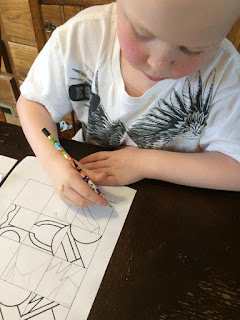
Dragon doesn't observe closely. He's the kid that can't find his shoes lying in the middle of an otherwise clear floor, and I've been looking to use art to help him learn to observe and pay attention to the world around him. This has been a little bit if a tough sell, because, not being naturally good at observing, art is often frustrating to him. This lesson was perfect for that. It's all about learning to observe basic lines in a piece of reference material, and then faithfully reproduce them. They've got some cool examples from a Polish church where they've used simple geometric shapes to great effect. Once he learned to see the lines, you could see him starting to gain confidence. His first effort was fast and sloppy, and he wanted to quit. I encouraged him to keep going, "If you go fast and sloppy, of course it's not going to look like the model. But look. This is half a circle. It starts here and goes to there. You can draw that, easy." And he could. And once he had a starting place, he could see how the rest of the lines could be added, and he gained confidence quickly. It was wonderful to watch. It worked out exactly the way that I'd hoped when we'd started doing the "copy the boxes" exercise that is the backbone of the lesson.

Choosing the second lesson was kind of funny: I asked the boys what they wanted to do and they kind of hemmed and hawed, and finally Peanut(4) spoke up and said, "I want to do the horsey!" So I started helping her... and as I suspected would happen, pretty soon the boys were interested and participating, too. Once again, Dragon's hang up was that it looked too hard: he didn't think he could do any of the projects. But there was another copy the boxes page for the warm-up, which included most of the lines in the project. Because he'd done one of those before, he attacked it with confidence -- and then I pointed out that he had drawn nearly the whole horse, just in pieces, and he could definitely handle the real project. He settled down and started enjoying himself. Those warm-up exercises are a great way to build the kids' confidence in doing projects that look intimidating, but really aren't so bad!

A review of the ArtAchieve online art lessons that we've been using in our homeschool through the Homeschool Review Crew.
Top: Dragon, Mom. Bottom: Peanut, Hero.

One thing that I really like about this program is that it gives a lot of support to the student's development of proportion. We quickly learned that it's really important to read the slides before just diving in. Some of them are directions, like this one, that help support proportion and teach planning the use of your paper.

A review of the ArtAchieve online art lessons that we've been using in our homeschool through the Homeschool Review Crew.

Additionally, they show how to find and use imaginary lines and "planning dots" to guide where to put your final lines. I love that they take the time to show how to see what you are doing before you do it; this kind of careful observation is key to being able to draw well -- and the slides are doing all the heavy lifting, so it's ok if mom thinks she has "no artistic talent" (which usually means that she just hasn't learned how-- if you can write your name you can learn to draw because drawing happens in the eye much more than the hand).
 
A review of the ArtAchieve online art lessons that we've been using in our homeschool through the Homeschool Review Crew.

The directions were so clear that even the four year old was able to draw a recognizable horse, which she was really excited about. She had some help getting started: I helped quite a bit with the head to the point where the slide above is, and then she completed the drawing entirely on her own: I helped her to understand the directions, but she did the work.

Each lesson has a fair amount of extra Cross Curricular Connections to go with it, and I was particularly interested in the things included in this lesson about the Swedish Dala Horse, because we have a lot of Swedish ancestry on my mom's side. Knowing that our ancestors may have made horses similar to these for their children made doing the project extra fun, and when we looked at the extra study materials, I did so with an eye toward highlighting things that would support that sense of connection to our own past. We actually ended up doing so much with the extras, and having so much fun with it that they got their own post.

A review of the ArtAchieve online art lessons that we've been using in our homeschool through the Homeschool Review Crew.We also worked on doing some Polish Szopka drawings. This was a more difficult project, and I didn't get nearly as many pictures of it, partly because I was concentrating much more on doing my own work and helping the kids do theirs. But it's so cool to see the kids learn how to see, and how to plan their drawings, and see how their art is maturing and their confidence growing along with it. We got interrupted before we finished (company came over), but Dragon kept going, working from memory, and really did a pretty credible job, particularly considering where he was at when we started this course. I'm really pleased with the way that his skills have been developing, and we'll continue these lessons even after the review, not only because the projects are fun, but also because the kids are enthusiastic and they're all developing some great skills to improve their art.


A review of the ArtAchieve online art lessons that we've been using in our homeschool through the Homeschool Review Crew.


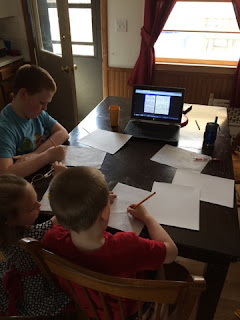
The one thing that is tricky with this program is getting it set up in our space so we can all see: the lessons are slideshows (they have a video format, too), and the slides are very step-by-step, so you can see exactly what you're supposed to add, and they also do a great job of teaching how to see like an artist. My kids love it. Which means that everybody wants to play, regardless of who the lesson is for, officially. This creates some logistical problems for us: my laptop is usually docked on my computer desk, and I dislike taking it unless absolutely necessary, but my desk can't handle 3 or 4 people all crowding around to see the lessons. I've taken the laptop to the table several times anyway, but we haven't done as much with this program as we would if the logistics were easier for getting the lessons to the kitchen table. It's not a huge problem, and the lessons are well worth the effort of moving the computer to the other room. But having a plan for where you're going to present these is probably good. If I had only a desktop system, which would leave us tied to the computer desk, this course would have been much more difficult to use for a group, and I feel like there was a lot of benefit from doing it as a group where we could encourage each other and the whole group benefited from questions and observations that everybody made.
A review of the ArtAchieve online art lessons that we've been using in our homeschool through the Homeschool Review Crew.


When I asked them to tell me what they think about ArtAchieve, this is what my kids had to say about it:


Hero(10): Patience! Patience, patience, patience. I always feel like I want to run through the drawings fast and furious, but I learned that it's easier to be patient with yourself. I really liked some of the tutorials they came up with. The connecting dots were really helpful.

The "connecting dots" he's talking about are tiny dots that the program has you put in to help plan where the lines are going to go, in order to help you get the proportions right, and I agree - that was a great feature, one that I will probably also carry forward in my drawing.


Dragon(6): I like how it's not a video. I like that you're able to walk away from it, and you don't miss anything. I learned how to draw a ton of things. I even learned how to use a ruler to make extremely straight lines.


Because we used the slideshow version, we never had to pause, or try to find the right place to back up and look at something again, which was really nice. I agree: navigation through the lessons was simple and straightforward and very user-friendly.


Peanut(4): I liked that we painted the horse.


A review of the ArtAchieve online art lessons that we've been using in our homeschool through the Homeschool Review Crew.

I was pretty impressed with her and with the lessons. These lessons are intended for kids who are much older than her four years, and she had very little help with this one, since I was trying to get some dinner made before we all went to Scouts for the evening. But they are so so well structured that she could do it, now that she'd already done one with help. I tried to persuade her to do watercolor, but since we'd used acrylics the first time, she wanted those same paints the second time. As a result, a lot of her cute details got obscured when she painted it.


Overall, these were a great fit for our family, and I'm looking forward to finishing our current project, and the kids have already picked out which one they want to do after that. Good times!


To read more reviews on ArtAchieve, and to see how other families used it in their homeschool, please click the link below:



Click to read Crew Reviews


Crew Disclaimer

LinkWithin

Blog Widget by LinkWithin